

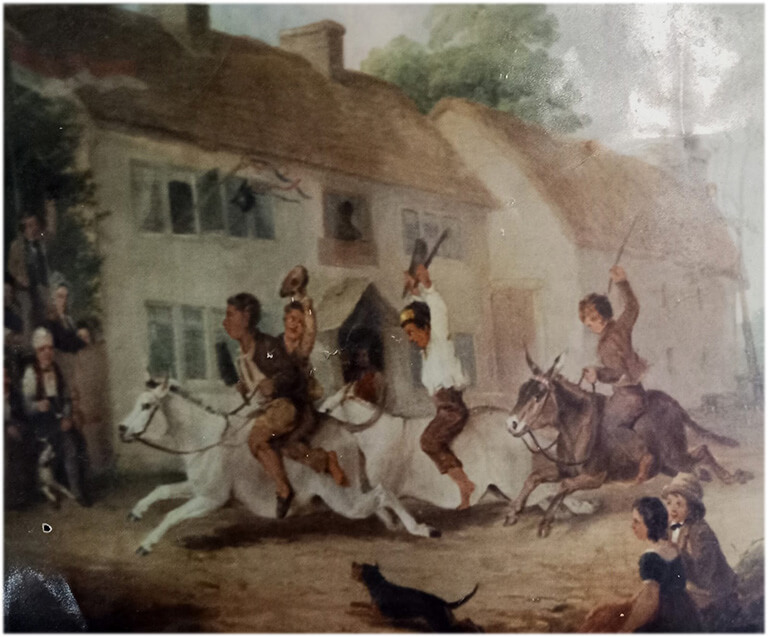
Pictured: A painting of the original Black-a-Moors Head Pub (c1847). This was on an annual ‘Club Day’ event and on the occasion a donkey race took place. Seen seated at the front far left is Mr & Mrs Bennet Lowe (Landlord and Landlady) with their dog ‘Paddy’ seen at the Landlords feet.
If you were standing here looking out into the reservoir in the early 1850’s, your view would have been different. Crossing the footbridge, one-hundred-and-fifty metres in front of you, would be The Black Boy Inn, known locally as the Black Lad, and just across the valley to the left, a group of cottages known as Walker Houses in ‘Basin Head’ behind which were the main roads to Chorley and Anderton.
Look south-east up the hill behind the present Bowling Club and Green, and you would see the main road run through Church wood, to the left of the Parish Church and continuing towards the green; you are at the heart of village life.
During the reign of Queen Elizabeth I, a new ‘pub’ had been built in Rivington which for some years to come was referred to as the ‘New Ale House’. Ale houses brewed and sold ale, and sometimes food, but did not provide lodging or stabling for weary travellers.
At the time, the Pilkingtons had held 5/8 of the manor of Rivington for centuries. Robert Pilkington died in 1605 and a few years later the Pilkington estate went to Robert Lever and Thomas Breres. The Lever portion eventually descended to Robert Andrews who became ‘squire’ in 1729.
A controversial name in modern times
All inns have had to been named since the end of the 14th century and public houses known as ‘The Black Boy’ certainly existed by 1600. With literacy uncommon in the general population, pubs displayed a visual sign by which they were known. Where and when our ale house got its name is only conjecture.
Most English pubs named ‘The Black Boy’ derived from King Charles II whose nickname ‘the Black Lad’ came from his mother because of his dark skin, eyes, and hair. Charles was born in 1630 but did not ascend the throne until 1660, so if this was our pub’s derivation, it may have been a later name. Other local ‘Black Boy Inns’ were named after the Lancashire legend of the Black Knight Ralph de Assheton, others depicted a blackened young chimney sweep.
Our name may in fact have come from the shop attached to the inn, run by the Levers in the early 1600’s, where you could acquire materials from the plantations, tobacco, sugar, and cotton, as well as trade your goods. Such shops often bore a sign depicting a man of colour.
The reason generally given for the Rivington pub name, is the crest of the Andrews family was “A Moor’s head couped” (in heraldic terms, ‘moor’ being a person with dark skin, and couped meaning with the neck cleanly separated from the body), but this would be a later connection since the Andrews family only arrived in Rivington in the 18th century. Certainly, by the 1840’s it was recorded on maps as The Blackamoors Head.
Change is coming
From the early 19th century, local Rivingtonian ‘Jemmy’ Brownlow, had been landlord of the Black Lad, and according to a local song, accompanied by his ‘sad scolding wife’ Ann and a troublesome son James junior, but in the mid 1830’s Bennet Lowe had taken over as landlord.
The adjoining shop was also run by the Lowe’s, and Bennett and Hannah kept a ‘good and orderly house’ frequented not just by the locals, but used for inquests, church meetings, and by a number of clubs and societies who held a grand midsummer dinner served in’ Mr & Mrs Lowe’s usual neat and excellent style’. But change was coming for the Black lad when plans for the Liverpool Corporation reservoirs were drawn; the Black-a-moors Head was within the proposed waterline. In a final insult, the plans for its destruction were displayed at the inn.
The Corporation’s wranglings meant construction work didn’t start until 1852, when hundreds of navvies, labourers and other trades descended on the sleepy valley and the local pub, found itself with a somewhat roudier clientele. By the winter of 1855, Bennett, now sixty-seven, was not relishing the upheaval to come. The pub was demolished in 1855 ready for the closing of the valve, flooding the spot where the inn had stood for nearly 250 years.
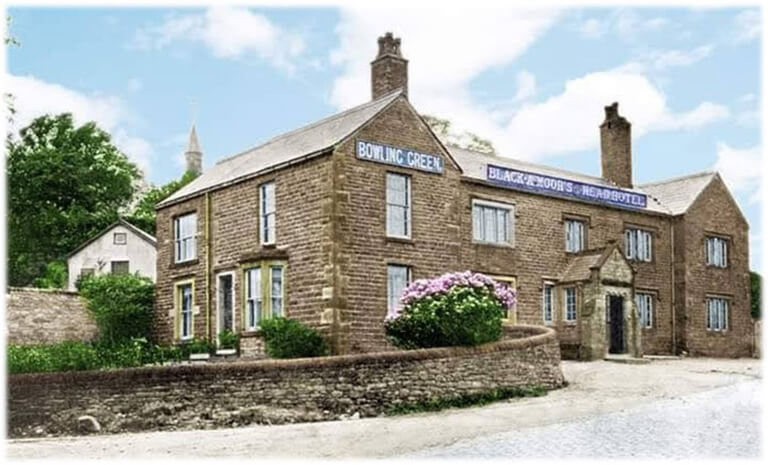
Pictured: The replacement Black-a-Moors Head Pub. To the right of the spot where the jug is and on the present club car park. Demolished 1904.
The New Black-a-Moors Head Inn
In February 1856, John Pass became publican of the New Black-a-Moors Head, the press still referring to it as ‘The Black Lad’, but he didn’t last long; next up John and Mary Jones who stayed until the new Yarrow Reservoir was completed in 1875 when the inn still belonged to The Andrews estate and had its own brewery plant. The Jones’s were followed by the Gerrard’s and after John Gerrard died, his widow Ann continued until 1889 after which the pub was sold to Joseph Sharman & Sons. There were several short-term licences before the bowling green was built in 1900. Soon after, during the tenure of Mr Patterson, complaints about sewage handling started, and Liverpool corporation demanded Chorley Council dealt with the issue. In June 1903, they proposed a one-off payment of £9000 for the purchase of the Blackamoors Head and completed the sale in November that year. The pub stood unoccupied by September 1904, pending demolition ending over 300 years of The Black Lad Inn in Rivington.
Images: Horwich Heritage. Thanks to Janette Cordwell with minor additions from Derek Cartwright and Neil Rickaby of Bolton Web Design.
Horwich Heritage & United Utilities Summer 2024.
