

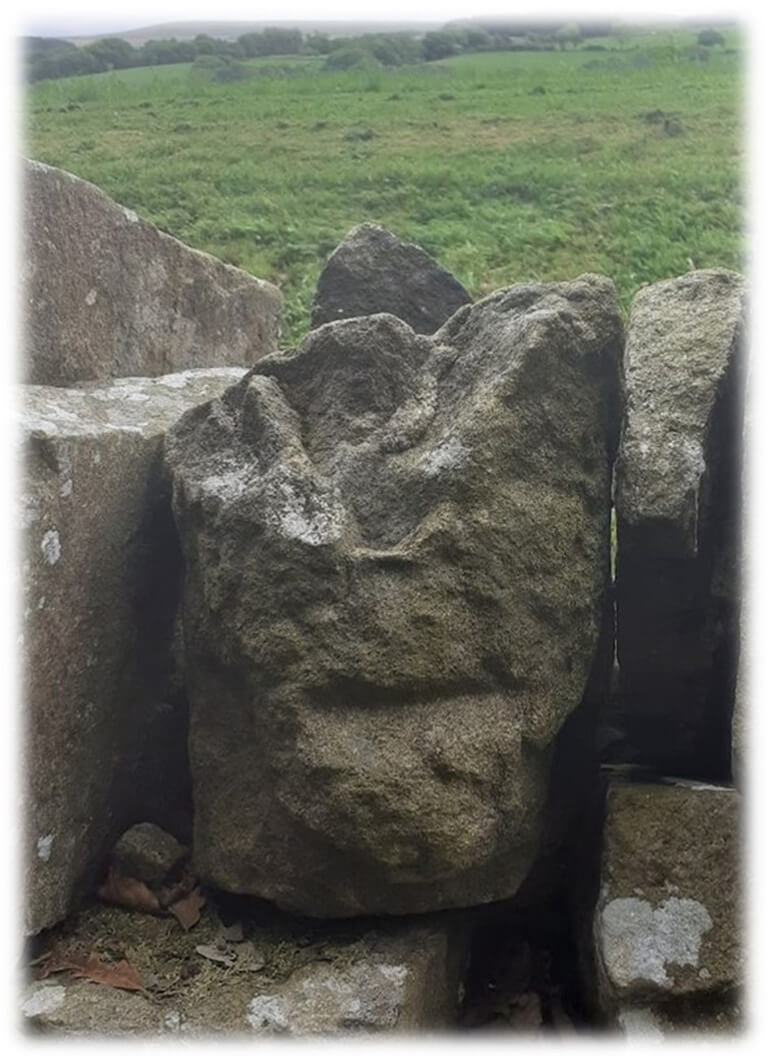
Pictured: The Remains of the original ‘Face in the Wall’ damaged by vandals
Walking here twenty years ago, children went running ahead of their family to find ‘the face in the wall’. Sadly, modern vandalism has deprived youngsters of this challenge, but fortunately photographs still exist which have allowed a modern craftsman to recreate the likeness.
The Remains of the original ‘Face in the Wall’ damaged by vandals.
The original Yarrow stone head certainly wasn’t the work of a sculptor, or even an artisan stonemason, neither was it a work of any great antiquity; it was a rough carving of a piece of millstone grit, intended to stare out, in perpetuity, hidden in plain sight, as a reminder of an infamous but local individual.
It depicts a man with a long craggy face and a moustache, wearing a flat cap who various sources inform us was an unpopular foreman or inspector, on the Yarrow reservoir works, who made the workers lives a misery, but who could he have been?
The walls were built at the end of the construction project around 1875 and were topped with rectangular coping stones. Most of the navvies and gangers had moved on, leaving the stonemasons and labourers to complete the access roads and walling under a superintendent of works who reported to the resident engineer.
By 1875 forty-seven-year-old Thomas Glossop was the Yarrow superintendent of works, living at ‘lane ends’. A native of Worksop, Glossop had worked as a labourer on the Longendale reservoir chain with J. F Bateman. He worked through the ranks to navvy and moved from one engineering project to another including the Roddlesworth under Thomas Duncan, and when this completed, straight to County Wicklow to work on the Vartry scheme. It was here he met Robert Townsend Martin, a young Irish civil engineer, who crossed the water from Ireland to England, to work on the new Yarrow scheme.
Having started a young family on a labourer’s wage, tramped around the British Isles with family in tow, lived in a navvies hut on the moors above Bradford, four years in the Irish mountains, then returning to a familiar area, with a familiar resident engineer, you might imagine Thomas, was a tough boss.
After the Yarrow works closed, Thomas moved to Withnell where, he was given a waterworks house, became an inspector and eventually retired in 1896 on a waterworks pension.
At the end of the construction, Robert Townsend Martin moved back to Liverpool, in the employ of the Corporation and the resident engineer of the existing reservoirs, fifty-year-old Percival Robert Charlton, who lived in the Corporation House on Dryfield Lane, took additional responsibility for the Yarrow and remained for nearly three decades.
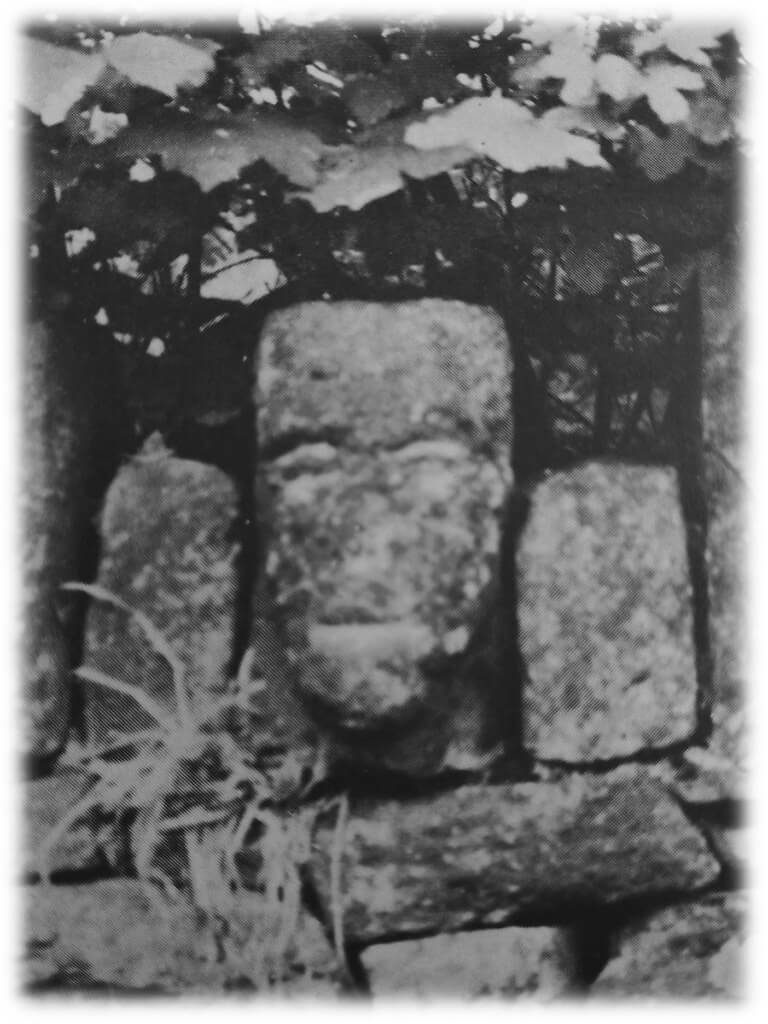
Pictured: The original undamaged ‘Face in the Wall’
Percy Charlton was born in Jarrow, the son of a horse-keeper, apprenticed to a Blacksmith. He moved to Elswick to work at Armstrong’s, which went on to become the Vickers yard. One of the company’s first commissions was a hydraulic crane for the Albert dock in Liverpool, and the technology was quickly adopted nationally and internationally. Percival must have excelled in engineering and management, as fast forward to 1861, he was superintendent of the waterworks at Rivington and by 1871, Resident Engineer, albeit with no apparent qualifications. During this time, he will have helped to oversee the construction of the additional reservoirs at Roddlesworth and the Yarrow. Another ambitious, strong-willed man who had risen from nowhere to a corporate house and salary.
Could the face be Percy Charlton, the blacksmith turned waterworks superintendent promoted to engineer who lived near the filter beds in Rivington?
Or Old Glossop for whom the Yarrow reservoir was a short walk from Lane Ends across the Knowsley embankment and up by the overflow opposite the Face in the wall.
We will probably never know whose was the face-in-the-wall.
The remains of the original ‘Face in the Wall’ is safe and kept at the Horwich Heritage Centre.
Thanks to Janette Caldwell, UNISON, Bolton Stone and Neil Rickaby of Bolton Web Design.
Horwich Heritage & United Utilities Summer 2024.
