

From 1750, the roads of Britain, which were in a terrible state, underwent great improvements under the management of the Turnpike Trustees. The first turnpikes were run by Justices of the Peace but the appointed Turnpike Trustees then took over. They had the power to erect toll gates on their particular stretches of road and set the toll prices with the money collected was used for road improvements.
They had the power to erect toll gates on their particular stretches of road and set the toll prices with the money collected was used for road improvements. Each turnpike required an Act of Parliament and the one for the Bolton – Nightingales (near Chorley) turnpike road was approved in 1763. This turnpike followed the route through Horwich we now know as Chorley Old Road, Church Street and Leen Lane.
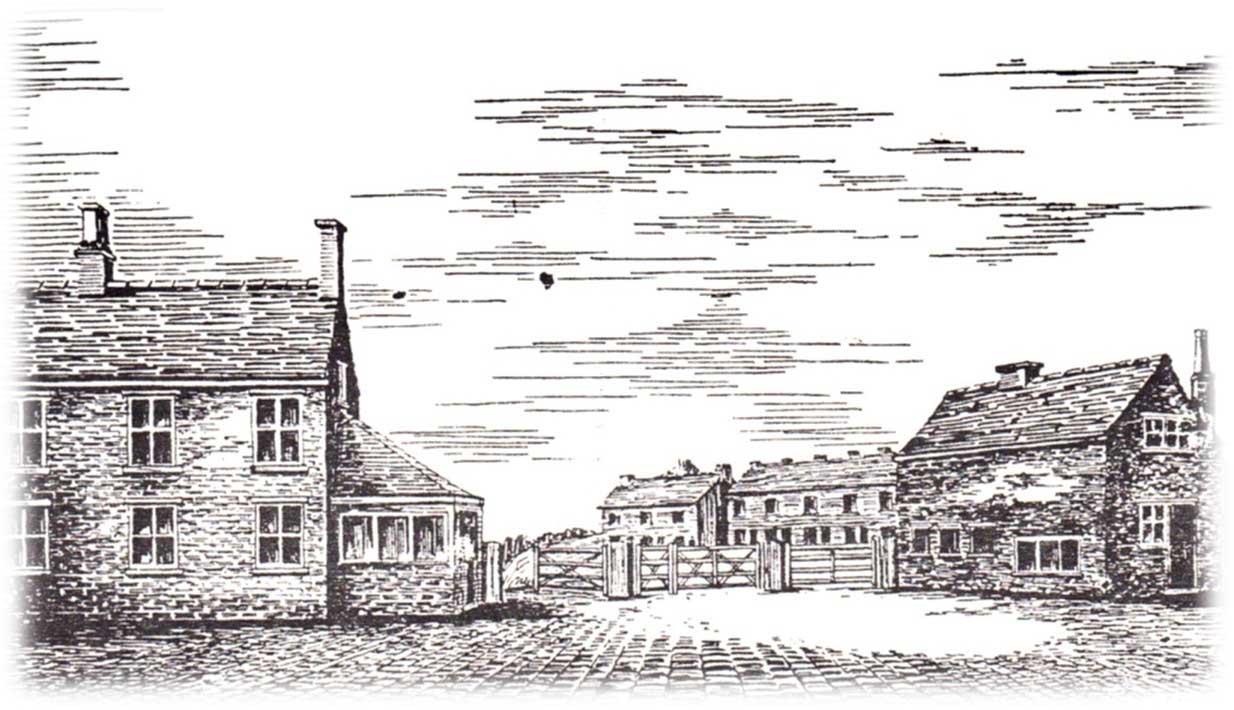
The Crown Toll Gates – looking towards Scholes Bank
To be a Trustee, a man had to be the owner of land, houses or other property to the yearly value of £50 or possess an estate valued at £1000 or more. The Trustees had to appoint a clerk, secretary and surveyor from within their own area and it is interesting to note that a number of familiar Horwich names are included on the list of persons qualified to act as surveyor on the Horwich section in 1792: James Turner, John & Timothy Eatock, Thomas Ridgway, Adam Howarth, Henry & Richard Pilkington, John & Richard Mason and John Kershaw. Many important Trustee meetings being held at the Black Bull in Horwich.
Toll houses were built near the Crown Inn in Horwich and the Doffcocker Inn in Bolton for the purposes of collecting the tolls (with different rates for horses, carts and carriages) with tollgates erected in front of the buildings to enable the toll keeper to collect tolls from passing traffic.
In 1775, the road from Doffcocker to the Moorgate Inn (now the Blundell Arms) and onwards to the Black Bull Inn in Horwich was straightened and widened to improve passage. Church Street as we now know it was formed with the new road passing in front of the Parish Church and not behind as it did previously.
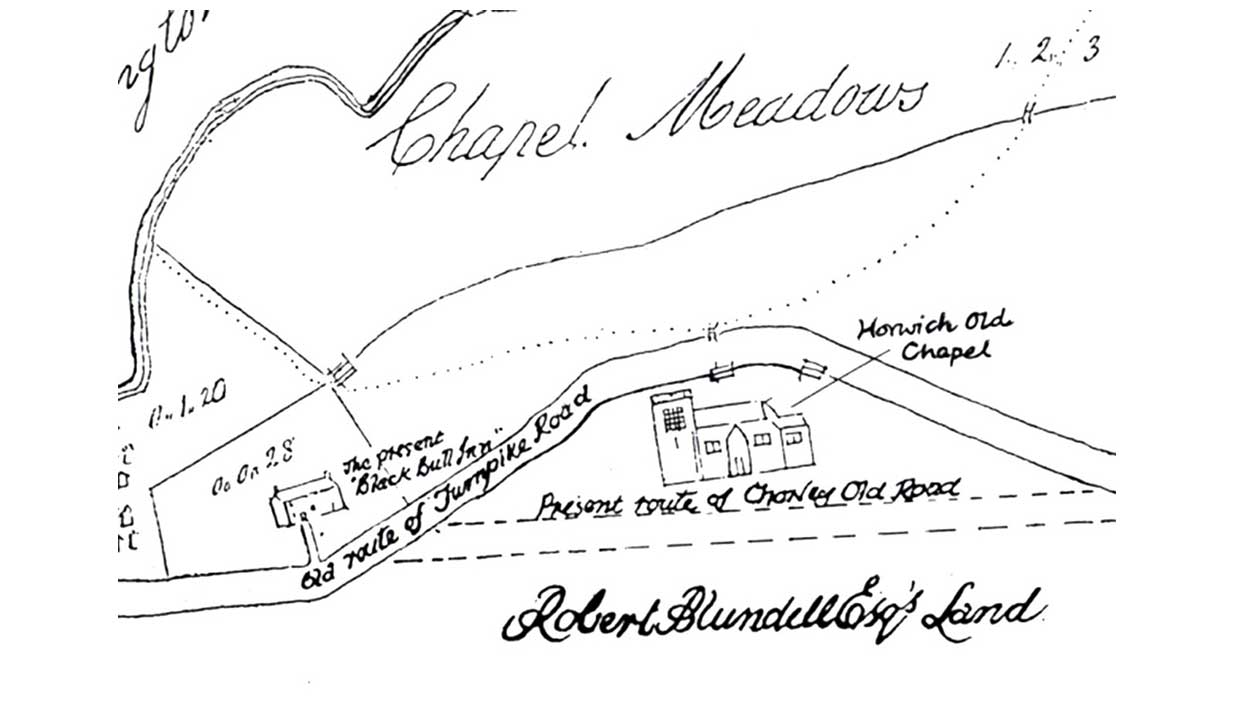
The re-routed road in front of the Parish Church
In 1829, the Bolton – Horwich Turnpike was opened along what we now call Chorley new Road, offering a flatter and more direct route. A lane then known as Bar Lane joined the new toll road near the Crown and to collect tolls from passing traffic a bar was erected across. The pub on the corner adopting the name of ‘Toll Bar’. Bar Lane is now known as Crown Lane.COACHING INNS
The Crown Inn was a Coaching Inn with an Inn being on the site from at least the 1780’s, Coaching Inns provided food and drink for travellers. Horses pulling the coaches were exchanged in ‘stages’ every 10-15 miles along a route, hence the name ‘Stage Coach’. As with the Crown Inn a blacksmith had a workshop nearby who could assist as required. As original Coaching Inns, only the ‘Swan’ and the ‘Three Crowns’ in Bolton and the ‘Blundell’ and ‘Crown’ in Horwich remain.
The Toll Roads could not compete with the rapid development of the railways and in November 1877 our local toll roads closed with all the assets, gates etc sold off.
FUN & FROLICS AT THE CLOSURE OF HORWICH TOLL BAR
Extract from Bolton Chronicle 3rd November 1877: ‘The demise of so ancient an institution was anything but an occasion for mourning (The Toll Roads were not popular)...About 30 persons sat down to an excellent supper at the Crown Inn, Horwich.
Closing time occurring about an hour before the closing of the (toll) bars, the party adjourned to the Toll House where a crowd of some 40 or 50 persons had assembled. At a little before 12 (midnight) the last conveyance to go through the Toll was a ‘Jerusalem Pony’ (donkey) belonging to John Dickinson, complete with bells and passengers in rural costume. This event was celebrated with a rendition of ‘Auld Lang Syne’. Accompanied by local innkeeper, John Calderbank, on the violin. The first toll free vehicle to pass was driven by Henry Hurst, a farmer from Adlington.
Following the end of the Toll Roads and the assets being sold off, Horwich business man Andrew Peak donated the ornate Lamp and Drinking fountain which was position roughly where the Toll House and Gates stood and where the main traffic island is now, in front of the Crown. The Lamp and fountain were taken during WWII to assist with the war effort.
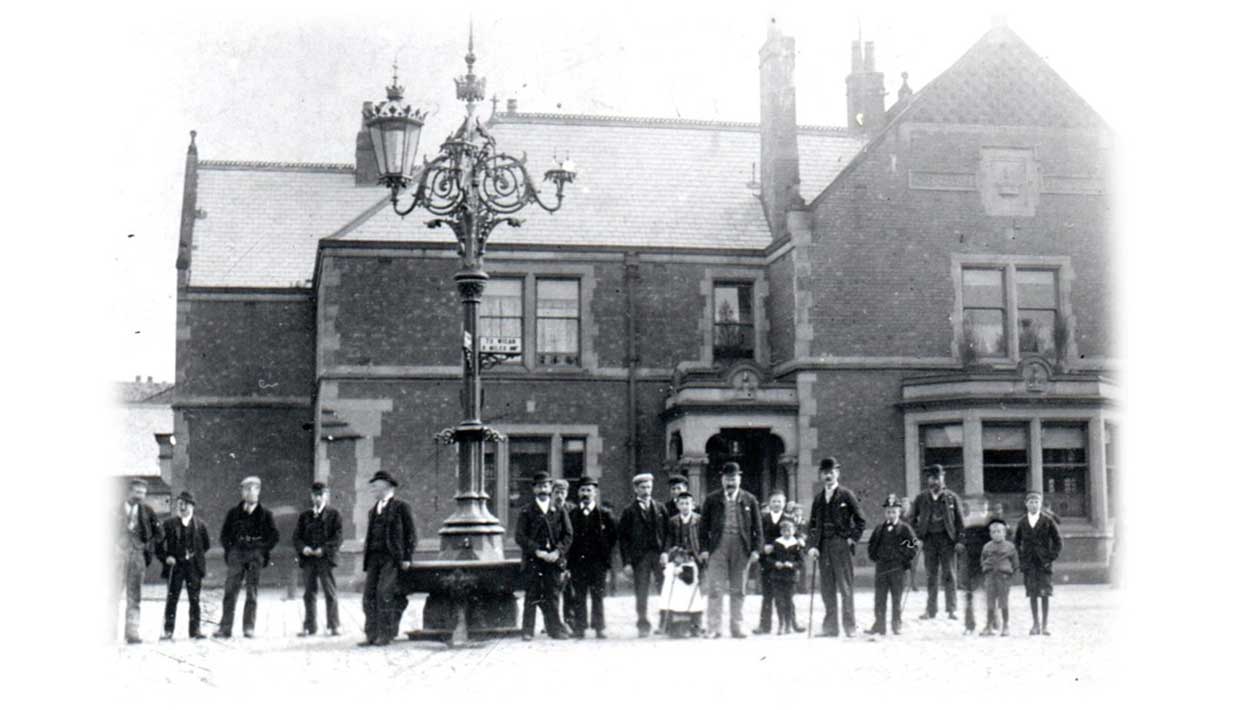
The lamp & fountain donated by Andrew Peak
FINALE
Almost overnight, the age of the stage coach with all its drama, glamour and romance passed into history. The sight of a ‘four in hand’ controlled deftly by a weather–beaten coachman became an increasingly rare sight on the roads of Britain. The Lancaster Royal Mail Coach no longer came thundering up Scholes Bank, post horns blaring. Something magical went out of our way of life in 1877.
Extracts from a piece by Stuart Whittle.
Anyone wishing to learn more about the Toll Roads or anything about our local history then please visit the Horwich Heritage Centre, Beaumont Road Horwich, BL6 7BG. Open Mon-Fri 2-4 pm and Saturday Mornings 10-12.30.
