



Looking Back
for the latest added articles visit page 2 >
DAVID OWEN REMEMBERED By Stuart Whittle
It is 13 years now since we lost David, but his legacy lives on. His remarkable life included being a ‘son of the Manse’ in Rivington, a distinguished mining engineer and mining historian and an authority on the families, farms, datestones, churches, myths & legends of the Rivington/Anglezarke area.
David grew up in Rivington as the son of the Rivington Church minister, George Owen, and attended Rivington & Blackrod Grammar School. Amongst his childhood recollections, he tells of a grandfather, Rev. George Vale Owen, who was famous for receiving messages from the ‘other side’. In the early C20th he converted to Spiritualism having been ‘contacted’ by his mother shortly after her death. He wrote 4 best-selling books on his ‘conversations’ with various people on the ‘other side’ under the title of ‘Life Beyond the Vale’. Perhaps influenced by this, David’s mother and father were drawn towards Spiritualism, as he recalls in his booklet about the ‘Headless Cross Ghost’ when his mother hosted a séance conducted by a well-known ‘medium’ in 1951. Naturally sceptical about the information that was being delivered from the ‘other side’, Dorothy Owen began investigating all the sources that had been mentioned in an effort to verify what had been said about the origins of the ghost and came to the dramatic conclusion that they all checked out (you will have to read the booklet to find out who the ghost was!).
David’s formative years were during WWII and he has written at length about the war years in Rivington in the Horwich Heritage publication ‘Horwich in World War II (1939-45)’. In it he talks of having evacuees from Liverpool staying with his family and the excitement of ‘being treated to a military build up on our doorstep’ with British and American soldiers being billeted in the area. There was plenty of target practice going on in the area and David and his friends used to watch the Americans doing all this in Leicester Quarry. Being both curious and naive, they also collected discarded ammunition (some of it live) and kept it until well after the war ended!
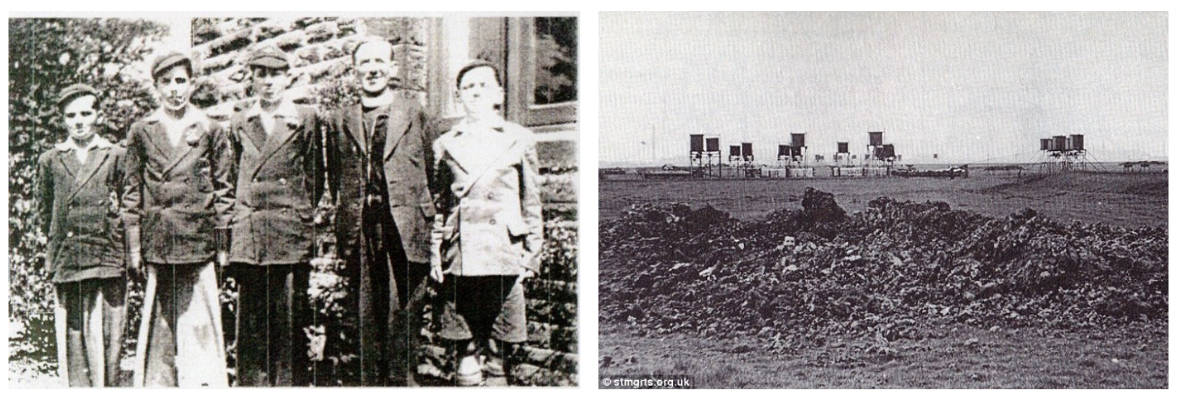
(1) Rev. Owen, David (right) and evacuees & (2) Decoy sites were erected on the moors to distract enemy bombers.
Anti- invasion measures were put in place all around Rivington and Anglezarke including removing boundary posts and street signs, the erection of ‘pill boxes’ and, more ingeniously, erecting ‘decoy sites’ on the moors and floating logs on the Reservoirs to prevent sea planes landing. The most dramatic and tragic event occured in November 1943 when a Wellington bomber crashed in Anglezarke killing all the 6 crew members. Despite being warned off by military personnel, the lure of searching for pieces of the wreckage at the crash site was too hard to resist and David and his friends managed to retrieve quite a lot of material from plane. David kept his collection in the loft at the Vicarage until he left home in 1954 – at which point his mother said he had to either take it with him or bury it in the garden. He buried it in the garden where it still lies to this day.

(1) An abandoned tank on road to Belmont & (2) Rockhaven Castle demolished in WWII
On marrying his wife, Betty, David moved to Westhoughton and thereafter began his considerable contribution to local history in that area as well. His professional life was spent working as a mining engineer, which accounted for his formidable knowledge of local mining and mining history which he put to good use in published material, exhibitions and talks. This knowledge was particularly useful when it came to researching and commemorating the Pretoria Pit Disaster centenary in 2010 which he did so effectively in his role as Vice-Chairman of Westhoughton Local History Group. As former Secretary, Pam Clarke, recalled: “He was an esteemed mentor and advisor to our Group and will be remembered with gratitude and affection. He achieved many things in a very fulfilling life and we will miss his sharp wit, sense of humour and endless fund of anecdotes and stories”.
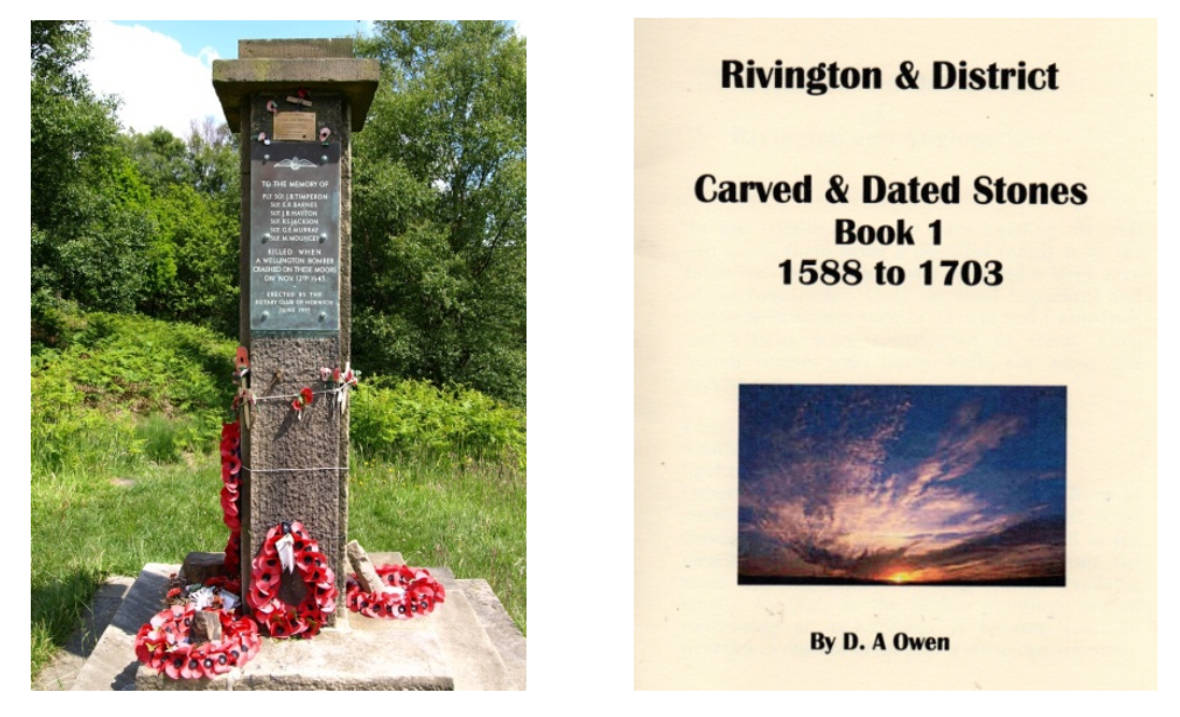
(1) Wellington Bomber memorial & (2) One of David’s many publications
Although now resident in Westhoughton, David retained his deep affection for the Rivington/Anglezarke area. And over the years he researched many aspects of its past including its families, farms, datestones, churches, myths & legends. A number of his studies have been turned into publications and films which are available from the Horwich Heritage Centre. One of his most notable achievements was the creation of a ‘Datestones Room’ at Rivington Church to save for posterity the many examples which were lying around uncared for and deteriorating in the churchyard and beyond. He also assembled a remarkable archive on the families and histories of the farms in the area, many of which go back hundreds f years. This archive is currently housed at the Rivington Information Centre and is available for public inspection on request.
Older Horwich Heritage members will remember David with affection and recall amongst other things his remarkably knowledgeable talks on local mines, the Pretoria Pit Disaster and the Lost Farms of Rivington & Anglezarke. Fortunately, we have captured a number of these for posterity on film so that future generation will be able to share his love and detailed knowledge of the area.
HOLLYWOOD STAR VISITS HIS RELATIVES
(Horwich & Westhoughton Journal 14th April 1969)
Members of a certain age will remember the famous film star of the ‘Golden Age’ of Hollywood during the 1940s, 50s and 60s, Glenn Ford (1916 – 2006). He was a versatile actor who had a film career that spanned 50 years which ranged across thrillers, westerns, war films and comedies. For 10 years (1954-64) he was in the top 10 Box office stars. He won numerous awards including the Golden Globe and is commemorated on the Hollywood Walk of Fame. His most famous films included ‘Gilda’,‘The Big Heat’, ‘The Blackboard Jungle’,’ 3.10 to Yuma’ and latterly ‘Superman’ (in which he played the superhero’s father). He was also a war hero, having served in the US Marine Corps both during WWII and afterwards in the Naval Reserve up until the 1970s. For this service he was awarded a Commendation Medal and the ‘Legion d’Honneur’. The reason for mentioning all this is because his mother came from Horwich (and emigrated to Canada in 1896) and in April 1969 he came over to England to visit his relatives. The following article takes up the story.
With a hearty “Dorothy how are you?”, Hollywood start Glenn Ford bounced into a small lounge at the BBC’s Manchester studios and met relatives from Horwich he had not seen since 1951. Waiting to meet him was Mrs Dorothy Harris of Mary Street West, Horwich, Mr Sam Wood of Chorley New Road, Lostock and Mr Edward Wood of Hartley Street, Horwich. – the brothers and sister of Glenn’s mother. With them were their families and Glenn’s niece, Mrs Doreen Burbeck, also from Horwich, who spent a holiday with her famous uncle in Beverly Hills 2 years ago.
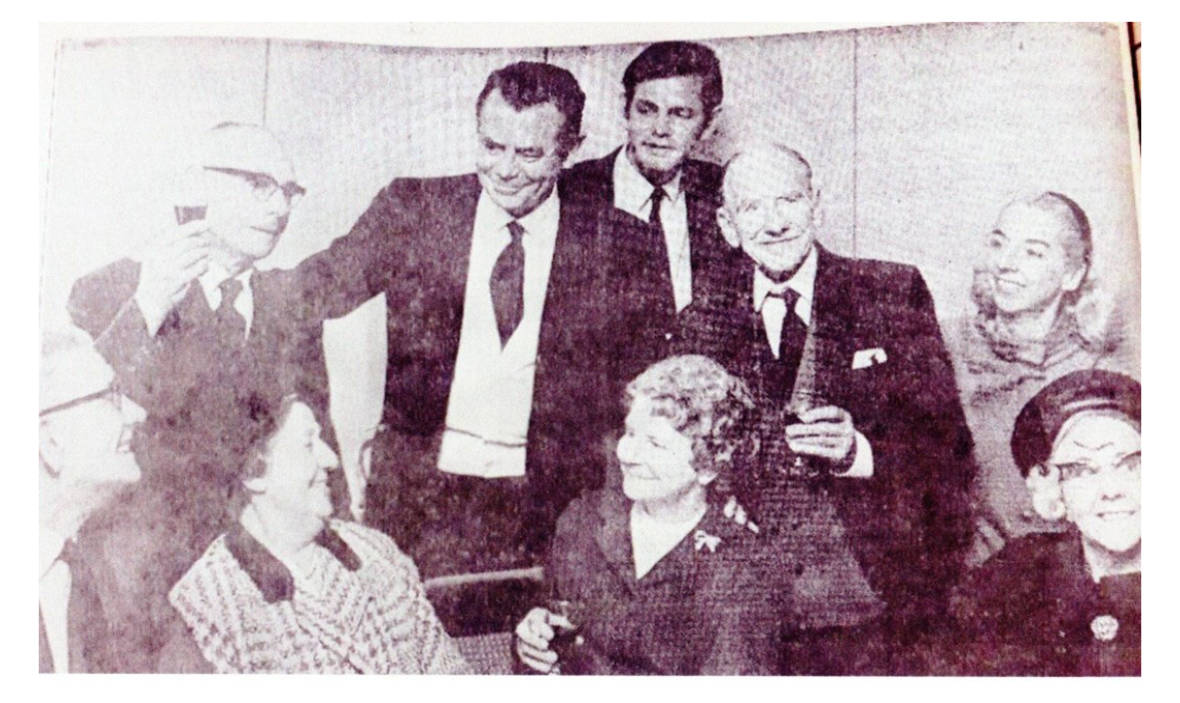
Glenn Ford with his Horwich relatives at the BBC studios.
For the short time he was in Manchester, Glenn was kept busy recording the first of a new series of TV programmes called ‘Personal Cinema’ and hadn’t got time to go to Horwich. So the BBC laid on a Daimler and arranged the reunion at the studios. The family watched Glenn recording the programme before meeting up with him in the lounge. With him was someone his English relatives had never met before, his 23 year old son, Peter. Peter had recently graduated from the University of Southern California and was now making a career for himself as a scriptwriter. It was his first trip to England. The BBC had an added surprise for Glenn’s relatives, they had arranged a telephone call to Hollywood so that Glenn’s 78 year old mother, Hannah (nee Mitchell), could be in on the reunion too. She last saw her Horwich relatives 8 years ago but now finds travelling a strain. Mrs Ford left Horwich for Canada with her parents when she was 5. The family then moved to California and, although her mother and father later returned to England, she stayed, grew up and married there. Glenn always promised her that if he did well he would bring her back to England to meet her family and he did.
HORWICH HERITAGE ON TV By Stuart Whittle
As we approached our 40th Anniversary in June this year and the opening of our exhibition to celebrate this milestone, I contacted both BBC North West and Granada Reports, more in hope than expectation, to see if they would like to cover this special achievement. Much to my surprise, I got a positive response from Granada who arranged for their reporter, Rachel Pritchard, to visit us at the Heritage Centre on the morning of the 10th June (it happened to be the same day as our AGM & 40th Celebration). She loved the Centre and with her camera crew spent 3 hours looking round and talking to us about what we did and what was on display. It would take a little time to edit the piece but she believed it would be shown sometime later that week. Of course it didn’t appear that week and we were beginning to believe the feature hadn’t got past the programme’s editor. However, at the beginning of the following week we got a message to say it would be on on Wednesday 18th June sometime between 6- 6.30pm.
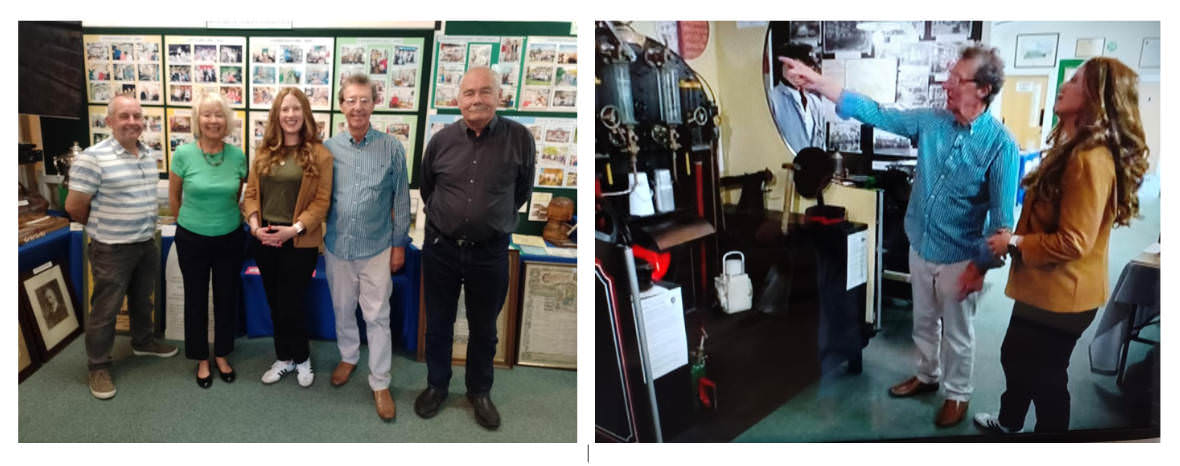
(1) The Horwich Heritage team with Rachel & (2) Showing her how to drive a steam loco
The anticipation rose and fell as the minutes ticked by and then suddenly we appeared as the very last item in a lovely piece that lasted all of 2 minutes - all those hours of interview distilled into a couple of minutes! Still it was worth it and Derek, Roy, Judith and myself got the chance to showcase our Centre and achievements in front of millions of viewers. And in the following weeks we did reap the benefit of visitors coming from far and wide to see us based on seeing us ‘on the telly’.
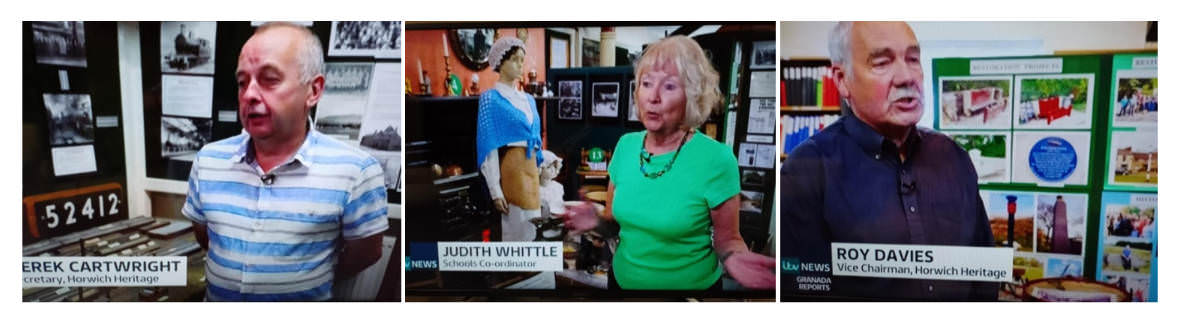
Derek, Judith & Roy during filming
VJ DAY IN HORWICH
Horwich & Westhoughton Journal 17th August 1945
The war in the Far East is often referred to as the ‘Forgotten War’ as hostilities continued for 3 months after victory was declared in Europe on 8th May 1945, with the British public largely unaware of what was going on. It was only after the Japanese surrender on 15th August that the stories of the kamikaze fighter planes, the desperate conditions in the jungles of Burma and the atrocities committed in the Prisoner of War camps started to emerge. The H&WJ recorded that 35 POWs had returned home in 1945 but 5 had died in captivity. Our recent ‘Horwich in 1945’ exhibition included a section on how Horwich celebrated VJ Day as described by the H&WJ:
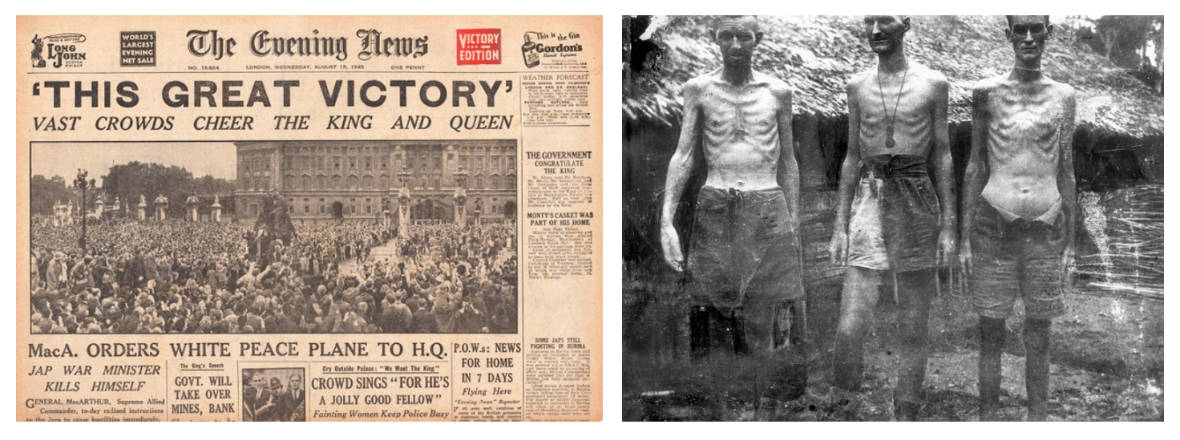
Peace at last! VJ Day 15th August 1945 & (2) Japanese Prisoners of War
“There was heartfelt relief as crowds of people emerged onto the streets of Horwich having heard the Prime Minister’s message of Japan’s surrender at midnight on Tuesday 14th August. There was singing and dancing and the sound of fireworks could be heard until 4am. A huge crowd gathered outside the Public Hall.where the singing of patriotic and popular songs was accompanied by Miss Ida Winnard on the accordion. The works and mills closed for 2 days and people enjoyed the holiday atmosphere with flags and bunting decorating many of the streets. The Horwich Band, conducted by Arthur Hazelhurst, paraded through the town and played in the evening for community singing and dancing outside the Public Hall. There were also street parties and bonfires with more fireworks. The public houses and clubs held Victory dances and several issued free beer to members. Well–attended thanksgiving services were held at Horwich Parish Church and St Catherine’s on Wednesday evening and on Sunday, the chairman and members of Horwich Council will lead a civic procession from the Public Hall to Horwich Parish Church starting at 2.30pm.”
We were pleased to include in our ‘Horwich in 1945’ exhibition some information about John Fletcher who served on HMS Illustrious in the Far East, kindly provided by his son, John. Here are some of John’s father photographs from that time:

(1) AS John Fletcher (gunner) & (2) HMS Illustrious
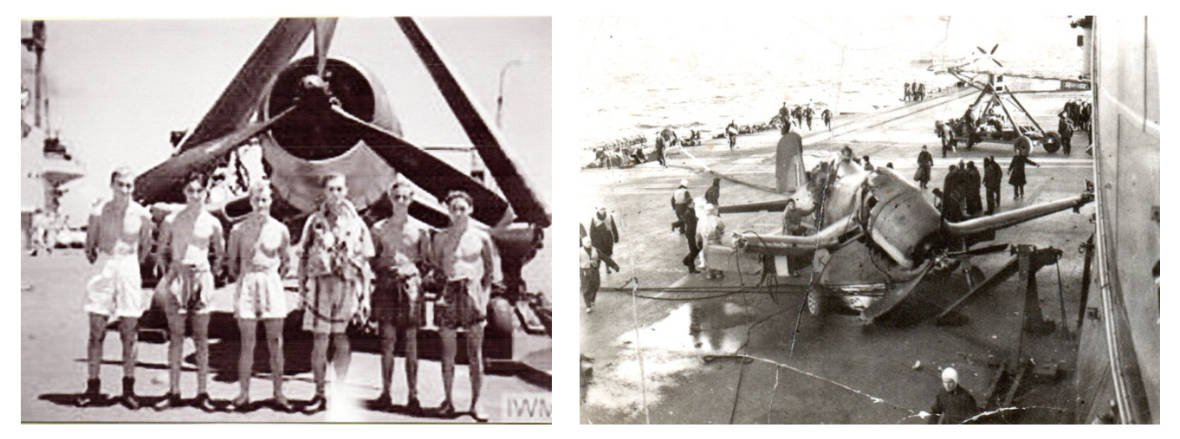
(1) Ground crew and pilot & (2) Corsair fighter, crash-landing on deck
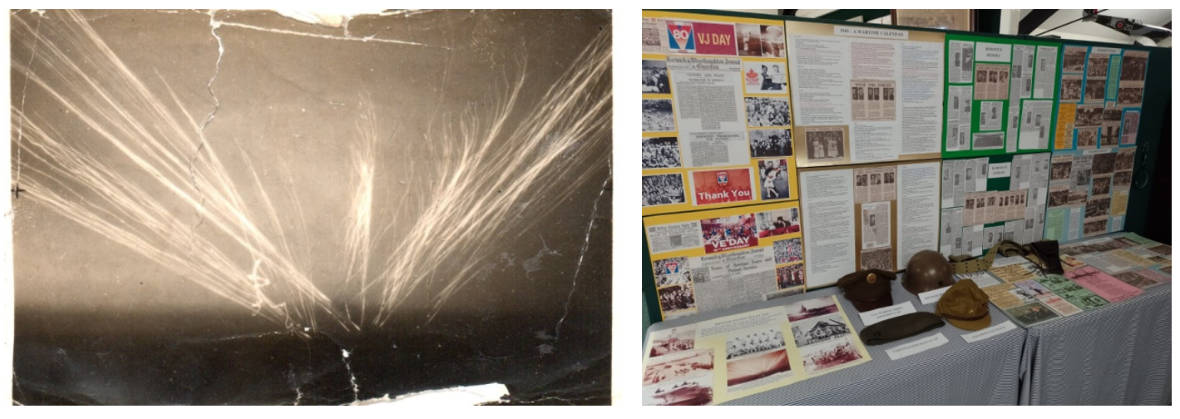
(1) HMS Illustrious firing all guns on VJ Day & (2) ‘Horwich in 1945’ exhibition
Able Seaman, John Fletcher, served in the Royal Navy from 1939 -45. He saw action in the Pacific War against the Japanese aboard HMS Illustrious. He lived and worked in Horwich. HMS Illustrious was a British Aircraft Carrier which served in the Mediterranean, Indian Ocean and the Pacific during WWII. She was badly damaged on a number of occasions but each time was repaired and returned to action.
SOMETHING AT THE BOTTOM OF THE RESERVOIR By Derek Cartwright
David Owen produced an excellent range of small books on all aspects of the Rivington area. One of these publications ‘Wartime Memories’ sets out a number of tactics employed to prevent or frustrate an enemy invasion. Amongst such schemes were the removal of signposts, the chipping of town names off boundary stones, easy to erect road blocks and arrangements to deter the enemy from landing on reservoirs or large lakes. At the height of World War II, it was thought that the enemy would attempt to bring over troops using seaplanes which would land on reservoirs. To guard against this, reservoirs and lakes across the country were obstructed so as to make it difficult to land a seaplane.
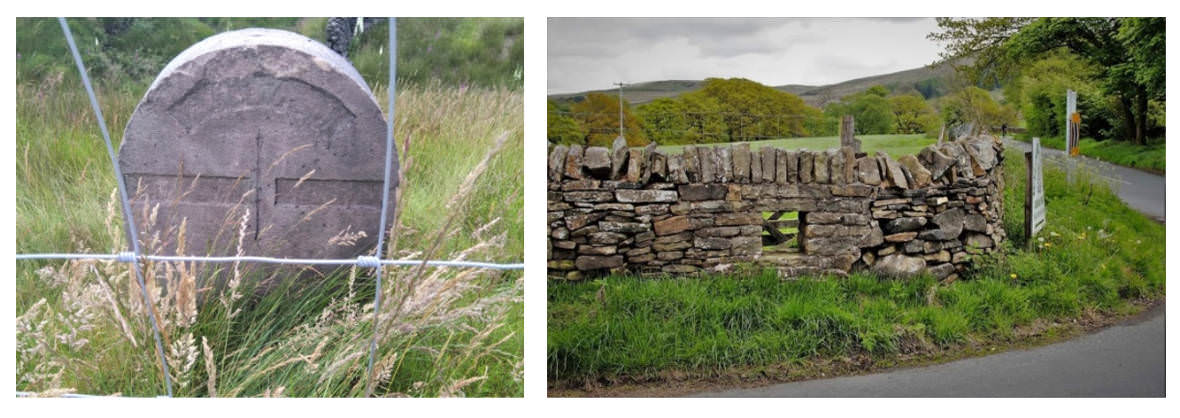
Still visible in Rivington today: a defaced boundary stone and a hole in a wall in which to insert poles to act as a road block
In common with other parts of the country, floating logs were moored at various places in the Rivington Reservoirs to prevent landing. It appears logs of different lengths were utilised, all being about the thickness of telegraph poles. Shorter lengths were believed to have been designed to float upright with the longer, telegraph pole lengths sitting on or near the surface of the water. Many of these logs remained on the water until they became waterlogged and sank. David pointed out that in dry years these logs could still be seen on the bottom of the lakes.
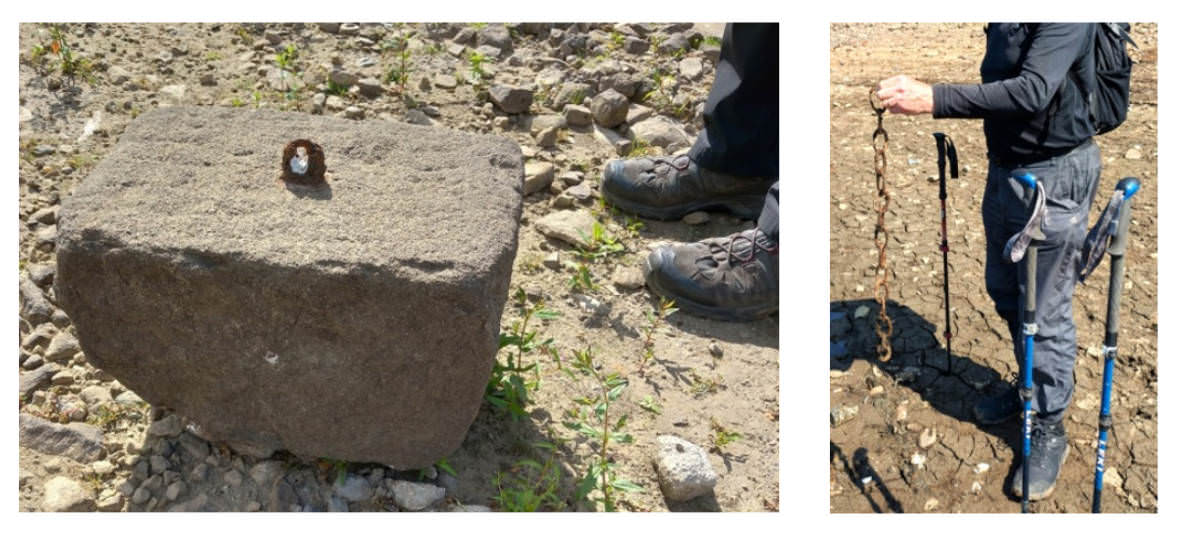
(1) One of the dressed stone mooring blocks & (2) A mooring chain
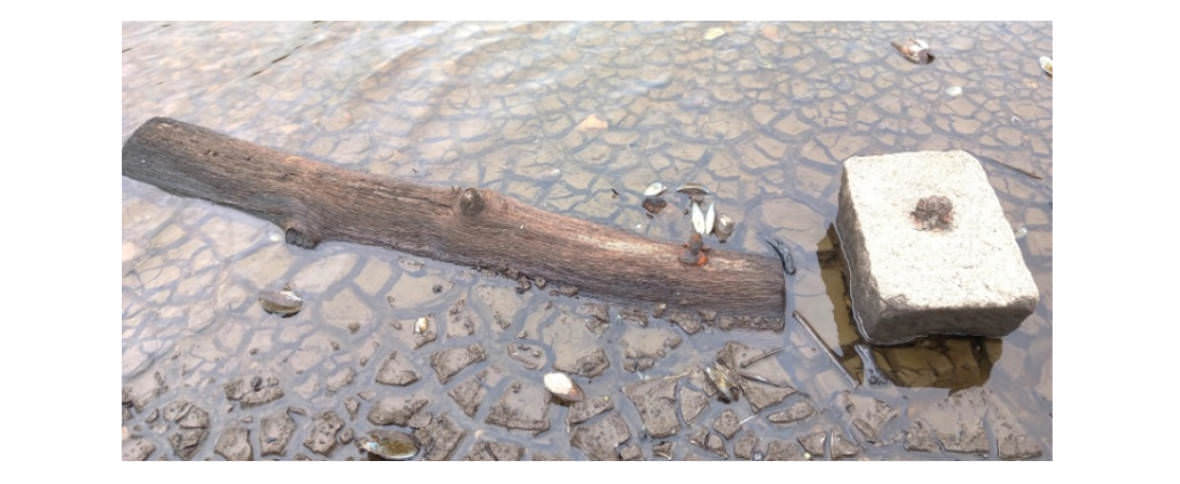
A cut log with a metal staple hammered into it alongside a mooring block
During the very dry summer of 2025, water levels in the Rivington Reservoir system were at their lowest since 1976. Just as David described, logs from the defensive measures of WWII became visible again after sitting at the bottom of the Rivington Reservoirs for probably 80 years. The first items fitting David’s description were numerous dressed-stone mooring blocks with embedded eye bolts. These were seen in the 3 large Rivington Reservoirs: Lower and Upper Rivington and Anglezarke. In the vicinity of these blocks, lengths of chain were seen - believed to have been used to attach the logs to the mooring blocks. As the water level dropped even further, cut logs of different lengths were spotted, these had metal staples hammered into them, with some found at the side of the mooring blocks.
What a fascinating series of objects to find and, thanks to David Owen, we know exactly what they are and what they were used for.
EVERY PICTURE TELLS A STORY By Christine Wrennall
As part of Derek Cartwright’s excellent talk on ‘120 Years of Lever Park’ in July this year, he showed a picture of a Scottish Dance Troupe performing in the Park. This has prompted Christine to come forward with some fascinating details about this picture, the troupe and her grandmother’s recollections of her time in Rivington in the early 1900s.
My auntie, Phyllis Anderton Dodd (age 97) has told me that her mother, Florence Dodd (nee Holt) was born on 4th September 1892 at Nab Farm on Back Lane, Heath Charnock. She attended Rivington Primary School and then Rivington & Blackrod Grammar School and used to tell of going to Primary School on her horse, along with all the other farmers’ children in the area. Still in the playground at the side of the school, there is a stone pillar with steps and this is where the children used to tether their horses/ponies after dismounting. After the morning school session, they would have lunch and then go out to put the ‘nose bags’ on the horses. At the end of the day they would mount the steps and ride home again.

The Scottish Dance Troupe Lever Park c.1914. Florence is on the left of the piper.
When the Dance Troupe photo was taken, Florence was in her early 20s, so it must have been around the time of the First World War (1914-18). Florence is on the immediate left of the piper. Many of the dancers had met at Rivington & Blackrod Grammar School and they regularly performed at events organised by Lord Leverhulme at his ‘bungalow’. Florence went on the marry James Dodd, a local farmer and they had 5 children including 2 sets of twins. One of Florence’s friends was a servant for the Leverhulme family at the bungalow and once a year they had a ‘servants’ ball’ in the ballroom. You were allowed to bring a friend and everyone danced on a sprung floor to music provided by a dance band. This suggests there must a have been a fair number of staff to justify such an occasion (they could have also included those employed at the Hall and barns, groundsmen and zoo keepers).
sounds like a ‘magical’ time in the story of Lord Leverhume and his Rivington adventure. My auntie just wishes she had asked more questions about it.
THE HARD ROAD TO SUCCESS By Martin Jones
Martin Jones is Horwich’s most decorated athlete. He is a double World Mountain Running Champion: 1992 Susa and 1993 Gap. 3 times British Champion across Road and Cross Country. Ranked in the top 20 in the World Cross Country Challenge Series and has represented his country in 10 World Championships across, Road, Track, Cross Country & Relays. He was 4th in the 1994 10,000m Commonwealth Games in Victoria Canada. This is his story.
I once heard someone call himself a self-made man., I laughed - how so? Did he live on a desert island? Had he no parents, community, local infrastructure? Surely, he is a product of all around him. Well we have all grown up in and around the Northern Moors. Vast, beautiful and challenging. Why did a North moorland region stretching from the Ribble to the Irwell deliver 70%+ of the British World Cross Country team members across the 1990’s? Chance? No, I would argue we are the product of our space and community, just look at our list of achievements!
A Product of our Place
The path we choose is determined by many factors: geography, genetics, community. So why would I write these profound words for a piece relative to Horwich, Bolton, Lancashire in the North of England? Well it is because these factors helped me to go on one heck of a journey. And I am not the first to be transformed by this town. If you are lucky enough to be from here you are affected by here. The characters, invention, industry and stoic self-effacing attitude delivered by this place is self-evident. Because of its characteristics, the North of England has produced great achievements in the world of industry, commerce, science and sport. And its the same across the world, where challenging terrain and circumstances in places like Chamonix, Friuli-Venezia Giulia, Portland Oregon and Bavaria have delivered outstanding sporting results and successful sporting brands like Nike and Adidas. The physical challenges of hills and valleys require the mind and body to be resourceful, resolute, creative, a problem solver and motivator. If you stop half way up a hill, you’re not only not at the top but you have lost momentum, and you’re not enjoying a great view and the thrill of the downhill run!

Leading from the front in the Manchester - Blackpool relay.
Community and our Attitudes
My views on life might be controversial, but when we give our children everything materialistically and adorn them with praise, are we denying them the benefits of constructive challenge? I believe that failure and not being the best is needed to teach us how to reach our full potential. We can all improve but we need targets. To be the best means hard work, pain, disappointment, but the rewards for the individual and community are tenfold. The gift of self-discipline and personal motivation often come from adversity. I spent years as a lad growing up on a farm and you quickly learn to get out of the way if an errant cow changes direction! If you are surrounded by achievers who set standards, and act as role models, you could quickly see opportunities. The ability to achieve in small steps was fed to me by my parents and community from as early as I can remember. The positivity of attitude demonstrated by my role models was so compelling, and then the desire to beat them became an obvious challenge. At my peak, I was running 120 miles a week and doing gym sessions. Training 3 times a day and competing, it hurt!
3 Dimensional Challenges: the Moors and Tracks
A hill, a mountain and moor, a tussock, a field? Don’t we all feel better after a walk, a workout or a problem solved. Overcoming a physical challenge is also good mental medicine. With each training session you get a little more capable. Why walk when you can run? A sense of capability soon creeps in and I have introduced many people to running by persuading them to take steady progressive steps. These ‘steps’ eventually produce great athletes who love running and love the benefits. And this applies to all sports. The more you challenge your body, the more perceptive you become and the more capable of overcoming physical constraints and managing them under stress.
Mentors and Motivators
I grew up, thank goodness, with the attitudes of ‘what doesn’t break you makes you stronger’, ‘half full not half empty’, ‘you only get out of life what you put in’ and ‘think of others’. So watching my childhood heroes Steve Ovett, Seb Coe and Graham Williamson leading the World on telly as a lad, was truly motivating. So this set me up to train and solve and persevere and suddenly I was able to compete. But then I found myself out of school at 16 without any qualifications or any idea what I wanted to be. So off to the Forces I went to 64 Fighter Squadron via RAF Halton and eventually the Mountain Rescue Team at Leuchars. It was there that I joined my first running team. The camaraderie was amazing and positive and mixed in with good humoured ‘mickey taking’. I was 17 and everybody was older and faster but, racing at the MOD Inter-services Cross Country Championships, I found myself not far behind some of the greats of British and World running, the likes of Steve Jones, John Wild and Mark Flint.

(1) Putting in the hard yards & (2) On the cover of The Fellrunner
The Lads and Ladies of Horwich
So, on my path to personal growth and achievement, I left the Forces and decided to specialise in Industrial Design. There then followed 3 years of A Levels and a degree course at the University of Manchester. My transport was a bike, I did cleaning work mornings and evenings and was training at Horwich and running probably 70 miles a week. All that can do only one thing – ‘make you or break you’ – and I got stronger! I joined Horwich RMI Harriers on the advice of a famous Bolton runner , Vince Regan, on the basis that they enjoyed a laugh, a pint and didn’t take themselves too seriously. On first arrival the ‘character’ of the club shone through, diverse, funny, grounded, all rounded off by self-effacing humour across all social fronts. The individuals are too numerous to mention by name. I loved them all. Tuesday and Thursday hill sessions, running mile after mile over bloody tussocks on Winter Hill followed by beer and laughs afterwards. The races were wonderful, travelling across the country all stuffed into cars, stinking of sweat and covered in mud. We laughed at each other but as a group we were getting stronger. Soon our club became Lancashire Champions, and the list of our achievements grew onto the national stage across all disciplines. We were the dominant Running Club in the North.
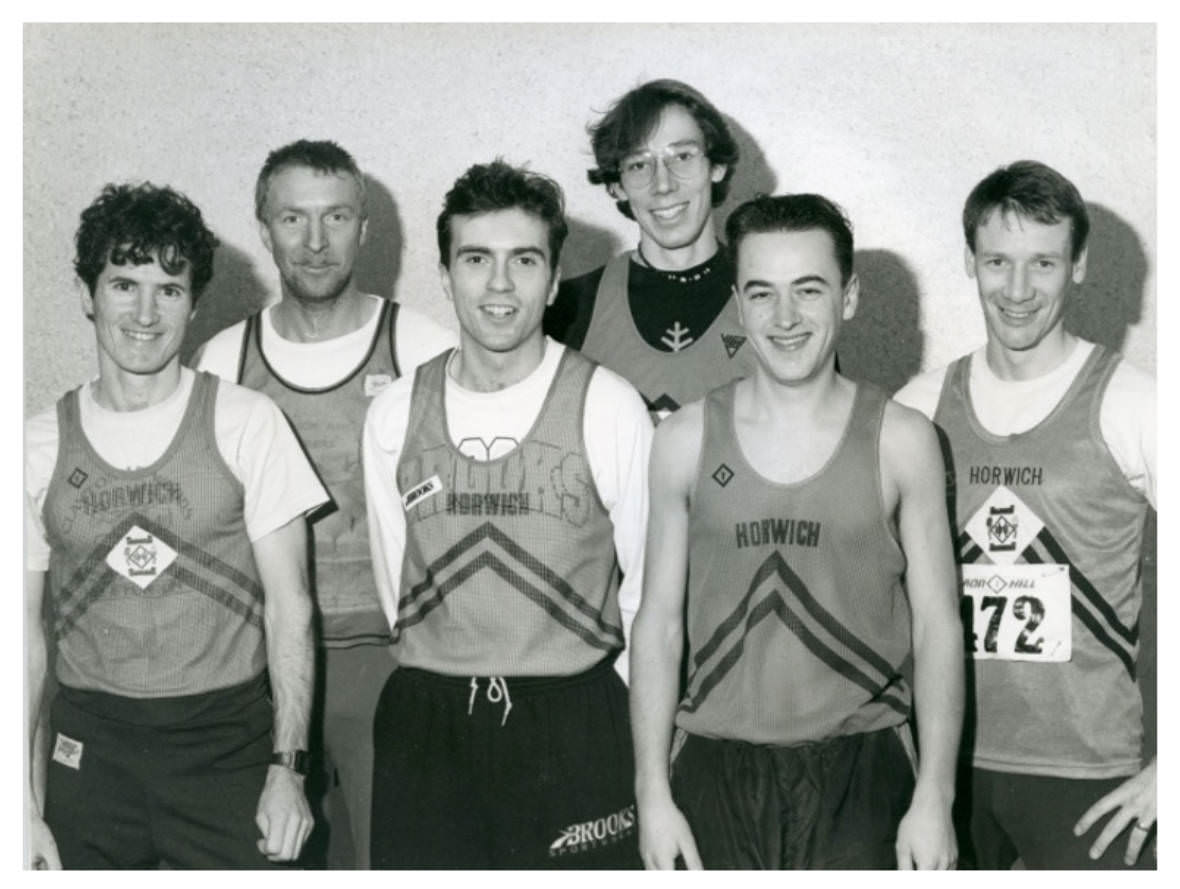
Lancashire Cross Country Champions 1990: From Left, Steve Barlow, Chris Lyon, Paul Dugdale, Martin Jones, Rob Jackson and Mike Harrison
The Coaches and Leaders
I have witnessed some pretty brutal coaching approaches in my career but the inspiration I found was in personal improvement. My running mate, Paul Dugdale, a talented runner in his own right, gave me connection to his Dad, a logical and calm guide to adjust and set targets which stretched and brought enhanced success. Lancashire Championship individual medals and beyond came my way. As I progressed into the International scene, I was then lucky to have the support of Dave Cannon, an internationally accomplished athlete and coach. He guided my efforts and helped me gain my first GB vests and then to take part in my first World Mountain Running Championships in Susa in 1992. On moving to University, I joined the Loughborough University training group surrounded by GB elites. The targets and barriers grew, the race quality grew, multiple world championships over, Track, cross country, relays, half marathons. I was helping Team GB bring home international medals. My favourites were another World Mountain Championship Individual win in Gap 93 beating 4 other World Champions in the race, first at one of the classiest Road races in Europe, the Geneve Course de L’Escalade (with a time equal to Olympic champions), followed by a 4th at the Victoria Commonwealth Games 10,000m in 1994. And to add to these, while studying my post grad in Manchester, I continued winning British Road Titles in 5 and 10K. But wait just a minute, let’s not forget the broader support team, the unsung heroes that also make it possible to achieve, the race marshals, and the club leadership, the Stuart Westhead’s, Peter Schofield’s and Pete Bland’s. Without these people there would be no Club, no motivation, no culture no achievement - so thank you all!
Inspired by Making Things Work
So if you spend 2 hours a day in a pair of running shoes your interaction with them is quite significant to say the least. You understand where they work and where they don’t. I was fascinated with the human - product interaction. I developed my knowledge and eventually won a scholarship off Clarke’s to develop sports technologies. My research and design skills then came to the attention of Adidas AG in Germany who invited me to join the company to start a whole new generation of technology leadership. I eventually ended up running the R&D team.

(1) The Reebok Running Shoe & (2) The Walsh PB
My understanding of the running shoe all started with REEBOK, made by Fosters in the UK at Bradley Fold in Bolton. I used to save my gardening job money aged 12 and set off to the Reebok factory. Money was scarce and making them last was key. They were my training, and racing shoes. Reebok ‘city’ and ‘aztec’ – practical, durable, great multi-function tread, durable heel. The shoes I could afford became more specialised, ‘road flats’ for racing and ‘spikes’ for track. But this is where another Bolton innovator (first globally, and now copied all over the world), Norman Walsh, came in. His ‘made to measure’ Walsh PB, developed by Norman with the assistance of Pete Bland, gave me my first World Mountain Championships individual win. Only people who interact with the user, sport and terrain challenges can achieve relevant innovations in shoe design. The scarcity of true performance training shoes today demonstrates this. Aesthetics are great, but not if the purpose of the product is left behind.
Conclusion
In this modern world of preoccupation with ‘self’ and conspicuous consumption, let us hope that there are still young people out there who love a challenge. For me, the life of the competitor, whether first or last, is always the winner. To challenge and discover is a privilege you can’t buy. I have had the best of lives because I was surrounded by a family of hardworking innovators, an environment that physically challenged me and a ‘community’ that provided fraternity and personal growth.
HISTORY ON YOUR DOORSTEP
As you look around your local streets, have you ever wondered about the history of a particular building or site or landmark? Well in Horwich, Horwich Heritage, with the assistance of Bolton Council (Highways Department) and Horwich Town Council, has decided to erect a series of Information Boards in key locations around the town to help its residents to understand various aspects of their local history, which they might otherwise not have been aware of. So far, these impressive Information Boards have appeared in Old Station Park, Winter Hey Lane, outside the Crown Hotel and outside the former Loco Works, with others to follow. As Chairman, Stuart Whittle, explained “We have developed quite a track record over recent years for restoring local heritage features including cleaning the walls and restoring the stocks on Church Street, upgrading the pillars at the entrance to Lever Park, renovating the Scotsman’s Stump on Winter Hill and assisting in the repair of the road sign outside the Crown Hotel, the restoration of tower from the former Chorley New Road Primary School and the rebuilding of the wall at the former goods entrance to Horwich Station on Lee Lane. To keep this type of initiative going, we have now turned our attention to more directly informing the people of Horwich about the important history that lies on virtually every street. And what better way to do that than by putting up these illustrated Information Boards. We are very pleased with the reaction so far which has been both positive and enthusiastic for more.”
The design and construction of the Information Boards has been undertaken by Horwich Heritage Secretary, Derek Cartwright and Vice–Chairman, Roy Davies, using their formidable engineering skills, with the valuable assistance of Neil Rickaby (Bolton Web Design) and, Craftprint Ltd (Horwich). The Society is also indebted to James Dickinson & Sons Ltd, Livesey’s Funeral Service Ltd and Woodley Equipment Company Ltd. for their financial support for this project.


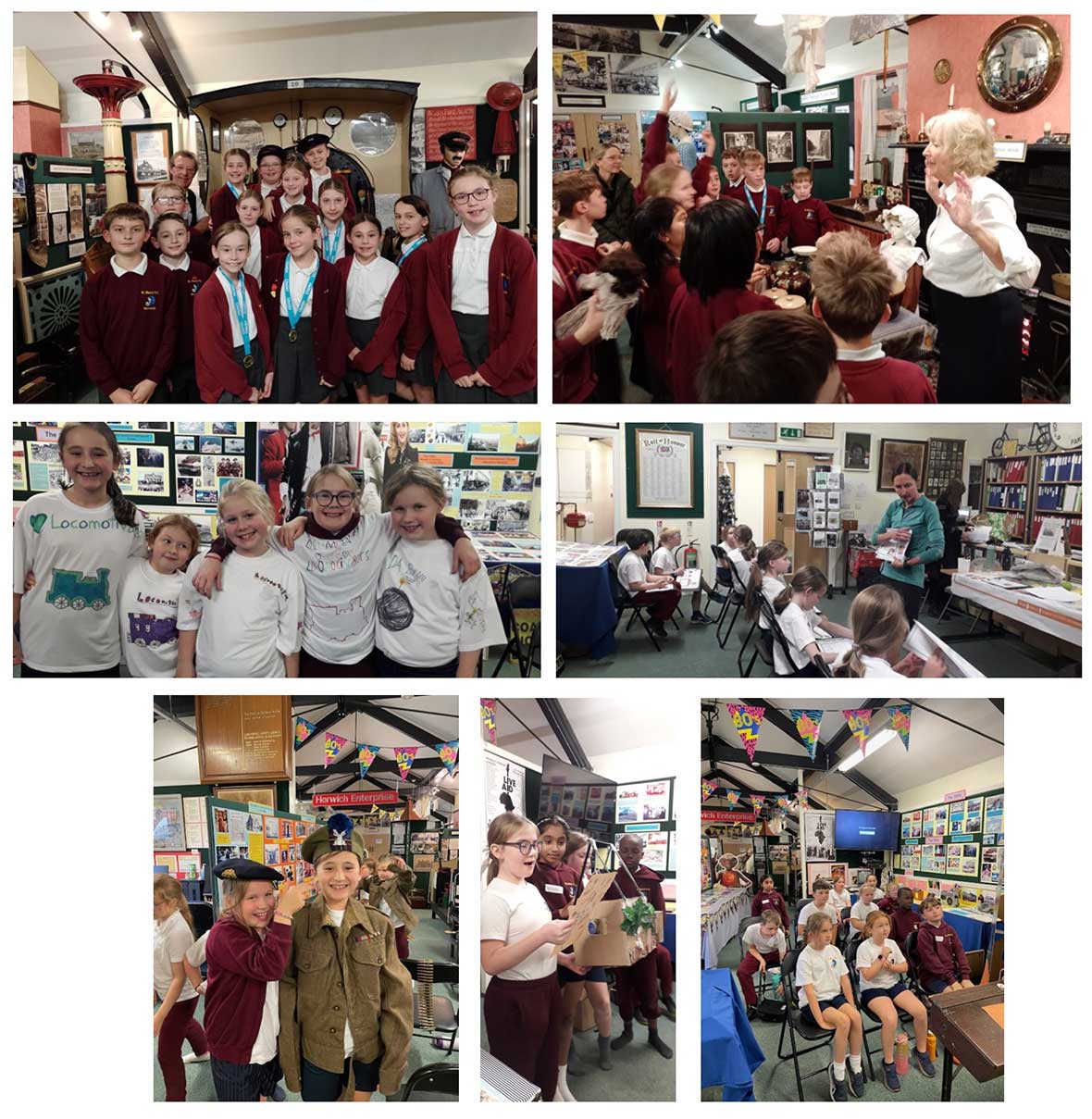
LOCOMOTIV8ORS 2025
As in previous years, we are able to report on another successful year of our ‘Locomotiv8ors’ schools project supported by a grant of £20,000 from the National Lottery Awards For All programme.
This year we have hosted 4 local Primary Schools and over 80 pupils, who have interacted with older members of the community, with more to follow in 2026. This is in addition to visits from the other Primary Schools in the town.
We cover subjects as varied as a Victorian Childhood, The Industrial Revolution, Evacuees & WWII, Climate Change & Sustainability and Health & Wellbeing. So if you wish your school or group to be involved please contact: whittlestuart@aol.com

40 YEARS SINCE THE CLOSURE OF HORWICH LOCO WORKS By Stuart Whittle
On 23rd December 1983 Horwich Loco Works closed after 97 years of locomotive production & design. At its peak the Works employed over 5000 people. It transformed this once sleepy Lancashire village into one of the 6 leading railway towns of Great Britain, making a major contribution to our industrial development and having an impact across the world. It changed for ever the lives of the original villagers and the 1000s of newcomers who came from all over the country to work here. The Loco Works provided not only their employment but their social, recreational & educational needs through the Railway Mechanics Institute, the famous RMI – whose legacy still lives on in the town today. Many families can trace several generations of their relatives who were employed on the Works. The Horwich we know today is still based on the new town created by the arrival of the L&YR Co. some 139 years ago. And, fortunately, there are many landmarks still standing to remind us of that time.
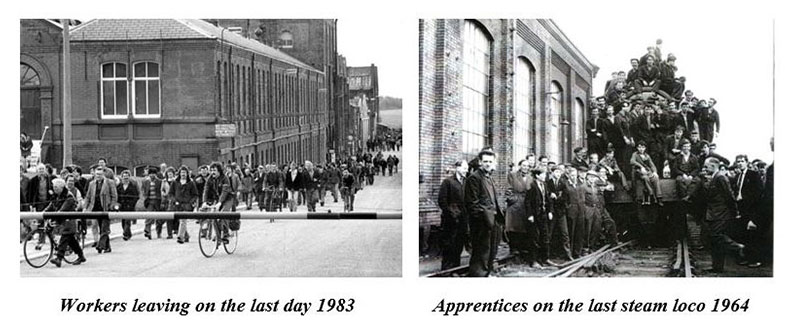
We have previously documented the remarkable ‘twist of fate’ that saw the purchase of the site and much of the surrounding area by the L:&YR Co. in 1884 and how a ‘new town’ was created in little over 10 years, increasing the population from 3,500 to 13,000 by 1891. We have also written at length about the wonderful legacy of Sir John Aspinall, the first CME and ‘Father of Horwich Loco Works’, who both master-minded its construction and designed its first locomotives. He also commissioned the building of the Mechanics Institute, which became known as the ‘University of Railway Engineering and produced some of this country’s finest railway engineers like Sir Nigel Gresley and Sir Henry Fowler. Horwich Works played an important role in the production of armaments in both World Wars, producing tanks & shells and it was during these times that women became an integral part of the workforce. In the post WWII years, the Works became part of British Railways and diesel and electric trains gradually replaced steam. The last steam locomotive was built at Horwich in 1957 and the last one repaired in 1964. But the Works went on for another 20 years producing diesel and electric units, carriages and wagons until its closure at the end of 1983. In its time, Horwich Works had a world-wide reputation and produced 1,830 steam locomotives and repaired 50,000 others. It also produced 169 diesel locos.
Although the ‘writing’was probably ‘on the wall’ for Horwich Loco Works after the ‘glory days’ of steam ended. there was a real hope that diversification into other rail and non-rail related engineering activities might keep the Works going, especially when BREL announced a £4 million investment in new facilities in 1979. However, under the new Conservative government, privatisation of loss-making public sector industries was the order of the day and job losses were soon being announced. There then followed a spirited campaign to save the Works led by the local management, workforce, unions, Bolton Council, GMC and the local MP, Roger Stott. This is well documented in the Horwich Heritage dvd ‘Countdown to Closure’ which contains extensive TV coverage from the time.

Until quite recently, the Works premises still dominated the skyline of Horwich as they continued as an Industrial Estate for 30 years after the railway operations ceased. In 2008 the whole site was designated as a Conservation Area, which should have afforded the buildings some protection. However, a few years later it was earmarked by Bolton Council as a ‘strategic development site’ and permission was granted for the building of 1700 houses and employment uses. With the whole site now under threat, it was agreed to retain 4 important ex-Loco Works buildings as part of the ‘heritage core’. But, as we now know, of those 4 buildings, only the office block has a secure future. The Erecting Shop has been demolished, the Stores building has recently been set on fire and is likely to be demolished and part of the Pattern/ Millwrights shop is in such poor condition that it too will probably be demolished in the near future. So in the face of all this loss, what will the Loco Works legacy be? Horwich Heritage will continue to strive to retain some ‘heritage features’ in the new ‘Rivington Chase’ development, maybe through a heritage trail containing some historic elements. The best hope lies in the proposals for the remaining section of the Pattern/Millwrights Shop which is designated for community uses using a ‘heritage theme’. Wouldn’t it be great to think that something like the scheme which converted the railway workshops in Swindon into a shopping centre full of ‘railwayana’, including a preserved steam locomotive, could be achieved here – with 1008 as its centrepiece! We live in hope.

BALLET IN THE SKY By Andrew Lockhart
The old man held his Grandson’s hand
As they waited for his past
They looked along the winding track
“Is it coming soon?” lad asked
The railway bridge on which they stood
Was built of iron and stone
Grandad’s heart swelled with pride
When he heard the Loco’s song
From the Loco Works their village grew
From farms and fields of green
To an industrialized, proud railway town
That served the age of steam
And those wheels made from steel
Sing songs that are real
To the stoic folk of Horwich - Time gone by
As the smoke dances ballet in the sky
The thunder sped toward them
As if born yesterday
Majestic locomotion
Hunting down its prey
Designed by men of vision
To travel round the globe
To carry people’s dreams and hopes
They built the world we know
Ramsbottom, Hoy and Aspinall
With men from far and wide
Forged the life that we now lead
On their carriage we must ride
And those wheels made of steel
Sing songs that are real
To the stoic folk of Horwich - Time gone by
As the smoke dances ballet in the sky
The young boy watched in wonder
As the last car passed them by
It never would return his way
But thunder never dies
THE 1970s By Derek Cartwright
On Saturday 29th July 2023, the Mayor of Horwich opened the latest Horwich Heritage exhibition entitled ‘The 1970s’. To many of us the 1970s might seem like yesterday, but we are talking about a time 43–53 years ago when today’s late 50 or 60 year olds would only be teenagers. And what a decade it was! We had just come out of the ‘Swinging Sixties’ when the ‘baby boomers’ had swept away many of the established ways of doing things and created a new ‘teenage culture’. The 1970s would carry on that tradition but, just like the 1960s, they would carry with them the shadow of war (in this case the Vietnam War) and also see an unprecedented level of social and economic and political instability resulting in petrol rationing, strikes, blackouts, the imposition of a 3 day working week and the beginning of the IRA bombing campaign. If you add into the mix, the country’s decision to join the EEC (Common Market) undertake decimalisation and Local Government reorganisation, the rise of ‘Feminism’ and the ‘Gay Rights’ and ‘Civil Rights’ movements, medical advances including the production of the first ‘test tube’ baby, the invention of the VHS recorder, the roll out of colour television and the ‘golden age’ of comedy programmes, the Queen’s Silver Jubilee and the incredible transformation in pop music from ‘Glam Rock’ to ‘Prog. Rock’ to ‘Punk Rock’, then you have some idea of what a remarkable 10 years of transformation it was.

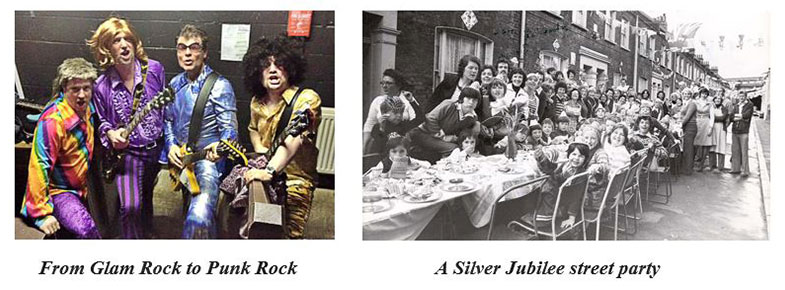
It is interesting to view what was happening locally in Horwich against this national background. Horwich UDC had only just celebrated its centenary in 1972 when it was plunged into Local Government reorganisation in 1974 and had to come to terms with becoming part of Bolton – which has never gone down well with Horwichers! Fortunately its long-held hope of building a Swimming Pool and Leisure Centre had come to fruition during the 70s with Princess Anne opening the new Leisure Centre in 1975. As well as offering hours of swimming tuition and pleasure, the pool is fondly remembered for having dolphins instead of swimmers during the latter part of 1977.

For over a century, Horwich had been a self-sufficient town based on the Loco Works with another main employer, the De Havilland aircraft factory, arriving in the 1930s. But things were changing in the 1970s, traditional industries like coal mining, textile mills and sanitary ware were closing down and Horwich Loco Works was having to diversify its production into carriage and wagon repair/manufacture instead of diesel and electric locomotive production (steam loco repair/production had ended in the 1960s). A major landmark was lost in 1976 when the Railway Mechanics Institute burnt down. It had recently closed, having been replaced by Horwich College, but for 90 years it had been the educational and social centre of the town and was greatly missed. Apart from having its own College of Further Education, there were other educational changes in Horwich in the 1970s with both St Joseph’s RC Secondary School and Rivington & Blackrod Grammar School becoming ‘Comprehensives’.

In terms of sport, Horwich continued to have a range of clubs playing under the RMI banner (including the Cricket and Harriers Clubs which are still going today). The Horwich RMI Football Team was still playing on their original ground at Grundy Hill and, despite struggling financially, became Cheshire County League Champions in 1978. The towns 3 cinemas had closed, but Horwich Leisure Centre had taken over from the Mechanics Institute as the social centre of Horwich and, amongst many other performing groups and societies, the Horwich Amateur Operatic & Dramatic Society continued to put on regular shows there. Horwich Carnival was going strong and there were long-standing traditional events that were still popular like the ‘Horwich Pub Race’ and the annual works or pub outings (picnics) to places like Blackpool. Facilities for young people could be a bit limited in a small town like Horwich but there were still Church Halls and Youth Clubs and the ever-popular Rivington Barn (and of course the countryside of Rivington & Anglezarke on the doorstep). The full extent of the fast-moving music scene took its time to reach Horwich, but it did have its share of free local pop festivals like the time there was a ‘Hippy Invasion’ in Rivington Gardens.

So do come and join us at the Horwich Heritage Centre for our ‘1970s’ exhibition where we look at events and activities that took place in Horwich 40-50 years ago set against the backdrop of a nation in social, economic and political turmoil – setting the scene for another turbulent decade the 1980s and the ‘Thatcher Years’.
Second World War: Rivington, A Military Zone
Horwich and Rivington transformed during the War. Large parts of Rivington became 'no go areas' for civilians as troops trained for combat on foot and in tanks and the barns became food and munition stores. David Owen vividly recalled the activities that took place: "My family were fortunate to have left Trafford Park, Manchester, for Rivington only a month before war was declared. I can only marvel at the providence that enabled us to avoid the devastation that took place in such a prime target area for enemy bombing raids. Instead, we young boys were treated to a military build up on our doorstep. Early in 1940, the authorities decided to utilise Rivington Hall Barn as a storehouse for sugar and flour. The Pioneer Corps moved in and erected a string of Nissen huts on each side of the road leading directly from the Barn to Rivington Hall followed by a barbed wire perimeter fence all around the Hall Estate (this stayed in place until the early 1950s). Another unit then set up searchlight battery emplacements between the Barn and the Village School. Our family befriended one of the soldiers, a Scot named Jock (perhaps because my parents were Scottish themselves). Other Army units occupied Lord Leverhulme's empty bungalow and were seen carrying Bren Gun Carriers up and down Rivington Pike as part of their training.

David Owen, Scottish soldier Jock, & John Owen outside the Vicarage
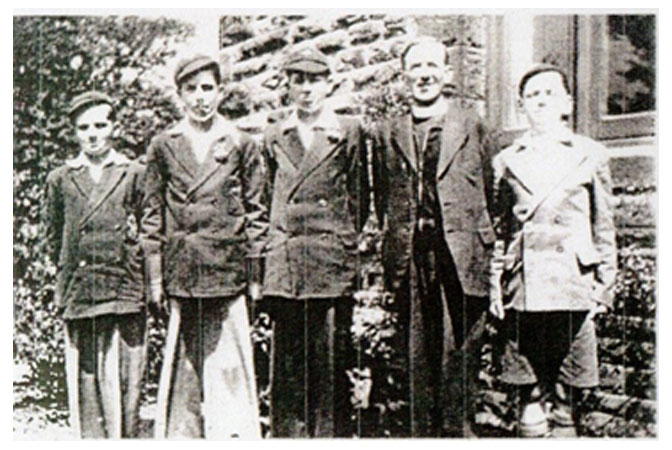
L-R Wallasey Grammar School evacuees, John Tebay & Leonard Platt with John, Rev. GE & David Owen
When the Americans arrived they used one of the quarries near Leicester Mill in Anglezarke for target practice. They would drive up in army trucks and loose off several hundred rounds of carbines and automatics. They didn't seem to mind us watching them and, after they had gone, we would collect up all the cartridge cases and store them away together with the rest of the wartime souvenirs we steadily accumulated. Occasionally, we used to hear explosions up on the moors. We were told that the army was detonating faulty ammunition and warned to keep away. Inevitably, this only acted as an incentive for us to want to investigate and one weekend 3 of us set off towards a disused quarry off Belmont Road, near the site of Comp Farm. Ignoring the warning signs and avoiding the barbed wire and locked gates, we entered the quarry to find a crater about 8 feet deep stacked with boxes marked WD. There were also wires leading to a dug out about 50 yards away. Undeterred, we proceeded to open the crates to discover items that looked like vacuum flasks (actually anti-personnel bombs), rectangular flat items that we thought were possibly mines (and were) and small metal 'footballs' with black plastic handles sticking out of the side (anti-tank grenades). We proceeded to scrape the substance out of the 'footballs' and take them home to be concealed with our other wartime 'souvenirs'. The mines we hid in a hole in the bank of nearby Dean Brook and the vacuum flasks we returned to the quarry. No one ever reported anything missing and we kept out trophies until long after the end of the war. At the time we had no idea how dangerous all this material was, but it was brought home to us when a young boy from Bolton was killed in March 1945 as a result of throwing a grenade in the very same quarry. Military ordnance was being recovered from the Rivington/Anglezarke moors for many years after the war and, even today, people report finding 'suspicious-looking' items which the military authorities turn out to recover or even detonate on site. Near to the quarry where the ammunition was exploded, just below Belmont Road, was the shell of an old tank which we loved to play on. It was used for target practice by the military and was at one time positioned near to Stoops Farm where it would be bombarded with mortar shells. When it was no longer needed for practice, it was dragged up the old farm track and left at the side of the road. There it remained for quite some time and was a familiar sight to passers by long after the war had ended.
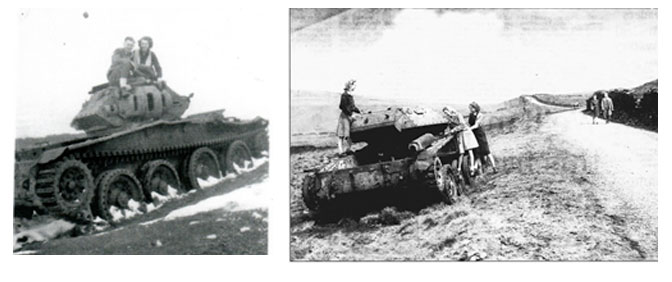
2 views of the abandoned tank alongside the road from Rivington to Belmont
The Home Guard and Air Raid Wardens in Rivington were both stationed in a small annex at the back of the Unitarian Chapel, one upstairs and one downstairs. The Home Guard did most of their exercises in daylight whereas the Wardens were mostly nocturnal. Henry Heaton was the Head Warden along with my dad, Rev.G E Owen, schoolmaster, Henry Whitehead, Johnny Miller, John Brindle and his sister, Olive. The leader of the Home Guard was Aubrey Hesketh of Fisher House. A contingent of the Horwich Home Guard was allowed to use Bolton Lodge, one of the gatehouses in the bungalow grounds, for their activities on condition that the Civil Defence organisation compensated the owners, Liverpool Corporation Water Works, for any damage caused. A lengthy dispute occurred when considerable damage was discovered after they left including the disappearance of doors and windows. This eventually resulted in the building being demolished.
With the threat of invasion, a number of measures were introduced which most readers will be familiar with: rationing, 'make do and mend', the blackout, the construction of air raid shelters (Anderson for outside, Morrison for inside - but most villagers preferred to build their own and we used the Vicarage cellar) and the carrying of gas masks. What might not be so familiar was the erection of wooden posts with a flat piece of wood on top which was painted green (as were the tops of pillar boxes). This would change colour if gas was detected and fortunately that never happened. Rivington didn't possess its own air raid siren, so it had to rely on those mounted on public buildings in Horwich and Adlington, which wasn't difficult as they were extremely noisy! Even youngsters like ourselves were taught practical lessons like how to operate a stirrup pump to extinguish a fire and how to extinguish an incendiary bomb using a sandbag.

A local stone signpost with details removed
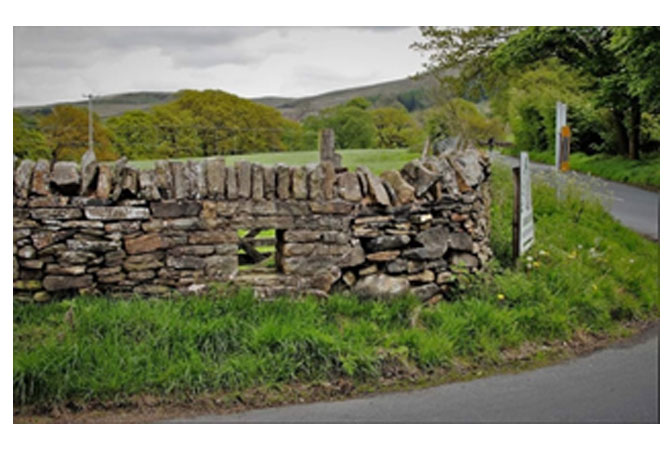
A hole in the wall to insert telegraph poles
Additional measures undertaken were the removal of all signposts and the chipping of town names off boundary posts in order to deny any directional assistance to an invading army. Around the village, holes were made in the stone walls on either side of the roads so that a telegraph pole could be inserted to block the road and, as a final deterrent, pill boxes were erected. There were several of these concrete constructions around Rivington at strategic locations. They had small slits for windows so that small groups of soldiers or the Home Guard could fire on the enemy as they advanced. Evidence of these preventative measures can still be seen around the village if you look closely. It was thought at the time that the Germans would attempt to land troops by seaplane on reservoirs like those at Rivington. To stop the seaplanes landing, floating logs were moored at various places around the reservoir system and they remained there until they became waterlogged and sank many years later. You can still see some of them today when the water levels are low. Perhaps the most ingenious of the attempts to deter/deceive the enemy was the idea of constructing a decoy town on Anglezarke Moor to persuade the Luftwaffe to release their bombs on desolate moorland rather than on densely-populated areas. Lines of oil drums were placed on the moor and set alight as the bombers were approaching. Unfortunately the plan failed, as not one bomb was attracted to this area. Furthermore, it then became necessary to construct oil traps in the hillside streams to prevent oil polluting the water supply. Incidentally, the story has persisted in the Horwich/Rivington area for many years that Rockhaven Castle was demolished because it was acting as a location device for German bombers heading for Manchester. This is unlikely, as the Rivington Reservoirs were a much more obvious directional guide. Whatever the reason (the castle was unoccupied at the time), it is understood that the Horwich Home Guard blew it up as a training exercise with the stone being retrieved for use by a local quarry owner.
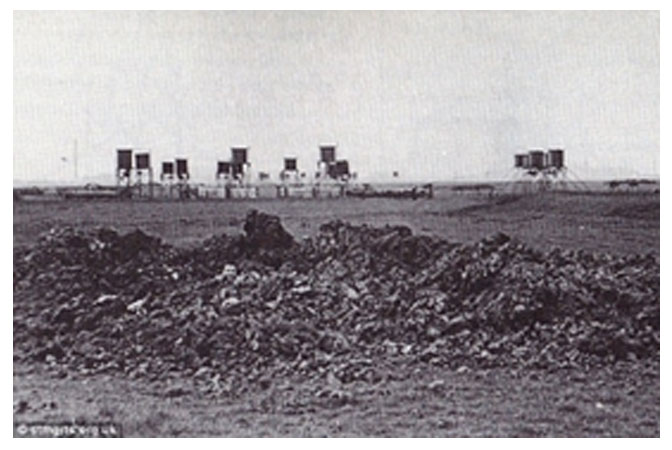
Decoy site on the Rivington Moors
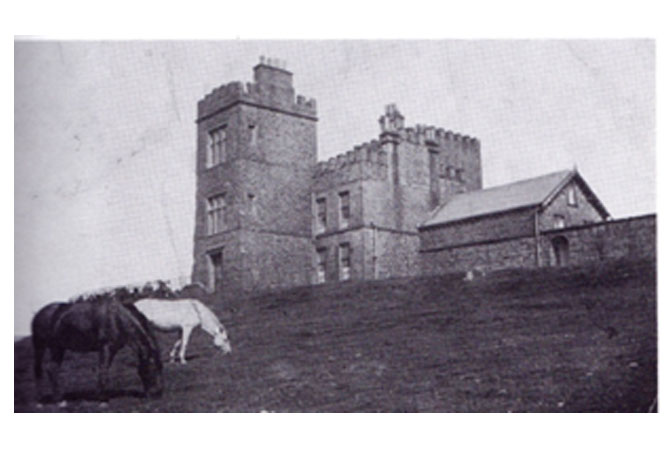
Rockhaven Castle - demolished by the Home
Later in the War, American troops started to assemble in the area in preparation for the D Day Landings. They were camped in Miller's Wood just outside the village and near Great House Barn. We would stand watching them in fascination as they dined on (to us) exotic items like tins of tomato juice and fruit salad which they were happy to share with us as we looked so hungry. Everyone knew that something big was about to happen and there was a lot of talk on the radio and in the newspapers that an invasion of occupied Europe was being planned. Quite soon afterwards, some of the roads in the surrounding area were closed to local traffic and lines of vehicles covered in tarpaulins started to appear there. Then the convoys of American troops began passing through the village (see Geoff Pollitt's sketch in 'Childhood Memories'), once more handing out 'treats' as they had done before, and before long we heard the news of the Normandy invasion. It was the beginning of the end of the war in Europe and I was now nearly 16 and preparing to leave Rivington & Blackrod Grammar School for a job in post war Britain. Although I had spent my formative years in a period of austerity, I knew from other relations in Liverpool, Manchester and Kent that we had been fortunate to be where we were. Even though we were away from the 'main action' of the war, we had had our moments of drama & adventure in our little village of Rivington. Postscript: the only Rivington villager killed in the war was Gordon Ratcliffe. He lived in one of the houses opposite the village green and worked at Horwich Loco Works. Being in a reserved occupation, he was only released to serve in the armed forces towards the end of 1944. He joined the RAF as a gunner and was killed in action only a few months later in March 1945."
Second World War: Horwich Loco Works During WWII
By 1923, Horwich Loco Works had, through a series of mergers, become part of the giant London, Midland & Scottish Railway (LMS), the largest of Britain's big four railway companies. Its activities extended north, south, east and west across the country and on to Ireland covering some 19,000 track miles. It owned 7,500 railway engines, 300,000 pieces of rolling stock and employed 250,000 staff and its interest extended beyond railways to docks, harbours, shipping, hotels, canals and even aeroplanes. The outbreak of the Second World War was seen as a distinct possibility long before war was actually declared and as early as 1937, the LMS railway workshops in the Midlands and the North were involved in fitting out ambulance trains, designing tanks and the manufacture of aeroplane parts. With the threat of aerial bombardment, all the workshops (including Horwich) were camouflaged.
On the day Germany invaded Poland, 1st September 1939, the Government took control of the country's railways. A Railway Executive Committee was introduced to coordinate the activities of the Ministry of War, Transport and the Railway Companies and ensure the smooth running of military and civilian services. One of the first operations performed by the railways at this time was the mass evacuation of 1,200,000 adults and children between 1st and 4th September. The LMS transported half a million children using 1,450 special trains. The building of new locomotives and carriages was largely suspended with the outbreak of hostilities and this period of inactivity in the workshops led to many skilled and unskilled men leaving to join the services or take up more remunerative employment elsewhere.
In WWI, Horwich Works was principally involved in the production of fuses and shells and the renovation of cartridge cases. Its responsibilities in WWII were much more diverse. Just as in WWI, women were employed to augment the workforce and take on munitions work. Some 600 women out of a total of 4,120 were employed at the Works at this time. The Forge was vacated and used as a Cartridge Case Reform Plant and it was here and in the Oerlikon shell and base welding shops where most of the women worked. They also worked as machinists, fitters, coppersmiths, coremakers, riveters and plater's helpers. George Fisher who later became the Head of the Erecting Shop and Acting Works Manager and Jake Cartwright, who worked on the tanks, remembered the dexterity and adaptability of the female workforce. Very little is known of these ladies and it would be wonderful to find out more about their important contribution.

Women working on munitions at Horwich Loco Works
However, unlike in WWI, we do at least have some names for the female workers (see photos below). We also have some memories of working on munitions from the Horwich Widows Association. Lilly Fido and Gladys Mason were recruited to 'fit bits' to Matilda Tanks and straighten out shell cases brought in from blitzed cities' anti-aircraft batteries. They remembered the 'banter' with Charlie Allison who did his best to control them and the wartime romances, one of which led to Lilly marrying Dougie Fido who was a lathe turner. Ernie Woof's widow recalled how her husband was a part time fireman as well as a fitter. One night he had a horrendous experience when the Loco Works fire train, which had been called out to help in the Liverpool 'blitz', was hit by debris as a result of a bomb explosion. Fortunately he escaped uninjured. We have it on record that the fire train performed many heroic acts attending fires at docks in Fleetwood and Manchester as well as Liverpool and is known to have reached Fleetwood in record time (before the local fire service!). Lilly Mansell recalled living through the Manchester 'blitz' and giving birth to 2 children on separate occasions in an air raid shelter whilst others worked at the Royal Ordnance Factory in Euxton and turned yellow as a result of working with 25 pounder cordite. The war did have its lighter side and most of the ladies managed to go to the local cinemas or go dancing at Bolton Palais and the Empress or at the 'Fling', British Legion or Reform Club in Horwich. Food rationing and clothing restrictions did pose difficulties and one lady even admitted to going out with her grocer boyfriend because he gave her a 1lb bag of sugar every month!
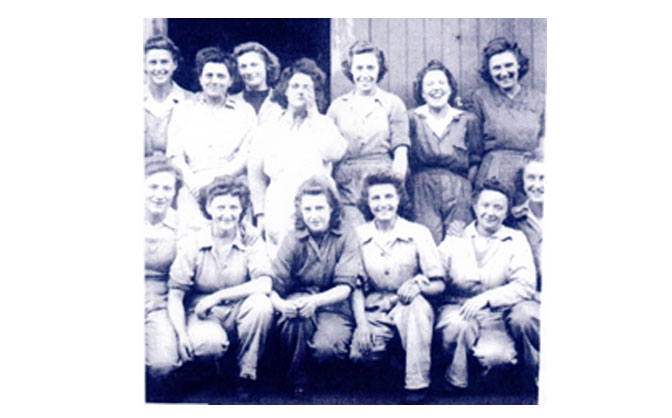
Female Munition Workers at Horwich Works
Clarice Southern, Eileen Ashworth, Dot Walmsley, Mona Seddon, Frances Davenport, Gladys Brownlow, Ann Price.
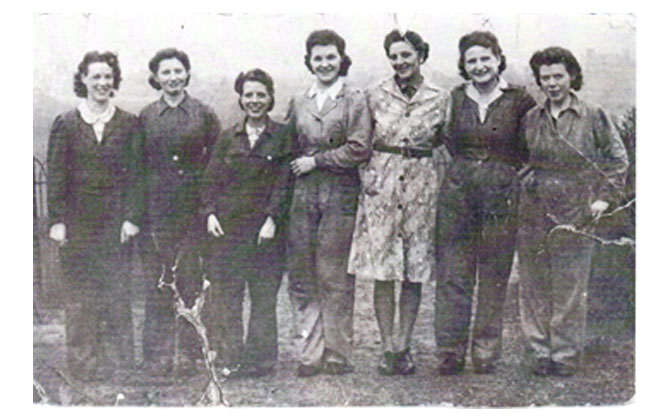
Female Munition Workers at Horwich Works
Wilhelmene Van Krikken, Marion?, Margaret Eden, Eve Telford, Beatrice Partridge, Alice Davenport, Ellen Durkin.
As early as 1938, Horwich Works was put on a 'war footing' and, during the war, the Works produced 6,740,000 Oerlikon shells and renovated a further 18,713,000. An additional 4.333,000 3.7 and 4.5 shell cases were also renovated. Horwich manufactured 481 tanks including 406 Matilda Mk II tanks, 45 Centaur tanks, 30 Cruiser tanks and a number of aircraft parts. Jake Cartwright recalled working on these tanks and taking them out for trials on the Moss and local roads where they caused quite a commotion frightening the horses in milk floats and catapulting 'cats eyes' at an unsuspecting public! So the story goes, Horwich was so used to putting name plates on its locos that it did the same on its tanks until it was pointed out that this made the Works an obvious target for German bombers!
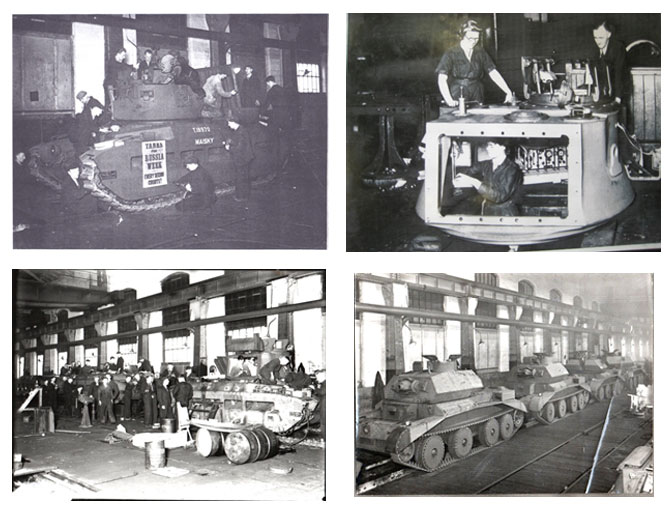
Tank construction at the Loco Works during WWII
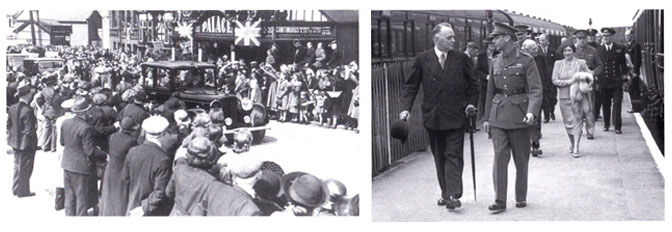
On 2nd May 1940, King George VI and Queen Elizabeth visited Horwich to thank the town for its contribution to the war effort
Second World War: Evacuees
The threat of German bombing brought about the need for mass evacuation from Britain's cities, particularly London, during the course of WWII. Around 3.5million people (mostly school-age children but also mothers with children under 5, pregnant women, the disabled and teachers) were evacuated during the war years with the first wave beginning in September 1939 when 1.5million people were removed from London in 3 days! The threat of invasion when France surrendered in June 1940 created another wave, followed by the Blitz in September 1940. The final wave came with Germany's last attempt to bomb Britain into submission in June 1944 using the V1 and V2 rockets ('dooblebugs'). For a small town, Horwich certainly played its part, accommodating 535 mothers and children. They mostly came from London but there were also groups from Manchester and Liverpool. There were also 2 distinct groups: official and private, with a surprising number (c.200) arriving as a result of voluntary arrangements between friends and relatives.
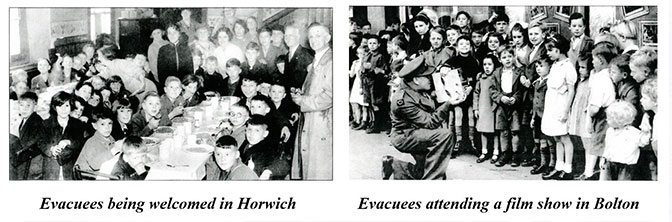
We are fortunate in Horwich in that many of the Evacuation Records survive. They are kept in the History Centre in Bolton Library. As a result it is possible to trace who the evacuees were, where they came from, where they stayed and who with. There were 315 host families spread across the whole of Horwich and most took in one or two evacuees, but the records show 17 households who took in 4 or 5 (usually because they were a mother and children from the same family). Some evacuees stayed for a short time e.g. Sept.1939-May 1940 when bombing was expected but didn't happen (the 'phoney war'), but others stayed for several years. In terms of billeting, this started in 1940 with the arrival of 21 evacuees, the peak years being 1941 (101) and 1944 (169). The reason for the 'spike' in 1944 was the V1 & V2 rocket attacks on the South East of England. The evacuation process was halted in Sept. 1944 and evacuees gradually began to return home. However, returning to London was not officially approved until June 1945. The billeting programme ended in March 1946.
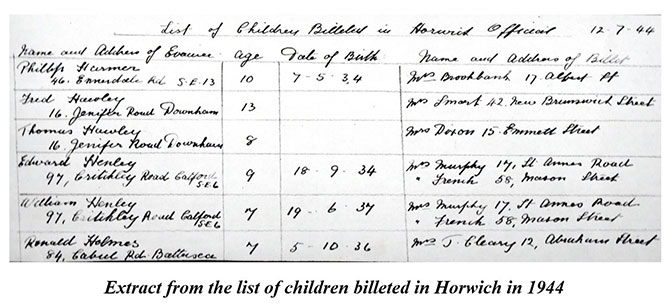
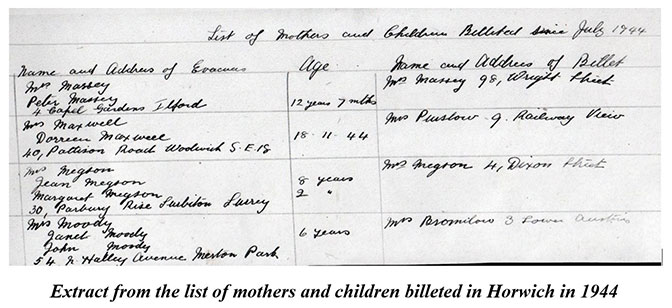
Fascinatingly, as well as the lists of evacuees and households, the Horwich records contain items like the notebook of Mrs Carter, the Billeting Officer, in which she assesses the suitability/ availability of households and premises in various parts of the town to accommodate evacuees. There are also evacuation forms and record cards, bed and blanket issue lists, billeting allowances, clothing payment forms, repair bills and complaint forms (asking for unruly evacuees to be removed). They are well worth a look and it would be wonderful to trace some of those evacuees who came and even more special to find any of those who chose to stay in Horwich after the war. Evacuation was a hugely disruptive process for those involved in moving and those involved in accommodating. It often created tension within the host communities and produced experiences that were both good and bad. Thanks to the memories of David Owen, Cedric Holt and Geoff Pollitt (see later sections), we know that there were indeed 'cultural clashes' in the local schools but hopefully Horwich turned out to be a welcoming town. We would love to hear the memories of evacuees who chose to stay in Horwich after the war.

First World War: Belgian Refugees Arrive In Horwich 1914
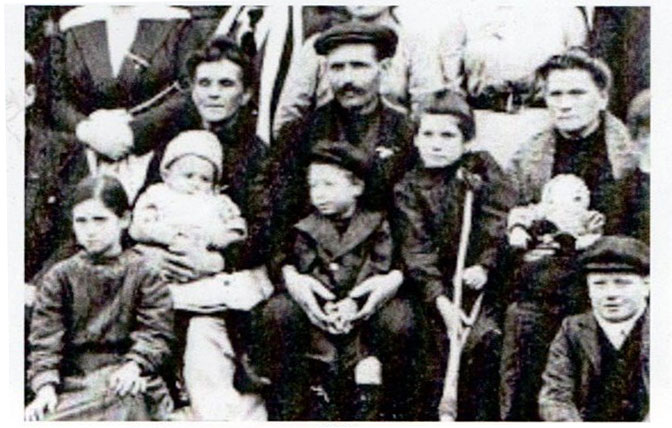
16th October: On behalf of the people of Horwich, Mr J.H. Riley, Chairman of the Council, welcomed the Belgian refugees who had arrived under the supervision of Father Moylan (St. Mary's Church). The refugees had been conveyed by car from Manchester Cllrs J.E. Dickinson & W.E.Pickup, Mr H. Makinson and Drs Sewell and Ramsbottom.
23rd October: Another body of Belgian refugees arrived in Horwich bringing the total up to 22. 20 are currently housed at Anderton Manor and 2 are residing with Father Moylan. A letter of thanks was given to Father Moylan from the refugees residing at Anderton Manor. It read "We already feel secure from the horrors of war which we have experienced in our own bleeding country and we shall never forget the hospitality extended to us by the good people of this locality in our deep sorrow. In the name of the refugees, please accept my most grateful salutations". Jean Gomkels.
23rd October: Local residents have provided food, clothing and furniture for refugees. The local church collections at St. Mary's for this month will be for the benefit of the refugees. Stories of the plight of the refugees were read from the pulpit.
30th October: Belgian refugees were entertained at the Mechanic's Institute.
30th October: A family of 8 Belgian refugees; a father, mother and 6 children under the age of 12, have been housed in Higher Darbyshire Cottage, Rivington. The house has been placed at the disposal of the refugees by Miss Ainsworth, who along with a few friends, has furnished it and promised to maintain the property for 12 months if necessary. It is proposed to send the children to the village school.
30th October: The Horwich and Westhoughton Education Sub Committee agreed that the Belgian refugee children will be able to attend the Fourgates Council School.
6th November: The question of holding a Flag Saturday in aid of the Belgian Refugees Fund was raised and it was decided to fix the date for 21st November.
20th November: Lively scenes were witnessed at the Mechanic's Institute when around 150 Belgian refugees and a number of wounded soldiers from Bolton and Chorley were entertained to tea and a concert and dance.
27th November: A Flag Day was held in Horwich for the Belgian Relief Fund when emblems of the Belgian Standard were sold by local ladies and young people. The whole supply of 5,000 flags quickly sold out and raised nearly 15 for this worthy cause.
11th December: The Belgian Fund stands at £127. 31s1 December: Nearly 100 Belgian refugees had been accommodated in the district.
Extracts form Horwich Chronicle and Bolton Journal & Guardian
First World War: The Life Of Thomas James Edwards D.C.M.
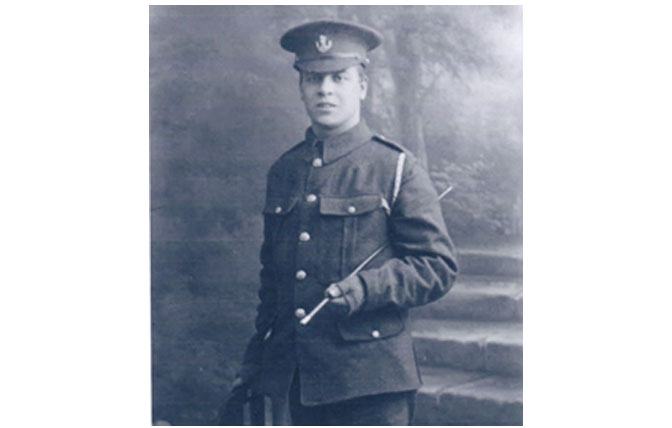
My name is Tommy Edwards. I was born in Newton Heath, Manchester in 1883. My parents came from Cardigan in South Wales but they had moved to Manchester to take advantage of work on the railways. They hadn't been at the Loco Works at Newton Heath very long when the opportunity came to move to the new Works being built at Horwich. We took up residence in Hawksley Street, one of the newly built terraces of houses built for the loco workers. Unfortunately my dad died in his 40s, which made things very hard for my mum and 5 young children. It was important that my elder brother and I started work as soon as possible to bring in a wage and by the age of 14 we had followed our dad and were both apprentices at the Works. My brother, Charles, became a riveter in the boiler shop and I became a blacksmith's striker in the forge. These were hard, dangerous jobs that required real physical strength but they toughened us up for life.
At an early age I became interest in the military having met a number of old soldiers in the town and I became determined to join up with the Old Volunteers, as they were then known, as soon as I was old enough. As our number increased thanks to the building of the Works, we then became known as 'F' Company of the 1st Volunteer Battalion of the Loyal North Lancashire Regiment. Our Commanding Officer was Colonel Widdows and our Drill Sergeant was Sgt Brady - one of the finest men you could ever wish to meet. He came over from Chorley twice a week to take charge and since we didn't have any permanent home we moved from our first base at Gorton Fold to Captain Street then to the Princes Arcade basement and the band room under the L&Y dining room in Gooch Street before finally settling in the new Longworth Rd. Barracks when it opened in 1910.
22 of our lads went out to South Africa to fight the Boers under Captain Foley and thankfully they all returned safely. Sgt Brady retired shortly afterwards and he was greatly missed. In 1907 came a great change. All the Volunteers became Territorials and we had to change our name to the 4th Battalion of the Loyal North Lancashire Regiment but were still known as 'F' Company. We also retained our old red uniforms. 1910 saw us nicely settled in our new barracks and enjoying the comradeship and our annual camps in various parts of Lancashire.
Unfortunately things were about to change and on 4th August 1914 the peace of our camp at Kirby Lonsdale was shattered when we were ordered to return to Horwich and get ready for war. We slept in the barracks and then caught the 4 o'clock train to Preston. Hundreds of people followed us as we marched from the barracks to Horwich station with tears and cheers. We joined the other 4th Loyals Companies and on 15th August we all signed up for overseas duty at Preston Town Hall. After a brief lull things started to happen fast. By October we were in camp in Swindon training for war service in France. And on 3rd March 1915 we landed in Boulogne as the new 'C' Company attached to the 51st Highland Division under Captain Foley and Captain Peak. I wrote home saying that I was sure that all our friends and relatives in Horwich would be proud to know that we were
going to the front to do our bit for our country. We all wanted to be a credit and to do honour to our home town of Horwich. The Company moved on to Flanders and by 27th May we were in the trenches at Festubert awaiting battle orders. This was it, what we had been training for, what we had been waiting for! Real action! We were both excited and frightened!
When we arrived, conditions were bad. The trenches were water-logged, ankle-deep, sometimes thigh deep in mud. Dead German and Scottish soldiers were still lying where they had fallen in the previous battles and when the sun came out there were swarms of insects drawn by the dead bodies. But we hadn't time to dwell on all that, we were there to fight and at one o'clock on 14th June we were in our trenches waiting for the order to attack. The Loyals' commanders ordered 'C Company, which included most of the Horwich men, to lead the charge and at 6 o'clock we went over the top.

The German trench was about 50 yards away from ours and the earth fairly shook with the fearful pounding of shells. No.12 Platoon charged first - it was mainly Horwich lads and commanded by Lt. Parker of Preston. We climbed the parapet and raced like tigers for the German lines. In five minutes it was ours - but at what cost! Very few of the Platoon were left. Sgt Smith was killed after bayoneting 6 Germans and Sgt. Clayton accounted for a few before he was brought down. No.11 Platoon then followed up with more Horwich lads and commanded by Lt. Davies of Preston - as brave a man as any I saw. We tried to advance as best we could but bullets seemed to come from every direction. Men were dying all around me including Lt. Davies whose last words to me were "For God's sake take the men on". With no Officers left I had to take charge and rallying the men we advanced by rushes towards the 3rd German trench. By this time we were down to about 20 or 30 so I gave the order to dig in. Even then our lads were getting picked off by machine gun fire. Then, as I was waving the lads forward, my right arm dropped as if paralysed. I felt no pain but looking down I saw it was covered in blood. I got it bandaged up and then Major Nickson told us to fall back as the German bombardment became too much.
After a journey of about 2 hours we reached the Dressing Station, which was crowded. It was wonderful to see the chivalry displayed by those wounded men. No one would have their wounds dressed until they were certain that there was nobody worse than they were. I think back now at how we had been scoffed and sneered at in Horwich but I tell you this.. if it had not been for the Territorial Force, England would have been in Queer Street, and I am proud to be one of them.
The battle raged until the early hours of the following morning at which point the British troops were ordered to return to their own lines. This they did after suffering heavy losses. When the roll was called only 243 out of 645 answered. The casualties were 26 killed, 266 wounded and 100 missing, a total of 402. Of the 86 casualties in C Company, 10 Horwich men were killed and 25 wounded.
Sgt Major Edwards returned to action after recovering from his wounds and was awarded the Distinguished Conduct Medal (DCM) for 'manoeuvring his company in such a way as to escape with very few casualties'.
After the war Tommy Edwards returned home but only a year later the following notice appeared in the Horwich Chronicle:
The death has been announced of Sgt. Major Thomas James Edwards D.C.M. of 24 Hawksley Street, Horwich and formerly of 1/4thBattalion Loyal North Lancashire Regiment and Secretary of the Horwich Comrades of the Great War. The deceased, who was 36 years of age and unmarried, had been in failing health for about 6 months. By trade he was a blacksmith at the Loco Works. He had a long connection with the volunteer movements in Horwich, having been in the Old Volunteers and in the Territorials since the formation of the LNLR. He was mobilised with the 1/4th LNL when war broke out and his regiment was sent to France in 1915. He was the first to bring honour to his native town by winning the D.C.M. and, in recognition of his services, he was presented with a purse of gold and an illuminated scroll by the Horwich Heroes Recognition Committee. Although wounded, he successfully rallied and led his Company at the Battle of Festubert when all the officers had become casualties. On another occasion his fine example during heavy bombardment gave great confidence to his men.
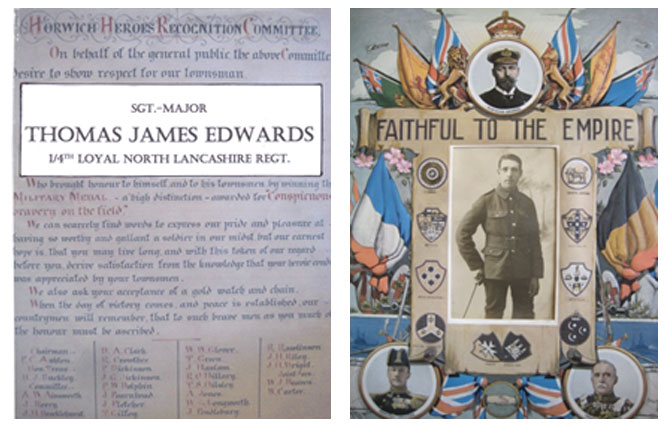
Sgt. Edwards' funeral took place with full military honours at Horwich Parish Church. The Horwich Comrades of the Great War and the firing party & trumpeter from Fulwood Barracks, Preston, marched in front of the coffin, which was draped with the Union Jack and covered with wreaths. The Rev. Shepard conducted the last rites as 3 volleys were fired over the grave and the trumpeter sounded the last post. A beautiful wreath from the Comrades was placed on the grave.
Tommy Edwards' life was typical of thousands of young men who gave their lives for their country in the Great War. 430 men from Horwich died in WWI but hundreds more returned home scarred physically & mentally by the ordeal. They returned to a battle-weary country which took many years to recover. Life was never the same again but some good things did emerge out of the slaughter - a more equal society, votes for women, medical advances, technical advances that gave rise to the rapid development of radio, TV, the motor car, aeroplane, health & welfare improve- ments - all of which we enjoy the benefits of today.
So as we commemorate 100 years since the start of WWI let us give thanks for the sacrifice that kept this country and the rest of Europe free - and may we always remember and be grateful.
WE SHOULD NEVER FORGET!
First World War: Jacob's Lament
I am Jacob Cartwright, age 54, worked hard all my life but will work no more.
I fought in t' war with my life at stake but all you hear now is "poor little Jake"
With that terrible gas and fever severe I often wonder how I lived to be here.
I've felt the pangs of hunger & sleepless nights with ceaseless shell bursts burning bright.
I have asked for help, as only God knows, when I've had to face the advancing foes.
I've passed through the dead both left and right after the end of a bloody fight.
It sounds like a dream that is being foretold but its only true, as true as gold.
I was healthy & strong, didn't care a heck when my Country called - but now I'm a wreck.
I have reared a good family, all lived but one, the flower of the bunch; well she's gone on.
To meet her maker who answered my prayer, to survive the hardships with no one to care.
My abilities raised me to Sergeant in rank, but through misfortune back to Corporal I sank. There ended my career as a military man.
I've had my times both good and bad both with my dogs and as a soldier lad.
I've served three reigns, Victoria, Edward & George and worked at th' anvil and at t' forge.
Worked 26 years for LMS but of no further use as I'm in a hell of a mess.
My heart's troubled with an irregular beat, it'll almost stop and then repeat.
I have a small garden to which I attend and Joe Smith's green-house at t'other end.
It's my only pleasure, as the days seem so long, sometime I feel merry & burst into song!
When all's said & done its nice to be alive but I'm waiting for the man to come wit'scythe. It's a thing we can't help but obey the call, for as time flies on it comes to us all.
I think this is all I have to say, now my pen and paper I will put away.
In conclusion this slogan we all know is true, I'll do my best to recite it for you:
"All men are born of equal birth in this and every nation.
The rich would be amongst the poor but for their wealth and education.
And when we are underneath the soil with a hundred years to back it -
Who will know the bone of the man who wore the ragged jacket?"
Written by Jacob Cartwright (1886 -1936) shortly before his death. He served with the Royal Welsh Fusiliers in Salonika in WW1 but suffered from the effects of being gassed in later life.

125 Years Of Horwich RMI
Stuart Whittle reflects on the whole range of RMI clubs & societies that have helped to shape the town we know today.
To anyone living in the Horwich area the initials RMI are immediately recognisable as those of the Railway Mechanics Institute built by the Lancashire & Yorkshire Railway Company in the late 1880s to educate its apprentices. However, the RMI quickly became much more than an apprentice school, it became the social, recreational and educational centre of the rapidly-developing town. Dozens of sports & social organisations sprang up to cater for every conceivable pastime of the day and many of those organisations still survive today, over 30 years since the Loco Works closed and over 125 years since it first started production. The RMI name not only lives on but is now a famous brand known across the country and forever associated with Horwich Loco Works.
As soon as John (later Sir John) Aspinall was appointed as Chief Mechanical Engineer of the new Horwich Loco Works in 1886, he recommended the introduction of a Premium Apprentice Scheme, the monies from which would pay for the construction of a Mechanics Institute. The L&YR Board accepted his recommendation and by 1888 the Institute was officially opened at a cost of £3,140. Up to 90 students a week were taught engineering sciences and such was the success of the scheme that the Institute was soon expanded with the addition of 2 wings to accommodate a reading room, smoking room, library, technical classrooms and a large hall capable of seating 900. By 1893 there were 790 students in attendance and thanks to the generosity of the widow of one of the directors, Samuel Fielden (who also funded the Samuel Fielden Wing), a gymnasium was added in 1895.
With such a wealth of facilities, it is not surprising that they began to be used for social and recreational purposes as well as education. An RMI football team was formed in 1896 that flourished for many years in the North West amateur football leagues. The 'glory days' were in the 1950s, 70s & 80s during which time they won the Lancashire Combination League & Cup, the Cheshire League & Challenge Shield , reached the 1st round of the FA Cup (losing to Blackpool) and won the GMAC Challenge Cup. Following the closure of the Works in 1983, the team moved ground and became Leigh RMI, achieving notable success in the Nationwide Conference League in the 1990s & early 2000s where they reached the 3rd round of the FA Cup twice (their finest hour was drawing 1-1 with Fulham at Craven Cottage in 1998 before losing the replay at home). Unfort- unately the clubs fortunes dwindled after that & they left the League in 2011. There is, however, a new Horwich RMI club playing in the Lancashire Amateur League, so long may the name continue!

RMI Club today
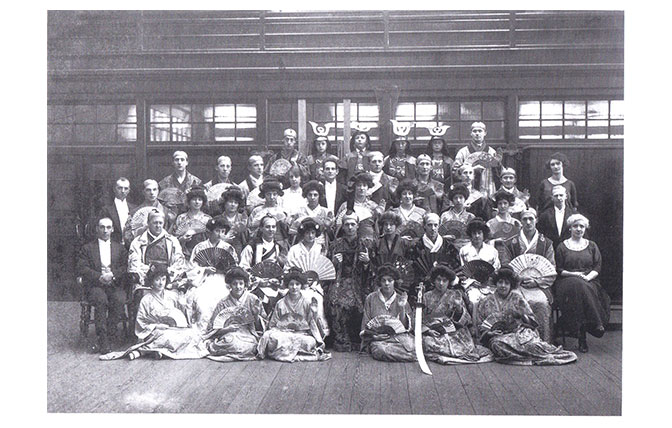
Operatic Society at Mechanics Institute early 1900s
Other sporting clubs that are still going strong today are the Horwich RMI Cricket Club and Harriers, the Cricket team being founder members of the Bolton League and winners of the League and Cup trophies on a number of occasions. This team has had the benefit of playing on the original RMI Recreation Ground, which was again provided by the L&YR Co., this time by 2 of their directors, William Himners & Henry Yates Thompson, since 1892. When it was first laid out the Recreation Ground comprised 2 bowling greens, tennis courts, a children's playground and band stand. Bowling as a pastime is still enjoyed by members of the RMI Sports & Social Club which also runs a whole range of social functions from its premises on the corner of Chorley New Road & Ramsbottom Road. These were built following the closure of the Mechanics Institute in the mid 1970s when its educational role was replaced by Horwich College. Once empty, the Mechanics Institute was vulnerable to attack by vandals and the place which had nurtured so much talent and hosted so many memorable Horwich occasions was burnt down in 1978.

Cricket Team: League & Cup Winners 1955
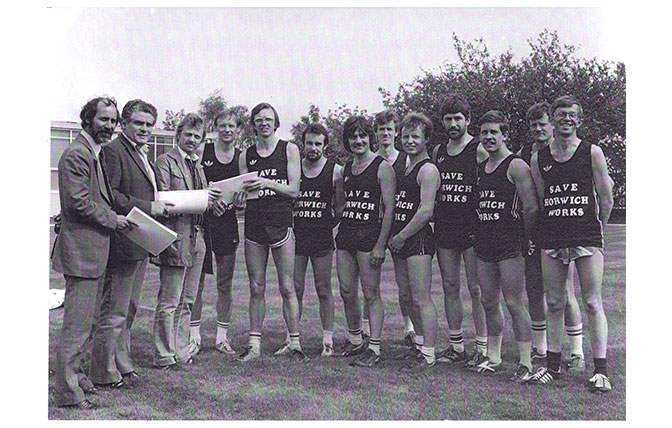
Harriers setting off on Works protest run 1982
Before the Mechanics Institute was built the centre of social life in Horwich was the Public Hall. However, the excellence of the new facilities at the RMI meant that it soon took over as the new 'leisure centre'. By the 1890s, 5000 men were employed at the Works and no less than 2000 of them were regularly involved in study classes or sporting and recreational pursuits. Employees paid a subscription which entitled them to use any of the facilities. In addition to the more conventional games of football, cricket, hockey, tennis & bowls, there was a club for nearly everything that generated an interest including a rifle club, archery club, camera & photographic club, Operatic & Dramatic Society (which has only recently ceased to put on productions) as well as trips to places of interest up and down the country. One element that the L&YR was particularly keen to promote (for its own prestige) was the RMI Band and by carefully recruiting the best players it managed to bring together a formidable group of musicians whose 'crowning glory' was to win the British Championship at Crystal Palace in 1922.
Employees' wives and families were entitled to join and as a result clubs like sewing, knitting & flower arranging also emerged. As the Works developed and the RMI quickly established itself as the social centre of the town, John Aspinall was keen that it should be enjoyed by the whole community and actively encouraged the Council, other organisations and the people of Horwich to use the facilities. The Institute's educational role also expanded to become Horwich Junior Technical College (which eventually became Horwich College). All of this cemented relations between the powerful new Loco Works organisation and the rest of the town and created the community spirit that Horwich (and the RMI) is rightly proud of and which has lasted right through to the present day.
Stuart Whittle Information source: M D Smith
ALAN DIGGLE REMEMBERED By Lillian Heath, July 1997
Lillian Heath and Alan Diggle were friends for most of their lives. Both born at the outbreak of the second world war, they went through school and through their adult lives living in Horwich and staying friends. When Alan was ill in Hospital towards the end of his life Lillian visited and on some occasions while there helped him at meal times. When Alan sadly died in the summer of 1997 and on the run up to the Horwich Carnival, Lillian knew an era had ended and contacted the newspaper to tell everyone of the loss of one of Horwich's best loved characters. She also put pen to paper about her own memories of Alan. These writings were discovered in the Autumn of 2018 some fourteen years after the untimely death of Lillian, a victim at 66 years of Motor Neuron Disease. The passages below were written in the summer of 1997 with love, feeling and with that sense of loss. They are the personal thoughts of Lillian, we know she would be proud to be referred to as a lifelong friend of Alan. Hope you enjoy.
Alan Diggle Horwich Character, January 1939 - July 1997, age 58 years

Sadly now characters are not tolerated, but Alan belonged to that dying breed (Alan's friend Lillian Heath 1997).
Going to school during the mid 40s to 50s, he (Alan) was what we would term today a child with 'special needs' but in those days Alan just had to get along with those around him. After school and during the holidays Alan would be allowed to ride free on the bus backwards and forwards from Horwich to Bolton and back. His one aim at that time was to be a bus driver, I bet the bus bosses never knew about this deception but this was one way to keep this certain little boy out of trouble and harm's way.
Alan at school 1940s
When Alan was not on the buses, he could be seen around Horwich driving a pretend bus, stopping at all the pretend stops and calling out to the locals. Later when Alan left school he started up his own car wash service. He was regularly seen around and about with his bucket and mop, and a good job he did without any complaints. I'm sure many of his past customers are still around today and will remember Alan with fondness and a chuckle.
Another of Alan's joys was the Horwich Carnival, always walking in the parade with his bucket to collect the thrown pennies. "Alan's here" would be the cry and loud cheers would erupt at Alan's serious face collecting pennies with pride. It seems sad that this carnival weekend at Horwich should be sharing his epitaph.
During Alan's grown up years he decided to take up singing in the local and roundabout hostelries. No fancy transport for Alan, just his legs walking as far as Chorley and back, calling at various stops on the way. In his later years, he became well known in Aspull and Westhoughton. Philip Peet and his friends, who are here today, are to be thanked for allowing Alan to serenade them in his own way, and letting him collect up glasses. To him this would be very important, it allowed him to think he was really needed.
During his last few months of life, he regaled the Greenwood crowd, this at a time when he would have been feeling poorly but, nevertheless, he being the troubadour he was, he carried on! He may not have been the world's best singer but he brought many smiles with his serious renditions of his songs, no one could have enjoyed his singing more than he did!
Missed he will be, but spoken of often I'm sure, with fondness and feeling. A latter day Peter Pan who on the one hand never grew up, and on the other hand was able to remember things that, in the normal course of events, lesser mortals would forget. Ask him a question who sang what song and what year and Alan's quick mind could tell you in an instant. A real old 'Horwich Character'.
Alan walking in the Horwich carnival - early 1990s
Alan in the Crown Hotel on Jubilee day, Horwich 1977

Piece by Lillian Heath in the Bolton Evening News 1997, found with Lillian's notes
Lillian's writing found summer 1997.
Complied by Derek Cartwright 2019, Published in the Horwich Heritage Magazine Spring 2019
ROMANTIC RUINS & HIGH EXPLOSIVES ON ANGLEZARKE MOOR By Mike Ince
The narrow winding road of Sheephouse Lane provides us with the shortest route between the picturesque villages of Rivington and Belmont. It is also one of the highest roads in the district, reaching just over 1000 feet, at Hordern Stoops, close to the source of the River Yarrow.
As the roads leaves Rivington and winds past Mosses Cockers Farm, the view to the west eventually opens out to reveal the full extent of Anglezarke Moor. Bounded to the north by the rising wave of Spitler's and Redmond's Edge and, to the far west by Great Hill and the deep gully of Dean Brook, there lies a patch of wild and rugged moor that presents to the traveller as impressive a view as you will find anywhere in the county.
This was not always the barren wilderness it appears today. If you look carefully, you can see odd piles of rubble, and at certain times of the day when a low sun strikes the curves of the land, sometimes you see the traces of ancient furrows. These are all that remains of the community that once eked a living from these high and lonely lands. You might find it surprising that anyone could have lived up here at all, but history teaches us that mankind once thrived in these parts, even from the earliest times. Below Sheephouse Lane, on the approach to Hordern Stoops from Rivington, the land falls away steeply into the valley of the fledgling river Yarrow and, if you're an energetic sort of person you might find it interesting to trace the course of this deserted valley on foot. If you have a romantic eye you'll find it an evocative place, completely different in character to the barren cuttings of the other moorland valleys in the district.
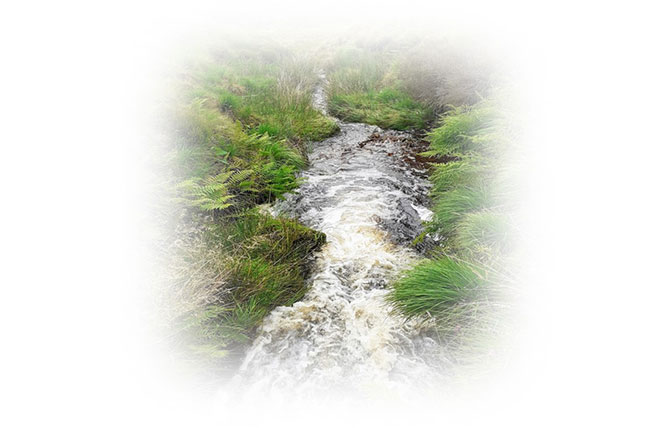
A young River Yarrow, Anglezarke Moor 2020
In the 16th century, this area was known as 'Helmshawside', and there existed here a small hamlet, all trace of which has now been erased. The valley is quite sheltered, a cosy fold, safe from the wilder heights of the moor, and one can easily imagine the thatched roofs and the little curls of smoke from the cottages - perhaps even a warm light in the window to guide the weary traveller home.
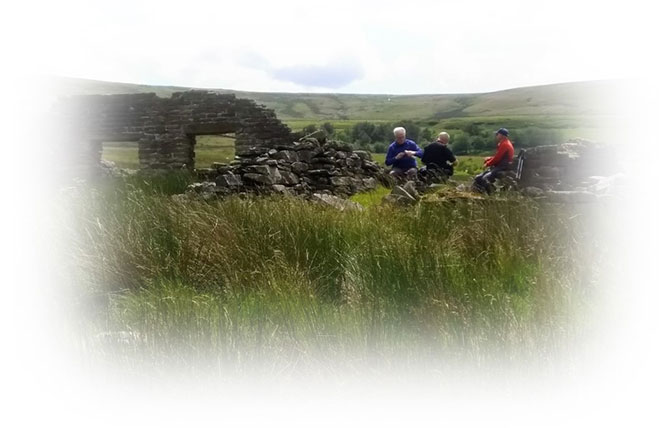
Higher Hempshaw's Farm ruin, Anglezarke Moor 2019
In more recent history, the tradition of farming in this upland area was continued in the main by five holdings: Higher and Lower Hempshaw's, Simm's, Stoop and Old Rachel's. These farmsteads survived until the early part of the 20th century, but thereafter were left to ruin and it is these sad, insignificant remains we now see dotted about as we gaze west from Sheephouse Lane. Whatever remained standing in those dark days of the early 1940s was subsequently used for target practice by army tanks destined for the battlefields of occupies Europe. Mortar practice was also carried out here, along with the enactment of other military exercises, Anglezarke being retained under the Defence of the Realm Act until 1946.
Before they were opened again in peacetime, the moors were swept for unexploded ordnance, though to what extent such clearances were successful is open to debate. It is interesting to note that documents issued at the time specifically avoided giving 100% assurance. This made sense of my father's advice to me, when growing up in the 1960s and early 1970s, to always to tread carefully in this area, and not to touch anything that looked suspicious. I was never sure if he wasn't being a little over-cautious, as parents sometimes are, but then in the early 1980's, an army truck appeared on Sheephouse Lane and I spied soldiers roaming the moor with long stakes. Having the proprietorial air of a keen rambler in those days, I went up for a 'nosy' when the soldiers had knocked off to see if I could work out what they'd been up to. I duly arrived at the ruins of Hempshaw's Farm to find sack loads of small mortar shells that had evidently been recovered. Needless to say, I didn't linger.

UXB signs, Sheephouse Lane (Horwich Journal 1946)
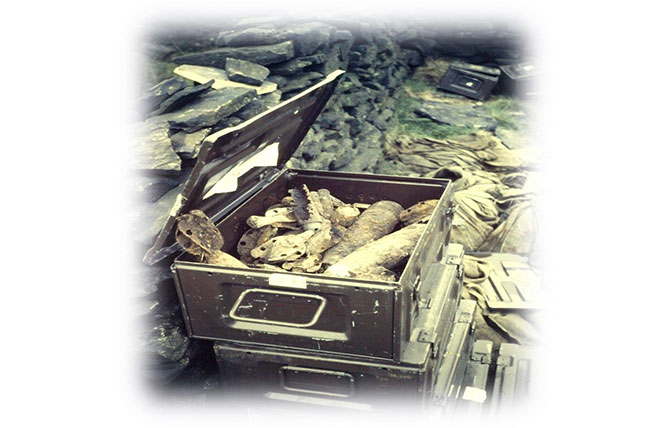
Ordnance recovered by the military, stacked at Higher Hempshaw's 1885 (Photo Garry Rhodes)
At the time I assumed the clearance of this remaining ordnance was in order to safeguard hill walkers like me from meeting with unfortunate accidents now the moors were being opened up more and more for access - better late than never, I thought. But I suspect recent times have proved me wrong, and if you gaze out across this area now you will see that since the 1980s the land has been progressively planted with conifers. Perhaps it was not just the wellbeing of us hill-walkers that was the cause for concern, but also the mechanical diggers that came to lay out the new plantation!
While the elements must have demanded a robust constitution of anyone who spent the winter months here in these isolated farms, one can imagine that life had its rewards in the height of summer, when the long day's work was done and the men folk finally turned for home,.. the russet of the moor ablaze with the setting sun and the air filled with the calls of curlew and lapwing.
It's hard not to sit by any part of these ruins now on a summer's eve without the imagination conjuring up all sorts of stories, and speculating upon the lives and loves that must have been played out among these remote farmsteads, far above the noise and the smoke of the buy cotton towns on the plain below. Of course its impossible to say for sure what life was really like and our views are inevitably distorted by our contemporary expectations of colour T.V. and central heating. We cannot help but wax either exceedingly lyrical or conjure up images of unimaginable hardship. We have perhaps lost sight of the simple reality of the times and the fact that people were once much more self-reliant than we are now, and that to be snowed in the depths of winter, even for a couple of weeks, was not the same cause for panic that it would be nowadays.

Old Rachel's when occupied in the early 20th century
In his book 'About Rivington', the late John Rawlinson, former president of the Chorley and District Archaeology Society, captured perhaps one of the last parting vignettes of the lives of these hill-farmers. He described how, in the 1890s, one of them built his own bowling green behind Old Rachel's and then how one young lad, upon being sent to the Cooperative store in Belmont for supplies in the winter months, asked his father if it was alright if he took the horse - his father replied that it was too rough for the horse, so he must take his sister instead! The names of these farms have lingered long. Most are still marked clearly upon even the most modern edition of the maps of the Ordnance Survey, and it is perhaps to this institution we owe our thanks that these places remain waymarks as familiar to travellers across the moors now as they ever were in the 19th century. Though first hand testimony of the lives of the people who farmed here is now sadly lost to us, their traces remain, in imagination at least, an everlasting part of our heritage.
First published in the Horwich Heritage Magazine Spring 2005
WINTER HILL & ANGLEZARKE (Our much loved Hills and Moors) By Derek Cartwright
"For what seems like most of our lives, we've wandered all over Winter Hill and Anglezarke in all seasons and in all weathers. There are many others like us. This bleak and lonely area somehow draws us back there time and time again. For those who cannot understand our love and affection for the place, Winter Hill and the surrounding moors must seem an appalling sort of environment except on the nicest of summer days!" Dave Lane 2019
During July 2019 Horwich Heritage presented a very popular exhibition entitled 'On Our Doorstep: The West Pennine Moors' covering as much as practically possible about this area from pre-historic times to the recent past, including last summer's catastrophic fire. We were joined by ex-Countryside Rangers Garry Rhodes and Dave Lane plus a team from the Smithills Woodland Trust who provided an excellent display on our local moorland wildlife. This article gives a brief summary of a number of aspects of the Moors' history but there is much more that can be written (and remains to be discovered). Some of the subjects that I haven't been able to cover here e.g. WWII military activities and the numerous air crashes are dealt with in our recent book 'Horwich in WWII (1939-45)' so please make sure you have a copy.
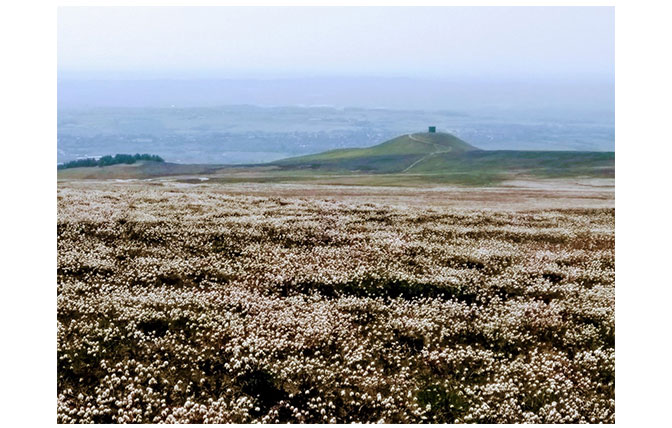
Rivington Pike & its moorland - an image embedded in our subconscious mind
Many factors layered together have produced the hills and moorland so familiar to us. Any minor changes millions of year ago would have led to a significantly different environment in our locality today and one which may not have produced somewhere that, as Dave Lane says, "pulls us back there time and time again". Around 300 million years ago, the land that we see as the hills above Horwich would have been positioned nearer the Equator and would have been at or near sea level. This time is known as the Carboniferous Period (354 - 290 million years ago). Much of our local mineral resources (coal etc) would have been developed over this period. A much warmer and more humid environment covered in forests would have existed. Tectonic plate movement across the planet would then have gradually positioned and shaped the land to form what we are so familiar today. The evidence of this period and its sea level position can be seen across the moors in the form of fossils in stream beds, shale banks and in paving stones, walls and cairns as a result of human activity.
Faults in the tectonic plates enabled geological pressures to create the precious metals and minerals which encouraged mining by countless generations over many centuries all around Horwich. The evidence of this is very much there if we know where to look, from spoil heaps to sealed tunnels, from filled bell pits to tracks and tramways. The same faults that created the twists and turns in the bed rock enabled the rain water to descend from the moors and run rapidly into and through our town. This was put to good use by our industrious ancestors who, as we well know, created a bleaching industry which played a major part in developing our town. The hills as we see them were further moulded and added to by the glaciers. The last Ice Age ended around 10000-12000 BC with the first post ice age humans inhabiting the British Isles c.8000 BC and the land mass becoming an island around 5000-6000 BC. The glaciers ground the hills smooth and deposited large amounts of materials once they started to retreat northwards. The evidence of this is everywhere, from run-off channels for the melting ice to stones deposited many miles from their original source e.g. limestone - which doesn't exist naturally in our locality but can be found in areas like 'Limestone Brook' in Anglezarke, which contains large deposits from the Yorkshire Dales.
All this has put together largely what we see today. But it has been overlain with a rich diversity of wildlife and thousands of years of human activity from pre-historic farmers right through to the dramatic changes of the 19th and 20th centuries dominated by the creation of the vast complex of Liverpool Corporation Reservoirs and the benevolence and personal endeavours of Lord Leverhulme (Lever park and the Bungalow & Terraced Gardens). Our moors are part of the 90 square miles of the West Pennine Moors and contain a unique range of interesting and historic features. Lead mining in the Lead Mines Clough area occurred sporadically between 1692 and 1837 with the main activity taking place between 1721 and 1789. The target material was lead (known as 'Galena') extracted from lead ore by crushing and smelting. 'Witherite', used in ceramic production, was found at Anglezarke and, once Josiah Wedgewood had discovered its special qualities in the production of his 'Jasper Ware', mining activity resumed at Anglezarke at a pace. As far away as Germany, porcelain manufacturers became aware of the properties of 'Witherite' and started to import it from the Lead Mines Clough area.
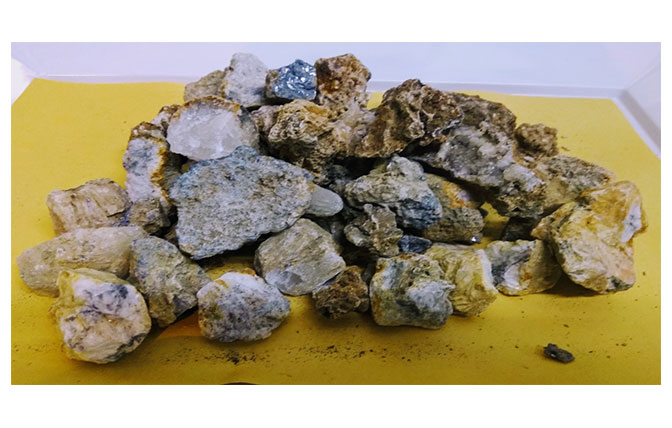
Examples of minerals laid down 300 million years ago and mined in Lead Mines Clough between 1692-1837: Galena, Witherite, Calcite, & Quartz - all recovered from spoil heaps, Summer 2019.
All the mineral extraction industries that sprang up on the moors required large and regular amounts of water, with engineers devising many ingenious methods to ensure they maintain a consistent supply. This often led to conflict between mine and quarry owners, bleachers and wood cutters.
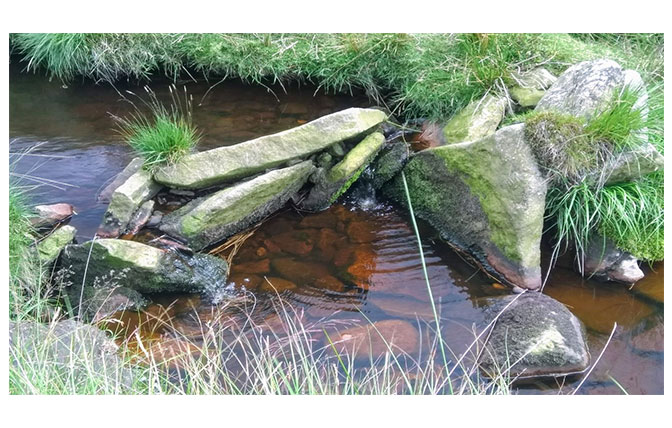
An early water control system close to Lead Mines Clough created a series of small lagoons in the stream to maintain water supplies in time of drought and control the flow in time of flood.<
The human presence on our local moorland can be traced back to 3000 BC, around the same time as the construction of the great Egyptian pyramids.
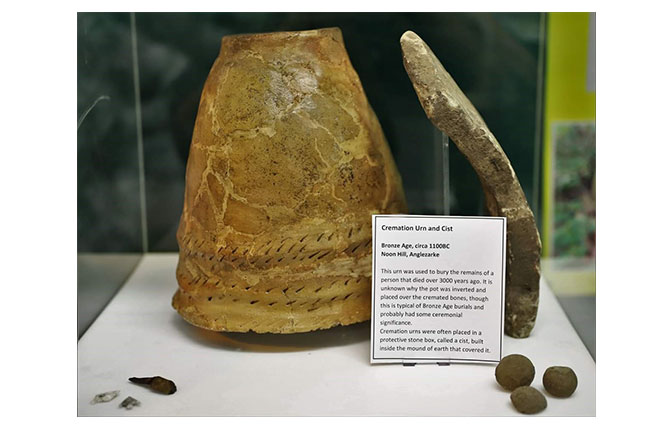
Noon Hill Urn c.1100BC displayed at the Horwich Heritage Centre Exhibition July 2019
However, evidence sometimes emerges of more recent activities of local workers on the moors in the last 250 years or so.
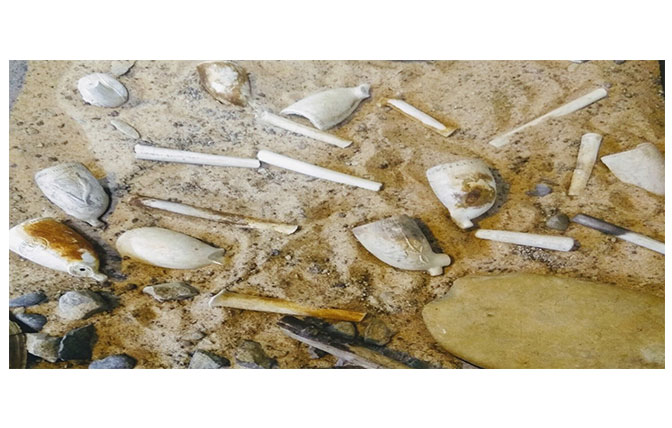
Clay pipes found on the eastern bank of the Yarrow Reservoir at low water during 1985. Thought to be dropped by men building the reservoir in the 1850s-60s. Note the harp and other markings suggesting Irish origin.
Following the July 2019 exhibition, Garry Rhodes, Dave Lane and myself joined forces to put together the 3rd edition of Dave's previous work 'The Winter Hill Scrap Book' (with the addition of Anglezarke). The book is now available for £13.99 from the Horwich Heritage Centre. It runs to 437 pages and contains all the information mentioned above and much, much more. All the royalties and profits are being donated to Horwich Heritage so please make sure you have a copy with you next time you are wandering over our much loved and sometimes 'bleak and lonely' hills. Don't forget to have a second look at that straight edge in the moors or that series of mounds or that change in the vegetation... the past is there for us all to see and enjoy. I hope to see you up there soon!
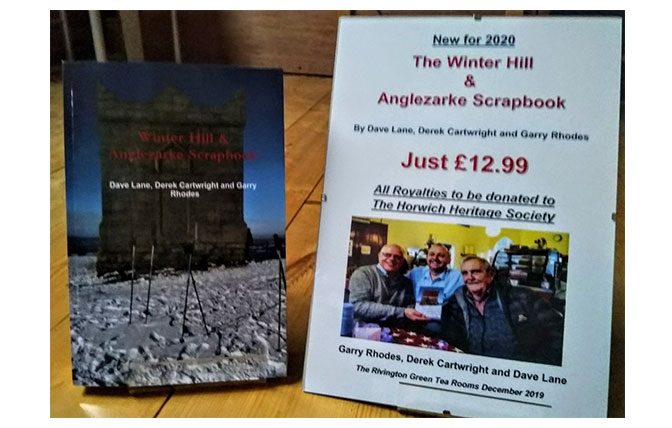 The book now published contains all the articles above and much, much more. A chunky book at 437 pages with all the royalties and profits being donated to The Horwich Heritage Society. Well worth it in preparation to your wanderings over our much loved and sometimes 'bleak and lonely' Hills and Moorland. Next time you are out walking have a second look at that straight edge in the moors, or that series of mounds or that change in the vegetation... the past is all there for us to see, enjoy and I hope to see you up there soon.
BOB'S BROW By Derek Cartwright
Generations of Horwich children have spent their summer days down Bob's Brow (Bobbs'y). Playing in the waterfall, making dams in the streams, fishing, making rope swings in the tree's, playing football, cricket, flying kite's, camping out, having picnics, playing tennis, getting up to no good..! it's part of our towns fabric and colours the memories of many who grew up in Horwich. So let's have a closer look at this small yet diverse area of land and water that straddles three districts and hides many secrets and clues to the past.
History & Boundaries
The area we call Bob's Brow lies on the western border of Horwich. It is broadly a triangular patch of fields, paths, plantations, woods and waterways (including a lodge and, the famous waterfall) bounded by Crown Lane, Scholes Bank and the River Douglas/Squirrel Lane The name is intriguing, so why is it called Bob's Brow (or Brew)? The site of the Garden of Remembrance used to be occupied by Scholes Bank Farm, which, until the early C20th was farmed by Mr Bob Swithemby (who is remembered by nearby Swithemby Street). Apparently Bob kept his cattle on the fields off Scholes Bank and had quite a task driving them back up the 'brow' (hill) to the farm - hence the name 'Bob's Brow'.
Scholes Bank itself has an interesting past. In 1850, it was known as 'School Bank' and, according to Jack Rawlinson, takes its name from the house of Mr George Rudall, former Head Master of Rivington Grammar School. After his retirement in 1625, he tutored children for a fee at his residence near the Squirrel. Around that time, a small community is said to have existed at Smithy Bridge (Yates 1786) in the dip near Heavily Grove, where the road crosses the River Douglas. A little further to the west, there was a crossing of the Middle Brook at Anderton Ford, this stream having flowed through the valley now covered by the Lower Rivington Reservoir. At the turning into Squirrel Lane, there is a house which was once a 'bobbin' mill and, further along, the Squirrel Pub, so named because it marked the boundary of the ancient Royal Hunting Forest (Jack Rawlinson 1969), has recently been replaced with some large detached houses. Squirrel Lane, technically in Anderton, runs to Anderton Hall Farm and beyond towards Blackrod, crossing the River Douglas in the valley near the Bolton/Preston railway line. This lane is an ancient thoroughfare with possible Romans origins as part of the route between the Blackrod outpost of Coccium (Wigan), the 'Street' in Rivington and onwards to Blackburn.
Waterways
The water features seen in Bob's Brow today are man-made and have been there for more than 200 years. Before that, it was the rivers that often formed the original village/district boundaries in valleys or the ridges of hills on high ground. In this area, the Middle Brook separated Anderton and Rivington and the Douglas separated Rivington and Horwich before joining the Middle Brook, at which point it separated Anderton and Horwich. The original courses of the Middle Brook and Douglas are indicated by the black broken line on the map below. They converge near Monks Farm, and from then on retain the name of the River Douglas ( David Owen). In terms of boundaries, Horwich is to the right of the Douglas, Anderton is to the left and the triangular area between the Middle Brook and Douglas is Rivington.
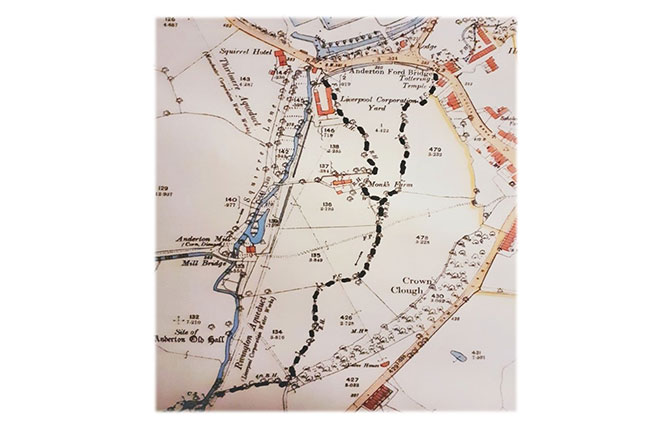
Map of Bob's Brow Area (1892) showing how the 2 rivers originally converged
The waterways in Bobs Brow have been significantly altered at least twice in the last few hundred years. Anderton Mill (see map) was a water-powered mill built in the C17th and, to meet its demand for a large and constant supply of water, both the Middle Brook and the Douglas were diverted. The Douglas was placed in a channel under Scholes Bank until it met the Middle Brook and the merged river (Douglas) then ran southwards parallel with Squirrel Lane. An earth mound was created to control the river which was widened and walled to provide a strong enough 'head' of water to drive the water wheel. This resulted in the feature we know today as the 'Waterfall'.
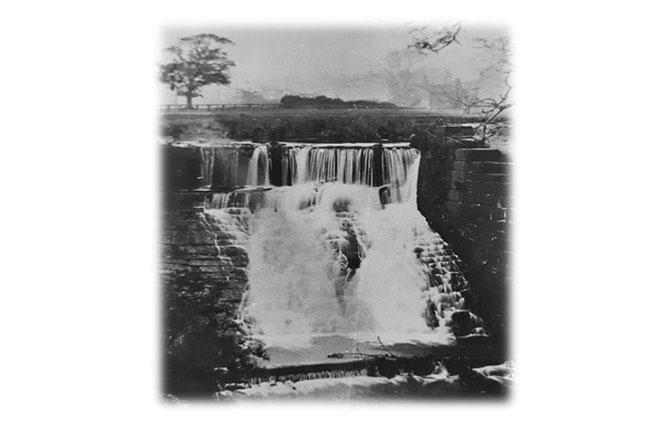
The waterfall, Bob's Brow, with Monks Farm visible behind c.1928

The Anderton Bridge, one of the oldest in the district
Anderton Mill
As far as we know, the mill operated for around 100 years. Some sources suggest the mill was used for the grinding of corn, others discount this. More evidence exists, however, about the time it operated as a 'logging' mill, grinding logs into wood pulp. This was then sent to the 'Star' Bleachworks (later Jolley & Jacksons), and other local bleachers for use in the bleaching of cloth. The last time the mill was recorded as operating, following many years of inactivity, was in the 1890's, when large quantities of mortar were needed to repair the banking of the Lower Rivington Reservoir. After this the mill gradually fell into ruin.

Anderton Mill c.1900
Reports in the late 1920s describe the roofless mill as it was falling into a ruin, with the remains of the water wheel still being present and said to be "several yards in diameter." Large shafts and other machinery were also still visible. The mill was finally demolished during 1928. During its time as a logging mill, two cottages existed (circa 1820) directly opposite on the other side of the present path. It is reported that they had well cultivated gardens and were occupied by the Sale family. No sign of these cottages exist today. In 1928 it was said that descendants of the Sale family still lived in Horwich.
Today, the River Douglas still flows through Horwich and out into the Douglas Valley. At the time of the earl textile industry it supplied the industries at Horwich Vale, mainly the Star Bleaching and Star Printing Works - but that is a story for another day. It filled 2 lodges, known locally as the first and second 'Stars', the first of which still exists within the housing development west of Crown Lane.
Rivington Reservoirs Era
By the time the Rivington and Anglezarke Reservoirs were built (1847-77), the Anderton Mill had fallen out of regular use. Diversions of the River Douglas up-stream and the flooding of the Middle Brook valley drastically reduced the amount of water entering the Bob's Brow area. This effectively ended the contribution the River Douglas could make to the industries it supplied downstream at Horwich Vale. A water compensation scheme was agreed with Liverpool Corporation to discharge 3 million gallons (13.5million litres) ) per day into the river which still operates today, and it is this water released from the Rivington Reservoir system that generations of Horwich children have played in since the 1860s.

Swimming in the water in Bob's Brow 1947- like many generations before and after
Despite the compensation scheme, the coming of the reservoirs had a major impact on the local industry and population. The water was of such poor quality that in October 1860 the Star Printing Works went out of business with hundreds losing their jobs. The premises remained unoccupied until 1862 when Leonard Cooke took over the site to commence his paper making operation, with Mr T. Y. Nuttall joining the firm later - a business that continued until the 1990s.
There are many other aspects of the Bob's Brow area that haven't been covered in this article but will will feature in future including Anderton Old Hall and Bridge, Anderton Hall Farm, Monks Farm, the Bobbin Mill, Tottering Temple and the Aqueducts. And not forgetting the many sporting activities comprising a race course, tennis courts, football pitches, cricket pitches, fishing and, of course, generations of children at play.
Final word: Is it Bob's Brow or Bob's Brew?
Thanks to the historical research by David Owen and Jack Rawlinson and the help of Ivan & Christine Snape, Barry Jubb and Andy Ryding
DE HAVILLAND PROPELLERS, LOSTOCK By Kenneth Fields
In a recent article, the connection between Horwich and the aviation world was highlighted with the story of A.V. Roe, who learned his engineering skills on Horwich Loco Works. But of course another important local link with the world of flight is the former De Havilland Propeller factory, which still remains on our doorstep. It was built 68-years ago (1937), when it provided a much-needed boost to local employment in a period of depression.
The founder of the company, Geoffrey de Havilland, was born in 1882. Like A.V. Roe, his family had no connection with engineering, his father Charles de Havilland being the curate of Hazelmere, near High Wycombe. The family moved to a parish in Nuneaton where Geoffrey spent his formative years, before moving to Crux Easton, Hampshire. It was expected that he would follow his father by becoming a clergyman, but it was his great interest in engineering that took him along another path. In 1900, he began to study mechanical engineering in London, following an engineering apprenticeship in Rugby. At this time he and his brother, Ivan, built their own motor car and a motor cycle. Then in 1905 he became a draughtsman at the Wolseley motor car company in Birmingham, followed by a period designing buses in London.
But, in the spirit of the age, and spearheaded by the achievements of the Wright Brothers, he was then drawn into the world of aviation. After borrowing £1000 from his grandfather he began to design his own aircraft. Assisted by his girlfriend, Louie Thomas, who was soon to become his wife, he constructed his first flying machine in 1909. This crashed after a short flight, but learning from his mistakes his second attempt in 1910 proved very successful. It was bought by the Army's balloon factory at Farnborough, where he then took up a position as an aircraft designer. Here he prospered from royalties paid for his aircraft designs that were used during the First World War. This gave him the necessary finance to set up the De Havilland Aircraft Company in 1920, which was based at Stag Lane, Edgware. Here he first concentrated on the civil market, selling to private owners and test-flying all his new aircraft. Having an interest in insects, his highly successful series of biplanes were named after moths, the Puss Moth, Gypsy Moth and Tiger Moth, becoming recognised in the aviation world.
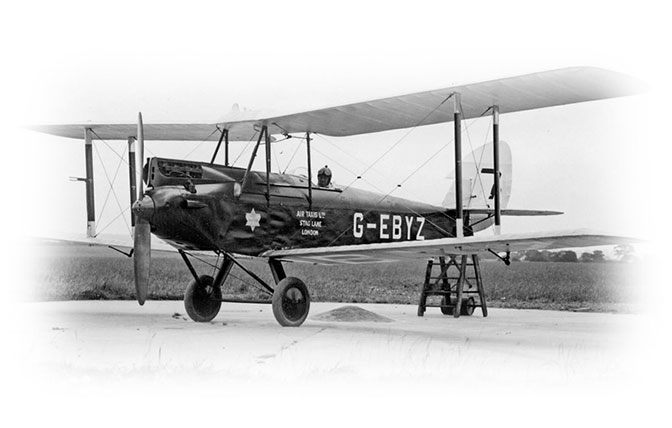
De Havilland Gipsy Moth
By 1930, the Stag Lane site had become too small so, although engine manufacture was to remain there, aircraft production was moved to a large new factory at Hatfield in Hertfordshire. And at this time the success of the DH Comet racer led to widespread interest in its variable-pitch propeller. This resulted in the setting up of the De Havilland Propeller Company, which was to manufacture and assemble these precision propellers under licence from the American Hamilton Company. Due to the worsening world situation at this time, it was also decided to move key industries away from the vulnerable south, so a new site for propeller manufacture was sought in the North of England.
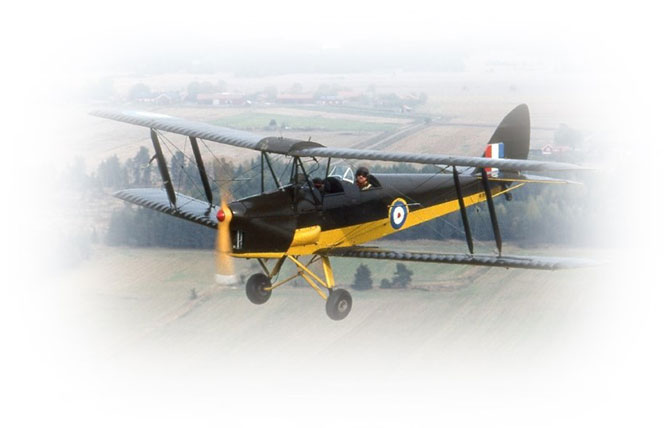
De Havilland Tiger Moth
Aviator Alan Cobham, who had become famous for his long distance flying, was also employed by Geoffrey De Havilland. Earlier, his 'flying circus' had used a flat field at Lostock as an airstrip, and it is believed this led to it being selected as the site for the new De Havilland factory.

Sir Alan Cobham's pre-war air display Lostock
With the threat of war, the factory was rapidly built to the very latest standards, being opened in 1937. Its Art Deco executive offices overlooked green lawns, while it boasted the largest machine shop under one roof in Europe. Based on a flow-line system, raw material arrived at its east side, passed through the machine shop with the finished parts then arriving at the west side for assembly. The precision nature of the propeller manufacture required a new highly-skilled workforce and many of the personnel employed at this time had been trained at the Horwich Loco Works.

Machine Shop, Lostock
Such was the urgency that, only 6 months after the building of the new factory began, the first propeller was produced. When war eventually came in 1939, the factory was working 24 hours a day, 7-days a week. By 1945, over 200,000 propellers had been manufactured, which were used on 40 different types of aircraft. High security prevailed,with the factory surrounded by a high fence and guarded by soldiers. Fortunately it avoided German bombs, but the Luftwaffe did photograph it. The most important aircraft produced by De Havilland during the war was the Mosquito. But tragedy struck in 1944 when Geoffrey's son, John de Havilland, was killed while testing the aircraft. This was followed in 1946 by the death of his second son, Geoffrey Jr., who died while flying the DH 108.
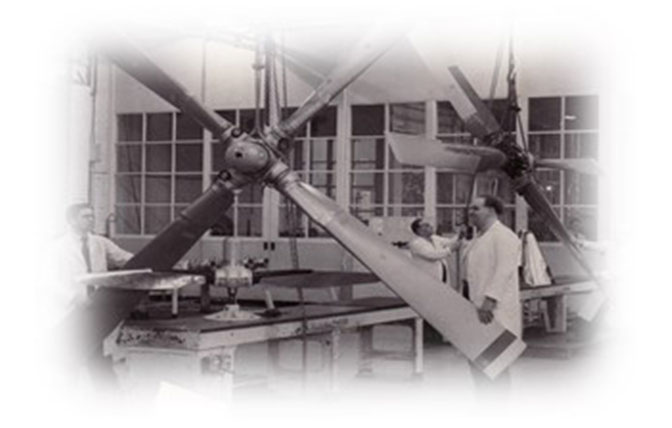
Propeller Work, Lostock
Geoffrey de Havilland always believed that his company should provide both social and educational facilities for its workforce, and this was reflected at Lostock. Football, cricket, hockey, rounders and many other sports teams were formed, together with a large social club. And the annual 'Family Day' became an event enjoyed by many Horwichites. In 1928, the De Havilland Aeronautical Technical School had been created and a branch of this was also formed at Lostock to provide training for apprentices. This was quickly acknowledged for providing the highest standard of engineering education. Many local trainees who reached degree standard spent periods in De Havilland technical offices in Southern England. This forged a lasting link between the Lostock, Hatfield, Stevenage and London sites.
The rapid advances in aircraft design always made high demands on the Lostock factory, which needed to keep at the forefront of new technology. After the war, it began to diversify from being solely a propeller manufacturer to producing other precision aircraft products. These included air conditioning units and undercarriages for the world's first jet liner, the Comet. However, the most far-reaching development came in the early 1950s when guided-weapon manufacture was introduced, the Lostock factory producing Britain's first air-to air missile, Firestreak. The company was also involved in the manufacture of the huge Blue Streak ballistic missile, but this was cancelled in 1960.

'Firestreak' guided air-to-air missile
In 1963 the government had decided that fewer but larger aircraft companies were needed. This led to the Lostock factory being absorbed into the Hawker Siddeley Group. Sir Geoffrey de Havilland, who had been knighted in 1944, then gave up control of the company. He later died in 1965 and his ashes were scattered on the site of his first flight in Hampshire. Missile manufacture, which involves a large amount of electronic work, began to dominate at the Lostock factory, which was then known, following the nationalisation of the aircraft industry, as Hawker Siddeley Dynamics. In 1981, it once more became a private company, retaining the same name, and by now it could boast a rich inventory of missiles that included Red Top, Martel, Sea Slug, Sea Dart and Sky Flash.
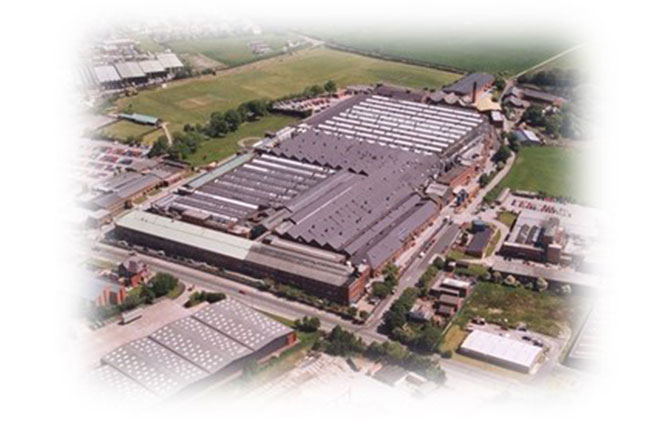
The Lostock site
But by 1990, with the end of the Cold War in sight, the British defence industry faced a downturn in orders. This led to the painful decision to cease manufacturing at the Lostock factory. In 1997, 60 years after it was built, the main site that included the huge machine shop was finally closed. The workforce had decreased from 3,000 to 450, and those who remained relocated to a nearby smaller site on Hall Lane. Here the company still continues to both assemble missiles and test missile systems. Following a merger between a number of British and French defence companies in 1997, there followed yet another name change to Marta British Aerospace Dynamics. And in 2001 a further European merger saw the name become MBDA. This large group now employs 10,000 highly skilled staff across France, Italy, Spain and the UK with about 500 of these based at the Lostock site.
After a gloomy decade of site closures and redundancies, the future for the Lostock factory now looks more promising. A need for expansion in 2003 resulted in Bolton West MP, Ruth Kelly, being invited to open a new factory at Mango Park in Westhoughton. And the two local sites are now responsibly for assembly of a variety of guided weapons. These include Sea Dart, Sea Wolf and Sea Skua for the Royal Navy, ASRAAM and ALARM for the Royal Airforce and Rapier for the British Army.
First published in the Horwich Heritage Magazine Spring 2005.
ST MARY'S R.C. CHURCH, HORWICH By Terry Foley
Prior to the coming of the L & Y Locomotive Works, Horwich was a village. It had a population of 3,761 people with only a handful of Roman Catholics and no Catholic church. But before the Reformation (1660) a 'Chapel of Ease' had existed under the jurisdiction of the Abbots of Whalley.
In Victorian times came the growth of Catholicism, the RC hierarchy was restored in England in 1850 and the diocese of Salford was then instituted. Also many Irish Catholics took the short sea route from Dublin to Liverpool, to seek a new beginning in industrial Lancashire. A number were to come to Rivington in 1847 to help construct the reservoirs. At this time, the Catholics of Horwich had to travel outside the village to attend Mass, some to Bolton, some to Westhoughton, but the majority walked to St Joseph's, Anderton (founded 1863). Sometimes the journey was done twice on Sundays. Mass was celebrated on occasions at Anderton Hall, where the Squire welcomed the people from Horwich. The children would attend school at St Joseph's, Anderton in the summer but the British school in Horwich during the winter months. Although Horwich was in the Salford Diocese and Anderton in the Liverpool Diocese, Father Webster of St Joseph's walked to Horwich every week to give religious instruction to the Catholics. This took place in the home of James Morris who lived near the Queen's Head pub on Lee Lane. The pub provided the seating for these occasions. The Morris family were to become stalwarts of the new parish to be formed here in the future. James Morris's grandson, Jack Rawlinson, would become well known as a local historian and author.
The situation was to change dramatically in 1884 with the purchase of 650 acres of the 'Horwich Estate' by the Lancashire & Yorkshire Railway Company. A new Locomotive Works would be built, covering some 20 acres, while surrounding it, new houses, streets and roads would be constructed. On 3rd January 1885, the staking out of land for the new works commenced. Mr Hugh Caunce of Dog Lane (Winter Hey Lane) had contracted with the L & Y to make the necessary trial holes, he was also instructed to use local labour where possible.
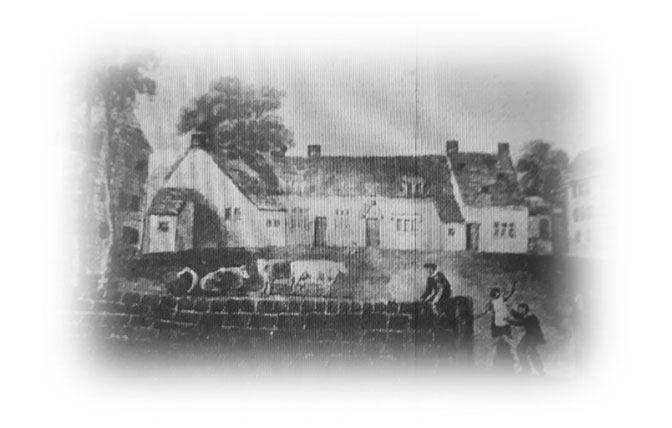
Gorton Fold, Horwich
In May of that year, the Roman Catholics of the town set up a mission in Gorton Fold, whose outbuildings had been converted into a chapel about 1807 by the United Methodists Free Church. The new mission was known as St. Benedict's, with fittings and furniture constructed by the male members of the new congregation. The first Mass in Horwich since the Reformation was held in May 1885. Catholics walked in procession from the Crown Hotel to Gorton Fold, and old Horwichites looked on in curiosity. It was said some stone throwing was in evidence. Horwich was no longer a 'stagnant pool' as had been voiced by locals some time previously. In 6 years it was estimated the population soared to 10,000. The official census in 1891 gave a figure of 12,850. With an increase of Roman Catholics in the area, the Gorton Fold premises proved too small. Land had been secured on Chorley New Road in March 1885, and a lease on 999 years, at a rate of £17 per annum had been obtained from Mrs Julia Catherine Wright, wife of Frederick D'Arley Wright of Mottram Hall, Cheshire. These names would be perpetuated in streets near to the land purchased. A new building 'Our Lady of the Rosary', comprising a church/school and accommodation for a priest was constructed using a loan of £1,500 from Salford Diocese to cover the cost. The priest appointed in charge was Father Hampson from Westhoughton. The church opened on 11th July 1886, and a school on 19th July 1886, accommodating 48 children.

Part of the first Church/School
In September 1889, the Bishop of Salford, Dr Vaughan, laid the foundation stone for a new infant school next to the church/school. After this ceremony the Bishop was a guest at the home of Mr Aspinall, the Chief Mechanical Engineer of the new Locomotive Works. The Aspinall family were devout Catholics who regularly attended Sunday Mass at St Edmund's, Bolton. His wife, later to become Lady Aspinall, donated money for Masses to be held in remembrance of the family, when they left the district in 1899.
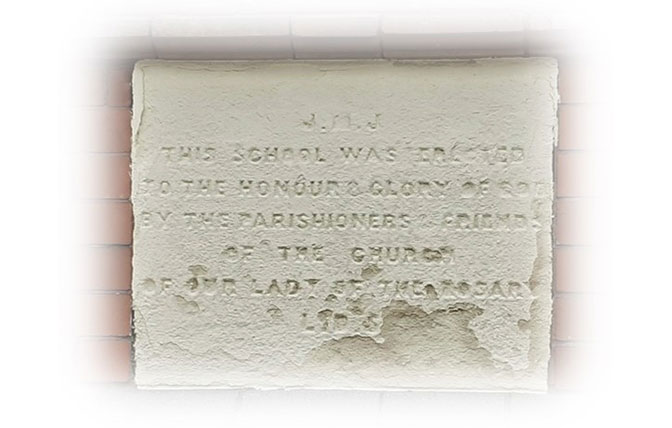
The foundation stone laid in 1899
It was Bishop Vaughan who approached the L & Y Railway company regarding the purchase of surplus land in Horwich, and acquired land at Brazley, off Sefton Lane, which became known as 'Bishop's Field' Trustland. This would later accommodate St Joseph's School and St Anthony's Chapel of Ease.
In 1887 Horwich, which had become a thriving town, was subject to a census of children. This showed a total of 1,060 children between the ages of 5 and 14 years, 870 attended school full-time, and 88 were part-timers. A number of 13 year old children were employed in the township.
Many religious groups moved into the new town. The 'Horwich Gospel Unionist Missionaries' were fined for continually obstructing the streets, but they only stayed in Horwich a few months. The 'Mission for Navvies', 'The Irish Mission', 'The Mission for Railway Labourers' were also short-lived.
In March 1888, the Wesleyan Methodist Chapel was built on the corner of the new Victoria Road. The Primitive Methodist Day School opened at Bottom'oth Moor in February 1889. That same year a new church Sunday school and day school for lower Horwich was nearing completion and the old National Schools were improved and extended. The United Free Methodists had secured land on the railway estate for new schools. Also the Wesleyans had plans for new schools. The Salvation Army had set up a Barracks in Captain Street and the 'Primitive' and 'Independent' Methodist were active as were the 'Unitarians' and 'Presbyterians', all of whom were endeavouring to get a foothold in the town.
During this rapid growth all was not 'wine and roses'. Unemployment reared its ugly head each winter as foundation digging and building of the Loco works, shops and houses had to be suspended until better weather prevailed. During these periods the clergy of Horwich joined together to provide food and provisions for the unfortunate. On Christmas Day 1890, over 300 people with children were given Christmas dinner at the railway canteen in Gooch Street. All the clergy served the food and gave each child fruit and nuts.
The Parish of Our Lady of the Rosary flourished as more Irish Catholics came to the area: the Kellys from Roscommon, Conways from Castlebar, Hesters and Sewards from Dublin, Leachs from Belfast, and many more who's names are still in evidence.
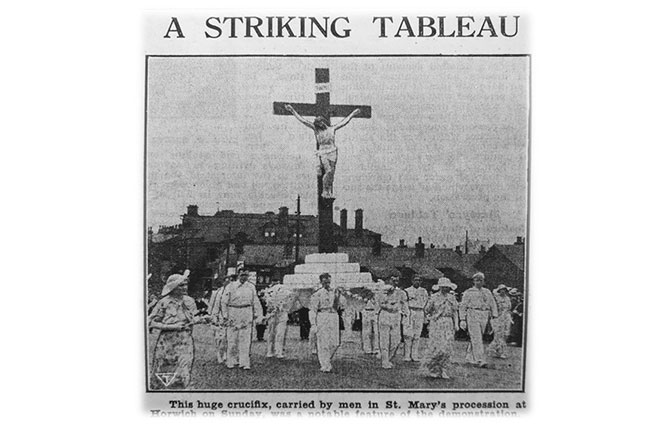
The flourishing church in procession
In 1905, the priest, Father McGrath, decided the Parish needed a larger church, and in August the foundation stone was laid for the building next to the infant school, on Chorley New Road. The new church, named St Mary's was built of Yorkshire stone and included a large presbytery. It cost £5,000 and had a seating capacity for 650 worshippers. On 6th May 1906 the first service was held with choral music and choirs. In August 1907, a new organ, built by Mr Williams of Horwich was used for the first time. Later that year the 'Stations of the Cross' made and installed by a Belgium company were blessed.

St Mary's Church 2021
The Parish prospered with priests participating in local social and educational affairs. In April 1912, seven nuns from St Joseph's Convent set up residence in Crown Lane and taught at the 2 Catholic schools and stayed until the early 1920's. At this same time, Father Vanerhaughe, the first curate of St Mary's, returned to Belgium with refugees who fled during the 'Great War', with them were 2 sisters from an Antwerp Convent, a male teacher and a young priest. Many Dutch families came to Horwich to work cutting peat on the Red Moss. They soon integrated locally and many of their descendants are parishioners of St Mary's.
In March 1963, a new social club was built behind the church and became a great asset for many groups within the Parish. At this time people living in the Brazley area celebrated Sunday Mass in St Joseph's RC School, giving rise to the idea of building a Chapel of Ease. Named St Anthony's,it was opened on 25th August 1972, at a cost of £52,000.
Today the parish is highly successful and the parishioners of those early days would be proud of their churches and schools.
Published in the Horwich Heritage Magazine Spring 2005.
TRAMLINES By Bill Jones
As the population of Bolton and Horwich Increased there was a need for some kind of cheap transport to enable people to get about more easily; to and from their workplace and so on. The need was first met by horse-drawn trams centred in Bolton.
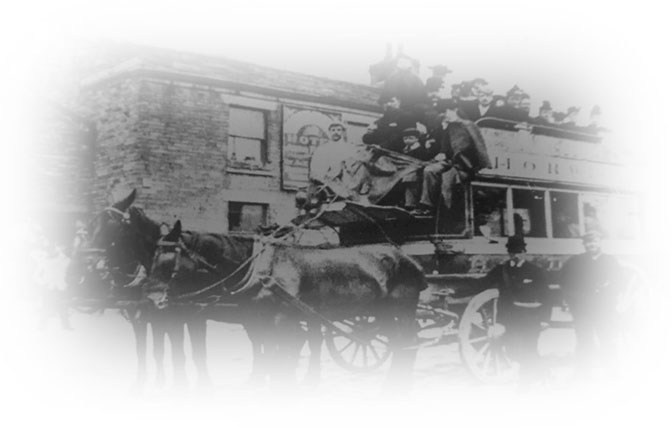
Horse Drawn Tran outside the Toll Bar, Horwich
The horse-drawn tram did not reach Horwich until the building of the Loco Works. In 1900 Bolton Corporation introduced electric tramcars using overhead wire systems for power distribution and the horse trams then began to be phased out.
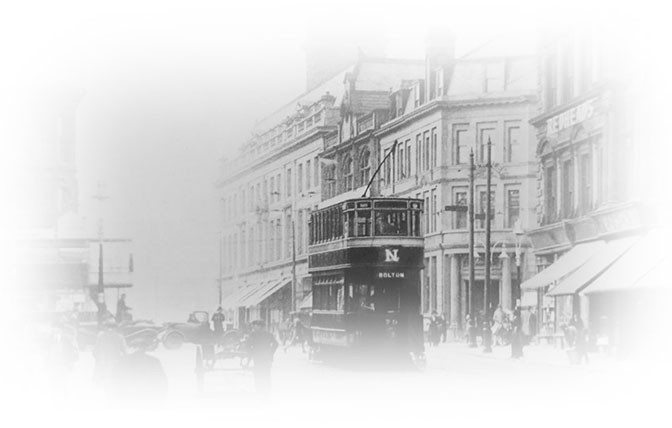
A Horwich Tram in Bolton 1929
The Chorley Old Road tram lines reached as far as Montserrat but did not extend any further due to the steep incline leading up to the Blundell Arms. Being almost level, Chorley New Road enabled twin tracks to be laid to the Crown Hotel late in 1900. A single line extension curved around the Crown into Lee Lane and continued along Church Street as far as Victoria Road. It turned into Victoria Road and re-joined the Chorley New Road lines. The extension didn't last for long being abandoned in about 1910. Each Bolton tram route was designated by a letter, and the Horwich one was the letter 'N'. Some trams only ran as far as the Beehive from Bolton, and others as far as Gooch Street.
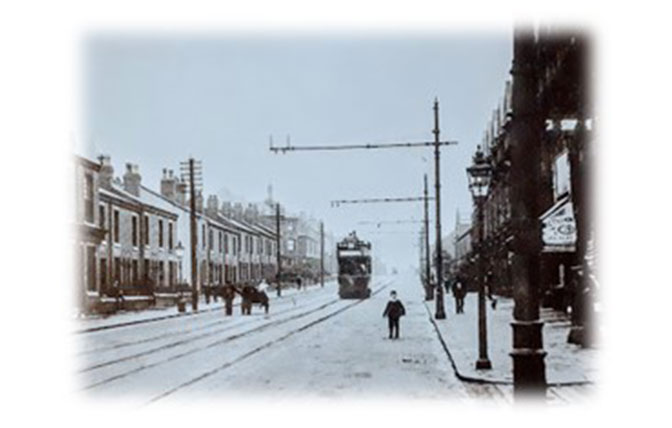
Chorley New Road Horwich early C20th
A tram depot for eight cars was built on Chorley New Road at the junction of Mottram Street with a passenger waiting room alongside. This building still remains but is now occupied by a tyre depot.
The Horwich Tram Shed
Motor buses started running in Bolton in 1923 and began replacing trams. For a while there were buses and trams both in operation, and eventually the Horwich tram route 'N' closed in 1946. So the old double-deckers no longer rattled and swayed along Chorley New Road, and the lines and overhead wires were removed. With no trams, traffic now had a clear road and cyclists no longer skidded on the tramlines in wet weather. Passengers could safely get on and off at the kerbside instead of the middle of the road.
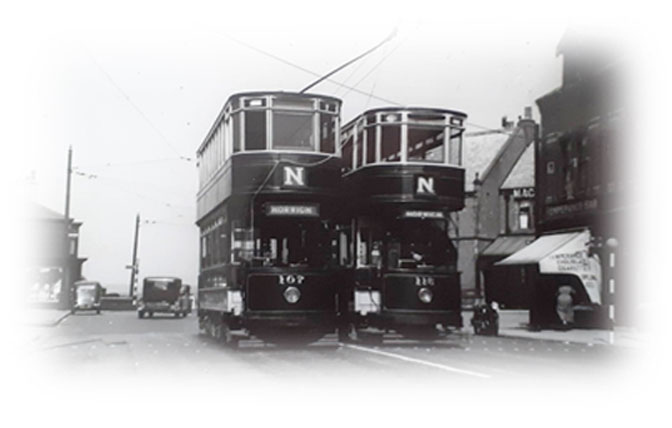
Trams passing near the Crown Hotel, Chorley New Road, Horwich
Trams still run in Blackpool as a tourist attraction, and amongst them is an old 1901 Bolton Tram which was restored by Bolton tram enthusiast a few years ago.

Model of a Horwich Tram made by Stanley Hughes (Horwich Heritage Centre)
First Published in the Horwich Heritage Magazine, Autumn 2005.
THE PRINCE'S SCHOOL OF DANCING By B. Butterworth
The Princes School of Dancing was part of the Princess Theatre Complex which was located in Lee Lane, Horwich. During the early fifties the dancing school was run by Mr Joe Turner F.M.A.T.D. and a committee of three others, all highly qualified to teach dancing, and like himself had letters behind their names. They taught ballroom dancing for all ages of medal test coaching, trained competition couples and students for the profession. The music for the dancing was provided by the use of gramophone records.
 There was also a Sunday club, where less serious dancing took place. It was extremely popular with teenagers from Horwich and surrounding districts including Bolton getting involved. It was widely known as 'The Fling' at Horwich. The club opened at 7 pm with the last waltz at 10 pm. Although ballroom dancing was the name of the game, the club allocated periods during the evenings for non-conventional dancing.
 At the start of the fifties the latest dance craze sweeping the dance halls in Britain was called 'Bee Bop'. This was to make a shift dance, two people together using their hands and feet to twist and turn in harmony with each other and improvising their movements to the rhythm of the music being played. Ragtime, a form of jazz music with much syncopation was the music the dance related to. The dance however could be performed to any type of rhythmical form of music and there were no hard and fast steps.
The 'Flings' popularity was at its peak in 1951 but like all these phases, changes take place for whatever reason and dropped off some 12-months later. The Fling being part of the Princes Theatre Complex had no long term future anyhow, the buildings were in a run down state and had come to the end of their useful life. The whole complex was demolished in 1962.
It was in the fifties that 'Musical Marie' used the Flings dance hall as the venue for her unsuccessful attempts for the world record for non-stop piano playing. Joe Turner also taught dancing at Walkden and did so for many years after the Fling had long gone.
First Published in the Horwich Heritage Magazine Spring 2002
HORWICH HOLIDAYS By Annie Smith
An article from the Horwich Journal of 1927 describes how an estimated 11,500-12,000 of the 16,000 inhabitants of Horwich would leave the town for at least a week and head to the seaside during Horwich Holidays. Generally taking place during the 3rd and 4th week in July, it was a time when the shops shut, factories fell silent and newspapers were sold at street corners - it was all change for a couple of glorious weeks. For generations, Horwich Station was the gateway to all sorts of holiday destinations up and down the country. The holiday makers would leave our heavily- industrialised, noisy town with poor air quality and spend time in the sun and sea air. It must have been quite an experience and possibly the only family trip out of Horwich for the whole year. The traditional Horwich Holidays still took place up until the early 1980s but by then the heyday of these 'Wakes Weeks' had gone. In this article, Annie Smith from the Horwich Reminiscence Group tells of her wonderful memories of Horwich Holidays.
We were getting ready for ages, mother knitting vests, Auntie Doris crocheting pretty dresses and me embroidering table and tray mats. The big occasion was a week's holiday in Blackpool. We were going to stay with Auntie May and Uncle Bill, their two children, my cousins Annie and Tom.
The week before it was shopping at Poole's for towels, nightdresses, liberty bodices, white cotton socks etc. Then over to Peacock Dyson for his special soap, shampoo and camphor blocks because, even in summer, Mother insisted I wear a camphor block around my neck just in case of colds.
The night before, the bath that was hung on the wall outside in the yard was brought in and I was bathed. My hair was washed and brushed until it shone, then put into rags for long ringlets down to my waist.
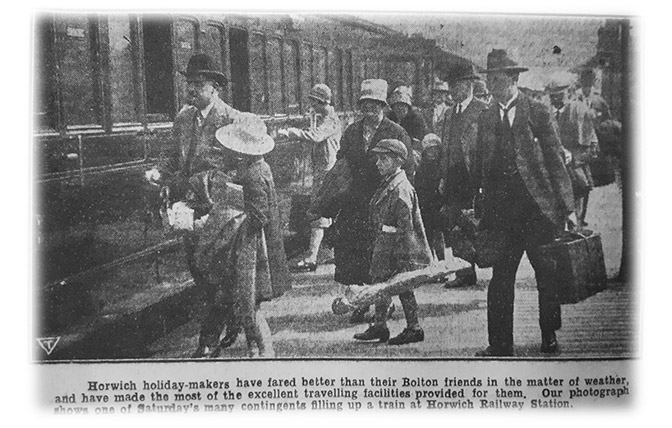
Holidaymakers at Horwich Station 1927
Next morning we were up at the crack of dawn, even though the train did not go until dinner time. There were still other trains to watch, those running to far distant places like Brighton or Bournemouth. How was it always wet and misty on Horwich Holiday Saturday, yet when we arrive in Blackpool the sun always shone so brightly? We walked from Central Station over to the promenade and caught a tram down to the Queens Hotel, South Shore, then down the side to Rydal Street, where my Aunt had a lovely stone built cottage. I could take you there right now if it is still standing.
When everything was unpacked, we had a meal finishing with lovely homemade, oven bottom barm-cakes, homemade jam and cakes. Then, with bucket and spade in hand, it was down to that little spot between the South Pier and the open air swimming pool, where I spent most of the week making sand castles and sand pies. That was my bit of heaven and I never wanted to go anywhere else, although we did go to Fleetwood Market, and Pablo's for a special treat (an ice-cream sundae) on the Friday after we had been to the zoo in the Tower.
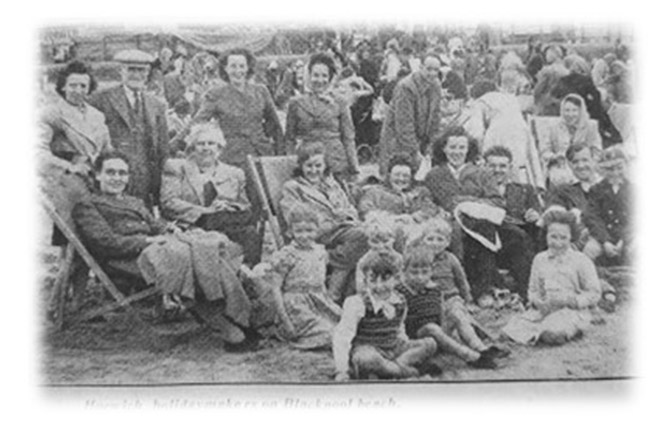
Horwich Holiday Makers at Blackpool 1947
One year a monkey nipped my beret off smartly when I was leaning too close to the bars. Then there were the little dancing girls and, seeing that beautiful little fair-haired girl being pulled up to the central light in a silver bell, always made me want to do it. After hearing Reginald Dixon playing the organ, I said I would practise my music lessons more regularly to be able to play the organ as well. But having lessons on the piano and then having to practice on the organ somehow didn't sound the same, so I gave up after a couple of years. However, I can still read music even if I can't play it so well. Uncle Bill was a part-time Fireman and was called out on duty when the ghost train set on fire in 1936. I remember that night well, because I was hoping the fire wouldn't burn down the birdcage man's roundabout. It was my favourite ride, because when I saw him every year he always seemed to recognise me. I always wore a red beret and blazer, he would say "Ah here's my little red robin again" so I was sure he knew me from the year before.

Horwich Holidaymakers in Blackpool 1937
Cousin Tom worked part time at a rock factory and was allowed to bring home pieces cut off. I was never without a piece of rock to suck, my favourite being humbug pieces. Aunt May could make lovely bread and cakes, but she couldn't make malt bread as sticky as the shop round the corner on Lytham Road. That was the only delicacy we bought that week and I had a slice every night when we went to bed. I never needed rocking with all that lovely sea air and sunshine and I came home as brown as a berry on the Saturday. Mum said she would never let me go to Blackpool again because when I woke up on the Sunday after we came home I always cried, realising that I wasn't in my beloved Blackpool and I wouldn't be able to go down to the sands for another 12 months.
First published in the Horwich Heritage Magazine Summer 1997.
MILL HEYDAYS By Anne L. Harvey (nee Williams)
The Beehive Mill, owned by John Ainscow and Sons Ltd, was based at Lostock close to the De Havilland Propeller Works. In 1954 when I was barely 15 years old, I started to work there. Nothing could have prepared me for the shock to the system of actually walking into the towel-weaving shed on that first day. The noise hit me physically, jarring my stomach, and I wondered how anyone could survive there.
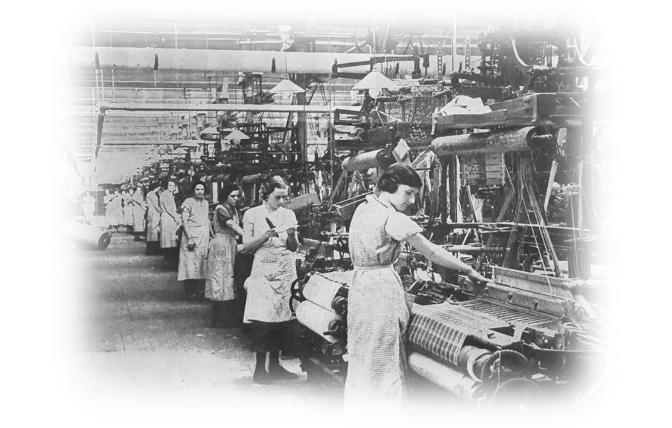
On that first day, there were 3 of us trainee towel weavers and we were taught how to stop and start the looms in order to fix a loose end or replace an empty shuttle, a clumsy and painstaking process to begin with. Instructions were shouted with our instructor's mouth right next to our ears since there was no chance of a normal conversation. Most people learned to lip-read quickly, a skill which still comes in handy sometimes. They were long days in the mill, commencing at 7.30 am, finishing at 5.30 pm with a break at 12 noon for dinner, meaning a full 45 hour week. While I was still under 16, I was one of the lucky ones who was allowed to work only 44 hours - leaving an hour earlier on a Friday. It seemed as if I was always tired. One morning in those first few months, I fell asleep sat on the edge of my bed after my mother had called me.
A typical day started with me usually running to catch the bus. Many of my fellow passengers on the overcrowded bus also worked at the Beehive and there was always a steady stream of people wending their was from the bus stop to the mill gates. In the gatekeeper's lodge, I'd punch my card and then walk through the overpowering stench of the bleaching and dyeing rooms. The adjoining warp shed smelt pleasantly of the stacked drums of spun cotton waiting to be lifted onto the looms. The weaving shed came next which, with its rigid glass roof, was either piercingly cold in the winter of uncomfortably hot in the summer. It was dangerous too, from the belts operated off central drive shafts which occasionally broke, snaking like a whip, to the wooden picking sticks which batted the shuttles containing the weft backwards and forwards through the strands of warp. The shuttles were 12 inches of steel-tipped wood that often flew out, causing considerable damage both to looms and to any weaver who happened to be in the way.
On reaching my silent looms, I'd take off my coat and bundle it up with my bag, placing both under a little pullout stool. On would go the looms, one by one, then the day proper would begin, threading shuttles, resting them against the wooden barrier that protected me from the spiked roller as the towels were being woven. I had to watch constantly for loose ends which, if they weren't 'drawn-in' with a reed-hook, could lead to more breaking and develop into a 'smash', where other strands became snarled up with loose ends and broke even more, thus spoiling the towel. We were paid in piecework and any ruined towel didn't count. When the roller was full, there was 'taking-off' to be done. The towels then had to be taken to the warehouse, weighed and noted against our earnings. In no time at all, it would be brew time. The brewing place was a huge cistern in the warp shed, the weavers standing patiently in-line, glad of a chance to chat, bearing their mugs and a brew, consisting of a teaspoon of tea and sugar in a twist of grease proof paper.
When the hooter went for dinnertime, one by one the looms would fall silent, followed by the stopping of the giant pulleys and drive shafts. The only sounds would be that of the chatting girls and women as we made our way to the canteen across the mill yard. There, to the sound of 'Workers playtime' coming over the loudspeakers, we'd eat our dinners. Dinnertime over, we'd make our way back to the weaving shed. When the hooter sounded again, there would be the rumble of pulleys, the swish of the belts as they started turning. This would be followed by the sound of a single loom clattering into operation and several catcalls of 'Grabber'.
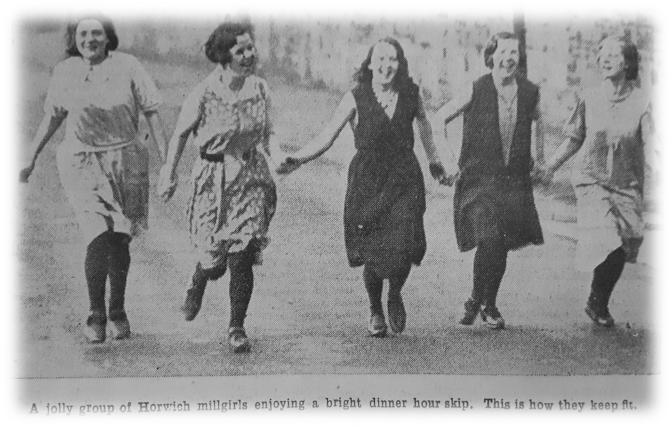
There was lots of fun and laughter, like the times when someone was getting married. The bride's looms would be decorated, often suggestively, by her workmates, many of the items being useful in the new home. After work, she would be walked home by her friends, balloons and 'L' plates attached to her coat and being forced to carry a luridly-decorated chamber pot. At Christmas, the looms would be decked with tinsel and balloons, usually with a sprig of mistletoe hung from one of the cross beams to catch any unwary tacklers or warp-carriers. There was a 'footing' too, with drinks and mince pies, everyone going home afterwards, slightly merry, and often singing.

Beehive Mill 1950
Although there was good money to be made at the mill, I never made a fortune because I did not apply myself diligently enough. The monotony of it all began to get to me and although my hands performed the tasks necessary to keep the looms running smoothly, my mind wasn't fully occupied. I came to the conclusion that I wasn't cut out to be a mill girl and eventually left to take up office work, something I did for the rest of my life, ending up as a Personnel Officer at a large University.
Although at the time, I thought I hated working in the mill. I'm glad to have been part of the last era of close involvement by the weaver. Within only a few years, full mechanisation and cheap imports had virtually destroyed the once giant cotton industry of Lancashire.
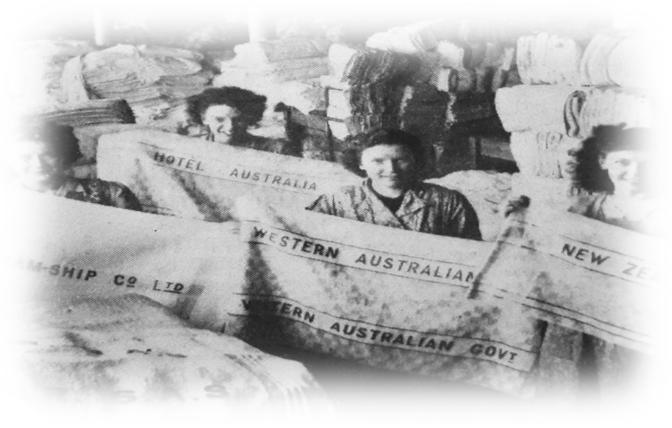
Thank you to all our mill workers
First Published in the Horwich Heritage Magazine Spring 2003.
HOW PARSON JOHNSON LAID THE GHOST By Tom Leech
First published in the Horwich Heritage magazine October 1987. From a story recounted by Thomas Hampson in his 'History of Horwich' 1887, which his Grandfather had told him. Parson Johnson was the Reverend Samuel Johnson M.A. who was the curate of Horwich Chapel (the Parish Church). He succeeded the Rev. John Norcross who died in 1788. Samuel died in 1826 aged 74 years.

Horwich Chapel (drawn by Jack Rawlinson)
Ghosts weren't hard to find in Parson Johnson's days,
And a ghost there was, so our historian says;
Just what kind of ghost is not at all made clear,
Or where it was, The Moorgate Inn? Or somewhere near?

The Moorgate Inn (now the Blundell Arms)
There were no lighted streets, just dark lanes lined with trees,
Waving, fearful things at night, sighing and moaning in the breeze,
And for the superstitious, the very place to chance upon a minion of the devil,
In some unholy dance.
Aye! A ghost there was, and all were sore afraid;
Afraid to venture out at night, but in their homes they stayed,
And the children silent sat, in the shelter of the ingle-nook,
And all the games and laughter of a normal winter's eve forsook.
All knew well, that only he with the title M.A. blessed,
Had the knowledge and the power, to lay a ghost to rest;
And was not their curate titled M.A.?
But he was then away from home, so they had to wait and pray.
How glad they were to tell their plight, upon his safe return,
How intently did he listen; he did not scoff or spurn,
But, at break o' day, (in daylight mind, not in the night)
On fleetest horse, went in chase of that eerie sprite.
Here and there, and everywhere, the gallant parson rode,
Through bog and mud, cross brook and bank his horse bestrode.
Then he chanced to meet a tardy traveller, owd Adam Hay,
Who quite forgetting the parson's quest bade him the time o' day.
Thou dunderhead! Thou stupid fool, the angry parson cried.
I've half a mind to whip thee like a dog, owd Adam could have died;
"Thou knowest well to speak to me was but to ruin my day,
All my work has come to naught", and he homeward made his way.

But once again, at morning's light, horse and parson renewed the quest,
and for all to see he chased with vim and zest,
Now madly riding up and down, now standing still to sniff the spirit out;
And everyone warned to keep well clear, including owd Adam, no doubt.
And at the base of Rivington Pike that ghost was laid to rest,
And should you pass that spot, which he in wisdom has blessed,
Beware! Lest you undo his work; for have we so wise a sage,
As Samuel Johnson, curate of a former age.
Horwich Chemists By George Melling
There are few towns in Lancashire, if any, that can claim 2 out of 3 of its remaining pharmacies have been serving townsfolk for over a century from the SAME premises. Horwich can proudly claim this unique record. Dyson's Chemist shop at 53 Lee Lane (now owned by Malcolm Suss) was first opened in 1895 by John Peacock Dyson and later run by his son Noel until 1958.

Hooton's Chemist at 182 Lee Lane is even older having been opened 111 years ago in 1887 by William Varley. 5 years later he bought the property with a successful bid of £750 at an auction in the Crown Hotel, following the death of its owner Andrew Peak. After Mr Varley's death in 1922 it was continued in the family, managed by his son Edgar, still within living memory of some older Horwich folk.

Edgar Varley, Chemist (1948) with two of his Grandchildren, Anne Vickers (left) and Christine Fearnley. (Thanks to Barbara Woodhams for the photo)
Edgar Varley, Chemist (1948) with two of his Grandchildren, Anne Vickers (left) and Christine Fearnley. (Thanks to Barbara Woodhams for the photo)
Both pharmacies have had only 3 owners during the span of the 20th century. There were 11 shops selling medicines in the town in 1900. This had fallen to 7 (including Boots and the Co-op) by 1950 and now only 3 remain.
The 1880s saw the greatest changes in the town's history with the purchase in 1884 of 736 acres of land sold for £36,000 to the Lancashire and Yorkshire Railway Company for the building of the Locomotive Works. The population grew nearly fourfold during that decade from 3700 to over 12000. In 1887 when Mr Varley came to Horwich, the Mechanics Institute, Victoria Methodist Church and the Board School, had still to be built, and the Loco Works had only just started production.
Aspirin had not yet been invented in Germany and it was only one year earlier had GPs in England been compelled to pass an examination, before registration by the General Medical Board as fit to practice as doctors. This was the age of self-medication when few working class families could afford to pay the doctor his fee, as it was to be sixty years before the setting up of the National Health Service. Flowers of sulphur, Epsom salts and bicarbonate of soda were consumed in vast quantities as were many herbal remedies. These were sold in penny-worth's, along with cannabis and opium in a variety of disgusting forms - the obsession of the Victorians then was for blood purifiers, laxatives and 'female' pills.
It was into this setting that William Mason Varley, aged about forty, moved from Southport to Horwich to open his chemist's shop. He had passed the chemist's and druggists qualifying examination as a young man in 1869, the first year this had become compulsory. He was married and had a clever aspiring son named Edgar, who was to follow him into the business. He was later to marry into the wealthy and influential 'Anderton' family and become one of the town's 'elite' himself. He boasted he was able to trace his ancestry back to 1066 and William the Conqueror. A license to sell ammunition was also taken out for the shop, since the upper class sport of shooting was still a pastime in Rivington. It is very likely that Lord Leverhulme would have obtained his supplies here. This license was still operative when Reg Brown took over the shop in 1899 and its wine and spirit license is still in use 100 years later.

This pharmacy has seen most of the changes that have taken place with the passing years. The discovery of thyroid extract and insulin, the discovery of M&B products, antibiotics and the powerful sedative medicines in use today. It has seen typhoid and scarlet fever, diphtheria and tuberculosis almost eradicated, no longer to be the dreadful scourges they once were.
What of the future? What will the next century bring? Well, they now have an 'in-store' pharmacy at Tesco in Lostock. The giant superstores have taken trade from so many small businesses in recent years, leaving the town centres with numerous empty shops and drained of their life blood. Small sub-post offices, threatened with closure, recently mounted a rearguard campaign using the slogan 'Use it or Lose it'. This applies more urgently than ever to the good, efficient shops remaining. We receive an excellent, helpful personal service from these independent retailers which the national giants cannot match. Would you care to be forced to travel to Middlebrook to obtain your medicines or to have your prescription dispensed? This unnerving situation could face us all if we don't endeavour to support the remaining shops in Horwich which once served ourselves and even our great grandparents for a century of more.
(George Melling and his father, Kingsley, owned a pharmacy on Chorley New Road for 64 years until retirement in the 1990's.)
First published in the Horwich Heritage Magazine Autumn 1999
Bertha Riley - George Melling celebrates a life dedicated to teaching the children of Horwich
Bertha Riley has been remembered locally with deep affection by countless junior school children who were taught by her. For over 40 years this dedicated and enthusiastic teacher drummed into our heads the importance of learning. Although she and her husband, Wilfred, had no children of their own, it was the pupils in her class who became her adopted family.

I vividly remember my family moving to live in Cedar Avenue at Claypool in 1959. Betha and Wilfred had recently retired there, so we were close neighbours. She was still in touch with scores of her former pupils, being very interested in how their lives had developed in the intervening years. At school she was a firm disciplinarian using teaching methods that had the backing of most of the parents. As children, our feet were firmly placed on the first rung of the ladder by Mrs "Ratty" Riley. Thousands of us feel that our success in adulthood is owed in part to the gift she had of stimulating us into learning.
Bertha Bell was born in 1896 at Brampton near Carlisle, but moved with her parents to Horwich at the age of eight. Her ability was soon noticed gaining her a place at Rivington and Blackrod Grammar School (as it was known in those days), where she stayed for four years. At 16 years old she knew that she wanted a career in teaching, having enjoyed working with children in her local Methodist Sunday School. So, when she won a bursary of 20 pounds a year to buy books for her studies, the decision was sealed. In 1917 after 4 years of study, she was awarded her teaching certificate, leading to her first teaching post at the newly-built Fourgates County Council School in Westhoughton. She stayed there until 1924, walking daily from the Beehive Hotel to Fourgates, winter and summer. The school hall there had an open coal fire that gave a warm welcome on many a cold and frosty morning.
The fathers of many of the children she taught worked in the local coal pits and, to their credit, most of them kept their offspring well fed and clothed. The children spoke with a broad accent, which she failed to eradicate, herself being keen to teach the 'King's English'. They were tough children, so strict discipline had to be maintained, a policy that she observed throughout her teaching career. Using the cane was an option open to her, but her proud boast was that never once did she have to resort to it.
In those days, as during WWII, resources were very limited; text books were in short supply and were backed with strong paper by the children to make them last longer. All equipment had to be shared. In local schools children were taught how to make their own exercise books using double thread to stich them together. The boys, under the headmaster's guidance, grew vegetables and strawberries in the extensive school garden whilst the female staff taught sewing to the girls.
Her next teaching position was at Lee Lane Congregational School in Horwich, commonly known as the British School. At this school lessons were held in a large room where a curtain was used to divide up the classes. Boys and girls were taught separately, the children sitting 6 to a desk, with ink wells that had to be topped up by the 'ink monitor'. The scholars were provided with pens, but the nibs had to be checked before a new nib was given, probably to avoid waste. When the British School closed in 1936, to be replaced by 2 new schools (one for girls and one for boys), Bertha elected to transfer to Chorley New Road Junior School, where once more she was back in co-educational teaching. Here the headmaster was very strict, keeping the staff on their toes. They had no such things as free periods, all lesson preparation and marking had to be done at home in their own time. At assembly hymns and prayers were said, after which the children went to stand behind their desks until the teacher entered the classroom with "Good morning children". Only then did they sit in their seats. Next came shoe inspection and woe betide anyone with dirty footwear who did not return after lunch with shoes duly polished! After marking the register there followed religious instruction, which dared not be missed. The memory work consisted of learning well-known passages from the scriptures, all children being encouraged to bring their own bible to school. Arithmetic followed scripture while the children were fresh and alert, which took the class up to playtime. "It was at this school that I first knew of the Punishment Book" she once recalled. "It was kept under lock and key and only the headmaster had access. Whenever corporal punishment was administered, usually by means of the cane, the name of the pupil and the nature of the misdemeanour were entered into it".
During the 1940s, Lancashire County Council began to appoint First Assistants and Deputy Heads. Mrs Riley was promoted to both these posts in succession. Being the headmaster's choice as deputy head she was pleased to accept this position of responsibility which she held until her retirement.
During the Second World War many of the fathers of the pupils were conscripted into the armed forces causing discipline at home to suffer. At this time many mothers began to go out to work to supplement the family income, a soldiers pay being meagre. Many worked in munition factories or in cotton mills. Evacuees also came to live in Horwich from cities at risk from bombing and this caused tensions and gang rivalry in the playground. It was during this time that the daily 'third of a pint' of milk scheme was introduced. The children each brought their two and a half pence per week, but poor children were given the milk free. The staff saw this as a great benefit as were school dinners, which came later in the decade.

There was little truancy, since the school was blessed with an excellent attendance officer who came in twice a week to chase up the list of absentees. One enterprising young lad once hid inside a dustbin outside his own home on seeing the officer coming up the street. Needless to say the boy was pulled out and brought back to school.
Bertha Riley finally retired from teaching after 40 years in December 1957, after a long and happy career. "It was hard work, but very rewarding to see former pupils doing well for themselves in their chosen careers. Now I can sit back and enjoy the fruits of my labours, knowing that I worked to the full extent of my ability". This she certainly did, having more than 30 years of happy retirement until her passing at the age of 96 in July 1992. Long may she be remembered.
This article was first published in the Horwich Heritage Magazine in 2005
The Making Of The Winter Hill TV Mast By William Kay
The television station on Winter Hill in Lancashire was built for the Independent Television Authority (later the Independent Broadcasting Authority) which had been set up by Parliament to broadcast and control the Commercial TV services then coming into being. The Winter Hill Station was built during 1956-57 with broadcasting of Granada programmes commencing in September 1957. The transmitting aerials for the service were mounted at the top of a 450 ft steel tower which resembled a large electricity pylon.

The Original Mast - Horwich Journal, December 1955
The services at that time the 405 line VHF system, but with the proposed introduction of 625 lines plus a requirement that BBC 1 & 2 should also transmit from Winter Hill, it became obvious that the 450 ft tower would be inadequate for the job. The ITA therefore decided to erect a new mast and to this end commissioned a 1000 ft structure of novel design from British Insulated Callender Construction (BICC). This mast was to be of cylindrical construction and to be held up by stay lines (thick guy wires).
 Work commenced on the new structure in 1964 with the digging of an enormous hole for the foundations, which were to consist of a large concrete raft with four corner legs rather like a table. Interestingly, three of the four shafts, dug to accommodate these legs unexpectedly intercepted old coal mine shafts which had to be backfilled and strengthened before the foundation could be started. A reinforced concrete base was built in the centre on top of the raft onto which the tubular mast was bolted. This was a break with convention as guyed masts are usually supported on a single large ball- bearing to accommodate all the swaying and twisting movements that occur in these structures.
The tubular mast body was erected by the process of bolting half cylindrical sections of galvanised steel (each 10 ft high and 9 ft in diameter) to each other. Work progressing at the rate of 10 ft per 2 lifts of steel with the early lifts being possible using a transportable crane. To go higher, an ingenious device was brought into play consisting of a long steel tube with a jib crane head fixed to its end. This was mounted vertically inside the mast cylinder and used to lift the sections. As these were added, the jib crane was jacked up and relocated into the next section and so was always in position for the next lift. As the mast grew, temporary stay lines were attached to it to steady the structure until the anchor points for the permanent stays were installed and those final stays fitted.
The construction of the mast was completed in 1965. As much of the work was took place in the depths of winter, one must admire the courage, fitness and tenacity of the rigging staff who carried out this work in often freezing conditions. It should be noted that the mast isn't quite what it seems, in fact the 9 ft steel cylinder only goes up to 600 ft after which it changes into a lattice mast for the remaining 400 ft. The TV aerials for all the TV services are mounted in this section which is covered by a cylinder of about 11 ft diameter made of fibreglass. This acts as a weather shield whilst allowing the transmission waves to pass through. For ease of access to the aerials, a passenger lift going to 600 ft was installed during the original construction.

Two further masts of this type were built, both 1250 ft tall, at Emley Moor near Huddersfield and in Lincolnshire, providing ITV and BBC services to those regions. Then, 'horror of horrors', in March 1969, during severe icing up and adverse weather conditions, the Emley Moor mast collapsed. Anxious eyes (particularly my own, as I was on duty under the Winter Hill one at the time) were directed to the Winter Hill Mast and its sister structure in Lincolnshire, both of which were heavily iced up. Luckily they survived, but both of them were subjected to intense investigations and to a programme of modification and strengthening over the years. Now it is probably true to say that they are as safe as any mast in Europe.

The collapsed mast on Emley Moor 1969
Over in Yorkshire, where the TV services were restored within four days using temporary structures, the fallen mast had damaged some property and closed a road. The Local District Council were reluctant to allow erection of another permanent mast, but eventually a compromise was reached and the present concrete tower was built to carry the broadcast services. The Emley Moor incident make it unlikely that any further cylindrical masts of the Winter Hill type and height will ever be erected. As terrestrial Digital TV and satellite services progress, the need for these structures will also decline.

The mast in the bleak mid-winter 2021)
Footnote: When the 1000 ft mast came into operation, the original 450 ft tower at Winter Hill was dismantled and rebuilt in Scotland where it continues to give sterling service.
First published in the Horwich Heritage Magazine Spring 2000
Horwich Pianist's Attempt at Non-Stop Music Record
Horwich Journal & Guardian May 1928
He will commence the attempt on Monday next at 7.30 p.m. To beat the world record by half an hour he will have to play until one o'clock on Friday morning. Abie finished his training yesterday and has gone to the seaside to rest quietly for three days. The picture and variety programmes will be as usual next week, but Abie will play continuously throughout each performance. The theatre will be open to the public night and day, and everybody is invited to see him playing at any hour of the day or night.
 But it wasn't to be...
After playing the piano in the Princes Theatre for 34 and a half hours non-stop, beating his own record, Mr Platt collapsed at 5.45 on the Wednesday morning and had to be carried to a nearby dressing room. He was taken home in a taxi and put to bed. Abie started to get discomfort in his right wrist after only a few hours and, despite continual massage, the pain became gradually worse. Eventually, his wrist would not function properly and was intensely painful making it impossible for him to continue.
However, the Journal account sets out what must have been an eventful few days in the famous Horwich Theatre...
Abie started at 7.30 p.m on Monday the 14th May 1928 and received a great send-off from a large audience. Counc. R. Taylor J.P., Chairman of the Horwich Urban District Council, gave Platt the signal to begin and wished him every success. Wearing light trousers, a cricket shirt and blazer, Abie took his usual seat at the piano with the orchestra and started with 'Tipperary'. He was full of high spirits and sang several choruses with 'gusto'. When the picture and variety show ended at 10.30 p.m, large numbers of the audience remained in their seats and, to Mr Platt's accompaniment, joined in singing popular songs, including 'Abie, My Boy'. The theatre manager, Mr Marsden, and a friend even executed a step dance on the stage. To comply with regulations, the audience left the hall at 11 o'clock and the doors were closed and immediately reopened. Large numbers trooped back in to watch Abie at work, including loco engine drivers, bus-men and tram-men, who had just finished work, filling the balcony and ground floor. A local dance band artist and the orchestra violinist played to Abie's accompaniment. A similar sequence of events occurred on the Tuesday evening.
Throughout the record attempt, Mr Platt alternately stood and sat down to play while wearing a head rest onto his chest. Mr Prince McBride, the holder of the record, sent a telegram offering support and on the Wednesday morning visited Abie to offer advice and encouragement. Abie explained that he couldn't remember how he was taken to the dressing room. He was, however, able to correct the Horwich rumour that his trainer, Mr Marsden, fainted and knocked Abie from his piano chair thus ending the record attempt, Platt explained that apparently Mr Marsden jumped forward in an attempt to stop him hitting the floor as he collapsed. After a rest, Abie was said to be feeling fine saying that he would have another shot at the record having learnt so much from this attempt.
As there is no further report, we don't know whether Abie made a second attempt at the continuous piano playing record. The current world record (2021) is held by Mrityunjay Sharma, who managed a non-stop piano playing session of 127 hours, 8 minutes and 38 seconds in India during 2015.
Well Done Abie Platt... a valiant attempt!
THE LEVER AGE By Audrey Makin
On Sunday 4th August 2002, celebrations took place to acknowledge the centenary of the gift of Lever Park to the people of Horwich and Bolton by Lord Leverhulme. As many of you will know, Leverhulme was a well-known Bolton-born philanthropist who, amongst other things, restored Hall i'th wood, built Blackburn Road Congregational Church, paid for the building of Bolton School and donated the land for Leverhulme Park. The 2002 celebrations included a march from the Black Bull in Horwich led by a brass band followed by a short service in Lever Park. There then followed a guided walk around the boundary of land he gifted, with a drama group from the Junior Octagon performing at the castle and later in Riving ton School Church Hall. Here there was music and refreshments with Horwich Heritage providing a backdrop of pictures and artefacts about Lord Leverhulme.
Most people who wander through the ruins of what is now known as the 'Terraced Gardens' at Rivington would be amazed at the history of the area and the genius of the man who designed and paid for this unique garden. During the year 1898, Mr J.W. Crompton of Rivington Hall put his estate on the market. It was generally expected that Liverpool Corporation would be the purchaser as they owned the Rivington reservoirs and would be keen to protect their catchment area, but it was bought by Mr W.H. Lever, the successful soap manufacturer. He obtained the Hall and Manor of Rivington together with the Manorial rights for £60,000 and the purchase was completed in January, 1900.

Rivington Hall
William Lever decided to build a residence on the ridge above Hall Wood, Rivington, about a third of a mile from Rivington Pike. A large wooden bungalow was erected which he called Roynton Cottage, Roynton being one of the old forms of the name of Rivington. Four Lodges were built at the entrances to the bungalow and extensive landscaped gardens were laid out. The water supply came from a spring on Winter Hill, and the main access roads came from Horwich, Rivington and Belmont. Work began in 1901 and to celebrate Mr Lever invited his Rivington and Horwich tenants (about 80 people) to dinner and entertainment at the Black-a-Moor's Head hotel in Rivington. Later that year he expressed his intentions of opening a large portion of his estate to the public, 'for free and uninterrupted enjoyment'.
Liverpool Corporation, who had previously been uninterested in the estate, then decided to pursued an Act of Parliament to enforce the acquisition of all the Rivington Watershed. A bitter legal battle ensued and, at arbitration, it was announced that Liverpool Corporation would have to pay WH Lever the sum of £138,449 together with costs estimated at £10,000 to purchase the land. The sale was completed in 1905.

One of the entrances to the Japanese Garden
Work started on the new 'public park' in June 1902. Existing roads were improved, the Hall renovated and a museum opened containing works of art and historical artefacts. Two large Saxon barns were restored and enclosures and shelters built for a collection of animals and birds in the form of an open air zoo. The park was opened to the public on 18th May 1904, although work continued after that date. A replica of the ruins of Liverpool Castle was erected on the eastern side of the Lower Rivington Reservoir. The small lake in front of Rivington Hall was divided into two, with black swans from Western Australia on one section and white swans on the other half. Among the other species in the park were fallow deer, Sambar deer and sacred cattle from India, zebra, llamas from South America, emus, wallabies from Australia, Shetland ponies, Mouflon sheep, peacocks and cranes.
9 years later, the work on the Hall, Barns and Park was nearing completion and a celebratory luncheon and dance was organised at Rivington Hall on 10th October 1911.

The Upper Barn

The 7 Arch Lever Bridge
I think we all owe a great deal to this generous man who gave us the freedom to roam around the Rivington area - which we take for granted today. But even in his wildest dreams, Lord Leverhulme could never have imagined how popular his gift would become, epitomised by the fact that the cycling events of the Commonwealth Games would be held in this area one hundred years after it was donated for 'free public enjoyment' .
First Published in the Horwich Heritage Magazine Spring 2002
HORWICH IN 1903
First Published in the Horwich Heritage Magazine Spring 2003
The late 19th and early 20th Century saw a spate of inventions which were to transform the lives of ordinary citizens of the country in ways hitherto undreamed of. By 1903, the telephone, radio, electricity and motor car were all beginning to have an impact on everyday life. The first mass produced motor car, The Model T Ford, went into production during this year and on 17th December the Wright Brothers made their first historic manned flight.
By 1903 some 30 people were registered on the Horwich Telephone Exchange at 97, Lee Lane, with a mixture of well known companies like the L&Y Railway, T. Ridgway and Co, Cooke & Nuttall, J Crankshaw & Sons, Adam Mason & Son, T.M. Hesketh & Sons (Albert Mill), Crompton Ainscow (Beehive Mill)and private individuals like C.F. and W. Ainsworth, A.P. Patterson (Dentist), G.H. Whittaker (Physician) and the famous W.H. Lever, who was one of the first car owners in the town. Most people still travelled locally by horse drawn carriage or cart or on foot, but public transport to Bolton and beyond was already developed, courtesy of the Chorley New Road Tram (Route N) which at this time also had a branch along Lee Lane, Church Street and Victoria Road, and the National rail networks had stations in all the near-by towns and villages including Horwich.

Lee Lane Horwich with the single tram track early C20th
Horwich was expanding rapidly as a result of the arrival of the L&Y Loco works in 1884. In 10 years the population had more than tripled from 4,000 to almost 13,000 causing much social upheaval with so many 'newcomers' arriving so quickly. New houses, shops, businesses, churches, schools, pubs, clubs and public buildings were springing up everywhere with areas in the vicinity of the Loco Works and the town centre being particular 'hives of activity'. Horwich Station on Church Street was the focus of much of this new social and economic activity.

Horwich Loco Works Erecting Shop
Almost 20 years after the first foundations were laid, the Loco Works was in full production, moving quickly towards the 1000th loco to be built there. At this time 3500 men and boys were employed, including someone from almost every local family. Much of the town's social life revolved around the Works and the RMI clubs and societies had regular functions at the Mechanics Institute. These close connections were to greatly influence the social and economic structure of the town for the next 80 years. The Chief Mechanical Engineer was Henry Hoy who succeeded the 'founding father' of the Works, Sir John Aspinall, in 1899. In 1904 Hoy was succeeded by George Hughes who remained in Horwich till 1922 when the L&Y merged with the L&NWR. It was at this time that the Mechanics Institute became known as the 'University of Railway Engineering' due to a very high standard of teaching which produced such famous 'graduates' as AV Roe, Sir Nigel Gresley and Sir Henry Fowler.

Winter Hey Lane early C20th
Elsewhere on the hillside above Horwich, W.H. Lever, founder of the soap empire, had acquired the Manor of Rivington in 1900 and proceeded to build a timber bungalow with exotic Japanese Gardens, which he continued to develop. The bungalow was burned down by suffragette Edith Rigby in 1913 but he rebuilt it in stone. One of his beneficial acts was to dedicate Lever Park as a public facility to be enjoyed in perpetuity by the people of Horwich & Bolton. This he did by an Act of Parliament in 1902 with the official opening on the 18th May 1904 at Rivington Barn.
Another important ceremony celebrated the start of work on Fall Birch Hospital, built by a Horwich Committee representing Horwich, Blackrod and Westhoughton, to combat the spread of infectious diseases. The foundation stone was laid on 23rd April 1903 by Mr J. Unsworth with the formal opening on the 9th March 1905. In Rivington, the Unitarian Chapel celebrated its bi-centenary on the 10th June 1903 with a service led by Rev. C. J. Street of Bank Street Chapel, Bolton. It is pleasing to note it will celebrate its tri-centenary this year (2003).

Horwich Holidaymakers at Horwich Station
It is only a 100 years ago but life was very different in Horwich in 1903. For local people the world was a much smaller place and Horwich was very self-contained with few people travelling far, other than for annual holidays (by train). Life was tough, work was hard labour at the Loco Works, textile and paper mills, bleaching, brick and clay works, down the mines or on farms.

Back Lee Lane
The shops sold everything to meet daily needs but technology has moved on so much that we would not recognise many of those items today. With change happening at an ever increasing rate, one wonders what Horwichers in 2103 will make of life today..?
THE GREAT STORM OF 1850
Mike Ince investigates a terrible storm over Horwich
In these days of much talk about climate change, of torrential rains and flooded roads, our newspapers seem increasingly keen to fasten onto any instances of freak weather as proof positive that we're all doomed and that the apocalypse is just around the corner. Extreme weather events are, fortunately, not that common, but you don't have to dig very far into the archives to find examples which make the occasional heavy shower pale into insignificance, and which remind us all that the sometimes destructive power is in itself quite natural, and unavoidable, that there will be times when we are powerless in the face of it.
One of the most remarkable events on record was an electrical storm that broke over Bolton in the middle of the nineteenth century. The storm then spread north west, focusing its destructive power in the area between Horwich and Wigan, causing several fatalities, widespread damage to property and the loss of livestock. Judging by the contemporary accounts, nothing like it has been seen since, and it is to be hoped it never will again.
The storm took place on the 16th July 1850. For most of that day the weather had been fine and settled, as it had been in the days proceeding, with no hint of the terrible events that were about to take place. There was a little light cloud, but by the afternoon this had begun to thicken and grow darker, eventually breaking into a thunderstorm over Bolton around 4:00 pm, with heavy rain and large hailstones. Over the next two hours, the storm gathered strength, spreading north towards Preston and west towards Wigan. Meanwhile another storm had been forming over Wigan and this now joined forces with the first, the result being that by about 6:00 pm the rain had more the appearance of a waterfall, with terrific displays of lightening.
Writing in the September 1850 edition of the Journal of Science, Peter Clare F.R.A.S. said of the storm:-
"In the district below the Rivington Hills the water advanced so unexpectedly, so rapidly, and with such impetuosity, as to remove whole bales of cotton from the mills, and also pieces of cloth from the print works, to a considerable distance. Other casualties also occurred, comprising the following, some of which are of a melancholy character.
At Horwich the flood rose to such a height, that the water burst through the windows of the cotton mill of William Bennett at Wilderswood, doing damage to the amount of several hundred pounds; other mills in the same neighbourhood also sustained considerable damage from the flood. At Adlington, a colt belonging to Ralph Shaw was drowned by the flood. At Blackrod, Joseph France, aged forty years, was engaged with another man in sinking a shaft at a colliery, when the water rushed so suddenly into that he could not get out and was drowned.
At Adlington, the electrical fluid entered a house where a women and her five children were sitting, and after breaking a looking-glass that hung over her head and destroying the chimney ornaments it left the house without injuring any of the inmates.
At Horwich, the electrical fluid entered the house of Mr Welsh, broke a large mirror and sundry other articles, and struck a boy twelve years of age, who afterwards lay in a precarious state for some time. At Daubhill, to the west of Bolton, a cow belonging to Peter Boardman was killed in a field by lightening. At Lostock, Ralph Shaw had a foal killed in a field from the same cause. James Lathem, also at Lostock, had a three year old colt and a horse both killed by the lightening. At Belmont, a cow belonging to Benjamin Helme was killed by the lightening on the road near to the church. At Hindley, a valuable cow belonging to John Battersby, of Castle Hill, was killed whilst grazing in a field with nine others.
At Horrocks Fold Farm, two girls, named Alice Makinson of Preston, and Ellen Longworth of Horwich, were sitting in the kitchen with four other persons, when the electrical fluid came down the outside of the chimney, through the roof and the floor, and struck Alice Makinson dead on the spot; the fluid hit her on the shoulder, and passing down her body tore the sole from one of her clogs in its resistless progress. There were no appearances on the body of the other girl, Ellen Longworth, of having been struck by lightning, but she was taken out of the kitchen in a state of insensibility; and though she revived a little, and was restored to consciousness, she only lingered until five o'clock the next morning, when she died".
The deadly effects by the storm were not confined to the Horwich area. Quoting Peter Clare again:
"At St. Helens, which is six or eight miles to the South West of Wigan, John Rigby, a coal miner, aged forty-six years, was looking out of an upstairs window of his house during the thunder-storm, about seven o'clock in the evening, when he was struck by the electric fluid and killed on the spot; there was a mark on his breast, and the shoe on his right foot was torn to pieces. Several persons in the same house were knocked down, but all of them recovered.
Evan Rimmer, a farm servant, aged eighteen year, was taking shelter with four others in a stable or shed adjoining William Wright's farm in Moss Lane, North Meols, when the building was struck by the electric fluid and they were all knocked down. Rimmer was killed; the others were put to bed and recovered".
The storm was still raging at nine o'clock, some five hours after it had begun. It was unusual not only in its ferocity, but also in the nature of the lightning displayed, and as evening came on, observers at Bolton and Manchester reported seeing atmospheric phenomena never before witnessed, according to one:-
"I was at Bolton on the 16th July, and witnessed an awful storm of thunder and lightning... There was a large black cloud in the South-West; behind it the heavens appeared to open, throwing forth sometimes showers of brilliant sparks or of balls of fire, sometimes circles of flame, sometimes, fiery serpents, and at others forked lightening of unusual breadth, the clouds always edged with beautiful sheet lightning"
A full account of this remarkable event, written by Peter Clare can be found in the London, Edinburgh, and Dublin Philosphical Magazine and Journal of Science - recently digitised and available on the internet free, through Google books. Search for Horwich Storm, 1850.
First Published in the Horwich Heritage Magazine Autumn 2011
 Knoll Bleachworks, a water- powered mill in Tigers Clough, was a victim of the flood which resulted from the storm of 1850. It is said to have wrecked the wheel and damaged the walls. The remains of the wall of the Mill can be seen in the background on the photo. The Mill owned by a Bolton man was never repaired and the main building cleared by Liverpool Corporation in 1869.

A photo of the same scene in the early 20th Century with the remains of the water chase and fall. This was the location of the main mill and water wheel.
THE HISTORY OF HORWICH PUBS & CLUBS
By Stuart Whittle
The history of pubs & clubs in Britain goes back not hundreds but thousands of years to the days of brewing mead and fermenting wine whether in people's homes, monasteries or "ale" houses. The Vikings are credited with introducing mead (fermented honey) into Britain where it soon became and established drink. Medieval Monks turned it into a thriving business serving pilgrims until the dissolution of the Monasteries during the reign of Henry VIII. The arrival of the Romans led to the establishment of a road network and with it the creation of road side 'taverns'. Ale (fermented malt, barley + yeast) gradually eclipsed mead as the most popular drink and with the addition of hops produced the beer we have today. Beer, wine and (in the C18th) gin, became popular, not just because of their alcoholic properties but because the quality of drinking water was so poor, unreliable and often polluted. Drinking together in groups and village communities also became an important social pastime and was a pre-requisite for men preparing themselves for battle.
In such a small place as Horwich, brewing would have been a 'cottage' industry in the middle ages supplying just local needs. The best example we have of how such a facility operated using the water supply from the surrounding moorland is to be found at 'Tigers Clough' on the border of Horwich and Rivington. Pub names like the Squirrel, Greenwood and Beehive also indicate that there would have been local 'ale houses' on these sites in the days when Horwich was covered by the Royal Hunting Forrest (Norman times). However, as communications started to improve and people started to move around more, roadside 'inns' started to appear and by the C18th, as stage coach travel became commonplace, a whole network of overnight 'coaching inns' began to emerge. These were given a real boost when, thanks to the Turnpike Acts, much better roads were constructed and travel became more comfortable.

A stagecoach outside the Bee Hive on Chorley New Road c.1890
In Horwich, the arrival of the Ridgways and their building the Wallsuches Bleachworks in 1777 and the opening of the Bolton-Nightingale (Chorley) Turnpike Road in the 1780s transformed the fortunes of the town. 3 'stage coach' inns particularly benefitted from this: the Moorgate (now the Blundell Arms), the Black Bull (now Il Torro) and the Crown Hotel. In 1829, a second Turnpike Route was opened up along what is now Chorley New Road. This was a much flatter and faster route than the original one along Chorley Old Road and produced a flurry of coaching inn development around the Crown Bar (Toll Gate) where the two routes came together. At its peak, there were 4 inns at the junction: the Crown Hotel, Kings Arms. Queens Head and Toll Bar - only 2 of which survive today and the Toll Bar has recently changed its name to Beeley's. Unfortunately no stable blocks survive but the Saddle still has its original barn at the rear.

Frank Stubbs' sketch of the Crown Toll Bar c. 1800
The Moorgate Inn and the Black Bull have particular places in Horwich History. The former was where the inquest into the murder of George Henderson (the Scotsman killed on the Horwich Moor) was held in 1838 and from where James Whittle was sent for trial at Liverpool Assizes. The latter was where Joseph Ridgway, said to be the 'Father of the present day Horwich', met with his officials to 'administer local affairs' in the mid C19th, before the days of local government.

The Blundell Arms (formerly Moorgate Inn) c.1870
THE COMING OF THE RAILWAY
Although Turnpike Roads effected some improvements, they were eclipsed by the rapid development of the railways. In Horwich, the combination of the opening of Horwich Station in 1865 and the building of the Loco Works in the 1880s saw a rapid development of the town which was matched by the building (or re-building) of dozens of pubs and clubs - most of which still exist. The establishments which were re-built at this time include the Crown Hotel, Bridge Hotel, Beehive Hotel and the Greenwood Hotel. The Old Original Bay Horse (Long Pull) on Lee Lane is originally believed to have been a weaver's dwelling/mill. The size of these re-built premises as well as the newly built Greyhound (Black Dog) on the corner of Chorley New Road/Winter Hey Lane, the Craven Heifer and Saddle, both on Lee Lane, gives an indication of the number of overnight visitors they were expecting to cater for at the end of C19th/beginning of C20th. With changing drinking habits and the changing fortunes of the town over the past 100 years or more, it is pleasing to note that so many have survived.

The Black Bull (now Il Toro)- a former stage coach inn dating back to the C18th
HORWICH PUBS AND CLUBS THAT STILL EXIST OR HAVE BEEN LOST IN RECENT YEARS
| LEE LANE | CHURCH STREET |
| Crown Hotel | Conservative Club (Closed 2020) |
| Queens Head (now private houses) | Bridge Hotel |
| Kings Arms (demolished) | Black Bull (now Il Toro) |
| Bowling Green | Horseshoe (now private House) |
| Old Original Bay Horse | Brown Cow (now the Ale House) |
| Bay Horse (now White Tiger) | Sawyers Arms (now a private house) |
| Albert Arms (now Victoria & Albert) | |
| Saddle | LEVER PARK AVENUE |
| Craven Heifer (now Sam's Bar/Cafe/Shops/Offices) | Tigers Head (demolished) |
| WINTER HEY LANE | CHORLEY OLD ROAD |
| Horwich Central Club (now empty) | Jolly Crofters |
| Liberal Reform Club | Plumpton's (now a private house) |
| British Legion (now Thai Boxing Club) | Mason's Arms (now a private house) |
| Blundell Arms (formerly the Moorgate Inn) | |
| CHORLEY NEW ROAD | |
| Toll Bar (now Beeley's Bar) | |
| St Mary's Social Club (demolished) | |
| Labour Club (now a fish and chip restaurant) | |
| Greyhound/Black Dog (now apartments) | |
| Horwich RMI Club (formerly the BRSA) | |
| The Cat (Still an Off License) | |
| The Railway Mechanics Institute (demolished now Aspinall Court) | |
| L&Y Arms (demolished now shops) | |
| Victoria Hotel (now a shop) | |
| Greenwood Hotel (demolished, now shops) | |
| Beehive Hotel |
MY TIME WORKING WITH FRANK HART BEM, CYCLE DEALER
By Derek Cartwright
Frank Hart has iconic status within the town of Horwich and rightly so. Frank served his time as an apprentice fitter on the Horwich Loco works before working at Leyland Motors for a number of years, cycling to and from Leyland every day from Horwich, around 25 miles. Always interested in cycling and the competitive side of the sport, Frank, throughout the late 1920s and early 30s, was known as a leading rider in the area in time trials and as a hill climber with many cycling victories under his belt. Frank was a founder member of the Horwich Cycling Club in 1934 and he became its first president, a post he held until 1965.

Horwich Cycling Club, outside the Arcade shop ready for a run one Sunday morning (early 1960s)
Franks first shop was located in tiny premises on Wright Street, Horwich, at the bottom of the 'coffin entry'. After this, he moved into the Arcade and opened two others shops, one at No 246 Chorley New Road, Horwich and the other at 58 Market Street, Westhoughton. Frank had a 'reserved' occupation during WWII as many people depended on bicycles to get to work e.g. the Police, Post Services, Midwives, as well as 'ordinary' workers. Many of us will remember Frank Hart Cycles in its final premises opposite Andrew Leach's at No.89 Lee Lane Horwich (with the blue door). This was the location used until Frank's retirement in 1978. During the 1930s Frank married Kathleen and they would be together until Frank's death in 1982 and that included working together in the shop for around 40 years. Kathleen remarried after Frank's death to Les Wilkinson in 1983 but sadly passed away in 1995.
Much more could be written about Frank's contribution to the4 town of Horwich, and not just about his cycling exploits. He had many cycling victories but he also established the first Cycling Proficiency Programmme (safe cycling training for children in Horwich) and his war time and post-war civil defence activity led to him being awarded the British Empire Medal in the Queens Honours List in 1967. However that part of his life should be looked at on another occasion. This areticle looks at my time working with Frank and his wife Kathleen at the shop on Lee Lane in the late 1970 up to their retirement in 1978. I hope the reader will learn a little more about Frank and Kathleen, the shop routine and the hard work they put in but also the great feeling of energy and fun that existed in Frank Hart Cycles, which made it so successful, standing the test of time for around five decades.
 My time working with Frank and Kathleen started in early summer of 1977 aged 15. Phil Worthington, Frank's previous helper gave me a great introduction to the job. The workshop at the back of the shop had a bench with two engineer's vices with all the smaller and special bike tools mounted in front of the vices on wall boards with the shape of the tools marked out onto the board - all very organised. A grind stone was mounted to the far right of the bench. Frank used the left hand bench and the helper (me) the right hand bench. There I worked side by side with Frank after school, at weekends and during school holidays until Frank and Kathleen retired... happy days. Also in the workshop was the all-important bike stand which held the bikes allowing them to be repaired at a working height, and which could be adjusted for use with any bike and to hold the bike in any required position. Frank always pressed for tidiness in the workshop, keeping safe and taking care for the tools. At the end of each day's work' all the tools were cleaned and put in their places on the wall boards and all the bikes in for repair brought inside and secured.
Kathleen looked after the front of the shop, serving customers, sorting and receiving the orders, dressing the windows and keeping Frank and I in check. When the shop got busy, Frank and I would down tools and join in serving the customers, oily hands and all, whoever made the largest sale of the day was said to be the 'king of the till'. During quieter times, Kathleen had a habit of standing on one leg while leaning against the front door of the shop watching Horwich go by - Frank often commented on Kathleen standing like a stalk. All sorts of Horwich gossip came into the shop courtesy of Kathleen's doorway routine. Kathleen had most Saturday afternoons off when the shop was left to Frank and me to run.

Frank, Kathleen and me, April 1978
A complicated piece of antique telephony sat on a shelf in the middle room of the shop. As would be expected, the phone would be answered there when people telephoned the shop. However the dark wood wall-mounted device could be switched through to Frank and Kathleen's home in Longworth Road and then it wouldn't ring in the shop. We could also we could ring through to Frank's home by throwing a switch and winding a small handle, this made the bell ring and Kathleen would answer. The faster the handle was wound the quicker the bell would ring - all good fun and plenty opportunity for mischief for a fifteen year old boy. Four large batteries (with wiring exposed) sat on the shelf and provided the power for the conversation to take place between shop and home. Phil, my predecessor, spent more time than he should trying to teach me the idiosyncrasies of this machinery and, when left to my own devices, many an error was made with people being cut off, the switch being thrown ensuring the phone didn't ring at all and with the little handle being wound so fast that the bell nearly jumped off the wall in Longworth Road.
The kettle was boiled on a gas ring in the workshop area which would be disconnected if we needed to use the gas for the blow torch. We had endless cups of tea to keep us going, always loose tea sieved and made in a pot, never tea bags. We often resorted to tea if things weren't going well in the workshop. Frank would announce "brew time" and one of us would brew up. Frank also had something of a sweet tooth and I would be sent, always still wearing my boiler suit, to get ice creams from the 'big dog shop' further along Lee Lane (Bostock's sweet shop, I think). They used to have a large dog in the shop which, although it never caused a problem, put the fear of God into me. I was also sent to Case's pie shop for Eccles cakes. Interestingly, I seem to remember most of these expeditions for sweet things happening when Kathleen had gone for the day or on Saturday afternoons. Kathleen used to bring in her home-made biscuits which were absolutely delightful, biscuits the like of which I have never had since. After Frank and Kathleen retired, the biscuits would come out whenever I went around to see them both in Longworth Road.
As well as teaching me the skills of a bike mechanic, including the almost sacred art of wheel building and truing, Frank taught me about the business side of things; making profit on second hand stock, bulk ordering, retail versus wholesale costs etc. Frank was also very aware that some people would struggle to have cash available to pay for large repairs on bikes they might need to get to work or for new purchases, and he was always able to come to an 'arrangement' so that they could get what they needed. He not only knew about people, he was also a good and very fair business man.

Frank with my predecessors in the workshop
A good working relationship between a long-haired 15 year old working side by side with a man in his seventies might seem like an impossibility. Not a bit of it, Frank and Kathleen had a zest for life that bridged any age difference. I can't recall ever thinking that they were old fashioned in any way. There was always plenty visitors, noise, good chat, stories to tell about all sorts including their cycling adventures and lots of laughter. A cheeky, cocky 15 year old with limited patience however caught the wrath of Frank fairly often but always with good spirits. On one occasion Frank caught me lighting the coal fire (first job everyday) with penetrating oil from the workshop - expensive stuff. He chased me out of the shop and up Lee Lane and, when I crept back to the shop some time later, he'd locked the shop door and turned all the lights off making me knock to get in. Frank was in there laughing saying "I'll get you next time".
I remember another time while in the workshop at our benches with Frank telling me about his epic Lands End to Jon O'Groats cycle ride he undertook with Roy Giles in the early 1950's, I said "You went from Lands End uphill?" He asked if I thought it was downhill from Scotland and I said "That's how it looks on a map". Frank's reply was "Yeh, all the silly buggers think that" at which point words were exchanged which resulted in me getting chased out of the back of the shop and up the back street with Frank in hot pursuit throwing stones at me. I remember us laughing for the rest of the day as the stones he threw went all over the place, hitting other people's property, which made us both return rather rapidly to the shop forgetting the argument altogether.
Frank used to say that people should ride bikes and not go in cars or on the bus. He used to shout from the shop to me in the workshop "Derek, another overcrowded bus has just gone past". I'd shout back "How many on board?". Franks would say "Two!!" Again laughter would follow. On Saturdays we always had a chippy dinner and it was free for me. I was dispatched to McDonagh's chip shop (near the Bowling Green pub) in my boiler suit for the chips and we would all sit, sometimes with visitors, in the middle room of the shop around the coal fire with a brew and fish and chips... heaven... getting up of course to serve customers in between things. Customers came first. Something I observed and learnt from both Frank and Kathleen is that they would stop all conversation between themselves when customers were in the shop. They made comment and didn't like it when they went into other shops where the shop assistants talked amongst themselves while serving with little regard or reference to the customer (a common trait today). They were professionals. I've often wondered what they would have made of the de-personalised, massive supermarkets of today or even on-line shopping - progress doesn't always change things for the better.
In the shop were Frank's cycling medals in a framed glass case of about 18 x 15 inches with the medals mounted on green felt. He never made a big thing about his cycling triumphs or the medals he earned, but was able to tell me when I asked about each medal and the battle to get it in great detail - a great, yet humble man. Also in the shop was a Dursley Pedersen bike: a Dutch-made antique two-speed bicycle which I had the pleasure of riding occasionally up and down Lee Lane. After Frank and Kathleen's retirement I think this remarkable bike went to Rivington Hall Barn, but I can't be sure. Frank still rode his Harry Quinn bike right up to and for a while after retiring, he couldn't stay off two wheels.
Both born in Horwich, Frank and Kathleen were a great couple to know and work for, I wish I could have worked with them and known them for longer. They worked hard all their lives, contributed massively to the town of Horwich and all the time thoroughly enjoying life itself. Frank was deservedly voted 'Person of the Century' by Horwich Heritage in the year 2000. Both Frank and Kathleen would have been very proud.
My time with Frank and Kathleen gave me an outstanding start in the world of work, which at the time I couldn't have known. Over the years, however, I've become more and more grateful to the couple for their friendship and teaching. I'll always be proud to have worked with Frank and Kathleen and will always look back on that time at Frank Hart's Cycles in that shop with the blue door at No 89 Lee Lane with the fondest of memories.
Published in the Horwich Heritage Magazine Spring 2019
GEORGE KIPLING - THE LAST HORWICH 'KNOCKER UP'
From the Horwich & Westhoughton Journal and Guardian December 14th 1928
The business of 'knocking-up' once indispensable in these parts, is now gradually disappearing owing to the popularity of the alarm clock. Horwich now has only one remaining exponent of this once flourishing occupation, in the person of Mr George Kipling, who lives in Cuteis Street.

Mr Kipling, who is 71 years of age, has been a 'knocker-up' for a quarter of a century and although the discontinuance of the early start in the workshops and mills had some effect on his practice, he still boasts over a hundred clients. He has never been known to fail them and, despite his increasing years, is still remarkably active, proceeding on his round like a young man. George wakes instinctively at the unearthly hour of 2.45am and makes his first call at 3.30am. He is then busy until the Loco Works 'hooter' sounds at 7 o'clock and he does this every day, 6 days a week.
Until January of this year, Mr Kipling was also employed as a bricklayer's labourer at the Loco Works and, although the work entailed strenuous physical effort, he was a remarkably good time keeper. On many occasions when he had finished his early morning 'knocking up' and was still soaking wet, he would have to rush to work without a change of clothes or breakfast. "I've tramped the streets of Horwich in all sorts of weather whilst other people were in bed" said George "and I've often come a cropper on dark wintery mornings". He uses a 15ft. long bamboo pole, mounted with two wire prongs to raise people. 'Knocking-up' is a trying job, and for one not hardened to the weather, it would be unbearable. Some people can be difficult to rouse, which means returning to rattle on the window several times. A few can be abusive when disturbed from slumber, especially if they have been on the 'spree' the night before. "But when people acknowledged my knock, I am satisfied and any signs of ill-temper are ignored", said Mr Kipling, with a twinkle in his eye. He has that same twinkle when he claims kinship with Rudyard Kipling, the famous poet and author, whom he states is his cousin. He is said to bear a facial resemblance to his famous namesake. Mr Kipling's activities following his retirement from the Loco Works include poultry farming and gardening. According to his wife, he is miserable now he has no 'regular' work to do but, in order to rise early in the morning, George still goes to bed directly after tea.
THE WINTER HILL MASS TRESPASS
Ken Fields recalls the hard-won battle for access to our local moors (additional photos and material by Derek Cartwright)
Horwich is most fortunate in having some of Lancashire's most splendid unspoilt moorland on its doorstep. The summits of Rivington Pike, Two Lads Hill and Winter Hill form a marvellous backcloth that many other towns envy. But there had been concern in 1989 that existing public access rights to our moors and mountains were under threat. This led to a large local outdoor meeting of walkers and climbers, known as the "Rivington Rally," to discuss the problem. It attracted such well known supporters as Sir Chris Bonington, MP Ann Taylor, and the great character the late Benny Rothman, who had been fighting for countryside access since the early thirties. As a result of such prominent and widespread support, the Government in 2000 eventually passed The Countryside and Rights of Way Act which, for the first time, gave the public the right to roam on foot over large parts of our wild, open countryside.
Although the Kinder Scout mass trespass of 1932 is often quoted as being the start of the campaign that led to the act being passed. It is interesting to note that the battle for access to Winter Hill began much earlier, in 1896. At this time, the summit of the hill was of course devoid of all the communication masts that are so familiar today. But in other places the moor was a hive of industrial activity, with several small mines and quarries being worked together with a tile works and a number of occupied cottages that have now long since disappeared. These included the isolated Five Houses, which figured so prominently in the well-documented murder of the packman, George Henderson that took place in 1838.
In earlier times, the paths and tracks that still criss-cross the moor today had been the main links between local villages and towns. They were used by the gentry on their horses, the working class on foot, and the strings of pack-horses loaded with cotton goods. However, this came to an end when the wider, better maintained turnpike roads began to be built in the valleys in the mid-18th century. What is now Chorley Old Road was opened as a turnpike in 1764 followed by Chorley New Road in 1829. Then came the railway revolution that made cheap travel over long distances possible for everyone - so these moorland highways became used less and less.
The hills then became more widely enjoyed for recreational purposes, spearheaded by the Romantic Movement that is often associated with the Lakeland Poets. This brought with it a culture of enjoying 'wild places' and walking for pleasure. It then led, in Victorian times, to the widespread formation of rambling clubs, often belonging to religious and political groups such as the socialist movement. However, large area of the most wild and inviting countryside were at this time in private ownership and, although in many cases rights-of-way had existed for centuries, disputes arose.
One of the popular routes for walkers from Bolton who wished to explore the moorland around Winter Hill led from the town up Halliwell Road and Smithills Dean Road, crossing directly over Scout Road, to join a track known as Coal Pit Road. This was an access road to several farms and cottages and continued onto the moor. But in August 1896 Colonel Richard Ainsworth, a wealthy bleach-works owner and landowner who owned Smithills Hall and estate, decided to stop public access to the moor by closing part of Coal Pit Road, leaving the moor undisturbed for his grouse shooting parties. He then had a gate erected across the track leading to Winter Hill, claiming that it was a private road that he owned. His later words: "we have heard too much talk and space devoted to the 'people's rights' and too little consideration being shown to the landowner" helped to inflame the situation. Soon local opposition to the closure grew to fever pitch; this led to local journalist Solomon Partington and shoemaker Joseph Shufflebotham arranging a public demonstration.

A Victorian painting of a shooting party with a shooting butt in the background (left) This would have been typical of many scenes on Winter Hill& Smithills Moor in the late C19th.

Red grouse placed on the moors by Colonel Ainsworth for his shooting parties

Clay pipe pieces and broken pottery. These items were found after the 2018 fires in a very small area in the middle of the moor on what would have been Colonel Ainsworth land in the late C19th. This was probably the site of a shooting butt where refreshments might be taken before the grouse were driven in the shooters' direction. The brown ink bottle dates the finds as c.1885.
On 6th September 1896 about 1000 people met at the bottom of Halliwell Road, but their numbers had increased to 10,000 when the offending gate was reached. The small group of gamekeepers and police on guard were greatly outnumbered leading to the gate being quickly broken down. The crown then marched on to the moor, and continued along the track to the Scotchman's Stump, ending their demonstration in Belmont.
The event became the talk of Bolton during the following week and writer Allan Clark wrote a sketch about it and a song was composed:
"Will Yo come O Sunday Mornin,
Fo a walk O'er Winter Hill
Ten Thousand went last Sunday
But there's room for thousands still..."
It appeared that the landowner had won the battle but he eventually lost the war. Over the following years, Solomon Partington continued the struggle by writing and publishing a number of pamphlets on the 'Winter Hill Right of Way' arguing that Coal Pit Road was part of an ancient public route known as the Houghton Causeway. And in the 1920s Bolton Corporation finally bought the land, which led in 1996 to the Coal Pit Road being designated a public right of way.
The mass trespass was commemorated in 1982 when 2000 people marched over Winter Hill. Paul Salveson wrote an excellent book that detailed the battle and a street theatre acted out a play by Les Smith that dramatically portrayed the struggle. A similar anniversary event took place in 1996 and a memorial stone was erected close to the disputed gate.

First published in the Horwich Heritage Magazine Spring 2009
Postscript 2021
This Year marks the 125th anniversary of the Winter Hill trespass. Paul Salveson has again been very active in ensuring this key 'Freedom to Roam' event is commemorated. A Facebook group has been formed to promote the celebration which will take place in September 2021. If you wish to know more, please sign up on Facebook to 'Winter Hill 125'. The event will include a commemorative march over the original trespass route to Belmont on Sunday September 5th 2021. The march is expected to start at 10 am from the bottom of Halliwell Road (original starting point). The Woodland Trust is organising a gala at Walker Fold, free transport is also planned from Belmont back to Bolton. More will be published about the anniversary activities over the coming weeks. Please support the events in September if you can as we shouldn't ever take our right to roam for granted.
GEORGE HUGHES C.B.E. CHIEF MECHANICAL ENGINEER HORWICH LOCO WORKS (1922-25)
By Rev. Brian Harris
George Hughes was born in 1865 in Benwick on the Cambridgeshire fens, the son of a farmer & miller. He was educated at County School at Elham in Norfolk and died in Stamford after spending much of his retirement in Cromer. In 1882 he became a premium apprentice at Crewe Loco Works under FW Webb and in 1887 moved to the new LYR Works at Horwich as a fitter & erector.
In 1888 he took charge of the Testing Shop and by 1894 he was in charge of the gas works and lighting system. In the following year he became Chief Assistant in the Carriage & Wagon Dept. at Newton Heath before returning to Horwich in 1899 as Works Manager & Principal Assistant to the CME, HA Hoy, who he succeeded in 1904. Under his direction, Horwich established a reputation for progressive locomotive engineering, particularly in the development of superheating.

As a result of a series of railway amalgamations in 1922 and 1923, George Hughes became first of all the CME of the LNWR then CME of the LMS, all the time retaining his HQ at Horwich. The most famous locomotive built during his time in charge was the 'Crab' 2-6-0 (Hughes Crab).
The difficulties of working under the conditions of the new grouping led to Hughes' retirement in 1925 just before his 60th birthday. He returned to Cromer where his wife, Ann died in 1928. However, he re-married in 1929 and moved to Stamford where he died in 1945 age 80. His obituary noted that 'he was a lovable, cheerful man who did valuable work without any display or pushiness' and perhaps for that reason he did not receive the recognition he deserved. George Hughes is remembered in Horwich with the naming of Hughes Avenue.

George Hughes
In recent years I have set out to discover his grave in the village of Benwick. The land in the vicinity of the graveyard has suffered from subsidence over the years so much so that the Anglican Church which stood there was demolished in the 1980s because it became unsafe. Despite the headstones & memorials being at 'sixes & sevens', I found an abundance of Hughes graves including the family memorial to George Hughes' family. It consists of a large granite stone cross mounted on a triple granite stone base and gives the details of George's parents, brothers & sisters, his first wife, Ann and himself.

A Hughes Crab in Horwich Loco for repair 1934
The family story is a sad one with his parents dying whilst the 5 children were still quite young. They were then brought up by different relatives in the Norfolk area. George was the only one of his family to have a 'full life span'. George Hughes made provision in his will for the family grave to be maintained which the present Rector of Benwick is endeavouring to do. However, my inspection of the grave revealed that the plaque at the foot of the memorial relating to George had become cracked and was suffering from the ravages of the weather. Concerned for its future preservation, I enquired whether it might be removed to a 'safer place'. The vicar agreed, and as a result, I have travelled up to Horwich to present it to the Horwich Heritage Society where I am sure it will be well looked after. The inscription on the plaque reads as follows:
IN LOVING MEMORY OF
GEORGE HUGHES C.B.E.
A GREAT BENEFACTOR OF THIS CHURCH
BORN 1865 DIED 1945

George Hughes' grave at Benwick

Memorial stone now at the Horwich Heritage Centre
Article first published in the Horwich Heritage Magazine Spring 2017
GOOD FRIDAY UP THE PIKE
By Cynthia Pearcy, Stuart Whittle & Derek Cartwright
My mum had a friend called Gladys Holland and she lived in Wigan. Every year, on Good Friday, Gladys came to Horwich on the bus with her husband, Bert, and their daughter, Mildred and son, Dennis. They got off the bus in Marsh Street, then walked down Chorley New Road to our house near St Mary's Church. Then off we set, up the Pike. That was 1958 and it was the second time up the Pike for me and my brother, as the churches in Horwich used to organise a service at the top of the Pike at 8am on Good Friday. We always went to that, then back to Lee Lane Congregational Sunday School for a breakfast of boiled egg and cocoa. Going up the Pike is still a tradition on Good Friday, but things are a bit different now, and in those days not a mobile phone in sight!

In addition to the religious gathering on the Pike, there is also the Fair (now a pale shadow of its former self) the origin of which goes back several centuries. In its hey-day, it attracted large numbers of people from the surrounding towns and villages but during the 1830s 'drunken and riotous' behaviour brought a clamp down from the authorities. The arrival of the railway with stations at Horwich and Blackrod in the mid 1800s brought more visitors until the lure of rail excursions to the seaside caused a decline in its popularity which has continued steadily ever since.

In addition to the Fair, a wide variety of events have been held on or around the Pike over the years.
In the early C20th, car and motorcycle races were held on the roads up to the Pike and it was possible to ride a motor bike up to the top of the Pike until the late C20th century when the owners (United Utilities) finally decide that too much damage and erosion was taking place. There is no stopping the Annual Rivington Pike Fell Race however, which originated in 1892 and is still going strong and, with the on-going restoration of the Terraced Gardens, we are likely to witness a lot more events there in the coming years.

At 1,191 ft (363m), Rivington Pike is a prominent feature in the south Lancashire landscape, being visible from as far away as Cheshire and the Lancashire coast. From it, on a clear day, you can see Blackpool Tower, the Lake District Mountains, the Welsh Mountains and the Isle of Man. So, not surprisingly it is a landmark which has considerable historical importance. The name comes from the Old English hreofing meaning rugged hill/pointed eminence. It was then recorded as Rovyng in 1325 and Rivenpike in 1540. Although, there are pre-historical sites nearby, Rivington Pike is a natural feature, though there is evidence of it being shaped by artificial means. The summit has never been the subject of an archeological survey.

The Pike may have been a site of pre-historic ceremony or pilgrimage but we have no evidence of this. There is evidence, however, of it being used as one of a series of 'beacons' spanning the whole of England which were part of an early warning system. This system was put in place around 1139 following a Scottish raid and its most famous use was to warn of the coming of the Spanish Armada in 1588. The Rivington Pike beacon has been lit in recent years for the Coronation of George V in 1910, the end of the Great War in 1918 and to celebrate the Silver and Diamond Jubilees of Queen Elizabeth II in 1977 and 2012. Horwich Heritage also lit a beacon in 1995 to celebrate the 50th Anniversary of VE Day. Most recently, Horwich & Chorley Councils have joined forces to illuminate the Pike to commemorate 100 years since the end of WWI in November 2018.

The Tower on top of the Pike was built by John Andrew, Squire of Rivington, as a hunting lodge in 1733. Lord Leverhulme included it in his gift of Lever Park to the people of Bolton in 1904 but the tower narrowly escaped demolition in the 1960s after it fell into disrepair under the ownership of Liverpool Corporation. After much public protest and legal action, the land was transferred to Lancashire County Council and Chorley RDC who restored the building in 1973. It is now a grade II* listed building and thankfully continues to 'watch over' the people of Horwich.

THE VIEW FROM RIVINGTON PIKE By Andy Ryding
Ten thousand steps, or so it feels
Lead up to Rivington Pike
Yet day after day, come rain or shine
It plays host to those out for a hike
The effort's all worth it, when you reach the top
With views and vistas abundant
But the toil takes it toll on the odd one or two
Finding them panting, and somewhat recumbent
But once recovered from all that hard slog
Take time to drink in the sights
Many a county can be clearly seen
Each yielding their visual delights
Firstly North East, where the view is obscured
By the mighty Winter Hill
But without that mast, perched high on its top
Our TV wouldn't be much of a thrill
Now pan to the North, across Anglezarke Moor
Great Hill on the near horizon
And gaze beyond to the farthest land visible
And the Lake District you may just set your eyes on
A little North West is Morecambe Bay
With its imposing nuclear reactor
Where shrimps are caught, and cockles are picked
Hauled ashore by a sea-weathered tractor
Now peer beyond the Blackpool Tower
Far across the sea, and scan
Those on the Pike on a perfect day
May well spot the Isle of Man
Westwards we go, across the Lancashire Plain
Flatlands and fertile expanse
Picking out estuaries, mill towns and villages
A scene for the mind to entrance
South West we now turn, to the great Liverpool Bay
With its port and docks and cranes
And just further on, the Clwyddian Hills
With prominent peaks and terrains
Jodrell Bank can be seen, as we move round a little more
As long as it's in an upright position
Listening for aliens, far out into space
Or partaking in some Top Secret mission!
And finally South East, is Manchester town
High-rises and chimneys abound
Bustling streets and industrial sites
With more than one football ground!
After all this banter, of what can be seen
A useful fact that you may wish to log
That on many a day, throughout the year
The Pike is enshrouded by fog!
63 YEARS SINCE THE WINTER HILL AIR CRASH
By David Griffiths (updated to 2021 by Derek Cartwright)
It was on Thursday 27th February 1958 when one of the worst air disasters in the region's history happened.
Many lost loved ones when the Bristol 170 Wayfarer, which was ferrying passengers on a visit to Manchester from the Isle of Man, careered into Winter Hill in atrocious weather conditions. Seven people survived.

Final resting place of the aircraft. The fuselage and other wreckage can be seen the foreground
The tragedy claimed the lives of 35 representatives from the Manx motor trade, mechanics, engineers and motor traders, who were on their way to visit the Exide Battery factory in Greater Manchester. 39 members of the Island's Motor Trade had set off from Ronaldsway on a charter flight to Manchester Ringway due to arrive at 10am. The Pilot was Captain Michael Cairns, the First Officer was William Howarth with Jennifer Curtis as Stewardess.
People of Horwich still remember 9.45am on that terrible snowy and foggy day when the aircraft struck the side of Winter Hill. The badly cut first officer was able to free himself and crawl through thick mist and deep snow to the television mast to raise the alarm. It has become part of our local history. One of those involved was John Sanderson, a licensee of the Jolly Crofters, and a member of Horwich Rotary Club. With Jack Speight, sub-postmaster, and John Shawcross, he drove up George's Lane to join a party of men from the quarry to dig through the snowdrifts to enable rescue vehicles to get to the site.
When they reached the wreckage, it presented a scene of devastation and there was little that could be done for many of the passengers. Those still alive were given morphine injections and carried down the hillside on stretchers to waiting ambulances to be taken to the Bolton Royal Infirmary. The Wesleyan Methodist Chapel on Victoria Road, now replaced with houses, became a temporary mortuary. Captain Cairns and First Officer Howarth both survived, as did Stewardess Curtis who was found still strapped into her seat.

Fortunately something good did come out of the disaster, the bringing together in friendship of the Rotary Club of Horwich and the Rotary Club of Douglas with the motto of 'service above self as a basis of worthy enterprise' and the four-way test of truth, fairness, goodwill and friendship, benefit for all concerned.
Members of the Rotary Clubs have made exchange visits over the years. Howard Callow, an active Isle of Man Rotarian visited Horwich on the 60th anniversary in 2018, and said: "I was only four when I lost my father. This date will forever be important to so many in the Isle of Man." Members of Rotary from Douglas and Horwich and some guests then gathered at the Horwich Heritage Centre to see the plaque and other exhibits and to watch the films that were made to cover the events of that fateful day and the 50th anniversary Memorial Services in Douglas and Horwich in 2008.


Stuart Whittle and Ted Wisedale were responsible for putting together the Horwich Heritage film in 2008 commemorating the 50th Anniversary of the crash. Their film also included footage and interviews conducted by ITV at around the same time. At the time, Stuart and Ted were able to contact and interview quite a few people who remembered the events of 27th February 1958 and helped with the rescue. These included Ken Whittaker, Neil Weaver and Jim Stutchbury, some of the quarrymen who helped to dig a way through to the crash site, Gordon Burton who, as a young police officer, was one of the first on the scene, Peter Tonge, a Bolton Evening News journalist, who had to immediately report back on the devastation that he witnessed first-hand, Dr Sheila McKinley, who attended to the injured and Kath Pyle, who helped out at the Jolly Crofters pub, which became the press HQ.
More than ten years on, these interviews and the footage taken have become even more poignant as some of those involved are no longer with us. Fortunately their memories will continue to live on for the benefit of future generations.

Commemorative Plaque at the Horwich Heritage Centre
HORWICH POSTAL SERVICE By Audrey Makin
The early postal service in Horwich was conducted from five Post Houses, one of these being the Crown Hotel which was useful in providing refreshments and fresh horses for the next stage of deliveries. Letters were addressed by name and village and usually had to be collected. In 1814 the Ridgways agitated for a penny post from Bolton to Horwich and the establishment of a post office in Horwich. This request received the approval of the GPO in London and in 1815 "Misses Campbell" who ran the Bolton Post Office received instructions that all letters sent from Horwich, Heaton, Rivington and Blackrod to Bolton were to be placed in a bag made up in Bolton.
William Sumner was the Post Master at the new Horwich Post Office in 1824, and letters arrived by 'foot post' from Bolton at 8.0 am and were despatched at 1.30 pm.

Thomas Fell became Post Master in 1851 and he had previously been employed as a toll collector at the Crown 'Toll Bar'. There was no local postman for the deliveries, a man came from Bolton each morning and walked back in the evening. He didn't leave the main road, but on request would leave letters at any place named along his route.
Most mail was simply left at the post office, the second one being a cottage near the Crown Inn. In the 1860's Horwich Post Office became located in Church Street next door but one to the 'Brown Cow', as this was where a large section of the community lived at that time. A William Rawstham held the job as post master as this time and his business included the granting and paying of money orders.
Gradually the Post Office in Church Street became inadequate to serve the needs of the people in other areas of Horwich, so in 1876 permission was granted to install a wall letter box in Lee Lane, known as 'The Crown Post Office'.

Early letter boxes in Church Street, Victoria Road & Hodgkinson Fold
In 1890 a Post Office was opened at 85 Winter Hey Lane in premises previously used as a news agency. Then in the 1920's the business transferred to the well-known location in Winter Hey Lane. Many alterations and improvements were made including an automatic stamp machine.
In 1990, the Post Office moved directly across the road, and is today a place where you can do your banking and purchase lottery tickets, travellers cheques and foreign currency - a far cry from simply posting a letter.
First published in the Horwich Heritage Magazine January 1996
Decimal 'D' Day February 15th 1971 By Derek Cartwright
The 15th of February 2021 marks fifty years since the UK and Ireland went 'decimal'. Not many of those born after 1961/62 will remember much about the old currency... I know I don't. So let's have a look at the currency change fifty years ago and find out about the old system that had its origins two-thousand years before.
Background
Whilst Britain and our nearest neighbour Ireland did not convert to decimalisation until 1971, this was not the first time Britain had considered decimalisation. As far back as 1824 Parliament had considered decimalising the British currency. In 1841, the Decimal Association was founded in support of both decimalisation and use of the SI metric system, the international standard for physical measurements which had been adopted by France in the 1790s, and has since been widely introduced across the world. However despite the introduction of the two shilling silver florin in 1849, worth one-tenth of a pound, and the double florin (a four-shilling piece) in 1887, there was little further development towards decimalisation in Britain for nearly a century. It was not until 1961, in the wake of South Africa's successful move to decimalisation, that the British Government introduced the Committee of Inquiry into Decimal Currency, whose 1963 report resulted in the final agreement to adopt decimalisation on 1st March 1966, with the approval of the Decimal Currency Act in May 1969.

The old currency
Prior to the 15th February 1971, there were 12 pennies to the shilling and 20 shillings to the pound. There were guineas, half crowns, threepenny bits, sixpences and florins. This old system of currency, known as pounds, shillings and pence or LSD, dated back to Roman times when a pound of silver was divided into 240 pence, or denarius, which is where the D in LSD comes from (LSD: librum, solidus, denarius).
Decimalisation
To prepare the nation for the changeover in currency systems, the Decimal Currency Board (DCB) was set up, running a public information campaign in the 2 years prior to the switchover on Monday 15th February 1971, also known as Decimal 'D' Day. 3 years before changeover, new 5p and 10p coins were introduced; these were the same size and worth the same amount as the one and two shilling coins. In 1969 a new 50p coin was introduced to replace the old 10 bob (shilling) note.

Posters of the time referred to the 'D-Day' change.
By Decimal Day, the Royal Mint had struck 2,000 million coins and these had been distributed in advance to banks across the whole of the UK and then to every shop so that they could give change in the new decimal currency.

Original Decimal Coin presentation set 1971
Schools, including those in Horwich, put on sessions and opened their doors in the evening to help the elderly prepare for Decimal Day. Banks were closed from 3:30 pm Wednesday 10th February 1971 to 10:00 am Monday 15th February, to enable all outstanding cheques and credits in the clearing system to be processed and customers' accounts be converted from £sd to decimal. Decimal Day ran without a hitch. Although the older generation found it more difficult to adapt to decimalisation, in general the population readily embraced the new currency and the oft-used phrase of the 1970's "How much is that in old money?" is now more commonly used in to refer to metric measurements than to the currency. currency related. For a short time the old and new currencies operated in unison, whereby people could pay in pounds, shillings and pence and receive new money as change. It was originally intended that the old money would be phased out of circulation over 18 months but, as it turned out, the old penny, halfpenny and threepenny bit coins were officially taken out of circulation as early as August 1971. To distinguish it from the old money, the new unit of currency was going to be referred to as 'new pence' but this was quickly adapted to the abbreviation 'p', which we still use today.
Upset Over Decimal Rises
Not surprisingly there were local difficulties adjusting to the new currency, as the H&WJ reported at the time:
 But of course everything settled down in the end!
Conversion Table
| Pre-decimal | Decimal | |
| Coin | Amount | Equivalent |
| Halfpenny | ½d. | 5⁄24p ≈ 0.208p |
| Penny | 1d. | 5⁄12p ≈ 0.417p |
| Threepence | 3d. | 1¼p |
| Sixpence | 6d. | 2½p |
| Shilling | 1/- | 5p |
| Florin | 2/- | 10p |
| Half crown | 2/6 | 12½p |
| Crown | 5/- | 25p |

A 'Pearson's Horwich Journal Advert showing both pre and post decimalisation prices
HORWICH PUBLIC HALL By Audrey Makin
It was in 1878 that the present beautiful building which adorns Lee Lane was erected by Mr Peter Martin at his own cost. At its opening it was described as follows: 'The Hall covers an area of 32 superficial yards, and the offices, stables and outbuildings a further space of 136 yards. The Bowling Green is 52 yards by 36.

The general style of the building is Gothic, Elizabethan type. The front is extremely attractive, being dressed brick, relieved by terracotta tracery with an apex of Yorkshire stone. The interior of the building is in keeping with its outward aspect, containing a handsome staircase of polished pitch-pine together with the other appointments being most harmonious. On the ground floor is a billiard room, reading rooms, chess, draughts and coffee rooms over which is a large assembly room of 1,505 square feet. The most striking feature of the building is the turret surmounted by a weather vane from which projects the points of the compass."
On Wednesday evening 2nd April, 1879, the hall was duly opened by its generous donor Mr Peter Martin JP of Heath Charnock. In the course of his remarks, Mr Martin said after many years of experience as a J.P. that 90% of the cases brought before the bench arose from intemperance. He had erected the Public Hall in the hope that the people of Horwich would find ample means for spending an alternative pleasant evening.
 Peter Martin only survived the opening ceremony by a few months and in 1883 the Hall passed formally into the hands of the Local Board, Mr Henry Taylor being appointed Hall Keeper.
 So when you next visit the Public Hall, I hope you'll appreciate its Victorian elegance and be reminded how fortunate we are to have such a fine building in the centre of our town, created solely for benefit of the people of Horwich.
Article first published in the Horwich Heritage Magazine Autumn 2001.
THE EARLY DAYS OF HORWICH FREE LIBRARY By Ken Webster
Friday October 7th 1887 was the first meeting of the Horwich Free Library. Mr Longworth was appointed Chairman and Mr A Mason was appointed Treasurer and it was agreed that the positions of librarian and secretary be advertised in the three Bolton Newspapers.
The hours of opening were agreed as 5pm-9pm Tuesdays to Saturdays. Mr A Mason proposed, Mr T Mason seconded that the L&Y Loco Works Manager be invited to join the esteemed committee.
On October 21st 1887, the Chairman read nine applications for the office of librarian and, after due consideration, Mr James Valentine was appointed. It was proposed and agreed that fines for overdue books be 2d a week, and book catalogues be available at 4d each.
On March 4th 1887 it was proposed by Mr Crankshaw and seconded by Mr T Mason that the library should open on November 14th and 500 handbills be printed and distributed in the village. Invitations to be sent to members of all denominations to be present on the platform on the evening of the opening.
November 14th 1887 (Monday) saw the opening of the library in the Public Hall. it being a 'Jubilee' gift (to commemorate Queen Victoria's Golden Jubilee) to the townsfolk. The library was set up in the large room formerly used for billiards, cards etc. Which had been handsomely embellished and refurbished and already contained 1,400 volumes "all of which are neatly bound, catalogued and arranged in the large cabinet provided for the purpose".
There was a fairly large attendance for the opening, including:
Rev H.S. Pigot MA, Vicar
Rev S.F. Maynard BA, Curate of Horwich
Rev W Ritson MA, Vicar of Rivington
Rev N.J. Houlgate, Pastor Lee Congregational Chapel
Rev. JJ Williams Pastor, New Chapel
Father N Hampson, our Lady of the Rosary
Col C. F. Ainsworth JP
Messrs R. Shaw, JB Greenhalgh, Thomas Mason, John Evans, J. Beddows, J. Stone, J. Ainscow, J. Crankshaw, J. Mansfield, J. Howarth, W.E. Mason, Henry Taylor, J. Clark, F.S. Foley and J Valentine (the Librarian). There were also a number of ladies in attendance.
Horwich's Wild West Days
Ken Fields looks at what life was really like in Horwich when the Railway Works first came to town.
I suppose that we all have our own fond memories of 'old' Horwich, which have been largely formed by the period when we grew up. For me, it is the Horwich of the 1940s that still remain most vivid in my mind. Like many Horwichites, as I walk around town, I can still picture the details of many buildings that are now long-gone and of the green fields, once covered with wild flowers, that are now covered with new houses.
Among the buildings that I most miss are Horwich's three cinemas, which all played a large part in my formative years. Of these only the former Picture House remains, but now has been put to other use. The Princes Theatre, always known as 'Jonnie's', stood above the dismal atmosphere of the dark Arcade giving any visit a hint of mystery. While the Palace, situated at the bottom of Church Street, was a simple building that appeared to be built largely of wood. When the heavy rain came down the noise of it hitting the tin roof often drowned out the voices of the actors, but this just added to the enjoyment of the kids. The Picture House on Chorley New Road was the 'posh' one that even boasted a uniformed commissionaire at weekends. However, on Saturday afternoons a more relaxed atmosphere prevailed when it opened its doors to the roar of the children, showing a selection of westerns, cartoons and early outer-space adventures, long before man had landed on the moon. To the groans of the kids these often ended at the most exciting point followed by the message "to be continued at this cinema next week"- thus ensuring a continual full house for a smiling Mr Rimmer, the Manager.
The passing of the Mechanics Institute I also mourn for, following in the steps of many Horwichites, it was in this much loved Victorian building that I received my early education. And the 'Klondike' Pipe Works, although something of an eyesore set amongst the rising hillside, was seen as an attractive place by the handful of children who lived nearby. The small trucks bringing coal and clay from deep within Winter Hill always seemed an exciting sight and its half- hidden water lodge provided hours of enjoyment as we fished for perch. The piercing siren that signalled the start and end of work became one of the well-known sounds of Horwich.
However, I always feel that my own nostalgic memories of the town must pale into insignificance when compared to that generation who were born here in the late 1800s. For, as they later looked back to their childhood, they would remember how they saw their former village of small cottages with a prominent hillside church, transformed, at an amazing rate, into the town we largely see today. For the decision made by the Lancashire and Yorkshire Railway Company to build their 'state-of-the-art' workshop at Horwich was destined to see a population explosion greater than any other town in England.
The works itself was built on a large area of agricultural land that contained Sharrock's Farm and Old Hart's Farm bordering onto Red Moss. This was a massive enterprise in itself, but the real impact came with the need to house a large workforce who were being attracted from all parts of Britain. Horwich at this time must have resembled the building of a 'Wild-West' town for, with typical Victorian vigour, scores of new streets were laid out and row upon row of terraced houses began to appear on what had been for centuries open countryside. This building programme must have taken a small army of workers to complete, the local brickworks no doubt working from dawn till dusk, and with horse-drawn delivery carts and steam lorries everywhere.
As well as housing accommodation, the social needs of the new 'Horwichites' had also to be met. This meant the building of shops, churches of different denominations, pubs, a police station, schools and the Mechanics Institute. So, in just a few years, what is now the familiar skyline of the town was created.
At this time the railways lay at the forefront of technology, employing highly-skilled engineers and craftsmen, but also needing many unskilled labourers. The latter came from the declining agricultural areas of England, freeing them from their tied-cottages and very low wages. So a colourful cosmopolitan population began to take root in the town, bringing with it a rich mixture of regional accents. My own relatives, who came to Horwich at this period, brought with them the accents of Norfolk, Cambridgeshire, Dublin and rural Ireland.
The making of locomotives was no business for 'wimps', as it involved the heavy work of forging and casting red-hot metal and fitting hundreds of components, all accompanied by the ear-splitting sound of riveting! The hours were long and were often in a working atmosphere that varied from being almost unbearable hot and smoky to being freezing cold. This created what now would be seen as a 'macho' working environment of tough, often heavy-drinking men, who took great pride in their work, treasured comradeship and enjoyed a joke. The elite of these were the Boer-war veterans, who in later years were seen as a race-apart, being noted for their toughness and stamina.
 Horwich Town Centre 1892 (25 inch:1 mile). Derek Cartwright collection
On Saturday evenings, after five and half days hard work and with their wages in their pockets, the workers let their hair down. My father, who grew up in Edwardian Horwich, told me how Lee Lane and Winter Hey Lane transformed into a colourful and vigorous hive of crowded activity. The shops remained open until after midnight, so shopping for the Sunday roast was combined with drinking in the many pubs, dancing and attending concerts or watching silent films. But the high alcoholic content of the beer at this time brought many casualties. Unconscious 'drunks', who often lay on the pavement, were taken away on a handcart by burly policemen, to spend a night in the cells.
Sunday, in complete contrast, was a quiet day of rest for those often recovering from the activities of the previous night. Churchgoers, in their best-clothes attended religious services and, on summer days, crowds paraded in formal dress in the country lanes of Rivington. The young people used this activity to go 'courting' and if they were successful they were said to have 'clicked'.
 The Loco Works and Horwich East 1892 (25 inch:1 mile.) Derek Cartwright collection
But in spite of the employment stability given by the Loco Works and many other smaller employers in the town, life for most families was a struggle with poverty never far away. Best suits and pocket-watches displayed with pride on Sundays, often found their way into the Pawn Broker's hands on Mondays. Those who could no longer pay their rent piled their few belongings onto a hand cart to escape from their landlord during the night, in what was known as a 'midnight flit'. And those who we would now call 'neighbours from hell' were often forced out of their homes by the collective effort of the more respectable members of the community. They were seen off by women from nearby houses who would stand at their doorways banging frying-pans loudly, 'panning out' what they saw as being disreputable characters. And for the very old, who could no longer work, there was the ever present worry of ending up in the 'workhouse'.
Petty illegal activities thrived. Every part of the town had its own 'Bookies' Runners' who took bets from punters and then passed them on to the town's well-known 'undercover' Betting Shops. And those in the know could always secure a cheap lamb chop from the local poacher, who had a fresh supply stolen at the dead of night from Rivington. Disputes and violence also flared up, particularly during the construction of the Works when arguments arose between Irish and English workmen. And in 1909, during a strike, children were paid to throw stones through the windows of the 'bosses' homes in Victoria Road.
However, August 1914 and the beginning of the First World War, marked the end of Horwich's 'Wild-West' days. Those local men who were fortunate enough to survive the carnage of the trenches, returned to find the beginning of a different world in which the mighty Steam Loco would no longer rule supreme. Its decline, which took over half a century, was slow but inevitable, as rival transport systems began to take centre stage. Sadly, the works, which had transformed Horwich from a village into a town, bringing it a colourful array of talented people, finally closed its doors in 1983. Originally published in Autumn 2005.
The Grey Lady Of Anderton
Ken Fields looks at some Ghostly goings on in Anderton with a short postscript from Derek Cartwright.
The small parish of Anderton, which lies to the North West of Horwich, is a quiet rural area of farms and secluded cottages. The main highway in the parish is the familiar A673 road to Chorley, which skirts the lower Rivington Reservoir along the embankment. At Grimeford Village, close to the Millstone Inn, it is crossed by Grimeford Lane which links Blackrod to Rivington. Nearby is the ancient Headless Cross; an upright figure said to be carved with the figure of St Anthony and named headless because the upper portion has at sometime in the past been broken away (the upper part is now held in the Preston Museum). A flat stone has been added to convert the structure into a crudely carved signpost and alongside lie the village stocks.

What makes the area interesting is the mysterious sightings of ghosts which have occurred frequently over the years. However, in recent times these events have taken a more sinister role for some people believe this apparition, the grey lady, may in some way be responsible for a spate of unexplained car accidents which have occurred along the embankment. This led to Mrs Hill of Anderton to contact Horwich Heritage (during 1992) to explain her concerns about the events.
Mrs Hill's husband, Colin, related how he first encountered the Ghostly Grey Lady almost thirty years ago. He was walking home to Anderton from Horwich late at night, when he was surprised to see a woman walking along towards him. As she came closer he stepped off the pavement, both to let her pass and to put her at ease as it was such a lonely spot. He turned to say "Good Night" and she just disappeared before of his eyes. The experience shocked him so much that he felt quite ill for three days and it was many years before he could talk freely about the incident. He finally decided to relate the tale in his local pub but was interrupted by a friend who said "I know what you are going to say". He then described an almost identical incident that had happened to him.
Mrs Hill then told me (the author) of the many unexplained car accidents that have happened along the same part of the embankment. On an apparently straightforward stretch of the road a broken wall has been demolished and rebuilt repeatedly due to being hit by out-of-control cars. An assortment of broken glass, light fittings and parts of bumper bars which litter the area, testify to the accidents. She explained that recently a taxi had ended up in a ditch at the same spot following a rare double tyre blowout. Fortunately, no one was badly hurt but, when the taxi driver tried to use the radio to get help, it wouldn't work. Sadly not all the people involved in the accidents have walked away uninjuredand there have been a number of deaths. Mrs Hill feels that the sightings of the Grey Lady and the many mysterious car accidents are somehow linked together. She told me how, very recently, a young walked from his wrecked car to see the Grey Lady approaching him, then as in previous sightings she disappeared before his eyes.
The sightings of apparitions in various places around Anderton have been reported for many years. Jack Prescott of Horwich remembers a friend telling him how he saw a ghostly figure of a Cavalier over sixty years ago, on the lane near the Headless Cross. Also in 1982 the Bolton Evening News carried a feature regarding the Anderton Grey Lady (see below).

The two halves of the Headless Cross together (by John S Stanley 1979). The upper portion is believed to be held in Preston Museum
Here is an account by a young lady in 1976. This happened on a lovely May evening on Grimeford Lane near the humpback bridge. The family were travelling by car when the young lady spotted the Grey Lady standing as if waiting to cross the road and again, as in many other cases, she suddenly disappeared. The young lady said that the figure was tall, seemed old and her dress was so long that "I thought she'd been to a party". However, she later identified from old drawings the Grey Lady's headwear as being a biretta, which is a four cornered cap worn by some priests. In 1982, after seeing a TV picture of the Pope's visit to Britain, she said the apparition was wearing identical clothes except they were coloured grey.
So perhaps the Ghostly Grey Lady is not a lady at all but a priest in long flowing robes. This would bear out the story told by George Birtill (local Historian and Writer) in his book the Enchanted Hills. He tells how Anderton was a strong Catholic area and it is believed that it had its own Monastery of St Anthony which also served as a hospital. The broken headless cross probably came from there and it may have been deliberately shattered during the closing of the religious houses by King Henry VIII. It is recorded that a Chapel did exist at Anderton in 1360 and in 1548 it contained six Priests. It was in this period of religious persecution that a priest, Father Bennett, tried to remove the sacred Catholic Vessels of the Chapel to a place of safety. He was using a tunnel which is said to come out near the site of the Monastery at Grimeford. Sadly, the strain proved too much and he died. The facts are meagre, but they may suggest that the apparition that is seen so frequently at Anderton could be that of Father Bennett whose soul is unable to rest...
First Published in the Horwich Heritage Magazine Autumn 1992
Post Script: Other sightings are documented from New Year's Eve 1946 and a 'seance' took place with a spiritual medium during 1951 in Rivington to investigate this sighting (this is covered in greater detail in the Horwich Heritage publication 'The Headless Cross Ghost' by David Owen). Several similar ghostly occurrences including sightings were reported at the nearby Millstone Inn and presented in an article by Brian Smith in the Bolton Evening News (1982). In it links were drawn with Father Bennet and the area around the Headless Cross, but that's for another day... If anyone has any ghostly tales to tell from anywhere in our area (Horwich, Anderton, Rivington etc) then please get in touch with Horwich Heritage.
A. V. Roe - Aviation Pioneer
By Ken Fields with photographic additions by Derek Cartwright
Those attending the Horwich Technical School in the 1950's/60's will be very familiar with the name of A. V. Roe. For he was proclaimed as being our most successful former pupil. Surprisingly it was not his engineering genius that was admired at the time, but more his athletic and acrobatic skill. For it was boasted that when he lived in Horwich he astonished his friends by riding his bike up the steps of both the Mechanics Institute and Bolton Town Hall!

The Mechanics Institute early 20th Century, the technical training and place of educational for Railway Employees in Horwich for decades. AV Roe is said to have ridden is bike up and down the steps.
Edwin Alliott Verdon Roe (AVR) was born on the 26th April 1877 at Patricroft, Manchester, the fourth child of a local doctor. Obstinate and inventive by nature he refused to follow his fathers profession but instead was drawn towards engineering. When he was fourteen a position was found for him to train as a civil engineer in Canada, but downturn in business that followed forced him to return home.
So it was about 1893 that he started a five-year apprenticeship at Horwich Loco Works, which at the time provided some of the best training in the country. He began his first year on a wage of five-shillings (25p) a week, working from 6.00 am to 5.30 pm. But he did not shine in his engineering studies, preferring more adventurous sporting and social activities.
He ran for the Horwich Harriers, took part in amateur dramatics and gained a reputation for being a fast madcap racing cyclist. He could easily beat most of his competitors around the perimeter of the old Horwich Racecourse, which is now covered by Old Lords Crescent, Fearnhead Avenue and Green Lane areas.
When his apprenticeship was completed he applied for a job with Bolton Electric Tramways, but the poor reference given by the Works manager, Mr Hoy, meant that he lost this opportunity. The manager said he seemed to be more interested in cycle racing than engineering! But he did find a position in marine engineering at Portsmouth Dockyard and then after studying at Kings Collage he applied to enter the Royal Navy, but he was again turned down. With the dogged determination that would be the hallmark of his life, he then applied to the African Royal Mail Company and finally became the fifth-engineer on one of their ships.
However as the Edwardian age dawned enthusiastic engineers like AVR were becoming excited with the new ere of the motor-car and the possibilities of powered-flight. This attracted him to enter the motor-car industry as a draughtsman, while is his spare time he began to study the theory of flight. Then after the historic first flight by the Wright Brothers in 1903 he began to correspond with them exchanging technical theories.
In 1906 AVR was at last able to begin to satisfy his thirst for aviation when he became a draughtman on a project to build a flying machine known as a gyrocopter. Sponsored by Armstrong Whitworth the machine was built by GLO Davidson in the USA. But with the continued success of aeroplanes enthusiasm for the project waned so he once more returned home. He was then able to successfully patent his design for the worlds first control column for an aeroplane, which was a major breakthrough at the time.
In April 1907 he took the first prize of £75, offered by the Daily Mail for a sustained flight by a model aeroplane. And his success spurned him on to build a full size version that could carry a man. This biplane he completed in September 1907, but due to it being under powered, it was at first unsuccessful. Then in June 1908, after fitting a 25 HP engine he took to the air, completing a flight of 75 feet. He had become the first Englishman to fly, but as no officials were present this was not recognised and the honour was later given to J.T.C. Moore-Brabazon.

A.V. Roe Biplane 1908
Overcoming many financial obstacles in September 1908 he joined in his first partnership with J.A. Prestwich to form the JAP Avroplane Company, to build a triplane. But after some differences it was dissolved the following year. And after his failure to maintain any sustained length of flight led him to be nicknamed by his rivals as Roe-the-Hopper. But his brother Humphrey had more confidence in his skill and determination, which led them to form a family partnership. Known as A.V. Roe Company, it became the worlds first registered aeroplane manufacturer in January 1910. Their first premises being in Brownsfield Mill, Ancoats, Manchester.
So the first aeroplanes were manufactured in Manchester. They were then transported in parts by horse and cart to London Road Railway Station to be sent south by train to Brooklands, where an aerodrome had been built. Roe's innovative new triplane, the Mercury, was guaranteed to fly five miles and was proving to be a great success. In 1910 he finally found time to pass his flying examination receiving aviation certificate number 18.
In spite of his initial success the company was still experiencing financial difficulties, as there were few orders for new aeroplanes. However many pioneers were trying their hand at building their own flying machines. So this led AVR to decide to supply aero parts, advertising as the aviator's Storehouse. This venture proved to be a life saver; his patented Avro Wire-strainer that changed the tension on the planes bracing wires, became a best seller.
As well as establishing a flying school at Brooklands to train pilots and producing several new designs of aeroplane the company continued to suffer from lack of finance. But a far-reaching event took place when AVR made a talented young designer named Roy Chadwick his personal assistant. A drawing office was opened at Brownsfield Mill and it was here that the small team rapidly produced many new designs including monoplanes and hydro-biplanes. Aviation engineering was now proceeding at an astonishing rate and the company received its first order from the War Office. In 1913 it became a limited Company and moved into larger premises in Miles Platting.
With the onset of WWI AVR's company assumed great importance with orders for new aircrafts rolling in. The AVRO 504 was used in raids against Zeppelin sheds and it became the first British plane to be shot down by the Germans. Roy Chadwick now became Avro's chief designer and was later regarded as being the best in the world.
At the end of the war in 1918 the modest AVR was awarded the OBE for his services to aviation. But Avro's large new factory that had been built at Newton Heath needed more work. However the beginning of a new market opened when Avro established Britain's first scheduled domestic air-service between Manchester, Southport and Blackpool.
In 1924 AVR desperately needed a new airfield near Manchester from which he could test and deliver aircraft. This was found near New Hall Farm near Bramhall, which lies 15-miles from Newton Heath. The site became known as the now famous Woodford; the name being taken from the nearby village.
During the twenties the company continued to flourish, but far from sitting back to enjoy his wealth AVR had a desire to seek new horizons. So it was a shocked workforce who learnt in 1928 that he had resigned from the company he had founded. He had decided to join Samuel Saunders in a new company known as Saunders-Roe that designed and built flying boats. And in the following year his pioneering work in aviation was recognised when he was given a Knighthood.
The AVRO company's achievements are now legendary. In 1938 a large new manufacturing plant was built at Chadderton, near Oldham. And it produced such famous aircraft as the Anson, The Lancaster, The Lincoln, The Shackleton and the Vulcan. In 1963 came a major reorganisation of the British aircraft Industry that resulted in the famous name disappearing as the firm became part of Hawker Siddeley Group and later British Aerospace.
On 4th January 1958 Sir Alliott Verdon-Roe died in his eighty-first year. This remarkable man, who learned much of his engineering skills on Horwich Loco Works, and had raced around Horwich Racecourse on his bike, helped to create our modern transport system. Perhaps it would now be appropriate if his achievements were remembered in Horwich by a blue Plaque?
First published in the Horwich Heritage Magazine Autumn 2004. Thanks to the late Ken Fields for this wonderful account of a great Engineer with Horwich connections. The Woodford site is now the AVRO Heritage Museum and well worth a visit.

The AVRO Lancaster Bomber, a significant British aircraft of World War II and beyond.
The Rivington Reservoirs
Kenneth Fields looks at a great Victorian achievement that lies on our doorstep with a postscript added by Derek Cartwright
Those of us who love to wander in the countryside around Rivington tend to take the "lakes" for granted, for as far as we are concerned they have always been there. Stretching for four miles from Horwich to Anglezarke these large man-made reservoirs now enhance the landscape with a splash of blue. The still waters reflect the outline of the rising hills and their reed-fringed banks provide a haven for a great variety of water birds. Yet behind this rural tranquillity lies the story of a magnificent civil engineering achievement. It resulted from the genius of one man together with the endeavour of an army of workers and it saved the people of Liverpool from the misery of decades of disease.
During the first part of the 19th century many villages in England rapidly grew into towns, and many towns into cities, resulting from the effects of the Industrial Revolution and the decline of agriculture. This brough numerous problems, not least the threat of disease as huge numbers of workers lived side by side in "crowded courts and filthy alleys". This was a great problem in Liverpool, where in the 1840's in just three months over 8,000 people became victims of cholera.
It was the shortage of water, both for drinking and for sewage disposal, which lay at the centre of the problem. So in 1846 Liverpool Corporation asked three prominent civil engineers to urgently propose a scheme to provide clean water to the city. Among these was an adventurous plan submitted by Thomas Hawksley that involved building a series of reservoirs below Rivington Pike, and the Corporation eventually chose this scheme.
Thomas Hawksley had been born at Arnold near Nottingham in 1807. At the age of 15 he had become articled to a firm of architects who also carried out water-related projects. Here it was quickly discovered that he had a natural talent for such work and in 1831 he gained national recognition when he designed the Trench Bridge Waterworks. This involved "Britain's first high pressure constant supply, which prevented contamination entering the supply of clean water mains". The prestige he gained from this project led to him being regarded as the man best suited to solve Liverpool's water problem.
The very ambitious scheme that he proposed at Rivington was the largest in the world at that time. It involved the construction of three large reservoirs (Lower Rivington Reservoir, the Upper Rivington Reservoir and Anglezarke Reservoir) extending from Horwich to Anglezarke. These were then linked by a new open channel known as the Goit, to the Rake Reservoir that was to be built at Abbey Village and the new Roddlesworth Reservoir at Tockholes. He also proposed the construction of six filter beds and two open filter tanks at Horwich, which were revolutionary at the time.
When this proposed scheme was made public it naturally gained a lot of local opposition, as it was revealed what an enormous impact it would have on the landscape. Those who opposed became known as 'Anti-Pikeists; a name derived from Rivington Pike. But in spite of this resistance the scheme was eventually approved by Parliament and construction work began in 1847.
This involved the employment of hundreds of workmen, many of these being Irish navvies, who were housed in temporary wooden huts close to the construction sites. Tales were told of their unlicensed drinking dens, elicit stills for making whisky and drunken fights between these hard working and hard drinking men.
They were required to carry out an incredible amount of hard manual labour, for the project involved the building of huge embankments and the diversion of both roads and rivers. It also resulted in the loss of several buildings, including the ancient Black-a-Moor's Head Inn, which was sited under what is now the Upper Rivington Reservoir.

The Rivington and Anglezarke Reserviors
On the 13th January 1857 it was reported in The Times that "The long expected supply of water from the Rivington Hills, 26 miles from Liverpool, has within the past few days reached the town". At first the water was discoloured but this later cleared and the people of Liverpool quickly began to enjoy its purity.
In 1856 the small Higher Bullough Reservoir, that existed at Anglezarke and supplied water to Chorley, had become the responsibility of Liverpool Waterworks. But still more water was needed for thirsty Liverpool, which led in 1860 to another reservoir being constructed at Roddlesworth and in 1868 the large Yarrow Reservoir at Anglezarke, which was not completed until 1877.
So for twenty years the residents of Horwich and Rivington had endured a huge "building site" on their doorstep and had seen large areas of their countryside transformed. And just a few years later were to follow yet another massive change with the building of Horwich Loco works.
Thomas Hawksley, with his success at Rivington, had consolidated his reputation as one of Britain's leading civil engineers. This led to him moving from Nottingham to London in 1852 where he established his own engineering practice. During his long lifetime he was responsible for the construction of more than 150 waterworks throughout Britain together with numerous gas-works and sewage disposal systems.
He became the first president of the Institute of Gas Engineers and Managers and in 1871 he was elected President of the Institute of Civil Engineers and a fellow of the Royal Society. He died in Kensington, London in 1893 at the age of 86 and was buried at Brookwood Cemetery, Surrey.
In 2007 a granite memorial was placed on his unmarked grave, while locally he is remembered by "Hawksley Street" and of course his great legacy of the Rivington Reservoirs.
This article was first published in the Horwich Heritage Special 25th Anniversary Magazine Edition 2010

Postscript from Derek Cartwright
Evidence of the hundreds of men that built the reservoirs can still occasionally be found. These clay pipes were found on the eastern bank of the Yarrow Reservoir at low water during 1985 by Rangers Garry Rhodes and Ian Harper. The pipes are thought to have been dropped/discarded by the men building the reservoir in the 1870's. Note the harp and other markings suggesting Irish origin. The clay pipe pieces (below) were donated to the Heritage Centre after being found in recent years and displayed at the Horwich Heritage West Pennine Moor Exhibition July 2019.

 A modern day complete clay pipe donated by Ian Harper to Horwich Heritage for the exhibition July 2019. The stem is approximately 200 mm in length.
Horwich Races - Keith Downham looks at an almost-forgotten local sporting event
Wednesday 2nd August 1843: This is our fourth meeting at this course. The weather this morning was awful, but now at two in the afternoon, it is great. The sun is out and people are looking forward to the races. Several improvements have been made to the course this year and a covered portion for the ladies has been set out near the Grand Stand. Mr. Fisher's Band has been hired, and given a place in the enclosure in front of the Grand Stand. All the stands are filled well there must be around four thousand people about the course. Hundreds of people being conveyed to Horwich by special trains. There are numerous huts around the course with names such as Golden Lion, Hen and Chickens, and Millstone, all being visited frequently by the crowd to quench their thirst.
The Tradesman's Golden Cup is the first race, with a 1st prize of 60 sovereigns, followed by the Willoughby Stakes. The last race of the day is The Hunter's Stakes of 10 sovereigns each with 20 sovereigns added.
Thursday 3rd August 1843: Heavy rain again in the morning, moderating a bit in the afternoon. The first race is just called 'A Cup'. Before the start of the race the cup, which was a gift from Mr. W.S. Standish Esq. Of Duxbury Park, was exhibited on a platform in front of the Grand Stand. Its value was said to be £50, but in reality it cost 100 Guineas.
The Ladies Purse of 15 sovereigns, added to a sweepstake of 3 sovereigns each, was followed by the last race of the meeting The Hurdle Sweepstake of 10 sovereigns each, with 30 sovereigns added.
As this race was about to commence the people in the front row of the Grand Stand were pressed forward by those behind, against the railings, which broke. And between forty and fifty people were thrown over into the enclosure below. Several were slightly injured with cuts and bruises and a dislocated shoulder was suffered by one.
A good meeting was had by all!
Published in The Horwich Heritage Magazine Spring 2013
Below is the Horwich Race Course taken from the map of 1848. The race course lay around the Fernhead avenue area and crossed where Lever Park Avenue now runs.
 To the left of the course, Grut is the site of a farm which is across the road from the present day Rivington & Blackrod High School tennis courts. Old Wills Lane (Side of R&B HS) can be seen running top to bottom on the left also. Note the Grandstand top right of the Race Course.
State of Siege - Horwich 1886
People today are familiar with the excuse "the building work is held up due to the bad weather", but in 1886 Horwich's new Loco Works was held up for a more colourful reason. Much of the work was being carried out by Irish navvies and there were often lively incidents involving these high spirited men. An interesting account was related in The Chronical of the time:
"Horwich has for the past few weeks been garrisoned by Police constables. Its streets patrolled by members of the force who walked in couples, and a reserve company was held at the Public Hall.
The state of siege was made necessary as a result of the English and Irish navvies employed at the new railway works having got to fighting and in terrible earnest. The ill feeling has been brewing for some time culminating in a free fight extending over a large area and in which bricks, pokers, and other weapons were freely used".
The fight seems to have started at the Craven Heifer when a one armed Englishman was set upon by the Irish and badly beaten. A gang of English took revenge with the aid of belts and 40 or 50 men involved. The reported takes up the story:
"Subsequently, small fights were common along Lee Lane and at 8.0 pm a proper set-to took place at the top of Winter Hey Lane. By this time the streets were thronged with people out to see the fun, but it was not until 10.30 pm that there was a real organised fight.
At that time the Irish had concentrated on Summer Street, yelling at the tops of their voices. The English made a dash at them with belts. The Police were powerless. Bricks were thrown and several windows broken. The Irishman with a scythe was soon put out of action with a well-aimed brick. The conflict raged fiercely, each party having the better of it until the Police eventually got between the parties, and, by a little tact, got the Englishmen to go away."
The fun continued all week, with Blackrod colliers declaring their intention to take part in the battle on the side of the English. Whether that is anything to do with it is not known, but a few days later peace returned to Horwich and some of those who had taken part were sent to jail without the option of a fine.
The Chronical said ill-feeling between the parties was intensified through the Irish working for 1/2d per hour less than the English.
From the 'Changing Face of Horwich' by Christine Southern. First published in the Horwich Heritage Magazine Spring 2002.


Sir John Aspinall's Legacy
What do Sir Nigel Gresley, Sir Henry Fowler and R E L Maunsell have in common? Answer: they were all apprentices at Horwich Loco Works who went on to become Chief Mechanical Engineers (CMEs) of Britain's major Railway Companies.
What does this tell you about Sir John Aspinall and his time spent as CME of Horwich Works during its formative years from 1886-89. Let me quote from F A S Brown the biographer of Sir Nigel Gresley, probably this country's most famous locomotive engineer who designed both the Flying Scotsman & Mallard (which still holds the record for the fastest steam loco at 126mph) "Whilst Gresley's pupillage at Crewe taught him much on both the practical and theoretical sides of locomotive engineering, it is not surprising that he should have sought drawing office training elsewhere". And for an ambitious young man at that time there was only one place to go - the newly-opened Lancashire & Yorkshire Railway Works at Horwich. "In charge there was one of the greatest of British locomotive engineers, J A F, later Sir John Aspinall. A pupil of Aspinall's trained at Horwich just before Gresley went there was Henry Fowler, subsequently Sir Henry Fowler, Chief Mechanical Engineer of the LMS, and R E L Maunsell, later CME of the Southern Railway, had gained valuable experience at Horwich on his way to the top of his profession. Thus three of the four British Chief Mechanical Engineers of the years 1925-30 were former Horwich men." And if you include George Hughes who worked under Aspinall at Horwich and eventually became CME of the L&YR and then, on amalgamation in 1923, CME of the LMS then that makes four! There can be no greater tribute to the inspirational leadership of Sir John Aspinall than this testimonial! And there's more..." Another pupil of Aspinall's at Horwich Locomotive Works was destined to pioneer a new form of transport. He was A V Roe, subsequently Sir Alliott Verdon Roe, creator of the 'AVRO' aeroplanes, which were notable for the soundness of their detailed design at a time when much early aircraft construction tended to be amateurish. Even on the last steam locomotives designed for service in this country the Horwich School has left its mark in the Britannia & Clan Pacifics."
We should be rightly proud of Sir John in so many ways. Although he didn't design the Loco Works complex (that was down to John Ramsbottom & Barton Wright), it was he who saw it through to completion and made many important changes along the way. It was also Sir John who secured the construction of the Railway Mechanics Institute (later known as the 'University of Railway Engineering') and devised the 'premium' apprenticeship scheme (which attracted such top quality pupils such as those listed above). Like so many of his generation of engineers, he was first and foremost a designer, although he went on to become General Manager of the L&YR. He designed a series of successful locomotives all built at Horwich Works the very first of which, No.1008, is preserved at the National Railway Museum in York. And not surprisingly, during his era, Horwich Works and its drawing office (under Chief Draughtsman, Zachariah Tetlow) attracted much admiration. Aspinall's biographer, H A V Bulleid, put it this way "It was this general air of achievement in locomotive building and design, progress in manufacturing technology and the will to experiment in the areas of uncertainty that earned Horwich its tremendous reputation and this in turn attracted better pupils."
As we reflect on the sad state of the Loco Works buildings today, we realise that nothing lasts for ever and before too long much of the site will have disappeared as part of the new Rivington Chase development. However, bricks and mortar may disappear but reputations last forever and those formative years under Sir John Aspinall helped to secure Horwich's legacy as a railway works of national and international importance. As well as being knighted in 1917 for his services to the British railway industry and his war effort, Sir John was also the first recipient of the highest award the Institute of Mechanical Engineers can give, the James Watt International Medal, which he received just before he died in 1937 aged 85. Having done so much for the development of the town, maybe he deserves to be remembered as more than just a name on a street sign and a residential home!
Stuart Whittle
Horwich Street Names (By Ken Fields)
It is often said that "familiarity breeds contempt" and in the case of local street names this is probably true, for we often take them for granted without questioning how they originated. Although some date back to the 18th century it was when the great expansion of the town took place in the 1880's due to the building of the Loco Works, that scores of new streets needed naming. So many of the interesting names that remain today reflect the culture of this period when Britain led the world.
Victoria Road and Albert Street appropriately commemorate Queen Victoria (1819-1901) and her consort Prince Albert, who also both pubs and mills in the town named after them. Most of the streets built close to the works were named after famous engineers of the 19th century who at the time were held in great esteem. John Ramsbottom (1814-1897) (Ramsbottom Road) was the son of a cotton spinner who owned a small mill in Todmorden. He rose to become one of the great railway engineers of the period, a director of the Lancashire and Yorkshire Railway and responsible for the design and construction of Horwich Loco works. His pupil, John Audley Fredrick Aspinall (1851-1937) (Aspinall Street, Aspinall Court, Aspinall Way) became the Chief Mechanical Engineer at the works.
Sir John Hawkshaw (1811-1891) (Hawkshaw Street) was a Leeds born civil engineer who was responsible for the building of bridges and tunnels on many projects including those for the L&Y Railway. Sir William Fairburn (1789-1874) (Fairburn Street) was a Scot who had a distinguished engineering career based in Manchester. Among his many achievements was the introduction of a riveting machine for the manufacture of boilers.
Some of the more well known engineers commemorated include: James Brindley (1716-1722) (Brindley Street) who was known as the father of canal building in Britain. Thomas Telford (1757-1834) (Telford Street), a brilliant architect and bridge builder who became the engineer for the Elsmere Canal Company. George Stephenson (1781-1848) (Stephenson Street), who was barely literate but became one of our greatest locomotive pioneers and the first President of the Institute of Mechanical Engineers. Isambard Kingdom Brunel (1806-1859) (Brunel Street), who built the London to Bristol railway and was also an outstanding navel architect who designed the celebrated Great Britain, Great Eastern and Great Western ships. James Watt (1736-1848) (Watt Street), a Scottish scientist and engineer who developed the steam engine and Sir Joseph Whitworth (1803-1887) (Whitworth Street), a Stockport born machine tool engineer who standardised the screw thread.
Paradoxically the main roads leading out of Horwich, Chorley Old Road and its later counterpart, Chorley New Road do not lead form Horwich to Chorley, but instead lead to Bolton. While Bolton Road, which is a continuation of Scholes Bank along the embankment, actually leads from Horwich to Chorley. Presumably this odd situation arose because the former Turnpike Road was named from Bolton and the later part named from Chorley, and Horwich lies in the middle.
This old pack-horse from Bolton to Adlington that passes through Horwich, was upgraded to become the Bolton to Nightingale Trust in 1763. Part of this passed through animal grazing land known as Urmstone's Lee, which resulted in the now familiar Lee Lane. While a small track off Lee Lane that led across a field in 1620 was called Horrocks Winter Hey, became Winter Hey Lane. And a small section of Chorley New Road that lay in the centre of Horwich (built 1829) was originally called Crown Street.
Captain D'Arley Wright of Mottram Hall in Cheshire once owned much of the land in the centre of Horwich. So when new streets were built on this land he became immortalised by Captain Street, Darley Street, Wright Street and Mottram Street. Likewise his wife, Julia Catherine Wright gave her name to Julia Street and Catherine Street, and their Daughter, Mary Wright gave us Mary Street. And even the name of their land agent is remembered by Brady Street.
Crown Lane is named after the Crown Hotel, an ancient hostelry that was in existence in 1786 but was rebuilt in 1886. However this was formerly known as Bar Lane, taking its name from the Bar that marked the entrance to the turnpike road, now remembered by the name of the Toll Bar Inn.
Many of the houses built in Crown Lane were built by a man named Marsh who is remembered by Marsh Street. Likewise Harrison Street is named after a Mr Harrison who built two houses known as Railway View, Walsh Street was named after John Walsh a local tradesman, and Longworth Road after William Longworth who was a prominent local Bleacher.
A former licensee of the Old Original Bay Horse and local councillor, Dick Hampson is remembered by Hampson Street. And Mason Street is named after Herbert Mason, another local councillor and son of Adam Mason who owned Mason's works and Montcliffe Mine.
Green Lane was originally an unmade road known as Sandy Lane. It led alongside the old Horwich Race Course on which Horwich Football Club once played their games. Fearnhead Avenue was named after William Fearnhead who was the Chairman of Horwich Council in 1924 and 1931. While nearby Ormston Avenue takes its name from ancient Ormstan's Farm which overlooks it from the rising hillside.
Baron Willoughby of Parham married into a local family in the 17th century, living at Shaw Place at Heath Charnock. His descendants owned property at Horwich leading to the names of Old Lord's Farm, Old Lords Crescent and probably, Lord Street.
Mr Peter Martin, a wealthy businessman who lived at "The Street" in heath Charnock, paid for the building of Horwich Public Hall, which was opened in 1879. His generosity is remembered by nearby Peter Martin Street; the only occasion when the full name or a person has been given to a local street.
William Lever, the first Lord Leverhulme, who was the great benefactor of Rivington gave his name to Lever Park Avenue. Close to its junction with Scholes Bank (formally Scolles Bank), on the site of the Garden of Remembrance, once stood Scholes Bank Farm. A century ago it was farmed by Bob Swithemby who is remembered by nearby Swithemby Street and Bob's Brow.
The late Jack Prescott told me (the author) that prior to the First World War Scholes Bank and the road from Horwich to Adlington had fallen into disrepair. So when a group of German POW's were brought to the area were employed in rebuilding this road using cobble stones. This they did with great skill, but they were allowed to lay out the cobbles using their own German pattern. So today, buried beneath that tarmac, lies a little-known piece of local history.
Many other street names exist in Horwich that have interesting historical links and in recent times the naming of Dehavilland Way highlighted the towns association with the famous aircrafts company, continues this tradition. However the humble "Street" seems to have gone out of favour when new property is built. It has been replaced by "Close", "Gardens", Court, "Approach", "Grove" and "Drive" and their names are chosen more for their commercial appeal rather than local heritage associations!
First Published in the Horwich Heritage Magazine Autumn 2007. Researched and written by Kenneth Fields. Ken passed away in October 2020, he was a massive contributor to Horwich Heritage and will be solely missed. Our sincere condolences to his family and friends.
Fire at Gaskell's Mill, Lee Lane, Horwich. Monday 4th December 1882
The scene of the disastrous fire in December 1882 was Pearl/Purl Brook Mill an old stone structure on the corner of Lee Lane and Winter Hey Lane, Horwich. The mill was built around 1822 and was known in the town as "Gaskell's Mill" originally belonging to a Peter Gaskell and Co. From 1870 the Mill was owned by Clarke and Collier of Manchester.
The main building consisted of five stories and an attic. The Engine, Boiler house and store were separate from the main building and off Lee Lane. The mill was used for fine spinning and contained 12000 spindles on double decked and single mules. Much of the machinery in the mill was modern with the mill employing around eighty people, both adult and children.

Map of central Horwich 1850 Showing the Pearl/Purl Brooke Mill (Gaskells Mill). Note the Mill lodge on what we call Lee Lane opposite where the Saddle PH now stands and to the left of the mill.
At about 2.45 pm on the afternoon of the 4th December 1882 villagers noticed the fire in the attic at the Winter Hey Lane end of the building. A little girl employed in the card room spotted the fire and informed the mill manager Mr John Ahlstedt. By this time the fire was already in the roof of the building. Buckets of water and fire extinguishers being used. Staff broke steam pipes with hammers to use the steam to quell the flames but to no avail.
The manual Fire appliance from Wallsuches (Ridgeways) was dispatched to the scene with water drawn from the mill lodge (Lee Lane). Soon after 3 pm a message was telegraphed to the Bolton Fire Engine depot which dispatched the "Albert Steamer" pulled by three horses. Evan with all the valiant firefighting efforts the mill was lost with floor after floor collapsing in and both side walls falling. The gable end wall on Winter Hey Lane remained standing but was in a dangerous state.
Thanks to Ivan and Christine Snape who collated this piece from the Bolton Chronical December of 1882.
Eye witness Sara Ann Rawlinson (nee Hart) told of the fire, her account was passed on by her daughter Winnie Ratcliffe.
Gaskell Mill was opposite my father butchers shop (Sara's father) on Lee Lane, the Mill stretched from the corner of Winter Hey Lane half way to Brownlow Road. Mother (Sara) was 12-years old at the time and at the Church School (Parish Church). Her teachers said that a fire had broken out at the Mill and she can go home to help her parents.
Mother (Sara) ran down Church Street and could see the flames leaping high into the sky. She helped move things from the rooms of her house facing the mill, the heat of the fire was cracking the windows.
All the workers were out of the mill when one man shouted my watch (he had left inside), he ran back into the burning building, he retrieved his watch and was rushing out when the top floor fell, the worker fell to his death. His fellow workers saw this happen but could do nothing to help him. A tragedy.
The fire and loss of the mill caused a lot of poverty at the time when the dole/social security didn't exist. Railings were put around the mill ruins but they blew down and it looked terrible.
Then the railways came to town, the land was sold and shops built along Lee Lane and on Winter Hey Lane. The little cottages next to Grandfathers shop (Sara's Father) had long gardens so the fire didn't damage them. These cottages were pulled down and shops were built where they stood.
(Harts Butchers stood on the corner where the Maypole once was, it's now a coffee shop).
Thanks to Tony Ratcliffe grandson of Sara Ann Rawlinson (nee Hart) and son of Winnie Ratcliffe..
This piece has been summarised from two articles published in the Horwich Heritage Magazines of Autumn 2003 and Spring 2004. Thanks to all concerned. Horwich Heritage Archive.

Pte John Harrison WWI
Jack Harrison remembers the heroic exploits of his father during the First World War
My father, John Gould Harrison, was born in 1897 at the Parsonage Nurseries, Horwich, the younger child of James and Elizabeth Harrison. After leaving Chorley New Road Junior School (the board school), at thirteen years old, he went to work with his father at the Parsonage Nurseries to learn what was the love of his life, Horticulture.
When War came in 1914, then a seventeen year old, he went off to Chorley to enlist; no doubt the shilling bounty was an inducment. He was "badged" into the North Lancashire Regiment, starting his training firstly at Blackpool and then at Gobowen, near Oswestry.
In 1915 he was in France with the Loyals, and was wounded in the thigh, sent back to Blighty and was hospitaised near Marske-on-Sea, Redcar. Returning to France early 1916. He was transferred to the 11th Battalion, East Lancashire Regiment (the Accrington Pals). Later, many years later, they became the subject of a play, "The Accrington Pals." The battalion had just done a stint in the Middle East, and then it went straight to France.
They then started training for the "big push," the first battle of the Somme, July 1st 1916. This was, in military parlance, a monumental cock-up. After the first day, out of 1000 men only 400 were left, the rest being either dead or wounded. Of the 400, only 125 fighting troops were left, the other 275 being support staff.
However, he was lucky and survived. In the re-organisation that followed, he transferred to the 1st/5th Battalion of the East Lancashire Regiment, and served with them until hospitalised in November 1918.
In August 1918, the East Lancs were fighting near Miramount. On the 24th August he and his buddy were both awarded the D.C.M., the second highest rating to O.R's at that time. The citation read as follows:-
No 29730 Pte J Harrison 1/5th Bn. East Lancs Regiment
Awarded D.C.M.
For bravery near Miramount on August 24th 1918.
He was No 3 of a Lewis Gun section, which proceeded in advance of the platoon. This section effectively silenced 4 enemy machine guns, taking the teams prisoner. On the final objective with another man he rushed a dugout, killed the sentry and took 1 officer prisoner and 16 O.R.'s prisoner.
A. Solly-Flood. Major-General, commanding 42nd Division
All went well for him until early November 1918 when he was badly wounded in his back, losing his left lung and ribs etc. He was hospitalised until 1920, mostly spent in Nottingham, where he made many friends.
Eventually, he returned to his former life and the plants he loved. He married and had three children, of which I'm the youngest. He smoked all his life and never let these things bother him. He died tragically of a perforated ulcer in 1968. Modern X-rays at the time showed he still carried 28 pieces of shrapnel and one bullet.
"Lest we forget"Published in the Horwich Heritage Magazine Spring 2010
SPEAKERS & EVENTS
All Talks Take Place At Horwich Community Centre
Tuesday 7.30pm
13th October
Steve Drinkwater - The Western Front Way Challenge
10th November
Norman Nuttall - Bolton Cinemas & Music Halls
8th December
Christmas Event - Horwich Community Choir
EXHIBITIONS
Sept – Nov 2026
20 Years of Horwich Heritage Centre
Nov 2026 - Feb 2027
The Mechanics Institute
All Open Days Are
ADMISSION FREE
MEMBERSHIPS
Membership: £15 per annum
Non-Members/Visitors: £2 per meeting
CONTACTS
General Enquiries: 01204 847797
Membership: 07789 367677
Family History: 07784 737660
