


Looking Back (Page 2)
for more articles visit page 1 >
HORWICH & BRITAIN IN THE 1980s By Derek Cartwright
Our latest exhibition in the Horwich Heritage Centre is all about the 1980s. Every generation thinks the decade it grew up in was the most momentous whether it was the1950s, 1960s or 1970s, but those who lived through the 1980s certainly witnessed a dramatic transformation in British society and in world affairs. Looking back now, it is remembered as a decade of contrasts, characterised by both innovation and social strife.
At the end of the 1970s, Britain had been labelled the ‘sick man of Europe’, a country crippled by strikes and unproductive /inefficient industries. Something had to change, and it was the new Conservative Government under Margaret Thatcher who set about a radical agenda for putting the country back onto its feet. Unfortunately, the measures taken, involving the closure or privatisation of many nationalised industries like coal, the railways, motor cars, gas and telecommunications, caused a significant rise in unemployment and severe hardship in the communities (mostly in the north of England) dependent on these industries. There were many clashes between the Unions and the Government and matters came to a head with the bitter Miner’s Strike of 1985 which effectively saw the end of the British mining industry. In contrast to this, the City of London financial institutions benefitted greatly from de-regulation and gave rise to the ‘loads of money’ culture as portrayed by Harry Enfield on UK television. This division created the social and economic ‘north – south’ divide which still exists today.
(1) Protests during the Miner’s Strike & (2) Horwich Harriers running to Parliament to try to save the Loco Works
This shift in the nature of the workplace was reflected in the fortunes of Horwich. In the immediate post war years, it was still a relatively self-sufficient town with a range of ‘traditional industries’ like textiles, bleaching, paper, leather, sanitary ware and mining underpinning its main employer, the LocoWorks. By the 1980s, Horwich was in transition as many of these industries had closed down or been ‘taken over’. Cooke & Nuttall’s Paper Mill closed its doors in 1980 for the last time after almost 120 years of continuous production and its neighbour, Jolley & Jackson’s Bleach Works, suffered the same fate. Another long–standing employer, Crankshaw’s pipeworks and its associated mine, also ceased production. But the biggest blow of all came with the closure of Horwich Loco Works in December 1983, ending 97 years of production. This loss hit the town particularly hard and it took many years (and the building of the Middlebrook Retail & Office Park) before the town could properly recover. Life was changing and Horwich was becoming a commuter town relying on employment opportunities elsewhere and the original ‘tight-knit’ community was gradually disappearing.
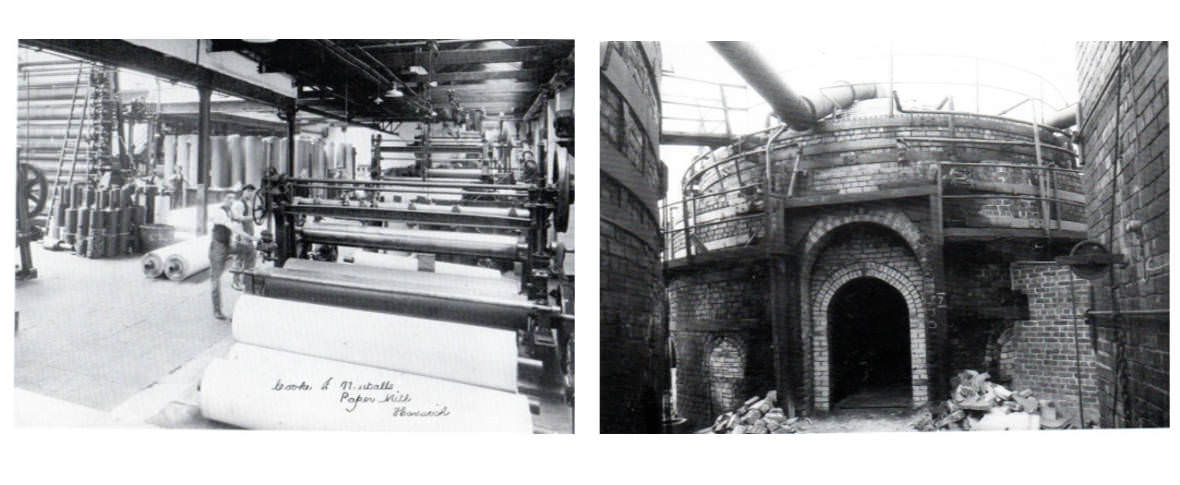
(1) Cooke & Nuttall’s paper mill & (2) Crankshaw’s pipeworks
However, it wasn’t all ‘doom and gloom’, and a new ‘cultural energy’ was emerging based on new technology. The home computer, the mobile phone and microwave oven arrived during this decade (all of which would ultimately change all our lives) and with them the ‘walkman’ portable music player, the cd and the video player (everyone will remember the ‘Blockbuster’ video shops). At the end of the decade, Tim Berners-Lee would offer the internet to the world opening up a whole new range of communication possibilities. Television also now offered more channels with the arrival of Channel 4 and the nation was treated to the spectacle of 2 Royal Weddings (Prince Charles &Lady Diana Spencer and Prince Andrew & Sarah Ferguson), neither of which ended happily. The music and fashion scene was reinvigorated with the ‘New Romantics’ movement and ‘synthesized’ production and the contribution of ‘pop music’ as a serious cultural phenomenon was recognised across the world with the ‘Live Aid’ concert in 1985 which raised millions of pounds for famine relief in Africa. This signalled that British society was becoming more conscious of such issues and in turn becoming more understanding in its treatment of children (corporal punishment was abolished in state schools in 1987) and minorities. The terrible AIDS epidemic would put this understanding to the test.
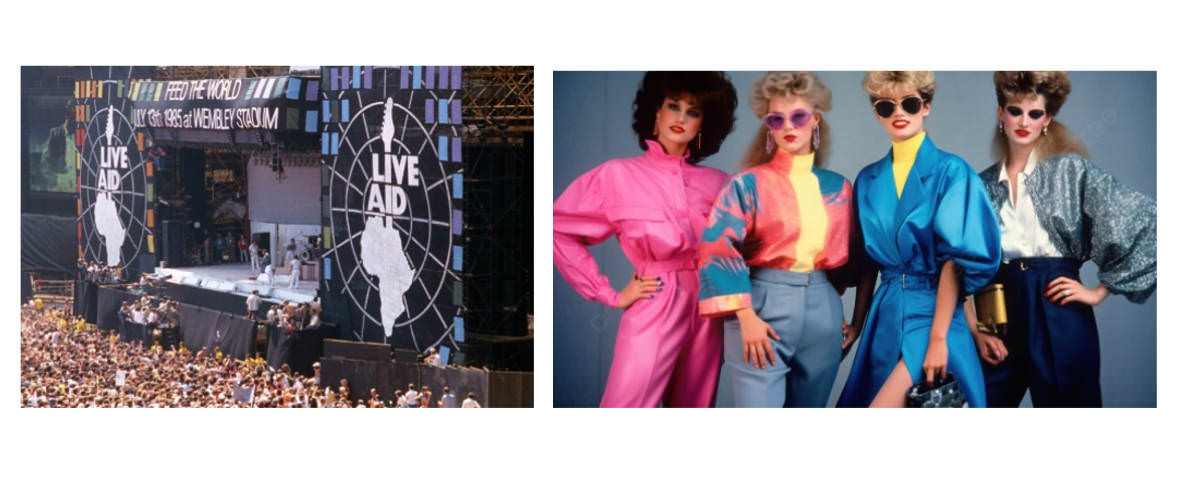
(1)The 'Live Aid' concert 27th July 1985 & (2) 1980's female fashion
As in the preceding decades, the world continued to be a turbulent and unpredictable place. The ‘cold war’ between Russia and the West did go through a more stable period thanks to the relationship between Ronald Reagan and Michael Gorbachev, which saw the ‘break up’ of the Soviet Union and the taking down of the Berlin Wall. But war raged in the Middle East (Iran–Iraq and Russia–Afghanistan) and in parts of Africa as it still does today, and a number of European countries saw their autocratic regimes toppled. Even Britain was drawn into war, having to win back the Falkland Islands after the Argentinian invasion in 1982 and the country had to contend with continued IRA atrocities including an attempt to kill members of the Government in Brighton in 1984. The American space programme was badly affected by the Challenger disaster in 1986 and much of the western world was traumatised by the ‘fall out’ from the Chernobyl nuclear plant meltdown. There were also, sadly, a significant number of fatal air crashes (including the terrorist attack on Pan Am flight 103 at Lockerbie in 1988) and other disasters like the Bhopal chemical leak and the Exon Valez oil spillage. And the ever-present problem of football violence reared its ugly head at the Heysel stadium to be followed by the even more devastating events at Hillsborough.
However, sport did have its happier side and its 1980s heroes. Who could forget the epic battles between McEnroe and Borg at Wimbledon, the Ashes exploits of Ian Botham, the golfing prowess of Jack Nicklaus, Steve Cram’s 1500 metre running or the dominance of Liverpool FC in the Football League – and there was of course the infamous ‘Hand of God’ incident involving Diego Maradona in the Mexico World Cup of 1986 which denied England a place in the semi-final.
Back home, the way we shopped was changing rapidly with the advent of the ‘supermarket’ and Horwich very much reflected the wind of change sweeping across the nation. It was even given the title of ‘Eating Out Capital of Bolton’ due to the number of ‘cosmopolitan’ restaurants opening up. Horwich even got its own night club ‘Nibblers’ which allowed only over 21s to enter and be served alcohol until 2 or 3 in the morning at the weekends – whatever next! People were going on foreign holidays and the area was becoming recognised as a desirable place to live (now that the smoky chimneys had disappeared and a greater appreciation of the unique moorland setting was emerging). And of course, in the midst of all this, Horwich Heritage was formed to help to restore the pride in a community devastated by the loss of its main employer, Horwich Loco Works.
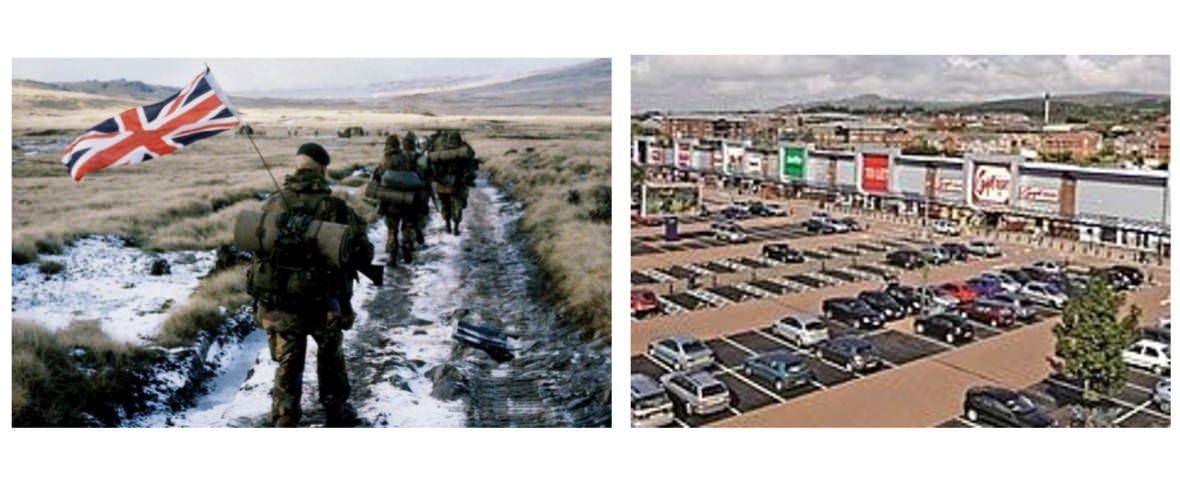
(1) The Falklands War April – June 1982 & (2) Middlebrook shopping centre
Thankfully some of the town’s industrial base soldiered on through the 1980s with such firms as ‘Sterling Mansell’ and ‘Nathaniel Lloyd’s’. Victoria Mill also continued to be a brand leader in towel production and the remaining major employer, British Aerospace, provided a wide varied of skilled jobs until the 2000s when it moved to the Logistics North site in Over Hulton. For Horwichers, it was a difficult time to find work and bring up a family, but thankfully the 1990s would bring better business and employment prospects with the opening of the Middlebrook development.
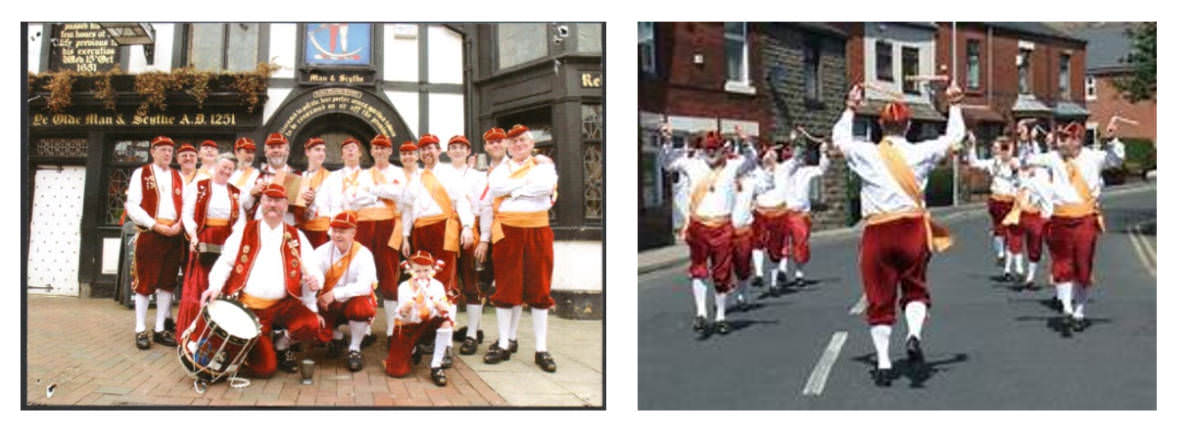
A SAD GOODBYE TO HORWICH MORRIS By Eoin McCaul (Bolton News)
In May this year Horwich Prize Medal Morris danced for the last time. Unfortunately, the local dancing troupe, which had been going in its present form for nearly 60 years keeping this centuries-old dancing tradition alive in the town, decided to disband because it just couldn’t find any new recruits. Former Leader Tom Besford said “It’s really sad, but I’m really proud of what we have done for the town and I hope Horwich is proud of us”.
On their last day they were joined by dancers from across the North West and local residents came out in force to cheer them on. Tom added “It was quite an emotional day and it was lovely to have so many people come out to see us. I was particularly pleased for Gary and Beverley, the landlords at the Crown, who have always supported us. Our final moment at the Crown was really beautiful and there were tears all round.” The final event also gave Tom the chance to perform alongside his dad, Ian, and son, Ned. “3 generations of Morris dancers in one troupe – its the first time I’ve ever seen it! I started dancing when I was 16 and I’ve spent my entire life dancing - I hoped my little boy would too.”
Horwich Morris in its present form has been going for 59 years and the group were all hoping it would make it to 60. However, the original troupe dates back over 100 years to its formation in 1891. In 1893 it won its first major competition and in 1895 was given the title of Horwich Prize Medal Morris Men. After winning another competition at Crewe in 1903, they were crowned ‘world champions’ and given medals. A woman called Joan brought her grandad’s medal from 1903 to the final show. His name was Edward Hudspeth and he was 17 at the time.

“Ultimately we’ve dressed up in stupid clothing in the middle of Horwich, been drinking in loads of bars and had a great time doing it” said Tom. “At the end of the day, we gave a good show and went out with a bang – which is how we wanted it to be rather than just disappearing. Thank you to the people of Horwich who have supported us down the years and to the pubs and the Council”. After the performance, the Horwich team revisited a tree they had planted to remember all the members who had passed away over the years as a great Horwich tradition came to a close.
THE SATURDAY MATINEE By Pam Sanderson
Between the wars, in the heyday of the film industry, the cinema was the most popular type of mass entertainment. Programmes changed at least twice each week including a summary of current events via Pathe News. Patrons could enjoy the latest films, usually American, in the comfort of upholstered seats with the benefit of warm surroundings, a luxury in the days before central heating was the norm. Horwich was blessed with 3 cinemas. As late as the 1950s, the local population could choose between being soaked, roasted, or bitten as an accompaniment to their evening entertainment.
The oldest of these was part of the ‘Prince’s Theatre’ complex showing films in the absence of live shows. I remember being taken to see Dean Martin and Jerry Lewis films here as a child, the slapstick was entertaining enough though the storyline went above my head. This cinema/theatre occupied the upper floor of an emporium which also hosted a billiard hall and a dance floor above an arcade of shops linking Lee Lane to Wright Street. This arcade always seemed dim and gloomy despite the shops themselves being lit up. One of these arcade shops was rented by my Uncle Jim, who sold and installed tiled fireplaces for which there was quite a demand in the mid-fifties. People were trading in their old cast iron coal-fired ranges for a smart, tiled hearth and a new electric or gas oven. Entrance to the cinema/theatre was by an iron staircase within the arcade with access to the ballroom and billiard hall via a wooden door from Lee Lane. The whole complex, known as ‘Johnny's’, after Johnny Holland, a manager from the 1920’s, was badly in need of refurbishment by the late 1940s. Sadly, funds were not available during post war shortages, and the whole edifice continued to deteriorate. Internally, the cinema was the worst affected. Having no windows or direct access to the outside air meant the atmosphere was very stuffy to begin with. Residual tobacco smoke combined with the whiff of elderly upholstery meant it no longer felt comfortable. The whole complex was demolished in the early 1960s to make way for a supermarket, whose concrete and glass facade could hardly be viewed as an improvement. Local residents didn’t really grieve the loss of the cinema as by this time it was known colloquially and realistically as a ‘bug house’.
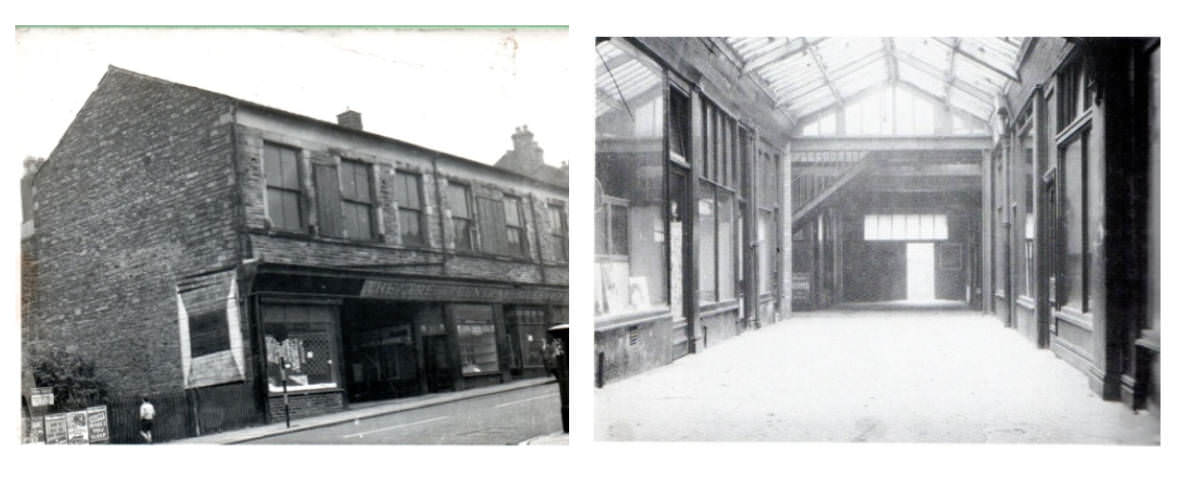
(1) The Prince’s Theatre complex & (2) Inside the Arcade
The second cinema, euphemistically named ‘The Palace’ (on Church Street) was the least loved of all 3. Its appealing mock-Tudor façade concealed a badly insulated interior with a roof made of corrugated iron. Unless it was showing a particularly newsworthy film, customers rarely patronised it in inclement weather (of which there is plenty in Lancashire) owing to the management’s inflexible attitude towards open umbrellas in the auditorium. Stalwarts who sat under the balcony, and who managed to avoid a view of the supporting pillars were mainly courting couples or completely deaf. The soundtrack of any film could barely compete when the heavy rain hammering on the bare metal roof. This edifice too was demolished in the early 1960s and replaced by Livesey's (fully insulated) funeral parlour.
The third cinema was purpose-built of solid brick complete with watertight roof and an over-zealous heating system. This was a novelty to local families used to sitting in a room with a coal fire scorching their legs and fronts whilst leaving their backs chilly from cold draughts. The ‘Picture House’ as it was known, on Chorley New Road did not have a balcony just raked stalls with seating upholstered in three different colours to reflect different price ranges. Silky ropes traversed two of the aisles to emphasise the segregation of each area and discourage the clientele from crossing the demarcation lines. These ropes also provided entertainment for the masses should any patron return from the booth besides the stage with ices when the lights were down! The third aisle, by the entrance, was patrolled constantly by an usher. At the rear, the auditorium was furnished with double seats on the three back rows, known as the ‘courting seats’ and in much demand at the evening performances. Saturday nights hosted two performances, the second house a favourite with teenagers too young to attend licensed premises. Groups of boys and girls paraded along the queue noting who was dating who and who was wearing the latest fashions. I remember a summer of crinoline net underskirts beneath crisp cotton knee- length dresses - very pretty they looked too! A few had reinforced the effect with a hoop inserted along the top of the lowest frill. Whilst the effect was spectacular outside, particularly on less windy days, when sitting inside, the hoop lurched upwards lifting the skirt and blocking the wearer’s view of the screen. Consequently, they only tended to be worn once to the cinema.
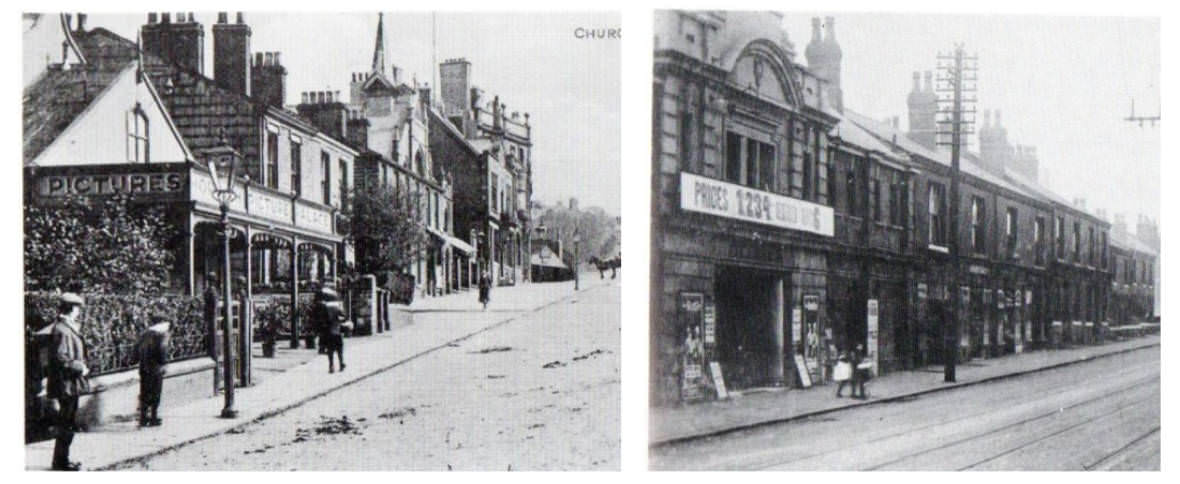
(1) The Palace Cinema, Church Street & (2) The Picture House, Chorley New Road
For a junior audience, the attraction was the weekly Saturday afternoon matinee, appreciated both by the adult population who could enjoy an afternoon’s peace and quiet for a modest price and by the children for whom the viewing of a cowboy film, cartoon and serial came incidental to the fun. Ticket prices were 5 pence, 7 pence and 9 pence. My brother Johnny and I went regularly whatever the state of the family finances. On the occasional good week, we had a shilling each to spend, ostensibly 2 pence for the bus fare, 7 pence for admission (to keep us away from the ‘rough- necks’ in the 5 penny seats) and 3 pence for sweets. In reality, we walked there and back so we could afford ice lollies and sweets and sat in the 5 penny seats anyway. On weeks when finances were tight, and with only 6 pence each, we had to walk and go in the cheap seats. Should we have less than 6 pence each, Johnny would wait with some of the poorer boys round the back while I paid for a single entrance ticket. These boys usually clubbed together for one admission ticket. The lucky legal entrant sneaked into the ladies’ toilets, opened the window and let the rest of them in. The management had got wise to them climbing in through the gent’s toilet window and put bars on it but never considered that the ladies toilets needed similar treatment. My job was to wait ten minutes and if Johnny did not appear, then I was to open the window. How the ten minutes were calculated was purely by judgment as neither of us possessed a watch and the cinema clock stayed permanently at 10 to 3. I only did it the once and remember being terrified of being found out. One enterprising youngster oiled the hinges of the emergency fire door so he could slip it open without it squeaking. He was able to let in the impoverished ones for some time before the officials caught on.
In the auditorium, mayhem ruled despite the staff on duty being the strictest available. Small boys squabbled and tussled over the seats and into the aisles. The wealthier ones bought sweets and ices from the booth beside the stage. If we had the money we didn’t join them. Our favourite refreshment was purchased before we entered the cinema. Just up the road, near the bus stop was a cake/sweetie shop and one of the first to have a freezer. The owner froze orange juice drinks which came in pyramid shaped cartons. These lasted far longer than traditional ice lollies and there were no drips when the corner was torn off. When the juice was sucked out, all that remained was a small lump of ice - much prized by the boisterous element in the 5 penny seats. The objective was to throw this ice cube and try and hit the manager’s bald patch and not get caught. The staff all heaved a sigh of relief when the programme started. The noise level abated to stamping, whistles and loud sucking sounds in the occasional romantic moments. Horwich has never had such peaceful Saturday afternoons!
40 YEARS OF HORWICH HERITAGE By Stuart Whittle
Who would have thought that a chance meeting between myself and the much-missed Geoff Waine at the end of 1984 would lead 40 years later to the flourishing Horwich Heritage Society we have today with over 300 members and a Heritage Centre that is the envy of many other heritage groups. In June this year, Horwich Heritage will be celebrating its 40th Anniversary, having been formed in 1985 in the wake of the closure of Horwich Loco Works. From small beginnings the Society has gone from strength to strength over the years and is now a valued part of the Horwich community. As you all know, we provide a monthly programme of speakers (over 400 to date) at meetings which are extremely well attended (100 on a regular basis), as well as organise trips & walks and a regularly changing set of exhibitions (over 100 to date) at our Horwich Heritage Centre which is open every weekday 2-4pm and Saturday mornings 10-12.30pm.
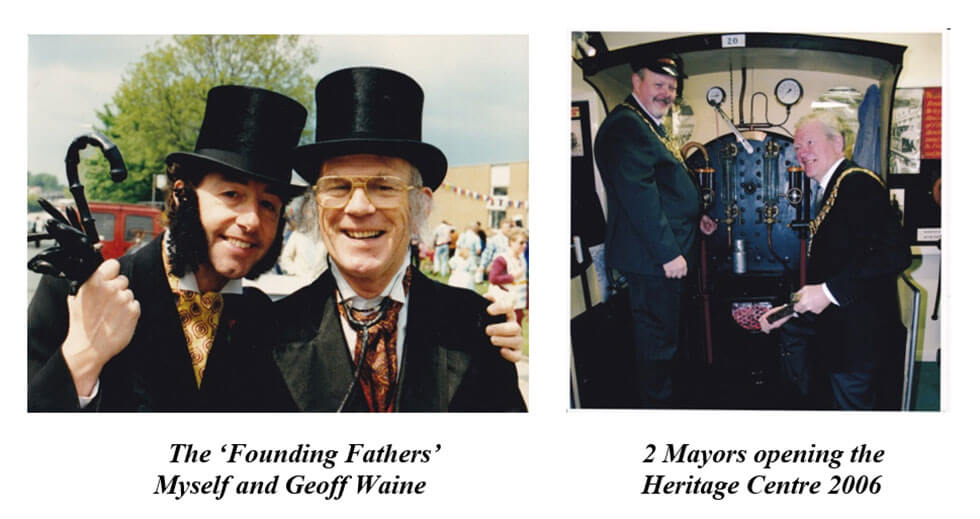
The Centre is free to visit and attracts over 2000 visitors a year including a large number of local school groups. It provides a range of professionally-produced displays on subjects such as the Loco Works, a Victorian Kitchen, The Way We Were, World War II, Winter Hill Mines and the Turnpike Roads. These are supplemented by special exhibitions launched at ‘Open Days’ on 5-6 occasions during the year – the latest one ‘Our Ancient Past’ opening on 22nd February. The Centre also has a shop, AV area, reference, research & archive facilities and welcomes enquiries about family history. Horwich Heritage is also proud of the fact that we produce our own books & films about the Horwich & Rivington area.
The 40 Year Celebrations begin on Saturday 24th May with an Open Day/Exhibition at the Heritage Centre (10am – 1pm) which will focus on the group’s achievements over that period with a ‘memory lane’ of photographs and artefacts. The Society will also be digging into its archives to display ‘hidden gems’ from its extensive collection. This event will be followed by a Celebration Party at the AGM on Tuesday 10th June 7.30pm. Members and non-members are all welcome.
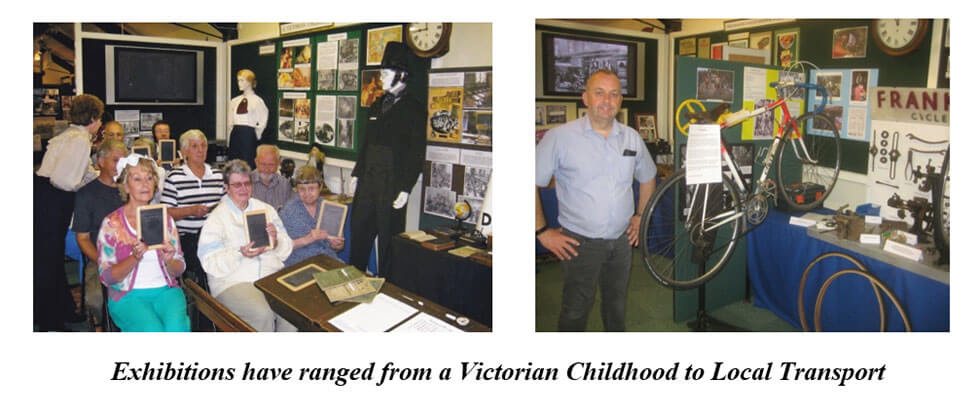
Horwich Heritage is especially grateful for the continued support of Horwich Town Council which has enabled us to run the Heritage Centre (in the former barracks rifle range) since 2006. During that time the Society has put on no less than 110 different exhibitions, produced over 20 different publications and 25 different films. We are proud to have played such an important role in documenting the fascinating history of the area. In recognition of its role in Horwich public life, 3 members of Horwich Heritage, Geoff Waine, Carol Walker & Norman Pendlebury have been given Horwich Civic Medals and I have been given the Rotary Club’s prestigious Paul Harris Award for service to the community.
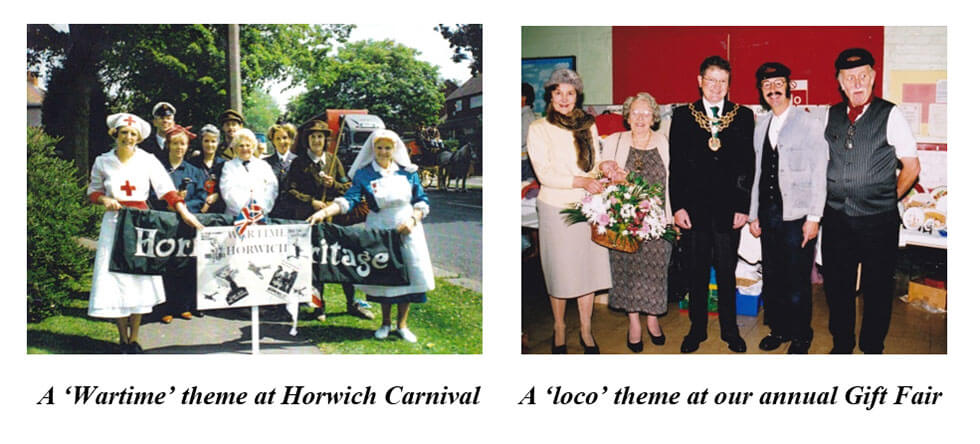
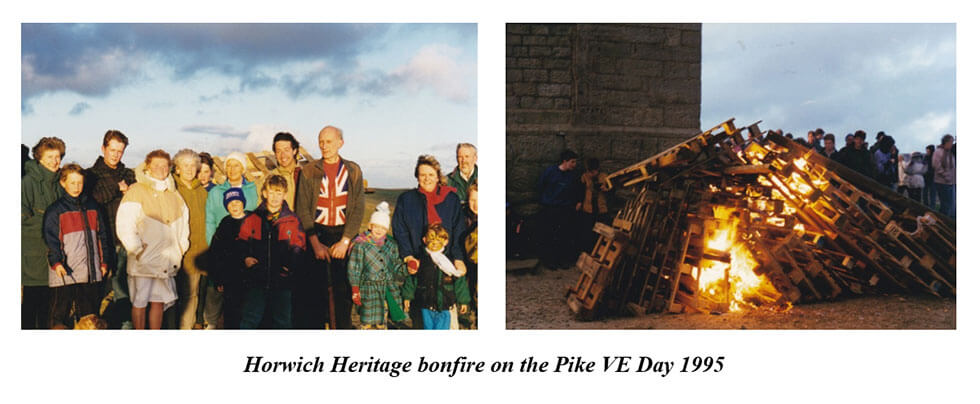
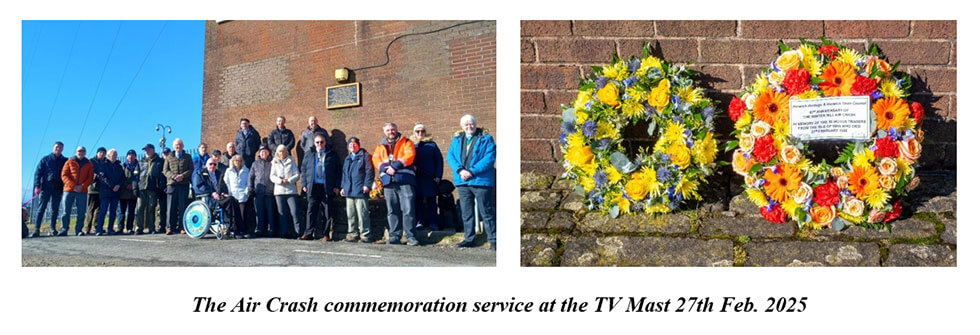
There have been many stand-out moments during the past 40 years including: a decade of period–costume appearances in the Horwich Carnival (1985-95) and 16 years of Gift Fairs/Exhibitions (2002 -2016), organising the VE Day 50th Anniversary bonfire on Rivington Pike (1995), hosting the commemorations to mark the 50th Anniversary of the Winter Hill Air Crash (2008), numerous exhibitions & events to mark landmark moments in the history of Horwich Loco Works including the 100th birthday of the 1st loco built there, No.1008 (1989) and a commemoration of the start and end of WWI (2014 & 2018) including research into the Horwich soldiers who fought & died which resulted in the unveiling of a new Roll of Honour.
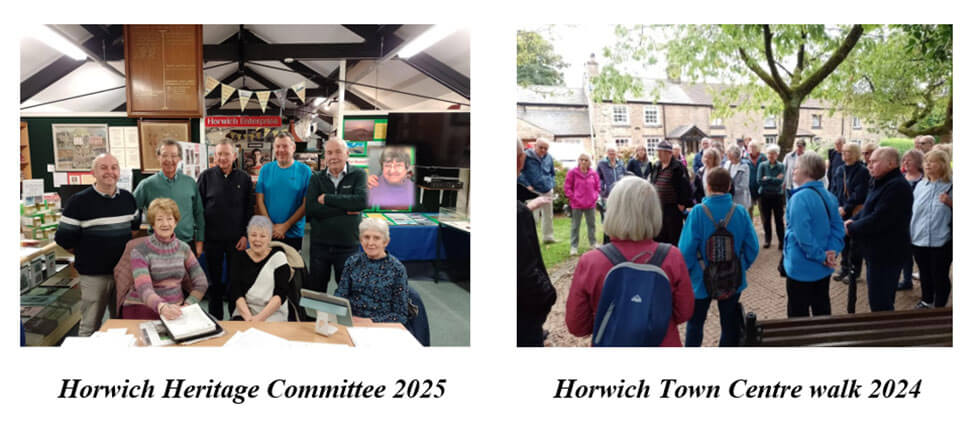
As I always say, none of this could have been achieved without the exceptional efforts of the Society’s Committee and Volunteers who ensure that the Centre is open 6 days a week and that a steady stream of new speakers, events, exhibitions, displays and archive material is produced.
Horwich Heritage also wishes to acknowledge the support of all our members during the past 40 years and hope to continue to deliver this high level of public service for many more years to come.
OUR ANCIENT PAST By Derek Cartwright
Our latest Horwich Heritage exhibition entitled ‘Our Ancient Past’ was opened by the Mayor of Horwich Cllr, Ian Aldcroft, on Saturday 22nd February. The exhibition explores the pre-historic period of our area and, in particular, the evolution of its moorland. With ancient history it is always difficult to know where to start but, for the purposes of this exhibition, we have started our journey in the Carboniferous Period. Why this period? Well this is the time around 354 to 290 million years ago when much or our coal and other minerals were formed from the deposition of vegetation, and in our region the presence of massive coal fields helped to fuel the Industrial Revolution. Britain at this time was much closer to the Equator, was much warmer and very swampy. The oxygen levels were higher than they are today which contributed to life thriving and growing to sizes much larger than in the modern era. In the exhibition, we have plant and animal fossils, many from our locality, from this key period in our planet’s development.As the land moved, was folded and pressed together, we would start to see the land forms that we might recognise today. The various glacial cycles over another few million years again altered and smoothed the landscape with thick ice sheets moving slowly over our highest peaks. Winter Hill, Rivington Pike and Anglezarke would be under many meters of ice. The ice would scour the land and hills forming valleys, moving material many kilometres from where it was captured by the glacier. The last ‘Ice Age’ ended around 12,000 years ago with the melting ice leaving behind rocks that had been transported long distances and glacial deposits that formed mounds and hills. The melt water was responsible for cutting deep channels, still very visible today, and our exhibition explores local features formed from the melting ice. It is many of these glacial channels that have formed the water courses which for several centuries provided the large quantities of water which powered the textile and bleaching industries that developed in and around Horwich.

As the last of the melt water dissipated (11,700 years ago), our ancestors began again to populate the north of our country. Over time, people started to settle and, with the benefit of their ‘latest technology’, flint and later bronze, trees were felled and early farming began. This tree felling especially on the high ground contributed to the formation of the peat. This material, made from slowly-decaying mosses and grasses added a blanket to our local hills, smoothing the ridges and valleys to what we see today. In our area, the peat is believed to have developed from around 1200 – 600 BC. Items dropped by the people of that time will therefore be in or under the peat. Local evidence from our ancestors ranges from flint and other stone finds to barrows, chambered-cairns and burial mounds. Excavations and opportunistic finds have produced artefacts which help paint the picture of life in our area from the period 2500 BC onwards, with the Pike Stones (2500BC) being the oldest pre-historic site in the area (built around the time that Stonehenge was being constructed).
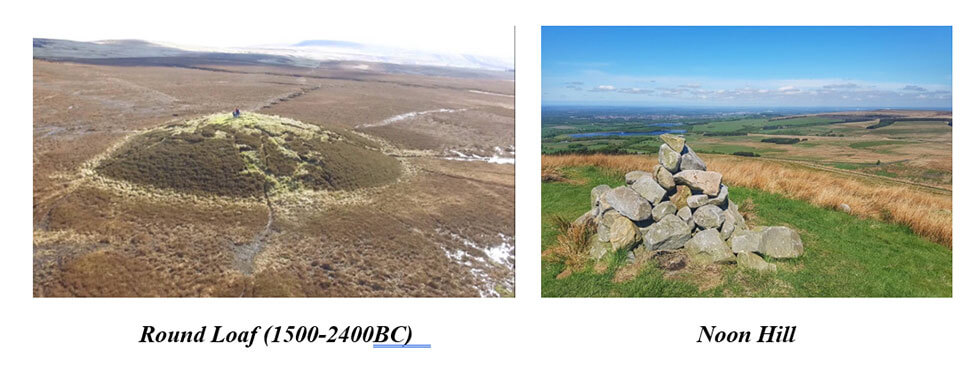
Our exhibition explores these sites and structures and many other features, with maps setting out each location and artist’s impressions helping us to see how they might have once looked. We are grateful to Bolton Museum who have loaned exciting finds from their archive for the exhibition. These include flints, a Bronze Age axe and spear heads, coins and a burial urn from the Noon Hill Cairn, Rivington. Sean Sale, a Horwich amateur geologist, has helped with many fossils found locally from the carboniferous period. Local photographers and drone pilots, Peter Revald and Martin Harrison, have kindly given permission for the use of their fascinating photographic work. Neolithic and Bronze age finds from a current excavation in Aspull will also be on display (courtesy of the Wigan Archaeological Society). And, as for the regularly-asked question “What did the Romans do for us?” - well please come and find out! Ian Trumble from Bolton Museum was with us on the morning of the exhibition opening holding a ‘Finds Surgery’ which was able to identify a number of mystery objects. With Stephen Hamer’s discovery of a 4500 year old Scandanavian axehead in Dean Wood, Rivington only last year, it pays to keep your eyes open when you are out walking on the moors.
You never know what you might find!

REFLECTIONS ON A CYCLING LIFE By Neil Brown
Horwich Cycling Club was formed in 1934 and celebrated its 90th Anniversary in 2024. For many years the ‘mainstays’ of the Club were Frank Hart (a founder member who became its President), his wife, Kathleen, and Les Wilkinson.I joined Horwich Cycling Club in 1960 age 15. I spent so much time hanging around outside Frank Hart’s Cycle Shop with my friend, Ian Walsh, that Frank & Kathleen encouraged me to join and I have enjoyed the freedom of the roads ever since. In those days, the Club had a membership in excess of 100 and contained 4 different sections: Road Racing, Time Trials, Touring and Family Rides. Touring was my choice, so at 16 years of age I set off on my first cycling run with Horwich to Nicky Nook, near Scorton. A photograph was taken at the entrance to Nicky Nook by Les Wilkinson, the Club Secretary, and appeared in the ‘Buff’, the sports section of the Bolton Evening News, which was published on a Saturday – suddenly I was famous!
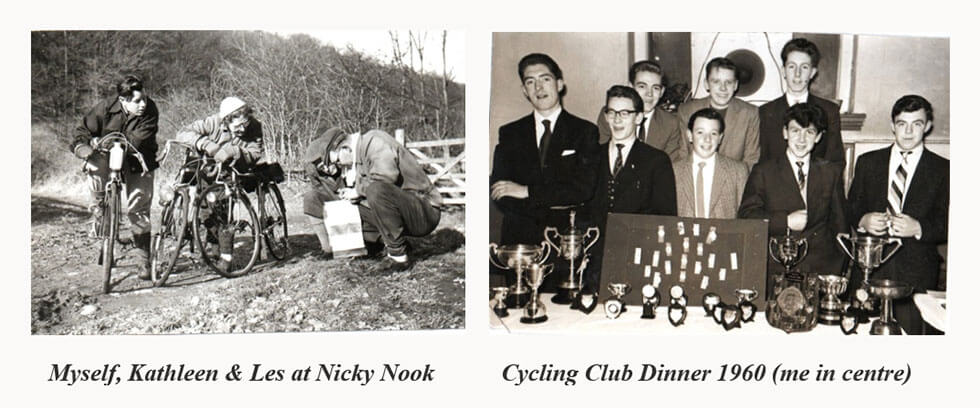
Once a month, the club went away to Youth Hostels in either the Lakes, Yorkshire Dales or North Yorkshire. The advance party would set off on a Saturday morning at 8.30am to one of these destinations, but I would meet my cycling colleague, Stan Cookson, who was the Treasurer of the Club, at the ‘Big Lamp’ in Chorley at 1.00pm. Stan was employed by the Electricity Board and had to work on Saturday mornings so we then had to ‘cycle like mad’ to get to our destination in time for the meal at the Youth Hostel. In the winter, this became a real challenge as most of our riding was carried out in the pitch black, on the tops of the moors and in the dales. Stan had a very powerful dynamo head lamp which helped us to weave our way along but, of course, when we stopped we had no light at all! As a result of this, we got into all sorts of ‘scrapes’. Here are 3 in particular:
It was the 5th November and the advance party had gone to Dentdale Youth Hostel in the Yorkshire Dales. Starting late as usual, Stan and I had gone through Lancaster by which time it was dark. Continuing on to Ingleton, the weather took a turn for the worst. We were getting battered by the wind as we headed towards Ribblehead on the Hawes road, so we had to take refuge in a pub to make ourselves feel like human beings again. When we reached Ribblehead, it was so dark (darkness like you rarely see now), that all we could see was an odd light coming from some distant farm. Eventually we turned left off the Hawes road and proceeded to the head of Dentdale. Looking down the Dale we saw numerous bonfires, a scene which I will never forget, as we continued down to the Youth Hostel. The Hostel had no electricity and limited running water. The lighting was by hurricane lamp on the ground floor and by candles in the dormatories – those were the days! Incidentally, it was several years later before electricity arrived in Dentdale.
On another occasion, Stan and I set off to ride up to Patterdale on a very wet winter’s day. We went through Milnthorpe in total darkness and the along the Barrow road to Gilpin Bridge. On turning into the Lythe Valley we hit floods and, to make matters worse, our dynamos were struggling to give us any light at all due to the pulleys slipping in the wet. We struggled along the valley until we could get onto higher ground. By then we were soaked to the skin, cold and quite miserable. On approaching Bowness down a steep hill, Stan passed me ‘like a rocket’ and shot into the high street unable to stop as his brakes just wouldn’t hold any more (in those days, brake blocks on steel rims were not very efficient). Fortunately, he didn’t hit anything and was unhurt!
The 3rd episode occurred when we had all cycled up to Tarnbrook in the Trough of Bowland and set out to go over Salter Fell. Les Wilkinson used to carry a primus stove for brewing up on his bicycle frame. Our other additions were a canvas water bucket, aluminium pans, a ‘tea bomb’ and fire proof material which acted as a wind protector for the primus stove (which, by the way, was fuelled by paraffin). The ‘tea bomb’ was a circular gadget into which you placed the loose tea (no tea bags in those days) which was then put into the pan until the water boiled. Climbing up Salter Fell, we took advantage of the stream bubbling down the hillside and filled our water bucket and set about the ritual of brewing the tea. After the enjoyment of a beautiful cup of tea, we continued up the fell. It was then that Stan announced that there was a dead sheep in the stream. Feeling a little ‘sheepish’, we continued on our way over the fell to Wray and back over Quernmore and home. I am pleased to report that none of the riders suffered any ill effects, or I don’t think so - Ba!
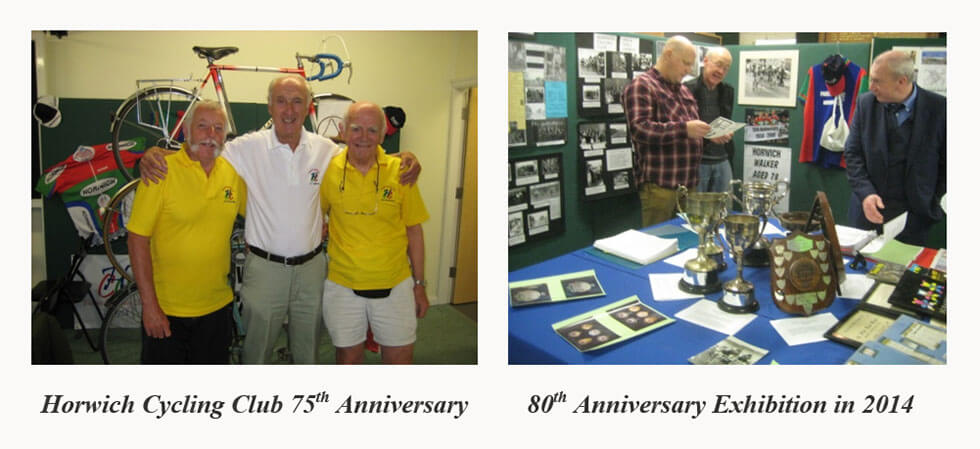
Cycling is a wonderful sport because it takes you into areas you have never encountered before. At 16 years of age, I went to Scotland for the first time and did a tour of Northern Scotland, having caught a steam train in Wigan which took us to Inverness. And over the years, I have had many more adventures in all parts of the country especially Scotland, Wales, the Lakes and Dales and eventually across Europe with my wife, Beryl. Cycling also breeds such camaraderie and my colleagues and mentors in those early days were Harry Millman, Roy Saunders, Elsie & Percy Carney, Les Wilkinson, Kathleen Hart and Stan Cookson. After a brief spell in London, I returned to Horwich and took up cycling again in 1970. By the 1980s, Les Wilkinson had acquired a car, so we could put the bikes on top instead of having to catch the train. This extended our range of cycling holidays. Les was a wonderful organiser. He would research each trip and carefully plan it all, booking hostels, trains and ferries. He was also our ‘tour guide’ and I learned so much geography and history from him, which was a major factor in sustaining my interest and enjoyment in the touring side of cycling. I could say so much more about other aspects of Horwich Cycle Club which has been so much a part of my life for the past 58 years, the races, marshalling, social events and dinners at Rivington Barn, but I think I’ve said enough for now. I still enjoy ‘going for a ride’ on a regular basis wherever it might take me. I acknowledge that cycling today cannot be the same as in my early days, but I would encourage people to take up cycling, for health reasons, if nothing else. As for the Club, it is still going strong and is much more racing-orientated these days – which is great for the younger members but not for me!

Neil Brown’s contribution to Horwich Cycling Club and to cycling in Horwich generally should be both acknowledged and applauded. Over the years he has been Cycling Club Secretary and Treasurer and arranged numerous events. He has also, in recent years, organised the highly-successful ‘Horwich Festival of Racing’ which has well and truly put Horwich and cycling in the area on the map. For his services to the town, Neil has been awarded the Horwich Civic Medal and has a place on the ‘Spirit of Sport’ statue. Well done Neil!
RIVINGTON UNITARIAN CHAPEL Taken from the Chapel Records
In October last year, a group of Horwich Heritage members visited Rivington Chapel and were given a fascinating tour and history lesson by Judith Crompton (a Minister there for 50 years) and Vince McCully. This is a summary of the information they provided.
History
The power of the Church of England was re-asserted after the restoration of the Monarchy (Charles II) in 1660 with ‘Non-Conformists’ being forced to use the Book of Common Prayer in their services. This resulted in the ‘Great Rejection’ on ‘Bartholomew Sunday’ in 1662 when 2,500 Ministers left their Churches. Samuel Newton of Rivington Church was one of the Ministers ejected and many of his congregation followed him and formed the first ‘Non-Conformist’ congregation at Rivington. They met in various houses including ‘Sheepcoate’ and ‘Pilkington House’. William Anderton was an early benefactor of the chapel, leaving funds in his will in 1670 for Ministers John Walker and Samuel Newton. Newton actually returned to preach at Rivington Church in 1674 and was succeeded by Walker in 1702. Thomas Anderton of School Brow Farm left £100 to aid the Non-Conformists in 1683 and, by 1697, George Brownlow and George Shaw had added to the Chapel funds. Hugh Willoughby (later 6th Lord Willoughby of Parnham) was one of the first trustees and benefactors of the chapel, which was built in 1703 on land named ‘Goosehey’, and given for a peppercorn rent on a 2000-year lease by John Andrews of Rivington Manor, with the stipulation it should only be used for religious services of Protestants dissenting from the Church of England. The first Minister of the Chapel was the Rev. Ralph Ainsworth (1704 to 1716).
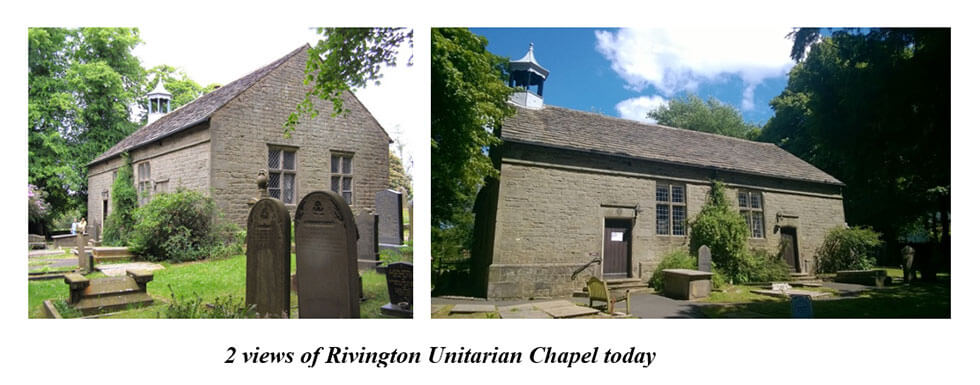
During the 1700s, the chapel was well-funded and had a congregation of 395. The Unitarian doctrine replaced Presbyterianism in 1754 and around that time the Chapel became licensed for weddings (which it has conducted ever since). In this period, Rivington Chapel and Rivington Grammar School remained under the influence of leading Non-Conformist figures including the Lords Willoughby of Parnham and the owners of Rivington Manor. In 1760, four men, Hugh Makinson, Moses Cocker, Thomas Anderton and John Ashworth, rallied support to build the Presbyterian Lee Chapel in Horwich in opposition to the adoption of Unitarianism at Rivington. The New Chapel was completed in 1774 and, as a result, the Horwich and Rivington chapels were "rent in twain", to quote local historian, Thomas Hampson, writing in 1893.
In Rivington, a manse was built in 1787 and a Sunday School in 1795 (which lasted from 1821–1985). One amusing episode involved the stopping of an ‘invasion’ by local Methodists who tried to convert the Unitarians by holding a loud service at the chapel gates in 1893 in an attempt to ‘overpower’ the congregation of the chapel indoors. Local residents responded by banging pans and trays to drown out the Methodists! Rivalry between Rivington Church and Chapel was equally fierce and lasted for a long time, again involving attempts to drown out each other’s services with loud noises outside.

Chapel Exterior & Interior
Rivington Unitarian Chapel is a Grade II* listed building. The building is a plain structure made of local gritstone which originally had a thatched roof. It has a small hexagonal bellcote on the west gable dating from 1876. The bell and cast iron gates date from 1816. One of the doorways bears the original inscription 1703. At the north west corner is a 2 storey wing which used to be the school house. Inside, the Chapel retains its original box pews which were originally owned or rented. The Willoughby pew by the south wall has a large ornate canopy with panelled reredos and a moulded and carved cornice in the classical style. The church organ was a gift in 1843 from Halliwell Road Unitarian Chapel in Bolton. The raised, 5-sided pulpit is still in its original position. The Chapel had extensive repairs in 1952, 1960 and 2016 and the Manse has been sold off as a private residence, the money being used to create a Garden of Remembrance. The Library closed in 1985 and is now the Rivington Village Tea Room.
There are some remarkable monuments both inside and outside the Chapel, dating back to the 1600/1700s, referring to the original Ministers and most influential people in the area at that time like the Andrews & Cromptons of Rivington Hall. The most impressive internal structure is the full-height C18th inscription dedicated to the family of the 11th–15th Barons Willoughby of Parnham on the north wall. Outside, there are datestones from the late 1600s including James and Rebecca Isherwood, from Woods Farm (otherwise known as Ainsworths Farm),1698, and gravestones for the Pilkington, Andrews, Crompton, Shaw, Ormrod & Oldknow families as well as for CJ Derbyshire, the 1st Mayor of Bolton. The Walt Whitman plaque was installed in 1913 by his Bolton followers.

Services and administration
The Chapel remains an active place of worship. Services are held at 2:15 pm on the 1st and 3rd Sunday of each month, and the bell is rung to call worshippers to the service and a candle lit at the commencement. Until the C20th, young females would attend carrying posies of lad’s love, thyme, pinks and roses. The Preacher arrived directly into the Chapel, in plain clothing with no gown and, prior to the arrival of the organ in 1843, music was by way of a bassoon and vioncello. Hymn numbers were given to the congregation by writing them on a slate with chalk.
The Chapel's motto is:
"Here is quietness for the healing of our spirits;
Here is history for the background of our lives;
Here let no one be a stranger."
Long may it continue to serve the local community.
SCHOOL VISITS By Judith & Stuart Whittle
Not everyone in Horwich Heritage knows the extent of our schools programme, which has been operating for almost 20 years, so we thought it would be a good idea to give an outline of the sort of sessions we run and the subjects we cover.
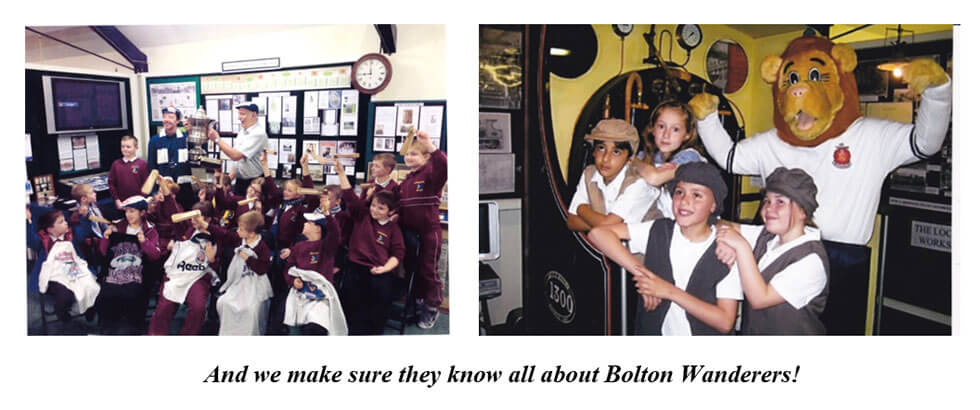
As soon as the Horwich Heritage Centre opened in 2006, our Society made it its mission to educate and entertain the young school children of Horwich on as many aspects as possible of our fascinating local history. Horwich Heritage is focussed on ‘preserving the past and promoting the future’ and we take great satisfaction from helping the children to appreciate how the past has shaped the way we live today. Since we started 19 years ago, thousands of local Primary School pupils have visited our Heritage Centre. We run 2 different types of sessions, the first are ‘one off ‘ requests from teachers for full classes of 30 to cover subjects like ‘A Victorian Childhood’, ‘ The History of Horwich’, ‘Horwich & the Industrial Revolution’, ‘Lord Leverhulme’, ‘The Suffragettes’, ‘Evacuees’ and ‘Wartime Horwich’. Each session includes archive film and/or power point presentations, interactive involvement with our exhibitions e.g. how to drive a steam locomotive, role playing and creative play – and the feedback has always been excellent.
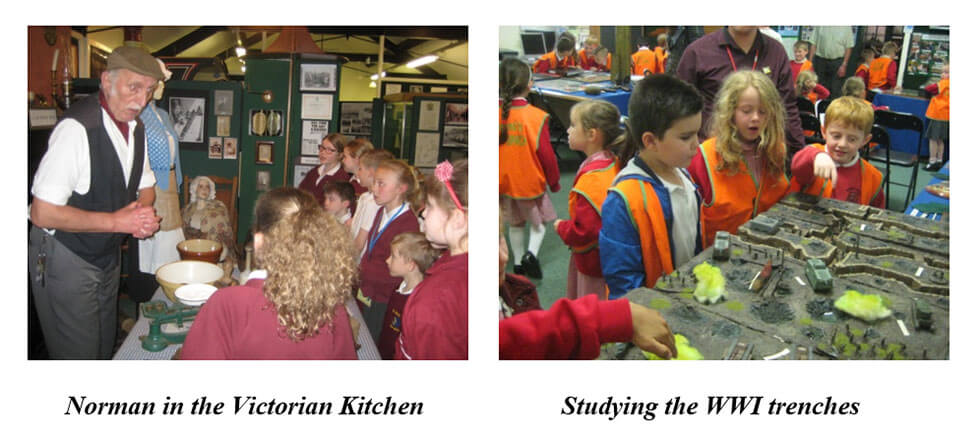
The second type of session is called ‘Locomotiv8ors’ which we have been running for the past 13 years supported by an ‘Awards For All’ grant from the National Lottery. To run this, we have teamed up with ‘Bolton Playing For Success’ who provide us with a qualified teacher, Janet Rhodes, teaching facilities and transport to and from school. The scheme involves children age 9-10 from different Primary Schools coming to an ‘After School Club’ for 5 sessions which we aim to make both interactive and enjoyable. To give you an idea of the material we cover, here are the outlines of the 5 sessions we are currently providing:
Session One starts with a study of Victorian Childhood and how much has changed since then: from children starting work at the age of six to the strict routine of the Victorian classroom, the hardships of everyday life and the simple toys they had to play with. The aim is to make the children recognise how much more privileged they are today with all the home comforts, modern devices, education and health care systems and transport options now available to them. The re-enactment of the Victorian classroom is certainly an ‘eye opener’ for the children with the emphasis on punishment for all sorts of misdemeanours. Safe from this world, the pupils often see punishment as a source of fun and can’t wait to try on the dunce's cap (they even say they would like the cane!). They are also intrigued by simple toys and games which were often much more physical and imaginative compared with the electronic games of today.
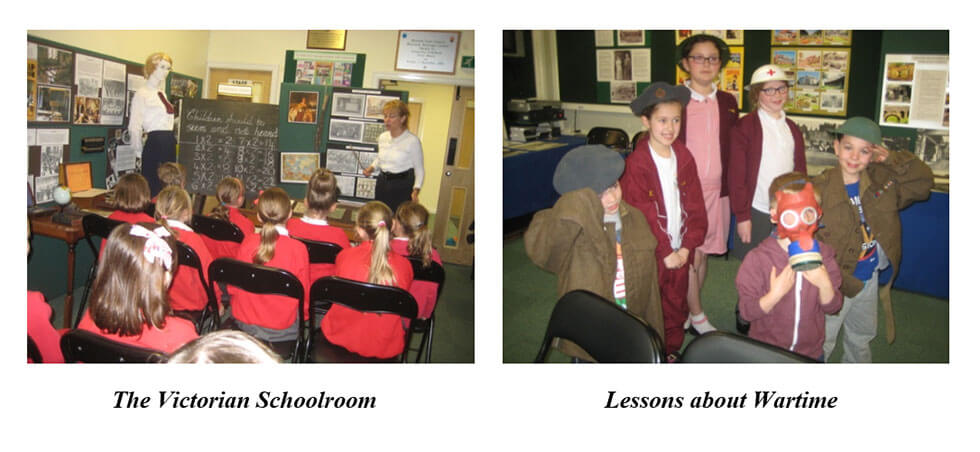
Session Two is about Evacuees, both in this country in WW2 and in Ukraine and Gaza today. Having watched a short film about Evacuation from London in 1939, the children are asked how they would feel about leaving their homes and families to live with strangers with only a small bag of items to take with them. Some children see pets as essential items but are told they would have to leave them behind and focus more on clothing and a toothbrush - and where would they be without their mobile phones! We have a wonderful WW2 area in the Heritage Centre and the children are amazed to see the Morrison Shelter, the rationed food items and the Spitfire and take great enjoyment from trying on the uniforms of the armed forces. The session concludes with food sampling from the days of rationing - anyone for Spam, powdered egg or jam sandwiches?
Session Three is all about how our Industrial Past has set us on a course for all forms of pollution and climate change. Starting with a piece of coal we travel through time to bring about awareness of factory life, materialism, consumption and waste. We then focus on the impact of modern day global travel compared to the horse and cart of 120 years ago! Gathering in our Victorian Kitchen, with the coal fire and no electricity, the children then experience a working day with Mother cooking on the range and washing with the dolly tub and mangle before deciding who goes first in the tin bath for the family’s weekly wash. They then have to come to terms with the absence of the bathroom and how the outside toilet was the normal facility with the ‘guzunder’ under the bed for ‘night time emergencies’. Looking at an everyday object (everything from a toy, a tee shirt, a plastic water bottle to a kitchen gadget), the pupils are asked to look at its ‘life’ and consider how and where it is made and how it can best be recycled. And to end the session, they start to design a sustainable ‘house of the future’ recognising the importance of ‘green technology’ and the use of the latest fuel-saving devices.
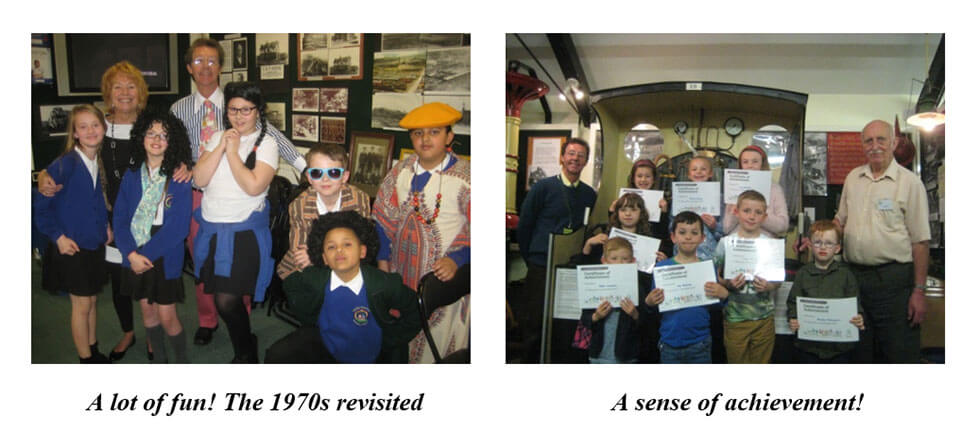
Session Four is entitled ‘Health and Wellbeing’ and for this we bring in a fitness expert to guide the children on food choices and a healthy lifestyle. We have fun doing physical games and exercises and exchange ideas on ways to keep fit physically and mentally. We offer guidance on how to cope in difficult situations when they feel unhappy or vulnerable. The children really like this session because of the amount of movement and interaction.
Session Five is the final one when we invite the children to do our own ‘20 Objects’ quiz. They have a clue for each object and then have to find it in the Heritage Centre. and provide as much information as possible about it. This raises lots of discussion and helps to recap everything we have discussed over the 5 weeks. It is also the time to complete the ‘sustainable houses’ started in week 3 and for the pupils to present them to their colleagues explaining the features included in their design . We find the inquisitive nature of the children and their enthusiasm to learn about and enjoy being in the Heritage Centre very rewarding - and the feedback over the years has been most encouraging. Sadly, Norman Pendlebury, one of the mainstays of our schools programme, is no longer with us, but we hope to continue them for many years to come for the benefit of future generations of Horwich school children.
RIVINGTON PIKE TOWER By George Birtill (1969)
Everyone in Horwich is familiar with its most famous landmark, the Tower on Rivington Pike, but what do they know about it? It was built by John Andrews, Squire of Rivington, in 1733 but do they know why? George Birtill, the well-known author of books about the moors around Chorley and Horwich, offers the following explanation.
The rounded stones which form the base of the tower were most likely used for an earlier beacon. That this site was of considerable importance is indicated by the fact that during the threat of the Spanish Armada in 1588, 3 towns, Manchester, Bolton and Middleton, had to pay a total of £8 2s 8d for a watch to be kept there between July–October of that year. Baines in his ‘History of Lancashire’ also notes that the beacon was again made ready in anticipation of a French invasion in 1708.
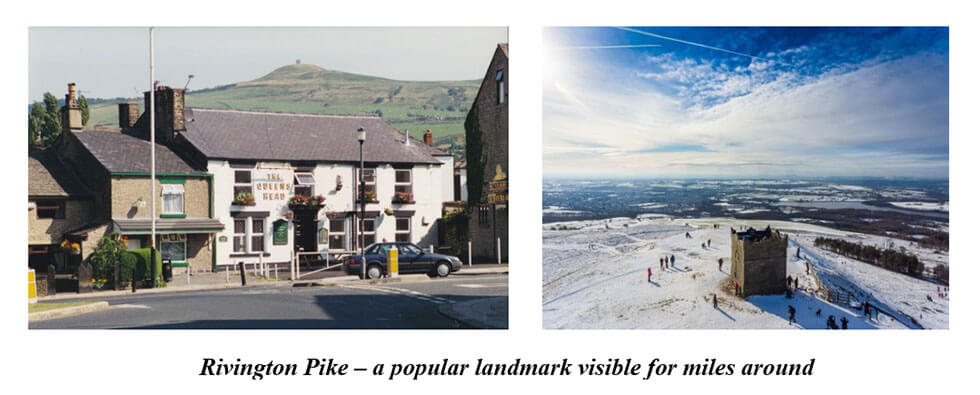
The Levers of Darcy Lever (distant relatives of William Lever, later Lord Leverhulme) had bought the Pilkington half of the Manor of Rivington in 1611 and on his marriage to the daughter of Robert Lever, John Andrews purchased the other half from the Breres family. He is then said to have built the tower to celebrate the reunion of the Manor but also, according to Major GN Shawcross, to provide evidence of legal ownership of the moor. It is popularly thought that it served as a ‘hunting lodge’, but it was also certainly used as a ‘watch tower’, having a fireplace to keep out the chill winds blowing across the moor. It seems Squire Andrews had good reason for such precaution as the boundaries of the moor appear to have been ill-defined and were only settled after an expensive legal action 4 years after the tower had been built. The issue began after a cow belonging to Christopher Horrocks of Horwich ‘strayed’ into Rivington Moor and was detained by 2 of Squire Andrews’ employees. This resulted in a summons and it took 3 Assizes before the Squire won the case.
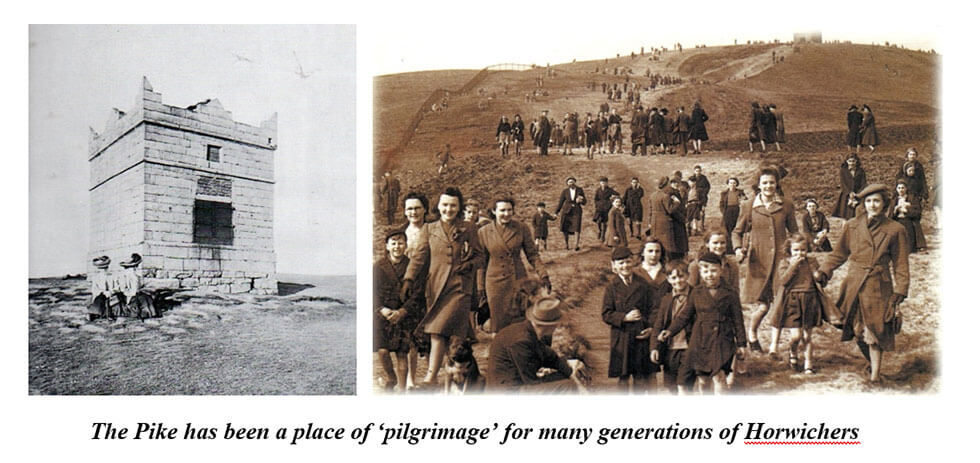
Squire Andrews left behind a record of the building of the tower, naming Henry Lathom as the stone mason. Major Shawcross notes that the Lathoms were ‘tall of stature and had great strength’. He also observes that hardy gritstone from the nearby hillside was used instead of the softer sandstone which was also available in the local quarry. John Andrews died in 1743, only 10 years after the tower was built and, although he had a daughter, the estate reverted to the male line with Robert Andrews, who went on to build the present Rivington Hall. 2 sons followed him, then John William Crompton, grandson of their sister. From this it will be gathered that, although the name changed through a lack of male heirs, the Lever ‘line’ continued right up to the purchase of the Manor by William Hesketh Lever in 1900. So, after 200 years, it was a Lever who eventually inherited the original Lever estate. Perhaps this explains his affection for the area with the generous creation of Lever Park and the inclusion of the tower within it – to be enjoyed for posterity.
Postscript: The last time the beacon was lit on Rivington Pike was by Horwich Heritage in 1995 to commemorate 50 years since VE Day (see photo below) - and because of current rules & regulations it might never be repeated. Looking back, I can’t believe that Norman and I managed to carry all that wood up there!
JIM STUCHBURY – WINTER HILL HERO By Leah Collins (Bolton News)
On 26th December 2024, the Bolton News announced the death of Jim Stutchbury, one of the ‘heroes’ who rushed to help when a plane crashed on Winter Hill on 27th February 1958. He was 92 and remarkably, he never talked about it to his family whilst he was alive.
The family of Jim Stuchbury have paid tribute to their dad who was one of the ‘unsung heroes’ who helped with the rescue efforts when a Bristol 170 Wayfarer carrying 39 passengers and 3 crew from the Isle of Man to Manchester crashed into Winter Hill in atrocious weather conditions 67 years ago. The crash claimed the lives of 35 representatives from the Manx motor trade who were on their way to visit the Excide Battery factory. Only 7 people survived including the 3 crew members. What followed after the crash was a desperate attempt to save those who had survived and Jim Stuchbury and his colleagues, Ken Whittaker and Neil Weaver, played a vital part in the rescue effort. They were quarrymen at the time working on Georges Road when they heard the crash around 9.45am. There was dense fog and the road to Winter Hill was covered in deep snow. Undaunted, they worked to remove the snow from the road so that the emergency vehicles could get through. They set out for the crash site in a works vehicle but ran out of fuel so they had to walk more than a mile carrying 10 gallons of diesel in order to continue clearing the way.
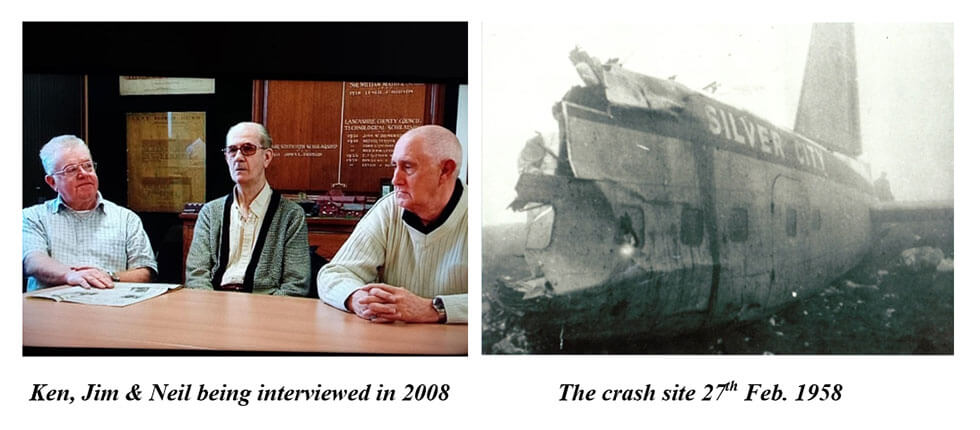
A DVD commemorating 50 years since the crash was produced by Stuart Whittle and Ted Wisedale of Horwich Heritage in 2008 featuring Jim and his colleagues and it was only when his granddaughter decided to look at it recently that his involvement was recognised. His son, Damon, then questioned him about it and the story came out after all those years. When interviewed for the film, Jim talked about the superhuman effort it took to carry the 10 gallons of diesel uphill in a milk churn (as that was all they could find), about how dense the fog was, how deep the snow was and how cold it was. “I don’t know how we did it, we must have had God-given strength, but if we hadn’t cleared the way, the emergency vehicles wouldn’t have been able to get through and no one might have survived”. As Damon said “It was a lot to take on board and we were so proud of him. It was amazing to find out my dad was a local hero. He was also a great father to myself, my brother and my sister and husband to our late mum.”
It is humbling to think that the film we made about the crash 17 years ago meant so much to Jim’s family. It goes to show the importance of Horwich Heritage recording events like this for posterity.
HORWICH GOLF CLUB (1884 – 2022) By Connie Kemp
This article is based on the booklet produced by Club member, Connie Kemp, for the Centenary of Horwich Golf Club (1895-1995) with an update provided by Stephen Clare and Colin Sherborne.
The origins of the Horwich Golf Club story, like much of the development in Horwich, lie in the decision of the Lancashire & Yorkshire Railway Company to build their locomotive works in Horwich in 1884. The Company was keen to provide the roads, houses, shops and other infrastructure to support the new works as thousands of workers began to arrive in the town to take up employment. A major boost to the provision of the new town’s educational and social requirements was provided by the opening of the Railway Mechanics Institute in 1888 followed in 1892 by the RMI Recreation Ground which contained tennis courts, bowling greens, a cricket ground and children’s playground. In 1895, *George Lowe, golf professional at St.Annes, was engaged to examine the feasibility of laying out a 9 hole golf course next to the reservoir (see plan). This resulted in the creation of Horwich Golf Club and the course was officially opened on Tuesday 19th November 1895. The first game was played by Dr JH Jackson (L&Y Medical Officer) and WL Longworth (Lancashire County Councillor and owner of Longworth’s Bleachworks). The initial membership of the club comprised mainly of L&Y managers and senior personnel as well as local gentry. The first captain was Charles O’Keefe Mackay, who was Assistant Chief Engineer at the Loco Works and lived at ‘Dunedin’ on Victoria Road. The first Secretary was H Jackson, Chief Engineer at the Works, who lived next door to the captain at ‘Glenthorn’ on Victoria Road. The Treasurer was WH Muckley, who did sterling work with the club’s finances which enabled the laying out of the course and the building of a new pavilion. The annual subscription at the time was one guinea for gentlemen and half a guinea for ladies
*George Lowe was a famous golfer who appeared regularly in the ‘Open’ but is best known for designing golf courses (more than 120!) and making golf clubs (some 25,000 in his lifetime).
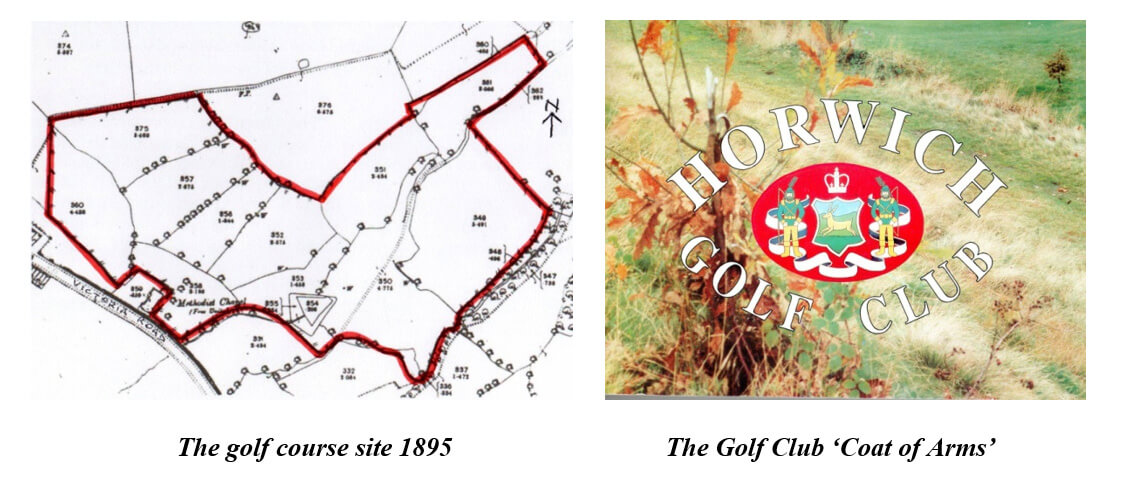
The course was immediately popular with the ever–increasing workforce and, although membership was limited, a Ladies Section and Junior Section were quickly formed. The first Ladies Competition winner being Miss Calderbank in 1899 and the first Junior winner Master CG Thornton. As the club developed, a First Prize presentation evening was held in September 1902 with one of the prizes, a silver cake dish, going to Mrs WH Howarth. In a lovely family gesture, the cake dish was returned to the club in 1993 to be given to the winners of the Mixed Knockout Competition.
Older readers will remember George Bell’s sports shop in Bolton town centre, but in his younger years he was a member of Horwich Golf Club who became a ‘scratch’ golfer and won many competitions. In 1913, he won the first Bolton Golf Championship and after joining Bolton Golf Club won this championship 6 more times as an amateur between 1922 and 1928 before becoming the Club professional (where he stayed for 19 years). George’s story is a remarkable one. From the age of 12, he was taught the game of golf by the then Horwich Club Professional, WE Bickle and became so proficient that at 15 he completed the club course in 34 strokes using only 3 clubs. As well as having a successful golfing career, George eventually went into business making his own golf clubs and set up his shop/workshop in Back Cheapside, Bolton in 1946. His son, David, became Assistant Professional to his dad at Bolton Golf Club before going on to run the family business.
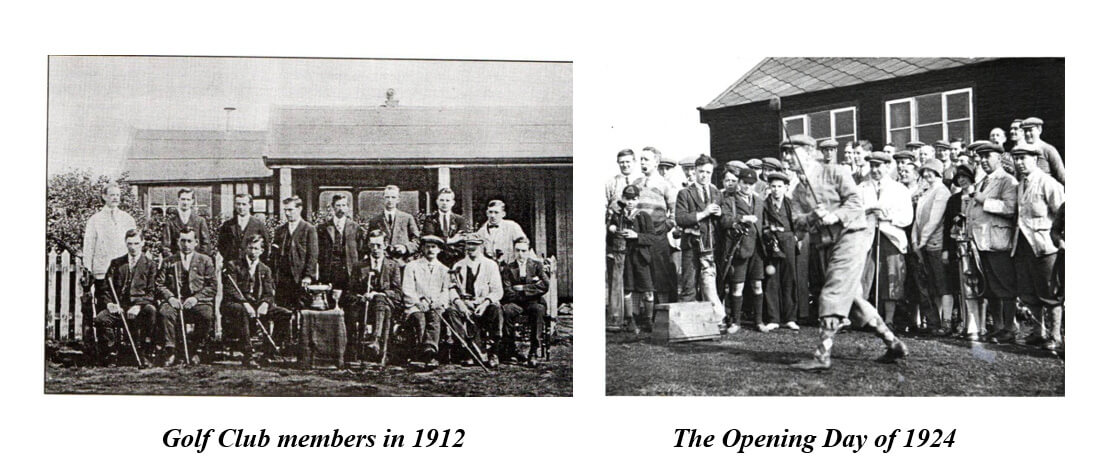
1914 saw the outbreak of WWI with many male golf club members joining the forces and leaving clubs struggling to continue. It was at this time that the Bolton ‘Golf Cot’ competition was created to raise funds to send ‘comforts’ to soldiers overseas. After the war, it was decided to donate the money raised to provide ‘cots’ at Bolton Hospital and eventually, after WWII, the money raised was given to local charities. This is still the case in 2025 with clubs competing for what was originally known as the ‘Buff Cup’. During the 1920s the club’s fortunes revived and a new era of the Professional/Greenkeeper began with the appointment of Arthur Kirkby. Arthur’s association with the club lasted for 36 years until his retirement in 1958. His skills as clubmaker, teacher of the game and green keeper were of lasting benefit to the club. In 1923 the new clubhouse was opened and the old pavilion was given to Arthur as his workroom. Henceforth, it was known to all members and visitors as ‘Arthur’s hut’.
In his time, Arthur Kirkby significantly re-modelled the course and, up until 1930, his duties included looking after the horse which towed the fairway machinery and pulled the cart taking deliveries of peat, cinders and sand. Following the opening of the new clubhouse, social activities increased and in 1927 the 1st Annual Dinner dance was held at the Mechanics Institute.
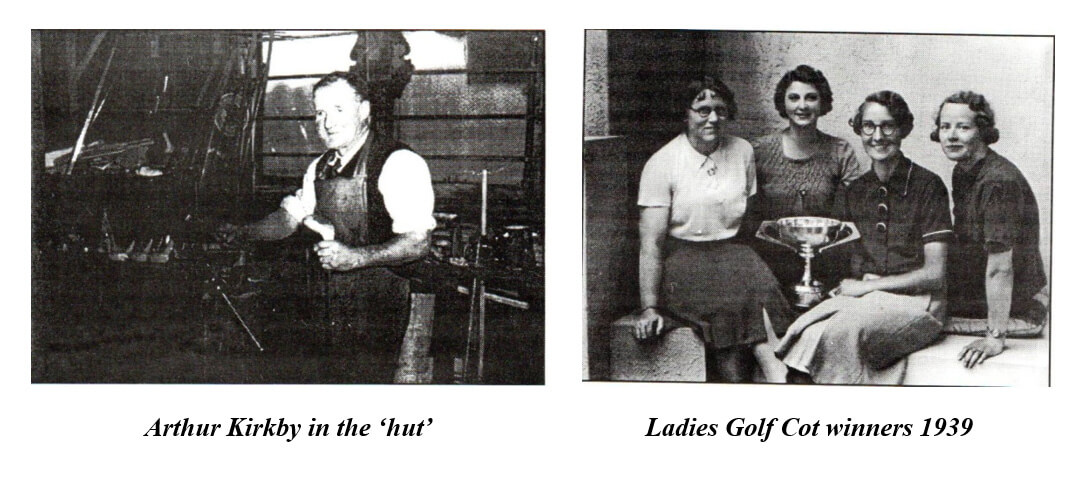
During the 1930s, the game of golf became more and more popular and Horwich benefitted from that popularity. So much so, that the subject of expanding the course was raised and discussions were held between the landowners (LMS Railway Co.), Horwich UDC and club officials, but they did not result in any concrete proposals. The Club joined the newly-formed Bolton Association in 1931 and soon gained a reputation for winning trophies, winning the 2nd division ‘golf cot’ in 4 successive years (1932-36) and the 1st division in 1937. Sadly, the ‘golden era’ of the 1930s was cut short by the start of WWII in 1939 and the wartime restrictions badly affected the administration of the club during the war years. Rationing affected the social activities of the club and the loss of personnel for wartime duties meant that maintenance of the course became a voluntary effort undertaken by the members. The club tried to carry on as normal with one of the main activities being to keep in touch by letter and parcel with those who had been ‘called up’. The main organiser of this was Club Captain H. Maugham whose son was tragically killed in Burma in 1942. One thing that did benefit from the war was the Saturday night ‘socials’ at the club which were boosted by the attendance of the Fleet Air Arm and US forces stationed in the area. The army dance band in fact played almost every Saturday night for 2 years to a very appreciative audience. Fund raising for the National War Effort became a priority at the club with unstinting support from the ladies. Past captain, N Holden became Secretary of the local ‘Warship Week’ Committee and the club played a significant part in Horwich raising the magnificent sum of £125, 000 (£6 million today). On the course, Horwich continued to do well in the Golf Cot competitions and produce a formidable club player in J Smith who won the club championship in 1944, 1945 & 1946. Although a great many players were away serving in the forces, the club celebrated its Jubilee Year in 1945 with a ‘gala’ event with competitions, games and a party in the clubhouse.
The return to ‘normality’ after the war was highlighted by the arrival of local landowner, Piers Bromilow, as President in 1947. He undertook the purchase of the club site and in 1951 granted a lease for 21 years with an option to purchase. The ‘star’ player at the time was John Kelly who won the club championship in 1948, 1950 -55 & 1960. Shortly after the Diamond Jubilee celebrations in 1955, monies had finally been assembled for the purchase of the land and Piers Bromilow was made an Honorary Life member for his services to the club with a trophy also purchased to perpetuate his name. Tributes were also paid to Arthur Kirkby on his retirement and local builder, John Banks, who had paid for many of the recent clubhouse and course improvements. The 1960s saw continued popularity for the game of golf with family membership very much to the fore in Horwich. The role of Vice President was created to harness the experience of senior members with outstanding players at the time being W Dougill, Mrs Marjory Black and R Tudor. An extra ordinary AGM was called to approve major course alterations which were completed in 1964 but proposals for a new club house did not proceed.
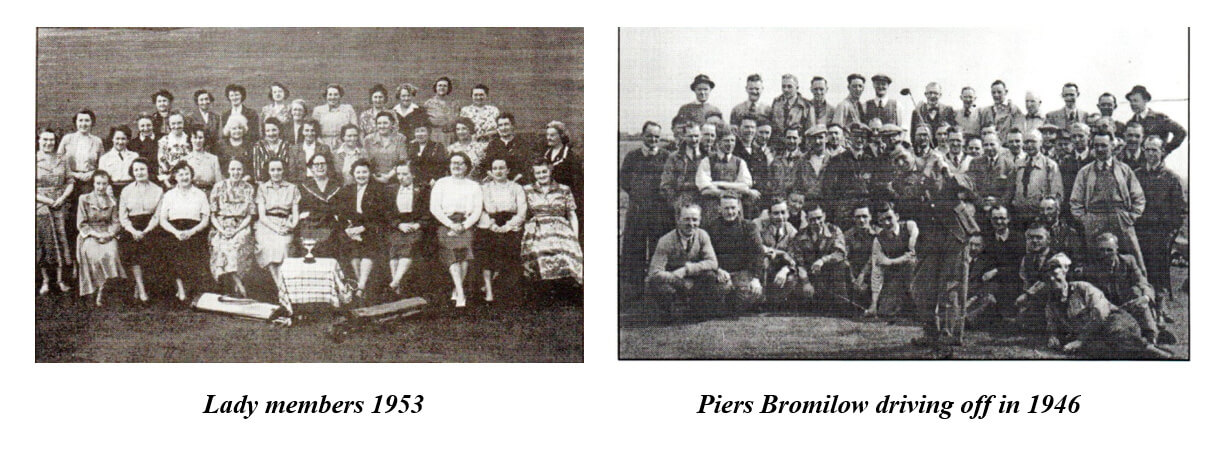
Work did finally start on club house improvements in 1971 with grant support from the National Playing Fields Association and thoughts then turned again to the prospect of an 18 hole course when Horwich UDC declared its intention to zone land next to the course for its expansion. Unfortunately, the momentum for this change seems to have been lost when Local Government Reorganisation took place in 1974 and Horwich became part of Bolton Metropolitan Borough. A number of Golfing Society honours came the way of Horwich members at this time. Don Cooper became Secretary of the Bolton Golf Cot Charity, Tom Taylor was elected as Captain of the Bolton & District Society of Golf Captains (he later became President in 1982) and Mrs LM Dorgan became President of the Past Captains Association. The outstanding golfer at this time was RI Furlough who won the club championship 6 times between 1969 and 1981. J Hamilton and Irene Hamilton became one of a number of husband and wife teams to be Captain and Lady Captain at the same time.
The 1980s saw the programme of improvements to the club house continue and a new watering system was installed on the course. To help with increasing costs, male membership was increased to £200 per year in 1984 and 2 plots of land next to the entrance driveway were sold to finance locker room improvements. Further successes were achieved in the Golf Cot tournaments and further honours bestowed on club officials: Ian Black succeeded Tom Taylor as BGA President in 1984 and went on to become President of the Lancashire Golf Union in 1995, Mrs Nellie Whitehead became Lady Captain and then President of the Past Captains Association and Donald Dougill Captain of the Golf Captains. A Seniors League (for over 55s) was added to the club’s golfing calendar in the 1980s together with a ‘200 Club’ Draw for club funds. The 1990s saw the introduction of ‘sponsorship’ by Fort Sterling and, in an effort to deal with a waiting list of 60-70 people, the club introduced a ‘5 day membership’ scheme. The junior sections were also thriving with the junior girls now entering Lancashire competitions. The long service of Mrs Ivy Pilling, Gordon Sharp, Tom Taylor, Don Dougill & Douglas Taylor was recognised by conferring Honorary Membership and Trusteeship. The outstanding male player of this period was Julian Farrimond who won the club championship 7 times between 1983–93. By 1993 it was time to prepare for the club’s Centenary and a Committee was formed led by Brian Hart. The Centenary celebrations paid tribute to all those who had gone before to make this a successful and friendly club and looked forward to a bright future with a full programme of events. The club was well run and felt financially secure, had a full membership (and waiting list) and still actively contemplated becoming an 18 hole course.
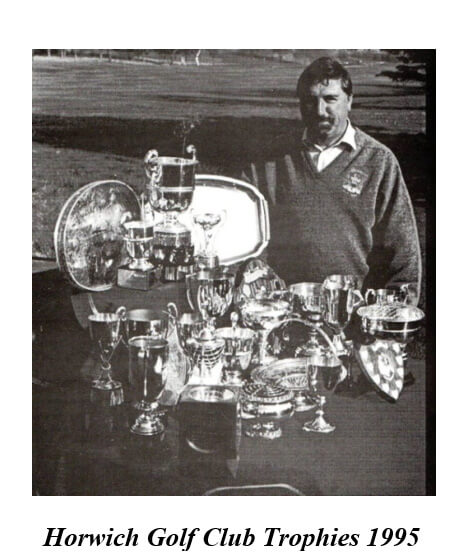
After the Centenary, everything seemed set fair for a long future, but the Club only continued for another 27 years, closing in 2022. The reasons lay in a combination of competition from other nearby 18 hole golf courses, declining local industry resulting in falling membership, and rising costs. In an effort to keep the club going, it did a ‘deal’ with Peel Holdings in 2012 which extended its life for a further 10 years before Peel decided to proceed with their plans for housing development on the site. And so ended a proud tradition of 127 years of golf in Horwich.
On a positive note, in the past 25 years, the Club had 2 male members elected as Presidents of the BGA and Bolton Golf Club Captains with a lady member becoming President of the Ladies Past Captains Assoc. It won the BGA League, Junior League and had the BGA Seniors Champion. It also had the honour of hosting the BGA Championships – things to look back on with pride!
HORWICH AT WAR By Stuart Whittle
As we all know, war is a horrible business. Unfortunately, mankind has had war-like tendencies from the earliest times and, as the centuries have passed, wars have got bigger and bigger. The 20th century was, of course, the worst of all for warfare, as it embraced more and more deadly weapons and drew in counties from across the world. We were promised that WWI would be the ‘War to end all Wars’ but it was soon followed by WWII, an even more horrendous conflict. At the end of WWII, the formation of the United Nations and NATO was supposed to ensure that such conflicts never happened again but, sadly, today we are still witnessing the awful scenes of warfare in the Middle East and Ukraine.
Last year we, as a nation, commemorated 110 years since the start of WWI and this year it will be 80 years since the end of WWII. It seemed appropriate therefore to produce a ‘Horwich At War’ exhibition which ran from November 2024 to February 2025. It is so easy to forget the sacrifice that was made to keep us free.
WORLD WAR I
Horwich is only a small town of 20,000 people but what it went through in WWI and WWII is typical of what happened to so many communities great and small across Britain during the last century. At Horwich Heritage we have many documents, photographs and artefacts illustrating acts of heroism as well as suffering and loss. On 6th August 1914, Horwich soldiers left the Barracks on Longworth Road to join the 1/4th Loyal North Lancashire Regiment and set sail for France. Of the 2000 men who left to fight in WWI, 430 lost their lives in the trenches of France and Belgium and elsewhere and the devastation to families can be seen on the map below showing in red the numerous deaths of those who lived in the terraced streets of the town. In 2014, we commissioned a new Roll of Honour to recognise that sacrifice. The most important battle that the 1/4th Loyals fought in was at Festubert in June 1915 and we have remarkable first-hand testimonies of what it was like, which we have transferred into a film which was shown as part of the exhibition.
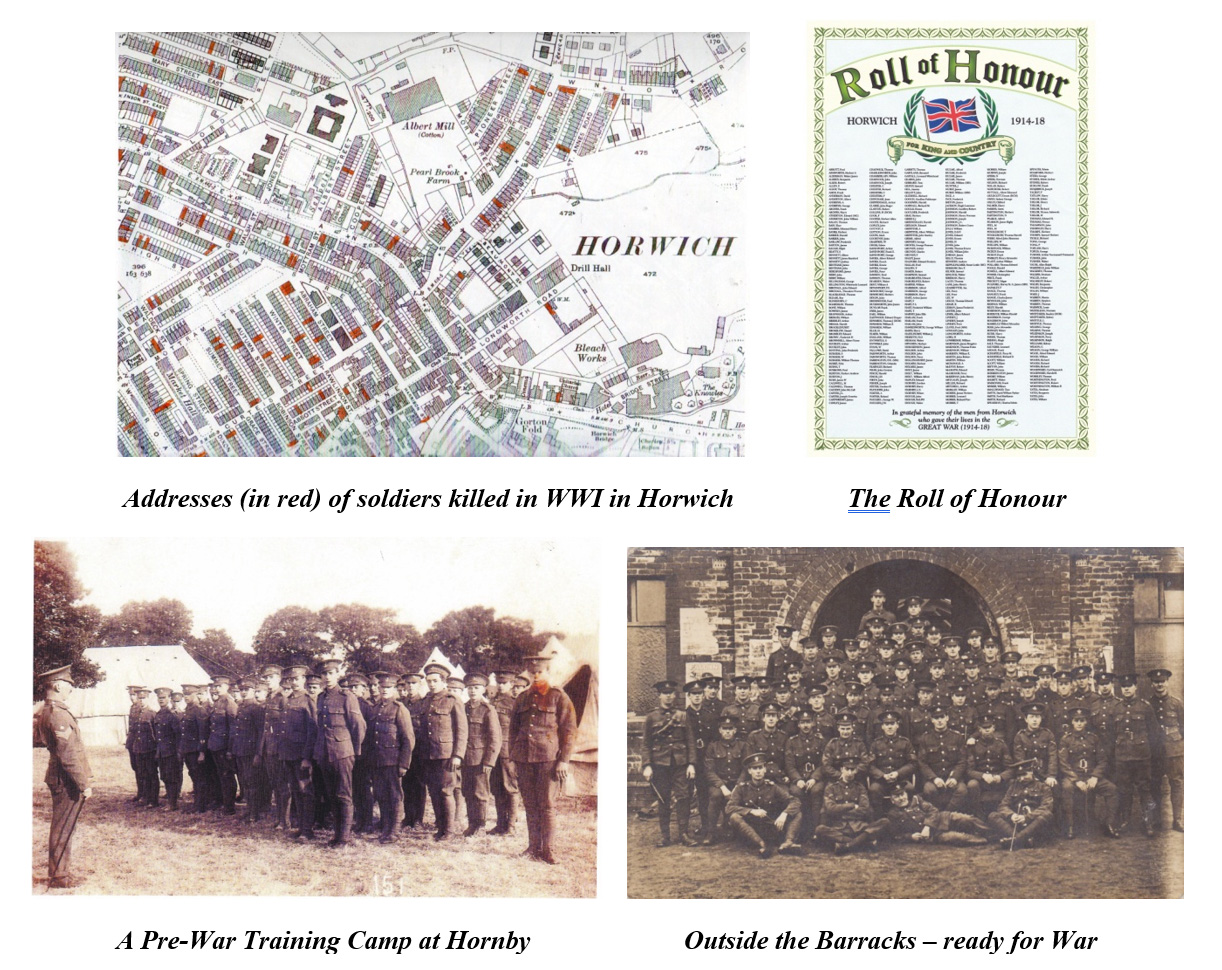
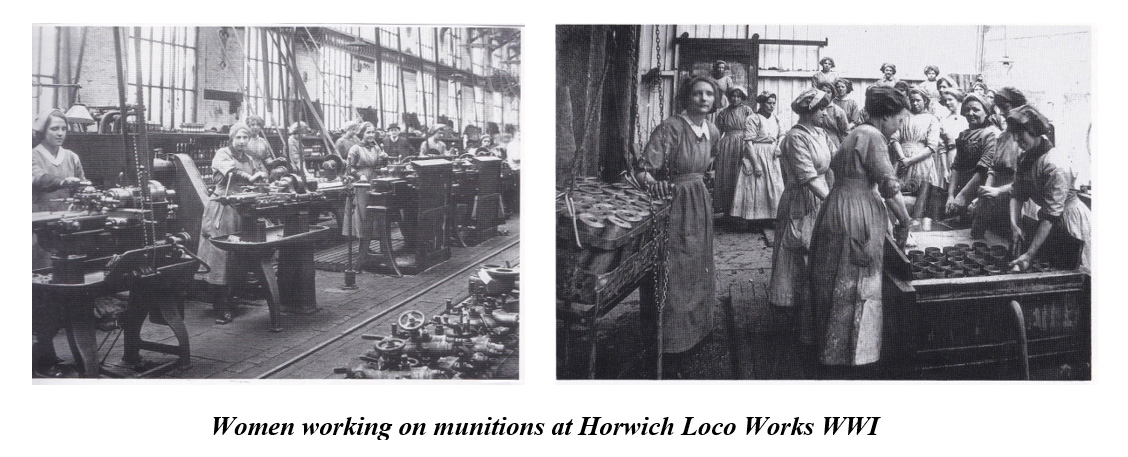
At home in Horwich, rising food prices and shortages caused great distress and a Relief Fund was quickly established to help those hardest hit. Despite the hardship felt by the Horwich community, they rallied round to provide support for the dozens of refugees who came to the town after fleeing the German assault on Belgium. 1914 also saw Horwich Loco Works suspend locomotive production and turn to the manufacture of armaments for the war effort. And, for the first time, women were brought into the workforce to replace the men who had ‘signed up’. They played an important role in producing fuses and shells and renovating cartridge cases and paved the way for increased working rights for women after the War.
THE INTER-WAR YEARS
Like the rest of the country, Horwich suffered during the depression of the late1920s/early 1930s but it was a tight-knit community and very resilient. It relied heavily on the Loco Works as its main employer but also had a range of ‘traditional’ industries as well like textiles, bleaching, paper, leather, mining, brick-making and sanitary ware. However, employment prospects improved as the storm clouds of war gathered again in Europe, particularly with the opening of the De Havilland aircraft factory at Lostock in 1937.
WORLD WAR II
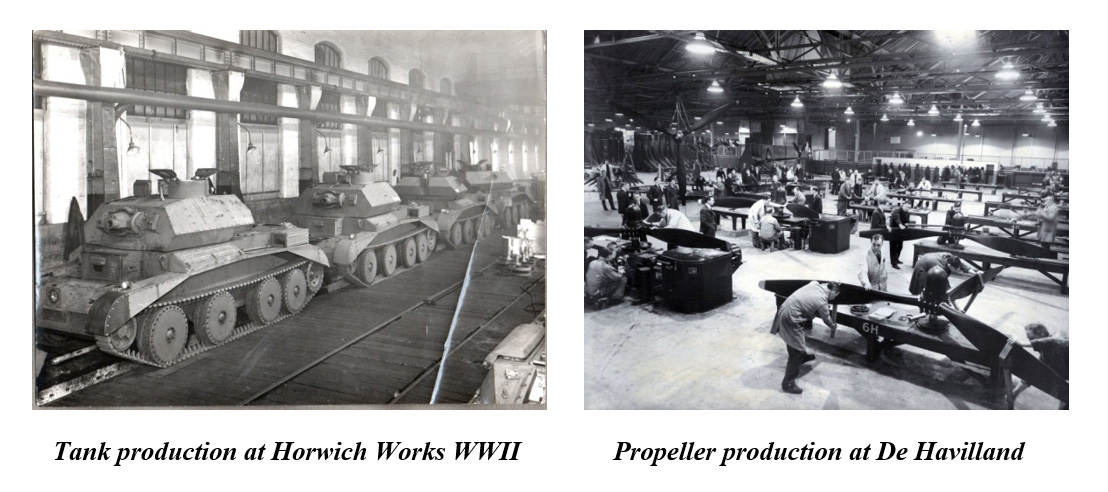
With the Declaration of War on Germany on 3rd September 1939, the immediate impact on Horwich was a surprising one – the arrival of the first group of evacuees from London. In total 535 mothers and children came to Horwich and were accommodated by 315 host families, a sizeable contribution for a small town of 15,000 people. As Horwich men were once more called up to serve, a range of Civil Defence measures was quickly put into place. Home Guard, ACF, ARP and WVS units were formed, air raid shelters constructed, gun emplacements introduced to defend the Loco Works and De Havilland and Rivington was declared a ‘military no go zone’ for the purposes of military training. Horwich women once more returned to help with the war effort at the Loco Works, this time working on tanks as well as shells and the De Havilland factory produced variable-speed propellers which helped the Spitfires win the ‘Battle of Britain’.
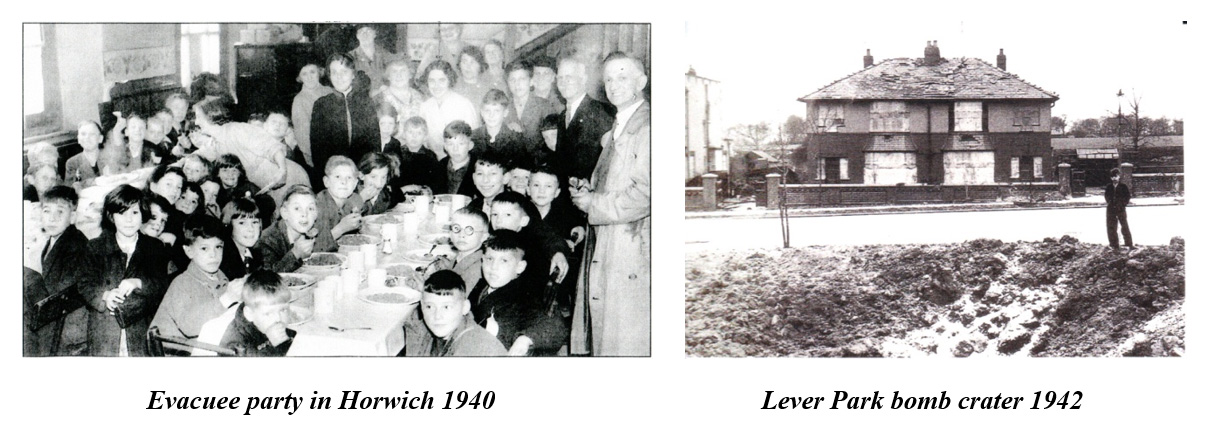
Nearly 2000 men and women from Horwich served in WWII. Sadly 127 lost their lives. Fortunately, only one bomb fell on Horwich (on Lever Park Avenue which thankfully didn’t kill anybody) but Horwichers were only too aware of the destruction taking place in Manchester and Liverpool (they could both see it and smell it!).
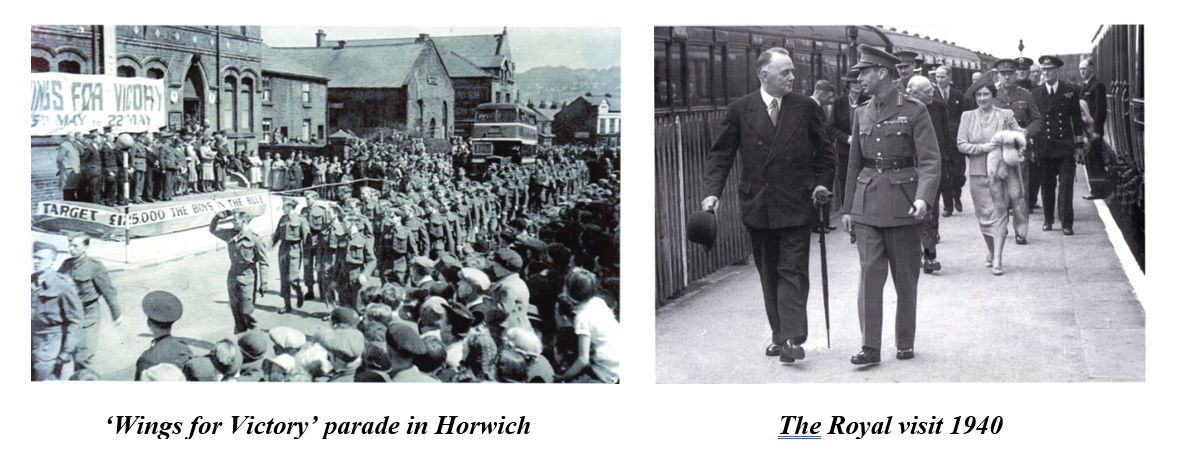
As in WWI, the civilian population suffered from shortages. Rationing was introduced, there was a nightime ‘blackout’and adults and school children contributed to the ‘war on waste’ by collecting scrap metal, paper and left over food (for the animals). Incredibly, in the midst of all this depravation, Horwich people collected a staggering £100,900 (£5 million today) for ‘Spitfire Week’ and ‘War Weapons Week’. They were also heartened by a visit by King George VI & Queen Elizabeth to Horwich in 1940 to recognise the wartime contribution of Horwich Loco Works.
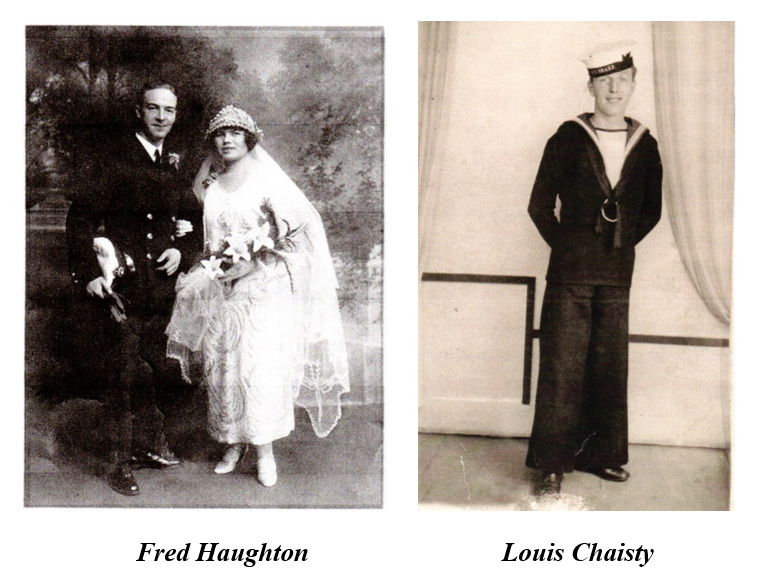
As in WWI, there were a number of military heroes who served in WWII. Edward Whittaker was the first to receive an award (DSM) for his services aboard the Submarine HMS Salmon. Unfortunately, he lost his life when the Salmon was sunk in July 1940. Fred Haughton (DSM) had an extraordinary war and survived to tell the tale. Having been involved in the Battle of the River Plate (which resulted in the scuttling of the Graf Spee), he was a gunner aboard the Prince of Wales, helping to sink the Bismarck, before being one of only a handful of survivors when the Prince of Wales was sunk by the Japanese. Undaunted, he continued to serve in Italy, in the D-Day Landings and on the North Atlantic convoys. Fred survived the war and died in 1978 – what a true hero! Louis Chaisty (DSM) was another hero who led a successful British commando raid on German- occupied Norwegian town of Vaagso in December 1941 only months after survivng the sinking of his ship, the Curlew. He was personally commended by Lord Montbatten, ‘Chief of Combined Operations’ for his leadership of the raid.
And, although Boltonians, not Horwichers, we always like to remember our brave Spitfire pilots, and none were braver than Squadron Leaders John Colin Mungo Park (DFC & bar) and Laurence ‘Pinky’ Stark (DFC & bar, AFC, Croix de Guerre), both ‘Battle of Britain’ heroes who had remarkable records of ‘kills’. Mungo Park was unfortunately shot down and killed over Belgium in 1941 but ‘Pinkie’ Stark survived being shot down over France and returned to take part in the D-Day landings. He was awarded the Croix de Guerre by the Prince Regent of Belgium in 1950 for his wartime service. Neither of these heroes is celebrated in their home town. I think it is time they were!
There was so much more to see and read about in our ‘Horwich At War’ exhibition. It was fitting that we remembered the sacrifices that people made and have continued to make to keep this country safe.
A SOLDIER’S LIFE By Tommy Edwards DCM
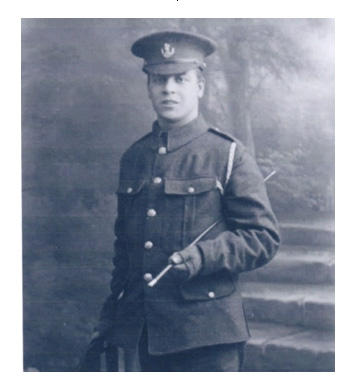
Remarkably, in the early years of WWI, soldiers were permitted to keep diaries and write home about their experiences on the battlefield. One such soldier from Horwich was Tommy Edwards who has left us this haunting account of life on the ‘Front Line’
My name is Tommy Edwards. I was born in Newton Heath, Manchester in 1883. My parents came from Cardigan in South Wales but they had moved to Manchester to take advantage of work on the railways. They hadn’t been at the Loco Works at Newton Heath very long when the opportunity came to move to the new Works being built at Horwich. We took up residence in Hawksley Street, one of the newly built terraces of houses built for the loco workers. Unfortunately my dad died in his 40s, which made things very hard for my mum and 5 young children. It was important that my elder brother and I started work as soon as possible to bring in a wage and, by the age of 14, we had followed our dad and were both apprentices at the Works. My brother, Charles, became a riveter in the boiler shop and I became a blacksmith’s striker in the forge. These were hard, dangerous jobs that required real physical strength but they toughened us up for life.
At an early age, I became interest in the military, having met a number of old soldiers in the town and I became determined to join up with the Old Volunteers, as they were then known, as soon as I was old enough. As our number increased, thanks to the building of the Works, we then became known as ‘F’ Company of the 1st Volunteer Battalion of the Loyal North Lancashire Regiment. Our Commanding Officer was Colonel Widdows and our Drill Sergeant was Sgt Brady - one of the finest men you could ever wish to meet. He came over from Chorley twice a week to take charge and, since we didn’t have any permanent home, we moved from our first base at Gorton Fold to Captain Street then to the Princes Arcade basement and the band room under the L&Y dining room in Gooch Street before finally settling in the new Longworth Road Barracks when it opened in 1910.
22 of our lads went out to South Africa to fight the Boers under Captain Foley and thankfully they all returned safely. Sgt Brady retired shortly afterwards and he was greatly missed. In 1907 came a great change. All the Volunteers became Territorials and we had to change our name to the 4th Battalion of the Loyal North Lancashire Regiment but were still known as ‘F’ Company. We also retained our old red uniforms. 1910 saw us nicely settled in our new barracks and enjoying the comradeship and our annual camps in various parts of Lancashire.
Unfortunately things were about to change and on 4th August 1914 the peace of our camp at Kirby Lonsdale was shattered when we were ordered to return to Horwich and get ready for war. We slept in the barracks and then caught the 4 o’clock train to Preston. Hundreds of people followed us as we marched from the barracks to Horwich station with tears and cheers. We joined the other 4th Loyals Companies and on 15th August we all signed up for overseas duty at Preston Town Hall. After a brief lull, things started to happen fast. By October we were in camp in Swindon training for war service in France. And on 3rd March 1915 we landed in Boulogne as the new ‘C’ Company attached to the 51st Highland Division under Captain Foley and Captain Peak. I wrote home saying that I was sure that all our friends and relatives in Horwich would be proud to know that we were going to the front to do our bit for our country. We all wanted to be a credit and to do honour to our home town of Horwich. The Company moved on to Flanders and by 27th May we were in the trenches at Festubert awaiting battle orders. This was it, what we had been training for, what we had been waiting for! Real action! We were both excited and frightened!
When we arrived, conditions were bad. The trenches were water-logged, ankle-deep, sometimes thigh deep in mud. Dead German and Scottish soldiers were still lying where they had fallen in the previous battles and when the sun came out there were swarms of insects drawn by the dead bodies. But we hadn’t time to dwell on all that, we were there to fight and at one o’clock on 14th June we were in our trenches waiting for the order to attack. The Loyals’ commanders ordered C Company, which included most of the Horwich men, to lead the charge and at 6 o’clock we went over the top!
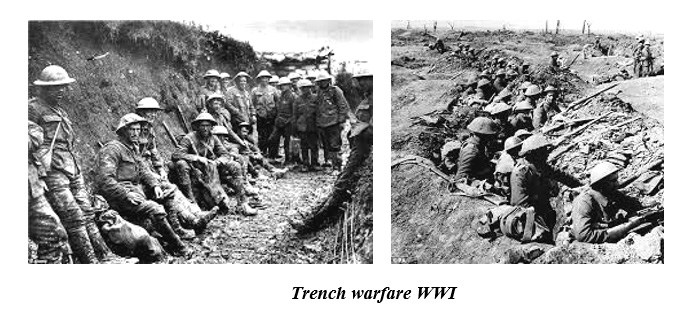
The German trench was about 50 yards away from ours and the earth fairly shook with the fearful pounding of shells. No.12 Platoon charged first – it was mainly Horwich lads and commanded by Lt. Parker of Preston. We climbed the parapet and raced like tigers for the German lines. In five minutes it was ours – but at what cost! Very few of the Platoon were left. Sgt Smith was killed after bayoneting 6 Germans and Sgt. Clayton accounted for a few before he was brought down. No.11 Platoon then followed up with more Horwich lads and commanded by Lt. Davies of Preston – as brave a man as any I saw. We tried to advance as best we could but bullets seemed to come from every direction. Men were dying all around me including Lt. Davies whose last words to me were “For God’s sake take the men on”. With no Officers left, I had to take charge and rallying the men we advanced by rushes towards the 3rd German trench. By this time we were down to about 20 or 30 so I gave the order to dig in. Even then our lads were getting picked off by machine gun fire. Then, as I was waving the lads forward, my right arm dropped as if paralysed. I felt no pain but looking down I saw it was covered in blood. I got it bandaged up and then Major Nickson told us to fall back as the German bombardment became too much.
After a journey of about 2 hours we reached the Dressing Station, which was crowded. It was wonderful to see the chivalry displayed by those wounded men. No one would have their wounds dressed until they were certain that there was nobody worse than they were. I think back now at how we had been scoffed and sneered at in Horwich but I tell you this…if it had not been for the Territorial Force, England would have been in Queer Street, and I am proud to be one of them.
The battle raged until the early hours of the following morning at which point the British troops were ordered to return to their own lines. This they did after suffering heavy losses. When the roll was called only 243 out of 645 answered. The casualties were 26 killed, 266 wounded and 100 missing, a total of 402. Of the 86 casualties in C Company, 10 Horwich men were killed and 25 wounded. Sgt Major Edwards returned to action after recovering from his wounds and was awarded the Distinguished Conduct Medal (DCM) for ‘manoeuvring his company in such a way as to escape with very few casualties’.
After the war, Tommy Edwards returned home but only a year later the following notice appeared in the Horwich Chronicle:
The death has been announced of Sgt. Major Thomas James Edwards D.C.M. of 24 Hawksley Street, Horwich and formerly of 1/4thBattalion Loyal North Lancashire Regiment and Secretary of the Horwich Comrades of the Great War. The deceased, who was 36 years of age and unmarried, had been in failing health for about 6 months. By trade he was a blacksmith at the Loco Works. He had a long connection with the volunteer movements in Horwich, having been in the Old Volunteers and in the Territorials since the formation of the LNLR. He was mobilised with the 1/4th LNL when war broke out and his regiment was sent to France in 1915. He was the first to bring honour to his native town by winning the D.C.M. and, in recognition of his services, he was presented with a purse of gold and an illuminated scroll by the Horwich Heroes Recognition Committee. Although wounded, he successfully rallied and led his Company at the Battle of Festubert when all the officers had become casualties. On another occasion his fine example during heavy bombardment gave great confidence to his men.
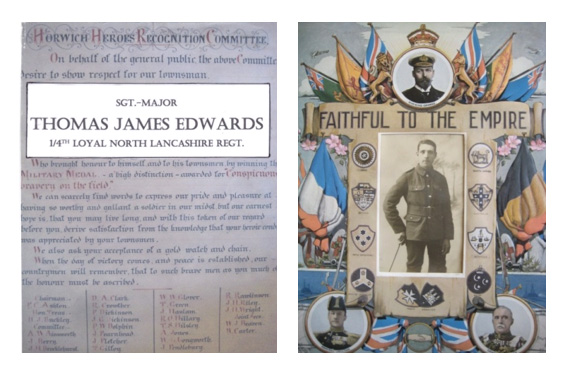
Sgt. Edwards’ funeral took place with full military honours at Horwich Parish Church. The Horwich Comrades of the Great War and the firing party & trumpeter from Fulwood Barracks, Preston, marched in front of the coffin, which was draped with the Union Jack and covered with wreaths. The Rev. Shepard conducted the last rites as 3 volleys were fired over the grave and the trumpeter sounded the last post. A beautiful wreath from the Comrades was placed on the grave.
Tommy Edwards’ life was typical of thousands of young men who gave their lives for their country in the Great War. 430 men from Horwich died in WWI but hundreds more returned home scarred physically & mentally by the ordeal. They returned to a battle-weary country which took many years to recover. Life was never the same again but some good things did emerge out of the slaughter – a more equal society, votes for women, medical advances, technical advances that gave rise to the rapid development of radio, TV, the motor car, aeroplane, health & welfare improvements – all of which we enjoy the benefits of today.
So, as we commemorate just over 110 years since the start of WWI and 110 years since the Battle of Festubert, let us give thanks for the sacrifice that kept this country and the rest of Europe free – and may we always remember and be grateful.
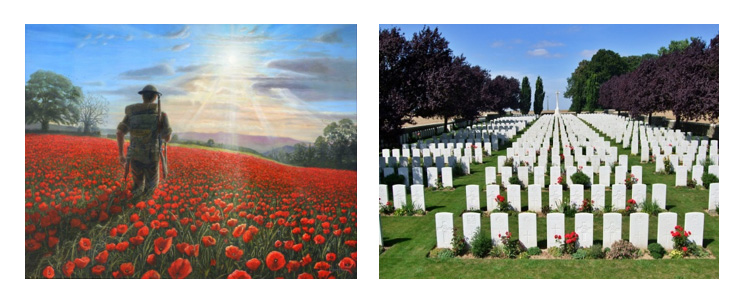
WE SHOULD NEVER FORGET!
HORWICH IN 1945 By Stuart Whittle
As we approach the 80th Anniversaries of VE Day & VJ Day, it is salutary to look back at what Horwich was like in 1945. Thanks to the Horwich & Westhoughton Journal, we have a detailed record of the events that year as 6 years of war finally ended. During the early months, because of press censorship there were only ‘snippets’ of information about the progress of the war itself, but there were strong indications of its progress across Europe thanks to the publication of letters home from members of the armed services and reports of the release of local men from the German Prisoner of War Camps (Stalags). When the announcement of the German surrender came on 8th May there were wild celebrations across the country and in the streets of Horwich which were repeated on 15th August when news of the Japanese surrender came through. As the town struggled to get back to ‘normal’ peacetime activities, the war still cast a long shadow with the joy of the release of Japanese POWs being mixed with revulsion at their treatment in the now notorious ‘death’ camps.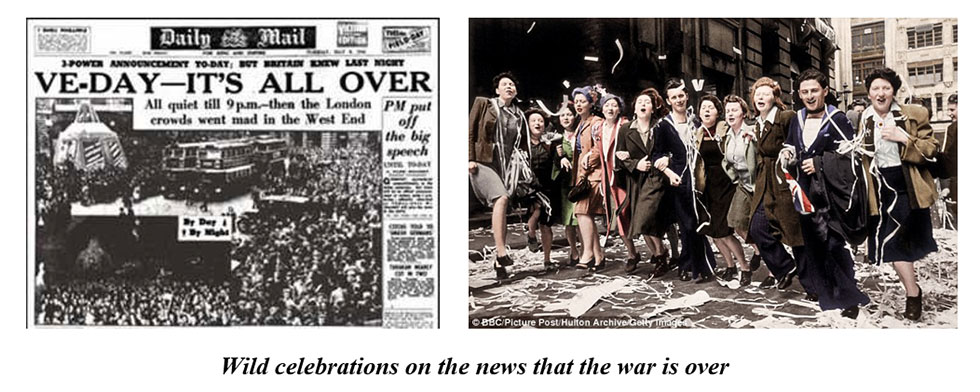
The various Civil Defence organisations began to step down, the blackout was lifted, women were released from work on munitions at the Loco Works and local mills like W T Taylor’s (the biggest towel manufacturer in Britain at the time) began to recruit workers for the post-war surge in demand. Both temporary & permanent houses were to be built with priority given to returning sevicemen & their families. However, rationing was still in place with shortages of coal and long waiting lists for most domestic appliances. There was a big rush to get away to the Lancashire coast in July for the first post–war Bank Holiday with 9000 Horwich residents making the trip. They managed to send back an astonishing 2000 postcards, most of which commented on how crowded it was!
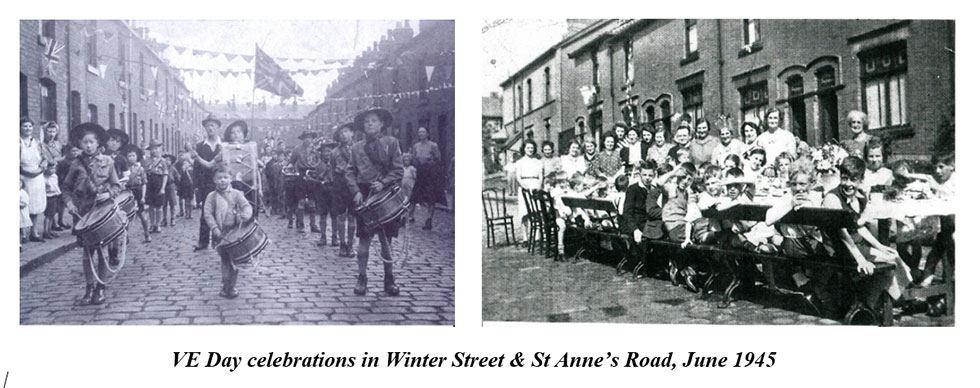
Despite the regard the nation had for Churchill’s wartime efforts, there was a ‘landslide’ victory for Labour in the General Election with the nation anxious to see changes (the nationalisation of the railways & mines, a National Health Service and educational reform) which would benefit all those who had fought for their country. The country was determined to show its gratitude to those who had fought and died by making a special effort to commemorate Remembrance Day on 11th November. In Horwich, ‘Thanksgiving Week’ at the end of September raised £96,740 (almost £5 million today) – and this was on top of the other magnificent fund-raising efforts that had taken place during the war years which had already raised over £100,000 (£5 million today).
In terms of a ‘fitting’ memorial to those who had died, Horwich UDC set up a Committee to consult the public and decide what form this should take. The feeling was against a ‘traditional’ monument and the majority voted for a public building which would accommodate a swimming baths, assembly hall and meeting rooms. The Council accepted this decision and offered to maintain such a building but the money would have to be raised separately to construct it. As we all know, it would take another 30 years (until the 1970s) for these facilities to be built and within another 40 years they would be demolished and replaced with a new ‘Leisure Centre’. The year ended in a relatively subdued fashion, with Christmas and New Year still ‘muted’ affairs similar to the previous war years. This was partly because festive food and drink were still in short supply but also because of the realisation that the post-war recovery was going to be a ‘long haul’. Nevertheless, the Chairman of Horwich UDC, Cllr Close, spoke for everyone in Horwich when he looked forward to a ‘lasting peace and greater prosperity’.
HORWICH HEROES 1945
Courtesy of the Horwich & Westhoughton Journal, we have a record of those who fought and died, those who returned safely from POW camps and those who received honours for their war service during 1945.
KILLED IN ACTION/POW CAMP
L/Sgt. Sampson Everin (Grenadier Guards), Chorley New Road
Trooper H Wallace (former County Librarian) (Japanese POW)
W G Ratcliffe, Air Gunner, The Green, Rivington
Trooper William Parker, Whitworth Street (POW on ship sunk off Japan)
W G Ratcliffe, Air Gunner, The Green, Rivington
Pte. Edwin Ainscow, Brownlow Road in Europe
Sgt. R S Finney, Brownlow Road, with the RAF in Germany
P/O Edward Rawlinson – funeral at Horwich Parish Church
Staff Sgt. John Ellison (glider pilot), Lee Lane – killed in airborne assault on Rhine
LAC Thomas Calderbank, Panton Street – funeral at Ridgmont
Flt.Eng. Arthur Thorp, Dixon Street – Europe
Pte. E W Smedley, Autumn Street (Japanese POW)
L/Cpl. Stanley Cranshaw, Stephenson Street
Sgt. George Hamer, Harper’s Cottage, West View, Wilderswood
Bandsman Henry Lane, Taylor Street
Cpl. J E Jones, Old Lords Crescent
(all Japanese POWs)
R N Engineer, Arthur Lee, Chorley New Road, aboard submarine ‘Poipoise’ off Malaya
POWs RETURNING HOME
Gunner Thomas Lloyd, New Brunswick Street - 4 years in German prison camp
Pte. Henry Wallwork, Brownlow Road - 5 years in German camp
Pte. John Johnson, Wright Street – 5 years in Germany camp
L/Sgt. Alfred Miller – captured in North Africa 1942
Sgt. Alfred Davies, Emmett Street – captured North Africa 1943
L/Cpl. Victor Holbrook, Station Road - captured Crete 1941
Gunner Joe Kennedy, St. John’s Street – captured Crete 1941
P/O Charles Robinson, RAF, Melbourne Grove – Stalag in Germany
Pte. Harry Turton, Canada Street – captured Anzio
Fusilier Fred Harrison, Wright Street
Pte. James Hatzer, Chorley New Road
Pte. Fred Brown, Fox Street
F/O Gordon Heyes, Blackrod
P/Officer Michael Wilding, Dryfield Lane, Rivington – Stalag Luft 3, Germany
Lt. John Byrne, Brindley Street – home from Burma (Chindits)
Sgt. James Green, Wright Street – captured North Africa 1942
Gunner Leslie Cannell, Ardley Road – captured France 1940
Pte. Leonard Wilkins, Wright Street – captured Dieppe 1942
Driver William Davies, Fairbairn Street – captured North Africa 1942
Driver Walter Burgess, Lee Lane – captured France
Gunner Norman Chandler, Chorley New Road – captured North Africa
Gunner Michael Doran, Drill Hall, Longworth Road - captured France
Pte. James Fairbrother, Hartley Street – captured Middle East
Pte. Willis Bromilow, Lower Austins – captured Arnhem
Driver Leonard Lord, Watts Street – captured Greece 1944
Japanese POWs:
Lt. A. J Wolfe, Crown Lane, Pte. James Smith, Winter Hey Lane,
Pte. Fred Whalley, Vale Avenue, Lt./Cpl. Richard Jolley, Whitworth Street,
Pte. Arthur Bromfield, Winter Street, Sig. E Heywood, Crown Lane,
Trooper H Gaythorpe, Old Lords Crescent, Pte. W Johnson, Mason Street,
L/Cpl. R Hellard, Old Lords Estate, L/Cpl. H Bromley, Ainsworth Avenue,
Pte. H Mason, Hawksley Street, Gunner Thomas Lord, Mason Street,
Bandsman John Garrity, Dickinson Street East, Pte. William Turnbull, Derby Street,
Pte. Jack Kendall, Dickinson Street West, Pte. William Partington, Gorton Fold,
Pte. George Prior, Hilton Avenue, L/Bdr. Harold Dagnall, Ainsworth Avenue,
Cpl. Douglas Britton, Leicester Avenue, Pte. George Thomas, Hilton Avenue,
Thomas Mead, Chapel Street, Trooper Clifford Downes, Berne Avenue
(38 POWs had now returned to Horwich)
MILITARY & CIVILIAN HONOURS
Awarded MM: L/Sgt. Sampson Everin (Grenadier Guards), Chorley New Road
Mentioned in Despatches: Lt/Cpl. James Goth (Pioneer Corps), Chorley New
Road for bravery & devotion to duty in Italy
DFC awarded to: P/Officer (Air Gunner) John L Showell, Bridge Street for
undertaking 52 operational flights in North Africa & 2 over Germany
Horwich Heroes Recognition Committee Awards (an illuminated scroll &
inscribed wallet) - 3 serving: Lt. John Byrne (DCM), Brindley Street,
L/Sgt. Alfred Davies, Julia Street. L/S Louis Chaisty (DSM), 2 posthumous:
L/Signalman Edward Whittaker (DSM), L/Sgt. Sampson Everin (MM)
Mentioned in Despatches: Sub. Lt. Ronald Moss (RNVR pilot) – for
distinguished service with the Russian convoys
Awarded DSM : Naval Officer Frederick Haughton for action aboard the
Prince of Wales in sinking the Bismarck
Awarded DSM: L/S Louis Chaisty for leading a successful commando raid
in German-occupied Norway
Awarded DSM: L/Seaman Royce Benson, Hawkshaw Street, for detection of
submarines
Awarded DSC: Lt. Ken Crompton RNVR for flying planes off aircraft
carriers to sink enemy ships in Far East
Mentioned in Despatches: W/O John Virgo, Lee Lane – for action in Burma
Awarded DSM: A/S William Parkinson, Eiffel Street, for ‘anti-submarine
activities’
8 local servicemen had won decorations in the war and received presentations from the Horwich Heroes Recognition Fund
OBE awarded to: D Williamson (Superintendent of Horwich Loco Works)
BEM awarded to: Harold Pollitt, Brownlow Road, chargehand at Loco Works
* Posthumous VC awarded to: Lt. W A (Pete) Sandys-Clarke, Loyal Regiment,
Dimple Hall, Egerton, Bolton for ‘conspicuous gallantry’ in Tunisia, April 1945.
* Awarded DFC & bar: Spitfire pilot John Colin Mungo-Park for action in the Battle of Britain
* Awarded DFC & bar & Croix de Guerre: Spitfire pilot Lawrence William Frazer Stark for action in the Battle of Britain and D-Day landings.
Some of these names may well resonate with families still living in Horwich today. If so we would love to hear from you. We should never forget their sacrifice.
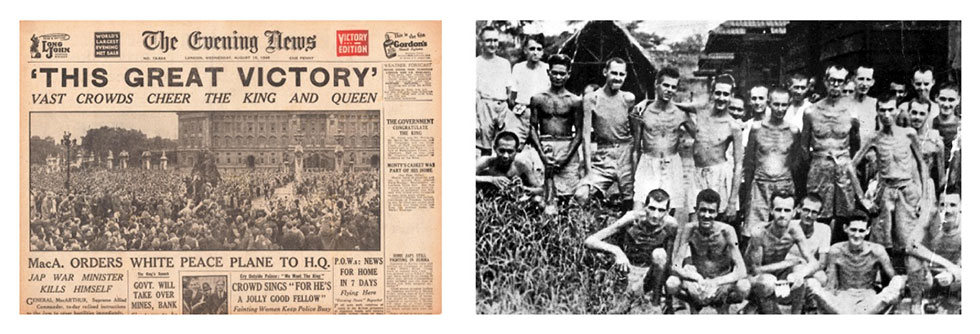
THOMAS CHALLENDER By Brian Smith
Glancing through the Horwich Heritage records of local people who had given their lives for their country in wartime, I came across the name of Thomas Challender. I recalled that this was the name of the young man who worked on deliveries for Grimshaw’s bakers at 95 Lee Lane before his call up to His Majesty’s Forces in WWII.
My wife, Joyce, whose father, Ernie Grimshaw, ran the shop remembers Tom from the times she visited it in her pre-school years. “He was a really nice lad who had fun with me and the other family members. We sold dried peas and one of his tricks was to toss them in the air, catch them in his mouth and eat them.” One job Tom did with Ernie was to deliver bread to the residents of Rivington Lodge on Dryfield Lane. On one freezing cold winter’s day, the pair struggled through a field of deep snow and arrived at the Lodge exhausted, only to be told “I didn’t think you’d be coming today, so I’ve done the baking myself.”
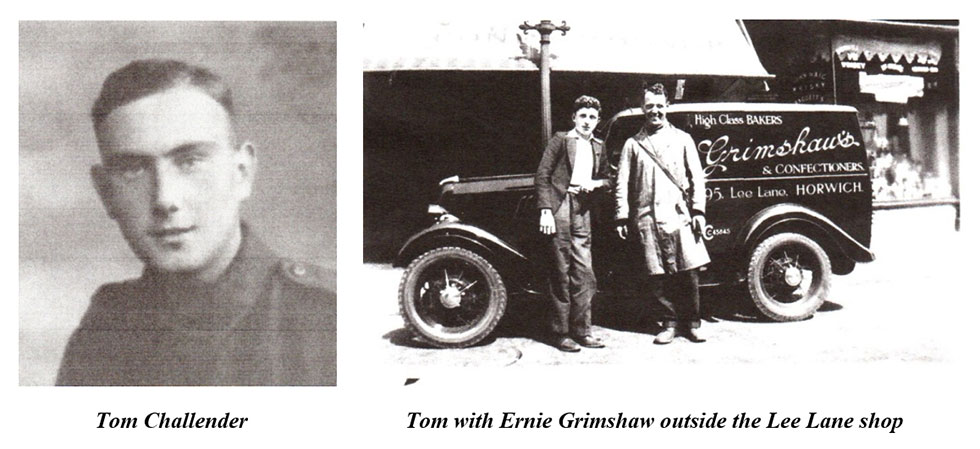
It is always that much more moving when you have known someone who died fighting for our freedom.
Thomas Challender was the son of William & Mary Challender. He was a Private in the 1st Battalion East Lancashire Regiment and was just 19 when he was killed in action on 1st October 1944 in Belgium. In the post D-Day advance into Europe, his regiment encountered fierce German resistance as they attempted to cross into Holland. He is buried in Geel Cemetery along with 400 other British & Commonwealth soldiers.
TWO LADS RESTORATION PROJECT by Roberta Gleaves (Smithills Woodland Trust)
The mound of stones known as ‘Two Lads’ which is such an iconic landmark on the moors above Horwich, has recently been declared unsafe by Smithills Woodland Trust who have declared their intention to ‘restore’ it. This is bound to be a controversial project with people having different opinions about what it should look like, so the Trust has promised to conduct an extensive programme of public consultation before, during and after undertaking the work. There will also be an archaeological dig to try to ascertain its true origins. So what do we know about Two Lads?
There have been many theories about the origins of ‘Two Lads’ and we recommend the chapter written by Karen Holroyd in the ‘Lives And Times of the Smithills Estate’ entitled ‘Two Lads: The Myths and Legends’ for a comprehensive examination of all the possibilities. It is not a protected scheduled monument but is acknowledged by Historic England in their Research Records as Monument No.43445. In terms of the evidence of what the site originally looked like, the best drawing and description has been provided by Dorning Rasbotham in 1776 (see below). At that time, the stone circle and 2 small cairns within it were still intact and suggest a pre-historic burial site of c.1500 BC – in keeping with other burial site in the vicinity at Winter Hill and Noon Hill.
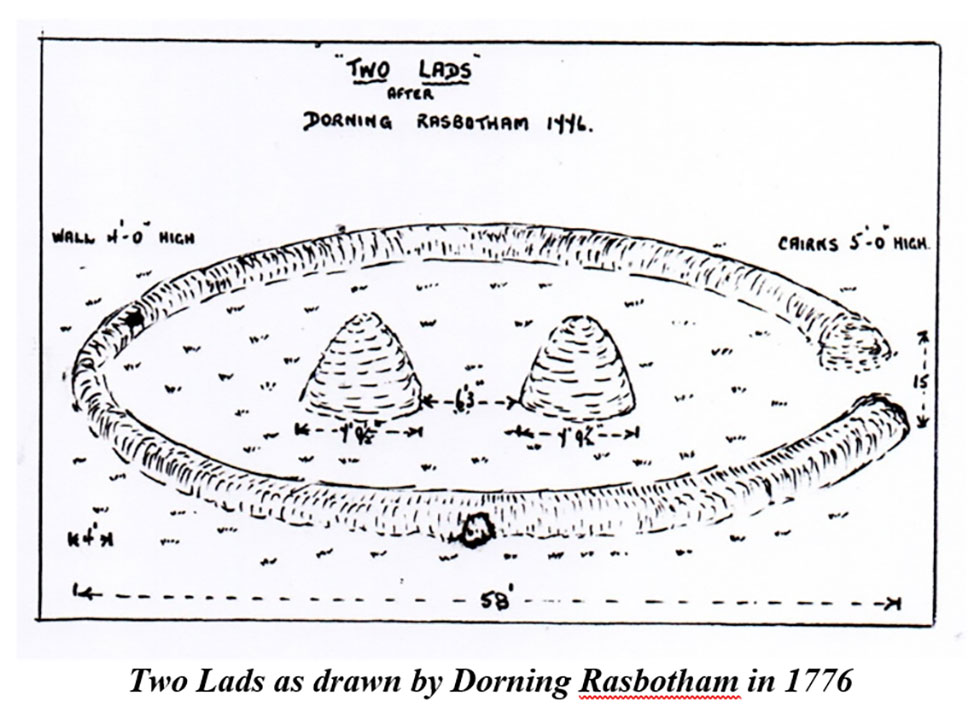
The popular local legend that the cairns were erected in memory of 2 boys who were ‘wildered’ (lost) on the moor persists thanks to the writings of local historian, Thomas Hampson who, in his History of Horwich, claimed the bodies were those of the children of one of the early Saxon Kings. To add to this intrigue, an early name for Winter Hill was Egberden Hill which in old English means valley belonging to Egbert. So was Egbert the Saxon King referred to? Unfortunately there isn’t much evidence of Saxon occupation in the area to back this up, although it is believed that Smithills Hall was once a Saxon Palace and there are the 2 Rivington Barns of course. The Roman may also have used the 2 Lads site as one of their upland ‘look outs’. What is clear, is that a person or persons unknown began to ‘modify’ it during the C19th, presumably as a result of it becoming more accessible both to local miners and the rapidly growing population of Horwich. It is not clear exactly when the cairns started to increase in height but, by 1819, Bolton Surveyor, John Albinson, recorded each cairn as standing at 9 feet tall. Fast forward to the 1970/80s, and we have a ‘battle’ between local man, Robin Smith, attempting to re-build the cairns and Bolton Council trying to demolish them on health and safety grounds. Fortunately, local opinion won the day because the cairns are still there, albeit in a precarious state. Which brings us full circle to the need to do something to ‘safeguard’ their future as a local landmark of major physical, emotional and historical significance.

CROWN SIGNPOST REPAIR By Roy Davies
On 28th November 2024, an historic local landmark was damaged in a road traffic accident at the Crown roundabout in Horwich. A car mounted the roundabout and hit the cast-steel signpost causing extensive damage to the post and its directional ‘fingers’. The signpost had stood in Horwich for more than 100 years and had become a well-known and much-loved feature in the town. That evening, Bolton Highways Department came out to make the post safe and take the damaged fingers away. Having seen the post still on the ground, I was concerned that it might be stolen, so the next morning I returned with James Dickinson of Dickinson’s Skip Hire to remove the post to his premises for safe keeping.
Speaking to the Highways officer, Stewart Newsham I was informed that it was normal procedure to replace the signpost with a synthetic material due to the cost and possibility of theft of a metal one. This did not seem to me to be a satisfactory outcome, so I ask Stewart to speak to the loss adjuster of the car driver’s insurance company. This he managed to do and it was agreed that a ‘like for like’ replacement could be made if we could find someone to make it. I managed to find the name of the original maker on the base of the post, a company called ‘The Royal Label Factory (1874)’ based in Stratford, and was delighted to discover that they were still trading as ‘Leander Architectural’, now based in Buxton. The company then confirmed that they could do a full repair on the post and repair or replace the fingers – which the insurance company agreed to at a cost £8000.

Whilst examining the damaged post, I noticed that one of the fingers (the one pointing to Bolton) was missing. No one seems to know when this might have happened but it seemed like a good time to have it replaced to bring the signpost back to its original condition. So Leander Architectural were commissioned to produce the Bolton finger post. The cost of this could not be covered by the insurance so an extra £920 would have to be found. Thankfully, through the intervention of Cllr David Grant, half the money has been contributed from Bolton Council’s ‘Discretionary Fund’ and the other half by a Horwich Town Council grant to Horwich Heritage. The new signpost has now been installed and Horwichers can once more admire this historic landmark. It just shows what a bit of knowledge and the support of the local people can do!
Well done Roy – a magnificent effort!
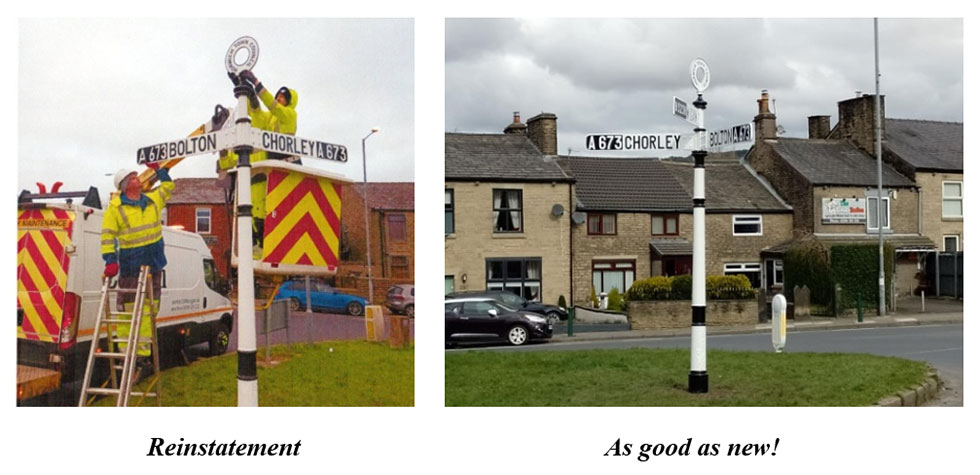
NARROW GAUGE LOCOS AT HORWICH WORKS
A 40th Anniversary edition of our magazine wouldn’t be complete without a feature on Horwich Loco Works – the closure of which in 1983 prompted the formation of Horwich Heritage. Here we look at the role of the miniature railway locomotives that delivered parts around the Works. The arrival of ‘Wren’ at the East Lancs Railway at Bury (on loan from the National Railway Museum at York) has prompted renewed interest in these ‘workhorses’ of the Locomotive Works. Here is a brief account of their design and activities.
It may be difficult to believe now, but the Railway Works of the early-mid C19th relied on handcarts, wheelbarrows and horses to move parts around their sites. To improve this operation, the LNWR Board authorised the introduction of a revolutionary steam-powered narrow gauge tramway system at Crewe Works in 1861. This was proposed by Works Superintendent, John Ramsbottom. The system was so successful that Ramsbottom included it in his design for Horwich Works in 1884. The length of the 18 inch narrow gauge track miniature railway route around the site was initially two and three quarter miles and it was later extended to seven and a half. On 15th November 1886, the Works was officially opened and 2 miniature railway 0-4-0 locos, Robin and Wren, were ordered from Beyer Peacock at Gorton. A further 5, Wasp, Fly, Mouse, Midget and Bee, were then built at Horwich and added to the network. The naming of these loco after small mammals and insects was in sharp contrast to CME John Aspinall’s policy for main line locos which he refused to name, only allocating numbers.
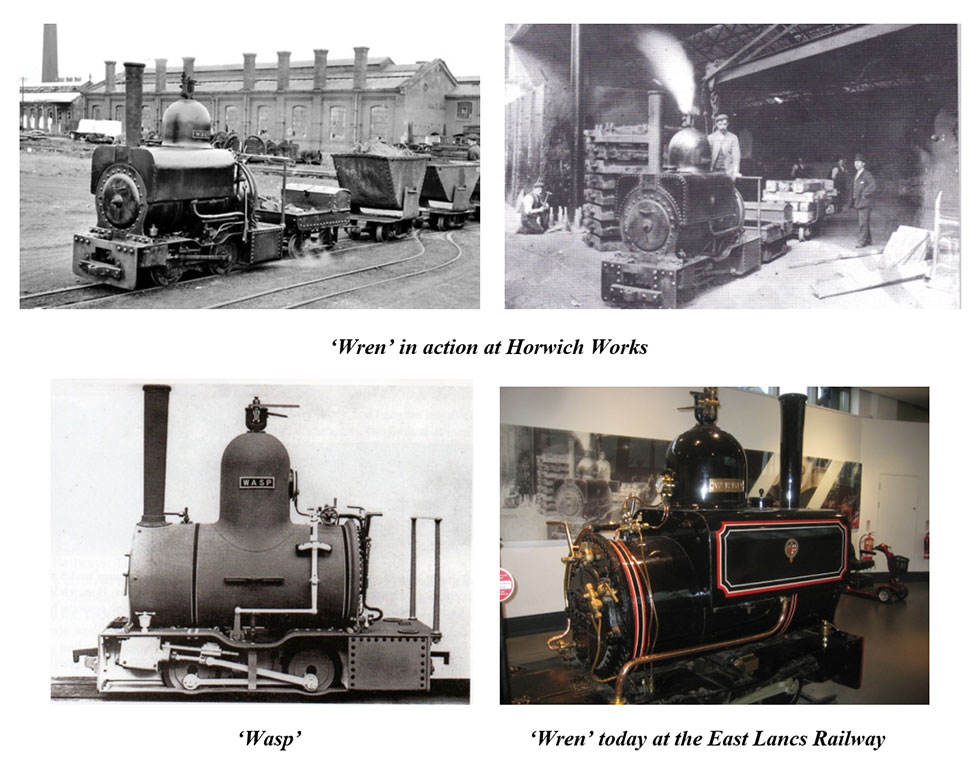
As an upgrade on the steam locos, in 1932, a Hidswell-Clarke narrow gauge diesel loco was transferred to Horwich from Crewe and given the number ZM9. Then in 1957, a Ruston & Hornsby diesel loco number ZM32 was built for Horwich Works. These diesel locos were never as popular as the steam-driven ones because of their unreliability as former Erecting Shop Manager, George Fisher, recalled “We could never start the damned things!” After the Works narrow gauge system closed down in 1965, ZM32 was eventually bought by the Steeple Grange Light Railway in Wirksworth, Yorkshire where it still operates today.
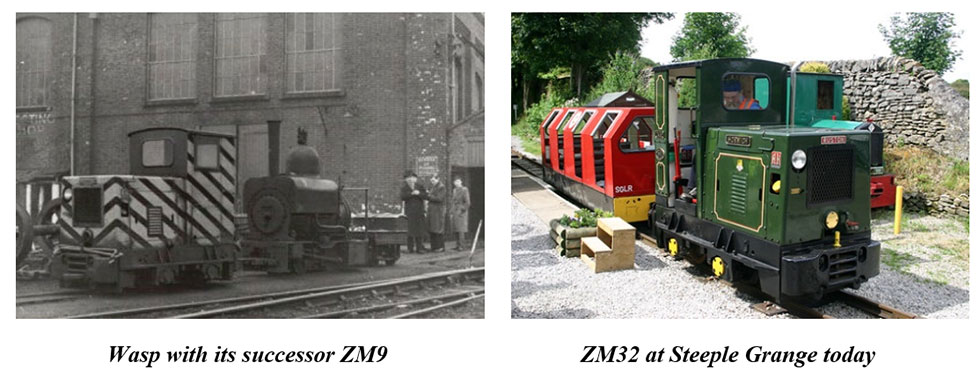
Acknowledgment: ‘Narrow Gauge in the Works’ by Glenn Clarkson published by the West Lancashire Light Railway Trust.
THE RESERVOIR NAVVIES By Derek Cartwright & Janette Cordwell
In the Autumn 2022 edition of this magazine, I paid tribute to the remarkable feat of Victorian engineering which was the building of the Rivington Reservoir system between 1847 – 75. In marvelling at its construction, we need to pay tribute to the designer, Thomas Hawksley, and to the thousands of ‘navvies’ stonemasons, carpenters and stable hands (who cared for the thousands of horses) who made it happen. Formal recognition of their efforts has been long overdue, so we decided to do something about it.
In 2023 United Utilities commissioned a stone memorial to Thomas Hawksley which was unveiled on the 7th July on the embankment between the Upper Rivington & Anglezarke Reservoirs on Horrobin Lane. Then,in March 2024, a second memorial, this time to the ‘Navvies’, was unveiled by Sir Lindsay Hoyle MP, Speaker of the House of Commons. This was designed by myself, fabricated by Roy Davies and landscaped by Richard Allen and Robert Irwin of UU and depicts the essential ‘tools of their trade’, the pick and shovel.
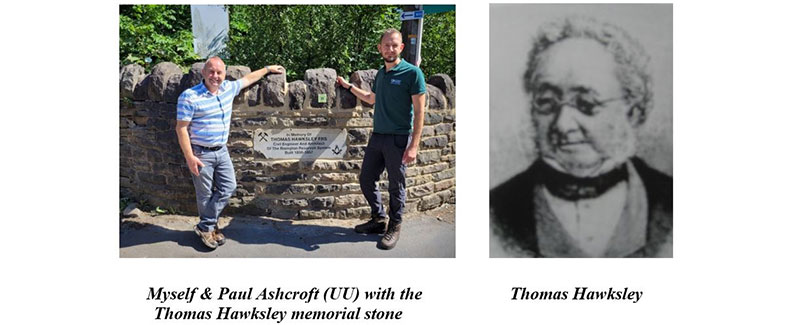
The first reservoir the navvies worked on was the Chorley (High Bullough) Reservoir, which would eventually become part of the Rivington Reservoir system. The first sod was cut on Wednesday 7th April 1847 by Richard Anyon who was joined by thousands more navvies over the next 28 years until the last of the reservoirs, the Yarrow, was completed in 1875. The navvies were hard-working, hard-drinking men who toiled away with picks, shovels and wheelbarrows (there were no mechanical diggers in those days). The only help would be the horse and cart, gunpowder when required, and block and tackle equipment for some lifting.
At one point, 700 men were said be working on the Yarrow Reservoir alone. The workers were organised into gangs of perhaps a dozen or so men with each gang having a foreman. These men often lived in the same huts, in makeshift camps with their families. The huts were very basic with earth floors, turf walls and wooden roofs. Thomas Hampson (the Horwich historian) in 1875 tells us that ‘Rivington had been transformed into a town of huts and rude structures where hundreds of men were accommodated. It was as if a plague has descended on their country’. A large proportion of the navvies were Irish, having fled Ireland to escape the potato famine of the 1860s.
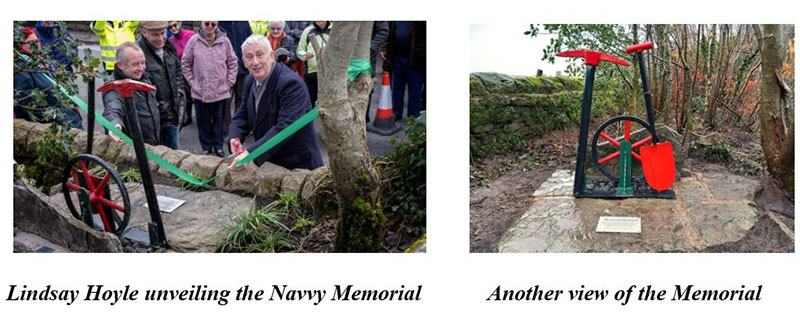
Building reservoirs was thirsty work and, after Rivington’s only public house, The Black-a-Moor’s Head (known locally as ‘The Black Lad’) was demolished to make way for the Upper Rivington Reservoir, the only remaining licensed ale house in the area was then the "Clog Inn" at Anglezarke. The ‘Clog’ was hard pressed to supply the needs of the workforce so many unlicensed ‘beer vendors’ and illicit stills sprang up in the local area. The navvies weren’t the only workers employed on the reservoirs. Due to the high specifications set by the architects and engineers, many stone masons were drafted into the area along with carpenters and stable hands to care for the many working horses.
Over all these years of reservoir building in the Rivington and Anglezarke area some workers lost their lives following accidents, others died of natural causes. Families grew up in the navvies’ camps and some stayed to settle in the area after the reservoirs had been built. Little evidence remains of their presence apart from an odd clay pipe, piece of pottery or broken or rusty tool. However, Janette’s research has yielded some tantalising details about some of the people who worked there.
For example, many of you will remember the ‘face in the wall’ alongside the Yarrow Reservoir. The original Yarrow stone head certainly wasn’t the work of a sculptor, or even an artisan stonemason, neither was it a work of any great antiquity; it was a rough carving of a piece of millstone grit, intended to stare out, in perpetuity, hidden in plain sight, as a reminder of an infamous, local individual. It depicts a man with a long craggy face and a moustache, wearing a flat cap, who various sources inform us was an unpopular foreman or inspector who made the workers’ lives a misery, but who could he have been? Could it have been Thomas Glossop, who was the Yarrow superintendent of works living at ‘Lane Ends’ near the Knowsley Embankment or Percy Charlton, who lived in a company house on Dryfield Lane, and was works superintendant and resident engineer responsible for the Yarrow. He remained in the area for nearly three decades. We will probably never know. What we do know is that a new ‘face’ is currently being carved to replace the original, damaged one which is now safely housed in the Horwich Heritage Centre.

Daniel Strang was born in 1832 in Scotland. As a labourer, he travelled the length and breadth of the country following work on the great engineering contracts of the day. At age 18, whilst working on the contract to build new docks at Birkenhead , he lost part of his leg in an accident and was lucky to survive. He married Ann Watson and they and their family eventually found their way to Rivington to work on the reservoirs. On the evening of 14th May 1871, Dan left his home on Babylon Lane, Heath Charnock to walk the 2 miles to work at the Yarrow Reservoir. It was the last time Ann and his children would see him alive. He had put his coat and stick in the cabin and went to check the puddle gutter on Turner’s embankment as usual. The following day, shortly after sunrise, Thomas King, horsekeeper to Mr Monk at the Yarrow works, noticed the pumping engine had stopped and saw Dan’s coat and walking stick were in the cabin. He went up the embankment and checked the puddle trench (which was approx.115 feet deep and 4 feet deep with water). With the help of Edward Dunn, and a grappling iron, Dan’s body was recovered from the trench and taken to the Black-a-Moors Head Inn. The inquest found that Mr Strang had probably slipped on some of the planking above the trench and fallen in. He was buried at Rivington Church on 18th May 1871. Ann was pregnant with their 6th child at the time. The family eventually moved away before emigrating to Pennsylvania, where their descendants live today.
Thomas Preston was born in Bamber Bridge in 1844 a surviving twin, his father Robert was a power loom weaver at the Cocker’s Mill at White Coppice. His mother Ann died when he was just 5 years old. On 11th August1855, Thomas, age 11, and 2 friends jumped on a navvies cart by the ‘goit’, but as it approached the bottom of the cutting, it failed to turn and the cart toppled over. Unfortunately, the cart landed on top of Thomas, who received a severe cut to the back of his head. He was taken home to his father’s cottage at White Coppice but died the following morning. At the inquest, the coroner recorded a verdict of accidental death and no blame was assigned. Thomas was buried at St. Barnabus Church, Heapey 15th August.

We hope to uncover more fascinating details about the navvies of Rivington in due course as we look to further recognise their incredible efforts in constructing what is now our ‘mini Lake District’. A ‘Reservoir Trail’ is currently being developed using QR code technology which will enable the visitor to access information about each site via the Horwich Heritage web site. Our thanks to Neil Rickaby at Bolton Web Site Design for his help with this.
WATER, WATER EVERYWHERE... By Jack Charnock (1969) & Derek Cartwright (2024)
Given the plentiful supply of water running down from the moors in the various watercourses into Horwich, it is not surprising that industries requiring lots of water thrived in this area from the 16th century onwards. Bleaching, textiles, paper and printing businesses prospered using water power until the ‘age of steam’ made them less-reliant. What is surprising is that in the 19th century Horwich struggled for 40 years to provide a satisfactory water supply for its growing population. Here is how the story unfolded.
In the 18th century, the small community of Horwich relied on springs and wells, and a little later hand pumps. As the village developed during the 19th century, access to some pumped water and wells was restricted by private owners with public use requiring a weekly fee. There was no such thing as turning a tap and having the pleasure of an unlimited supply of fresh, clean water. Nearly every farm had its own water supply from a pump, well or nearby stream. The village had public pumps in some areas, there was one at the end of Duncan Street and another close to the Black Bull Inn. A private pump was maintained at the rear of the stone cottages on Scholes Bank by ‘Owd Aggy Fell’ who we have talked about previously (Spring Mag. 2023)
As is well documented, the 19th century rush to the towns as the Industrial Revolution gathered pace resulted in overcrowding and insanitary conditions. Disease spread quickly and easily and urgent solutions were required to improve water supply and sewerage systems. Although Horwich was not a major town or city, like Bolton or Manchester, it did have its insanitary conditions in places like the ‘courts’ off Lee Lane which had to share a water supply and toilets. The demand for an improved water supply began to grow in the1860s with the debate being intensified after the drought of 1868. Why then did it take another 40 years for a solution to be found? The first suggested scheme in 1868 was for a reservoir in the ‘Old Lord’s Heights’ area at a cost of £4.240 plus the additional cost of piping. This would supply water not just to Horwich but to Blackrod, Adlington and Westhoughton. This scheme appears to have been rejected and the site, interestingly, was near Crowther Fold, and was used a few years later for the construction of Blackrod Reservoir.
In the mid 1870s the Government were taking a greater interest in the provision of both fresh water and drainage systems, largely due to outbreaks of cholera in many industrial areas of the country. As a result of Government action, a number of water companies were set up, one in South Lancashire and, in 1876, Blackrod obtained powers to build their reservoir in the Wilderswood area of Horwich! Without its own solution, the Horwich Local Board had to agree to a fairly humiliating arrangement to take 50,000 gallons a day from the Blackrod Reservoir whilst waiting for the South Lancashire Company to solve the problem - which it never did. So when Andrew Peak installed his water trough and drinking fountain at the Crown in 1879, the water came from Wilderswood. There then followed a period of what can only be described as ‘political and personal animosity and infighting’ within the Horwich Health Board and later the Horwich Urban District Council which lasted for another 25 years.
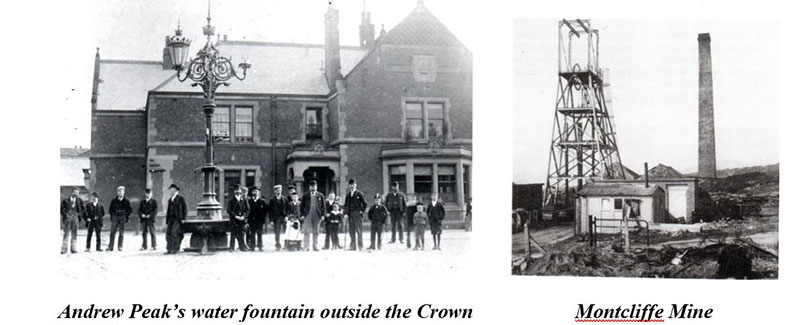
In 1884, the Lancashire and Yorkshire Railway Company decided to build a Locomotive Works in Horwich, and development started to accelerate. A much larger water supply was needed. The dry season of 1887 completely exhausted the Blackrod storage, and a new source was required. The Horwich Local Board found that the only water supply available was from the Montcliffe Colliery belonging to Messrs A Mason & Son. There was public concern that this water might be contaminated, so a Dr Franklands was appointed to analysis the water from the mine. Fortunately, his conclusion was that the water would be suitable for domestic purposes so, on 1st January 1888, a contract commenced with Adam Mason and Sons for the supply of an additional 50,000 gallons of water each day which would be provided through mains laid around Horwich. The water supply issue appeared to have been solved until Blackrod claimed a breach of contract stating that Horwich was drawing more the agreed amount. This was likely to be have been caused by the Loco Works now being in full production.
The L&Y Railway suggested that Horwich approach Manchester Corporation to draw water from the Thirlmere Aquaduct which passes directly beneath the town to supplement its water supply. This reasonable suggested was not followed up. Instead, in December 1900, Horwich UDC finally decide to construct a reservoir at ‘Markland’s’ on land owned by John Pendlebury at a cost of £20,000. Work commenced on 20th February 1904 and 3 years later the valve was opened and water finally flowed into Horwich from its own reservoir! The reservoir was opened by Cllr Dickinson, Chair of the Horwich Urban District Council and, at the ceremony, he was presented with a beautifully decorated and inscribed wheel barrow and spade (see photo below). 3 years later when the reservoir was completed, he was also presented with a silver key to open the valve and let the water flow. These valuable items are now in the possession of Horwich Heritage thanks to the kind donation of the Dickinson family.
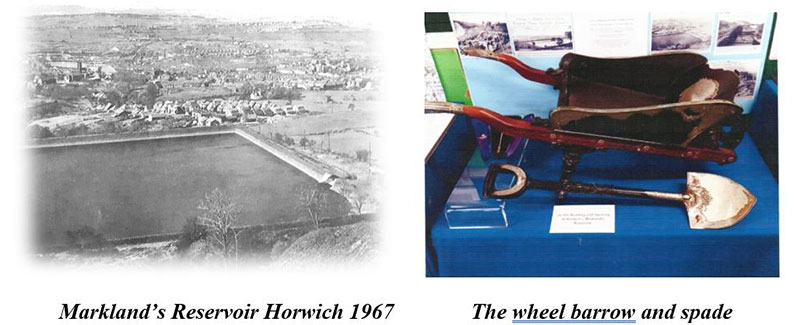
Despite this major step forward, the Horwich water supply has been found to be inadequate on a number of occasions. One solution to the deal with the shortage was to sink a ‘bore hole’ at ‘Tup Row’, near Georges Lane . Today our water is supplied by United Utilities from its reservoirs, treatment works and pipe-delivery network across the North West of England. Few of us give a second thought today to the turning of a tap and the full flow of water which follows, blissfully unaware of how it took 40 years to build a reservoir for Horwich!
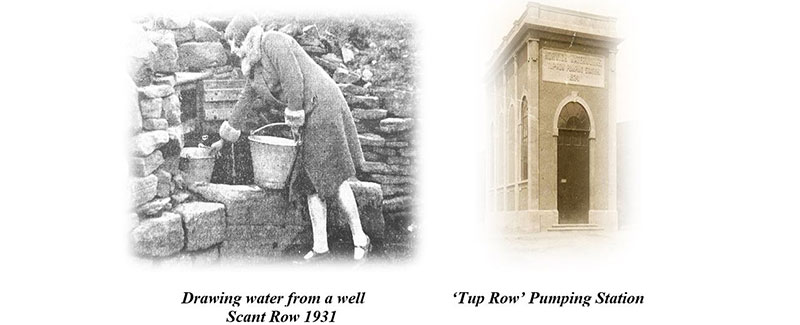
MY SCHOOLDAYS AT HORWICH PARISH By Kath Grundy (nee Shaw)
Horwich Parish C of E Primary School has just celebrated its 230th birthday, being the oldest school in Horwich. As part of those celebrations, every class (over 200 children) visited the Horwich Heritage Centre to learn about the school’s and Horwich’s history. One of the teachers who is very much part of the school’s recent history is Kath Grundy and she has been good enough to recall both her schooldays and teaching years in this edition of our Magazine.
I started my schooldays at the Parish School in 1949, aged four. My mother accompanied me on the first day, but thereafter I went with a neighbour who was in the top class. There was very little traffic on Church Street, so we had no need if a ‘lollipop’ lady. My reception class teacher was Miss Baker and our classroom was just off the hall. Every morning we had an assembly taken by the headmistress, Mrs Dora Shaw. To me she was ‘Auntie Dora’ as she had married Harold Shaw, my dad’s brother, and I loved her dearly. During assembly we had to hold up our hankies and, if we had forgotten to take one, we had to stand up so everyone could see the ‘rule- breakers’. If we had a birthday on a school day everyone would sing ‘Happy Birthday’ to us and it felt special.
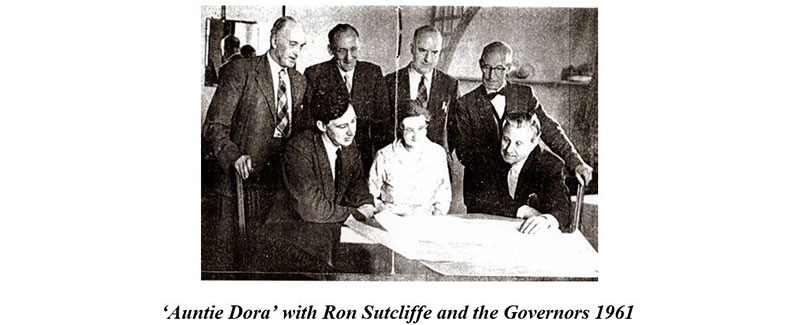
I well remember Miss Baker teaching us to read. We would go in a small group to the front of the class and learn phonics and letter blends from a large flip-over book, resting on an easel. Once we had mastered our phonics, we were given a ‘Radiant Way’ reading primer and the wonderful world of reading was open to us for ever. Miss Baker was quite strict and I remember having to stay in at playtime for talking……no surprise there I guess! Mrs Elliott, Miss Baker’s sister, taught the next class. We would work through maths cards and reading books, but on a Friday afternoon the magic cupboard would open and out came the toys…tactile, brightly-coloured wooden puzzles, building bricks and abominable purple plasticine which smelled dreadful and must have been something of a health hazard!.
By the time we were 7 years old, the boys had departed for the Old Boys’ School further up the road and we had advanced to the junior classes upstairs. These classes were taught by Miss Gladys Woods, Mrs Hilda Phoenix and Mrs Dora Shaw. Miss Woods was gentle and kind and had the most wonderful sense of humour. She loved to tell us Bible stories and we would join with the older girls for singing and hymn practice. Sometimes the vicar, the Reverend Douglas Michell, would come and join us for those joyous together times. By the age of 9 or 10 we were with Mrs Phoenix. She was strict but fair and I enjoyed being in her class. We learned how to use pen and ink with equipment distributed by an ink monitor. A ‘blot’ on the morning’s work was very much frowned upon. In maths we learned how to do long multiplication and long division and reduce £19 .13 shillings and 6 pence 3 farthings to farthings!!…all incredibly useful! We knew how many yards there were in a mile, how many bushels made a peck and we chanted tables every morning. In English we had handwriting practice, comprehension exercises, spelling tests and ‘composition’ or story-writing afternoons. I guess this was all leading up to the 11+ examination which was introduced in the Education Act of 1944.
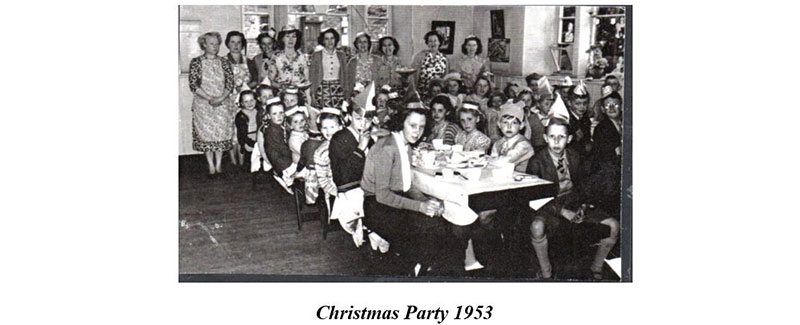
Although we learned nothing of world history or geography, Mrs Phoenix taught us about the industrial north and agricultural areas where our food was produced .Stories of historical figures like Florence Nightingale, Queen Elizabeth I and the dubious tactics of the Normans at the Battle of Hastings in 1066 were all spread before us. She taught us how to read a thermometer, work raffia and attempt embroidery…. life was never dull. Last thing on a Friday afternoon was a magical time for me. It was when Mrs Phoenix would read to us. Books such as ‘Black Beauty’ by Anna Sewell, ‘Uncle Tom’s Cabin’ by Harriet Beecher Stowe and ‘The Water Babies’ by Charles Kingsley. Who could ever forget Mrs 'Do-as-you-would-be-done-by’ and what better way to teach a child how to behave towards others? I am sure there are hundreds of modern day equivalents. Many of the children stayed for school dinner which was delivered from a central kitchen and served in the hall. I lived so near to school that I ran home for lunch then raced back to join in the playtime frolics. Playing ‘tig’, ‘the farmer wants a wife’ and skipping were all popular, but visiting the outside toilets was a nightmare as they were cold, draughty and smelly.
Our final year was with Mrs Shaw and we were taught on the ‘stage’. This was used as a classroom during the week but as a stage for the production of plays, pantomimes and visits from the Dinky Dots’ dancing group at the weekend. Mrs Shaw was keen on poetry and we were encouraged to commit several to memory. My favourites were the ‘Wraggle Taggle Gypsies’ . .. .who wouldn’t want to know about an escapee princess?…… and ‘When Icicles Hang by the Wall’ by William Shakespeare . To this day this poem runs through my head when I bring in the milk on a cold Winter’s day. The Parish Church and the Parish School have always had a strong connection. During Lent, we would recite the Catechism which is an outline of the Anglican faith delivered by question and answer. ‘My Duty Towards My Neighbour’ is the longest answer and a challenge to memorise. Your heart sank if you were the chosen one to remind everyone of their neighbourly duty. However, the highlight of the year was the Sermons weekend. Girls from the school were chosen to be the Little Singers and for weeks we would learn and practise two or three hymns and a psalm. The favourite psalm was number 121’I will lift up mine eyes unto the hills’, which I always thought was hugely appropriate being so close to Rivington Pike! We all wore white dresses and were given white satin hair ribbons and we were proud and delighted to walk in the Sermons Day procession of witness and attend the service afterwards. ………….. but all good things come to an end and in the Summer of 1956 I said an emotional good-bye to Horwich Parish School…….for the time being at least.
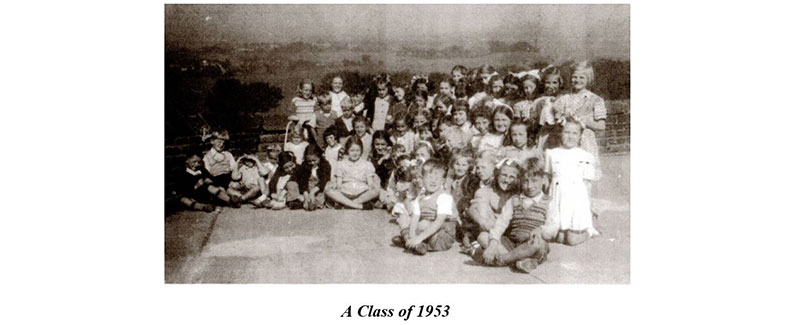
THE COMEBACK By Kath Grundy
After leaving the Parish School in 1956, I spent seven glorious years at Rivington and Blackrod Grammar School, and then three more years at Christ Church College, Canterbury, where I received my teaching qualifications. Knowing that I wanted to teach northern children, I returned to my beloved Horwich roots, and took up a post teaching junior children at Westhoughton County Primary School. The learning curve was pretty steep from Canterbury to Westhoughton, but I was very happy there. However, after three years, the vagaries of the number 16 bus to Westhoughton and an advertisement appearing in the Horwich and Westhoughton Journal for a junior school teacher at Horwich Parish School, persuaded me to apply for the job. My application was successful and I joined the staff in 1969, thus beginning the second chapter of my journey with this special place.
There had been many changes during my absence. When Mrs Dora Shaw retired Mr Ron Sutcliffe was already the headmaster at the Old Boys’ School up the road. The 2 schools combined and Mr Sutcliffe became the head and the school became a mixed Infant and Junior School. New housing estates were being built in Horwich. Many new families moved into the town and school places were needed for the children. Several new modern classrooms were built with open spaces for craft areas and book corners. The dreaded outside toilets were demolished and play apparatus was built in the playground, with funds raised by the newly-formed Parents’ Association. We held an annual Autumn Fair which raised money to further modernise the school and provide extra benefits for the children. Ron Sutcliffe was a forward-looking head who believed every child should have the chance to play a musical instrument if they wished to. He formed a school band which performed at the many school concerts and carol services. One year they even had the honour of playing at Bolton Albert Hall.
When I first joined the staff, I taught a mixed infant and junior class in what was known as Miss Woods’ room situated at the top of the stairs in the original building which overlooked the churchyard. Miss Woods was still teaching there when I returned and I count it a huge privilege to have been taught by her and later to teach alongside this wonderful lady. She understood children so well and it was a sad day for us all when she retired.
I too left the Parish School in 1972 and took a few years out to be with my young children but, by 1979, I was back, this time in the Infant Department .During my time away, there had been yet more changes at the school. The dining hall had moved up to the top (Old Boys) school and a kitchen had been installed, so meals could be made on the premises. A path through the churchyard was built so the children could safely walk from one building to the other. Parents’ evenings and open days were introduced. We started a skittleball team and a football team and enjoyed after school matches with other Horwich schools. I enjoyed teaching the infant children and being involved in the early stages of reading and numeracy. Beautiful books and reading schemes were available to us. ‘Roger Red Hat’ and ‘Billie Blue Hat’ were eminently preferable to my ‘Radiant Way’ primer of 1949, but the learning of phonics and letter blends, the essential tools for reading, remained the same.

In Maytime the pillars in the hall, which were such a nuisance in P.E., became maypoles for my class. We had sports’ days and Christmas parties with a beautiful Christmas tree in the hall. At the very end of the year the leavers produced a concert for everyone which was always full of surprises……mainly for the staff it must be said! The children excelled themselves always on Sermons Sunday—not with hymns and psalms as of old, but with splendid productions of ‘Joseph and his Technicolour Dreamcoat’, ‘Samson and Delilah’, ‘Noah’ and a plethora of children’s hymns. It was such a joyful occasion. But, change was in the air. In 1987, Ron Sutcliffe retired and Richard Fairclough took over as headmaster of the Parish School. Richard and I are second cousins and, as infants, were in the same class with Miss Baker and Mrs Elliot. It was a huge privilege for me to teach under his leadership as the school continued to flourish. Kenneth Baker’s Education Reform Act was passed in 1988 and the National Curriculum was introduced into schools. S.A.T.s and league tables took over and paperwork massively increased. By 1997, I began to think about retirement. I had been teaching at the Parish School for over 20 years and had seen many changes both in the school buildings and in the curriculum. I had enjoyed my teaching years immensely, and made lots of new friends along the way……lucky, lucky me !!
WHO WAS MOSES COCKER? By J A Partington (1941)
Moses Cocker’s Farm is one of the most intriguing place names in the Rivington/ Anglezarke area but what do we know about him?
A short distance along the road leading from Rivington Village to Belmont lies the roadside farm house known as ‘Old Moses’s’ or ‘Moses Cocker’s’. Little seems to have changed over the years except for the rebuilding of the barn and shippons and, of course, changes in the tenancy. Even the tenancy changed only once from one family to another in upwards of 2 centuries. The Cocker family held the tenancy from 1693 until the close of the 18th century. It then passed into the occupancy of the Woods family who retained the tenancy until the end of the 19th century. I have often noticed the initials and date over the lintel and I am indebted to my old school friend, Abraham Thornley, for deciphering the precise details. The inscription reads as follows: C.R.A.M.1693. C stands for Cocker and R.A.M. for husband and wife, Robert and Annie, and their son Moses. It is Moses who stamped his personality on the farm and caused it to be known as ‘Old Moses’s. It was one of the farms used by the early non-conformists as a place of worship before Rivington Chapel was built in 1703. Moses was one of the original founders of the Chapel but seceded because of the tendency of the congregation towards Unitarianism. He then became a prominent figure in the building of Lee Chapel in Horwich (later to become Lee Lane Congregational Church).
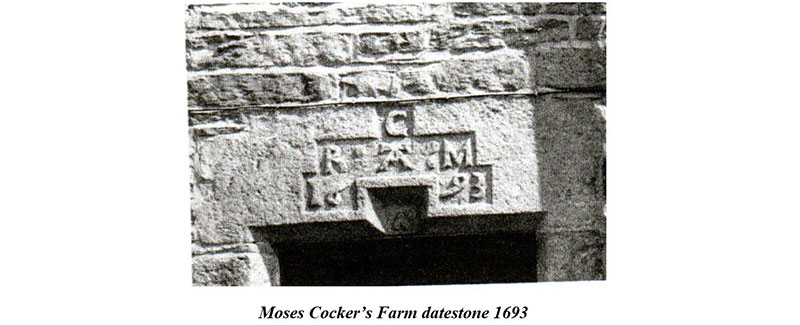
Moses Cocker is buried in Rivington Chapel graveyard, beneath the yew tree and near the western door. He died in 1779 at the age of 95 – hence the appellation ‘Old Moses’. From the dates recorded, it is clear that he was 9 years of age when the farm house was built and 19 when the Chapel was built in 1703.
The last of the Cockers left the farm in the late 1790s and moved to Darwen where the family became prominent members of the community with an Alderman Cocker becoming the Mayor in recent times. After the Cockers, Charles Woods tenanted ‘Old Moses’s’. He was the son of Charles Shaw, a near relative of Baron Willoughby, who supported his son despite never marrying his mother. Charles married Margaret Pendlebury at Deane Church in 1798 and took possession of ‘Old Moses’s’. They had 2 sons and 4 daughters, with the eldest son James, succeeding the Ainsworth family at Ainsworth Farm near Rivington Hall. It was one of the daughters, Ann, who maintained the family connection with ‘Old Moses’s’. She married Francis Berry and together they looked after the farm until 1890 when Ann died age 80. Francis died a few years later but not before completing a century’s tenancy by the Woods family.
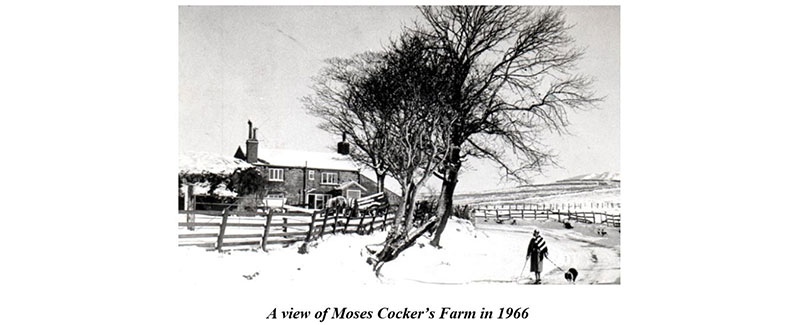
4500 YEARS OF HORWICH HISTORY: FROM STONE AGE TO SPACE AGE By Stuart Whittle
As our recent ‘Horwich Timeline’ exhibitions has shown, for such a small town, Horwich has had a remarkable history starting with primitive man living on the moors above the town around 2500 BC. There is plenty of evidence of this including a 4500 year old axe head found at Tiger’s Clough, Bronze Age burial sites at Winter Hill and Noon Hill, the ‘Pike Stones’ on Anglezarke Moor (3000 BC) and ‘Two Lads’ on Winter Hill (1000 BC). Early man was also living in the valleys as evidenced by the discovery of a perfectly preserved skull on Red Moss dating from1000 BC. There are clear indications that the Romans marched through Rivington & Anglezarke on their way from Blackrod to Ribchester and the Saxon period is also well represented by the well-preserved barns at Rivington.
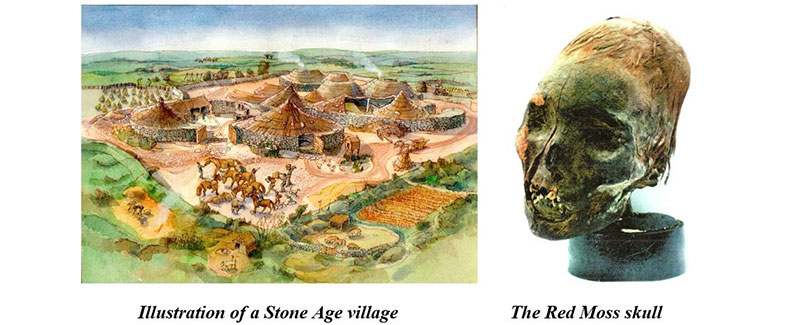
After the Norman Conquest, Horwich became a Royal Hunting Forest presided over by Albert Grelley, Baron of Manchester, and, as the area slowly developed in the Middle Ages, it was Rivington with its Grammar School (founded by Bishop Pilkington in 1566) that emerged first as a distinct settlement. However, as land ownership passed into different families, it was in 1620 that we find the first map of Horwich commissioned by Sir Thomas Barton (who also owned the Smithills Estate). This indicates 48 tenanted pastures with the predominant family being the Whittles, who were overseers, church wardens and constables of the village from 1684-1778. The population in 1620 was 250 and the village grew very slowly until the first of 3 ‘twists of fate’ took a hand.

THE COMING OF THE RIDGWAYS
It all started on a day in 1775 when brothers John & Thomas Ridgway suffered a devastating fire at their bleachworks in Bolton. They needed to start again, this time with bigger and better premises and their search led them to the sleepy hamlet of Horwich which had a population of only 300 people. Here they found a site called ‘Wallsuches’ which suited them perfectly. It had fast flowing streams coming down from the moors which were just what they needed for washing cloth and driving their water wheels. As the business expanded and word spread, people came from all the surrounding communities to work at the bleachworks. The bleaching processes provided employment for whole families, including young children, who worked long, hard hours to provide food, clothing and a place to live. As a result the tiny hamlet grew into a small village with workers’ houses, a school, a church and pubs – this was the beginning of the Horwich we know today.

THE ARRIVAL OF THE LOCO WORKS
Fate was to play its part for a second time, when on 27th June 1884, the residents of Horwich awoke to the news that the Lancashire & Yorkshire Railway Company had purchased a large area of land on the south side of the town and, a few weeks later, they learned that the Company intended to build a new locomotive works. In those days, this kind of news was always welcome as it would bring jobs and prosperity to the village. However, when they heard how big it was going to be and that it would triple the population from less than 4000 to over 12,000 in 10 years, they were understandably alarmed. A massive building operation began in 1885 and almost overnight Horwich began a dramatic transformation with new houses, shops, offices, schools and churches springing up to cater for the influx of new workers & their families who came from all over the country. The old village would never be the same and Horwich quickly became a ‘new town’. And, despite the horrors of two World Wars and the ‘ups and downs’ the town experienced due to strikes and recessions, the Loco Works remained the main employer and ‘backbone’ of Horwich for almost 100 years until its closure in 1983.
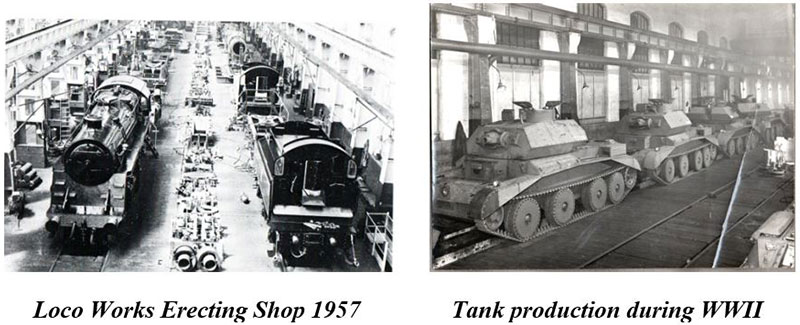
MIDDLEBROOK RETAIL PARK & BOLTON WANDERERS STADIUM
The 23rd December 1983 was a dark day in Horwich’s history. This was the day Horwich Loco Works closed down and 1500 people were made redundant, in many cases several members of the same family. What would the future hold for the proud railway town of Horwich without its main employer? Remarkably, within 10 years, fate intervened for a third time and Horwich would rise like a ‘phoenix from the ashes’ to become a thriving place once again. And the reason for this revival was the building of the Middlebrook Retail and Office Park and a new stadium for Bolton Wanderers. Once development commenced in 1996, unemployment ceased to be a problem in Horwich as thousands of new jobs were created in the construction, leisure, retail and office sectors. And, with its proximity to the Motorway network and easy access to the beautiful countryside of Rivington, Anglezarke and the West Pennine Moors, Horwich became a desirable place to live!
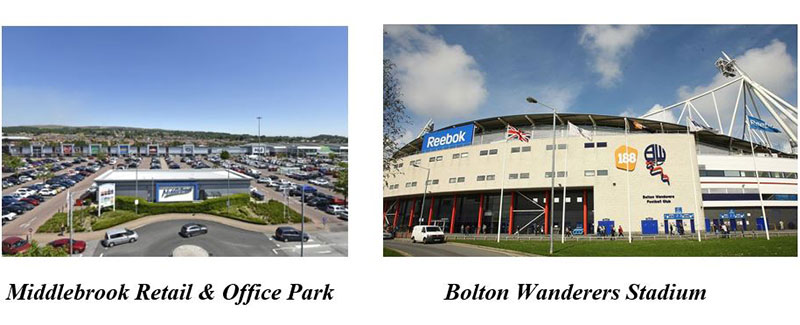
THE FUTURE: 2024 AND BEYOND
In 2024 Horwich is preparing for a new era. The bulldozers have moved in to sweep away the old Loco Works and make way for a new development of 1700 houses called ‘Rivington Chase’. Together with other new housing sites in the ‘pipeline’ (including the former Horwich golf course), this will increase the population of Horwich by about 50% to 30,000 over the next 10 - 20 years. Will this be a good thing? Can the roads and the public services cope with this influx? Will all this development destroy the character and charm that has made Horwich so popular in recent years? These are the questions that are on the minds of the people of Horwich as they prepare for yet another transformation of their town.


BOLTON – NIGHTINGALES TURNPIKE (1763-1877) By Stuart Whittle
INTRODUCTION
From 1750, the roads of Britain, which were in a terrible state, underwent great improvements under the management of the Turnpike Trustees. Before this, the maintenance of the highways was the responsibility of the parishes – who used such crude methods as throwing stones into the worst holes (with the current ‘pothole’ situation you could be forgiven for thinking we haven’t progressed much in the past 274 years!). The first turnpikes were run by Justices of the Peace but the appointed Turnpike Trustees then took over. They had the power to erect toll gates on their particular stretches of road and the money collected was used for road improvements. Each turnpike required an Act of Parliament and the one for the Bolton – Nightingales (Chorley) turnpike road was approved in 1763.
To be a Trustee, a man had to be the owner of land, houses or other property to the yearly value of £50 or possess an estate valued at £1000 or more. Not surprisingly, the local Trustees were some of the most prominent businessmen of the day and John & Thomas Ridgway, founders of Wallsuches Bleachworks, were invited to become Trustees with many important meetings being held at the Black Bull in Horwich. The Trustees had to appoint a clerk, secretary and surveyor from within their own area and it is interesting to note that a number of familiar Horwich names are included on the list of persons qualified to act as surveyor on the Horwich section in 1792: James Turner, John & Timothy Eatock, Thomas Ridgway, Adam Howarth, Henry & Richard Pilkington, John & Richard Mason and John Kershaw.
Each Turnpike Act laid down certain exemptions from the payment of tolls and listed those persons and official bodies accordingly. The Bolton – Nightingales exemptions were as follows:
- Tenants of Henry Blundell Esq. (Trustee) & John Gartside, Mayor of Little Bolton.
- Wagons carrying oatmeal, flour or grain for the mills of Edward Byrom (Trustee).
- Ministers of all recognised religions & persons on their way to Church or Chapel for worship on a Sunday or a funeral.
- Persons on their way to vote in elections, including the day before, during or after.
- Horses or cattle going to or from pasture or horses going to be shod at the smithy.
- Post horses carrying mail or the ‘Packet’ mail coach.
- Horses or carriages belonging to officers, soldiers or military personnel.
- Wagons carrying materials for repairing the roads or improving the land and farm machinery & implements passing from field to field.
- Carriages carrying vagrants being sent back to their legal place of settlement.
Not surprisingly, there were many and varied attempts to avoid the tolls and we do know from our records that the Ridgways (who were Trustees!) used some of the back roads through Horwich to do this.
Toll houses were built near the Crown Inn in Horwich and the Doffcocker Inn in Bolton for the purposes of collecting the tolls (with different rates for horses, carts and carriages) and tollgates were erected in front of the houses to enable the toll keeper to deal with passing traffic. In 1775, the road from Doffcocker to the Moorgate Inn (now Blundell Arms) and onwards to the Black Bull Inn in Horwich was straightened and widened and in 1829, the Bolton – Horwich Turnpike was opened along Chorley New Road offering a flatter and more direct route.
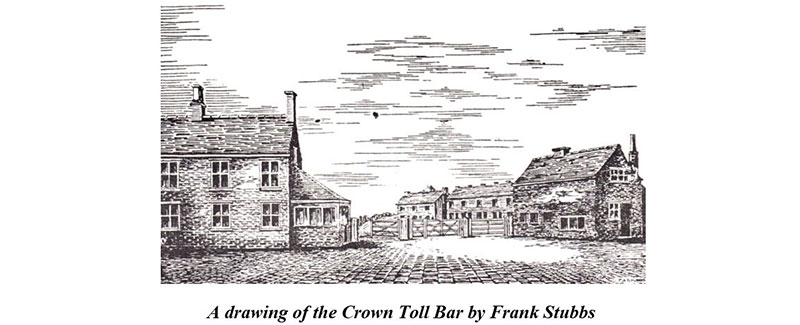
A COLOURFUL OPENING
The Bolton – Horwich Turnpike (along Chorley New Road) was opened on 29th October 1829. On the day, in the grey light of dawn, a crowd of Trustees, officials, creditors and local inhabitants gathered outside the ‘Crown’ to await the first arrival which was Bolton carrier, John Smith of Fold Street. He had decorated his horses with ribbons and bells and had a clarinet player and trumpeter serenading the crowd from the back of his wagon. He was given a great ovation. During the afternoon and early evening several stagecoaches came through including the ‘Independent’, homeward bound to the ‘Angel & Woolpack’ in Deansgate from Carlisle, the ‘New Times’ en route to the ‘Ship Inn’ on Bradshawgate and the best known coach in Bolton, the ‘North Star’ (which until quite recently was on display outside Smithills Coaching House).
COACHING INNS
Most of the coaching inns that were so common on Deansgate, Bradshawgate & Churchgate have disappeared without trace. Only the ‘Swan’ and the ‘Three Crowns’ in Bolton and the ‘Blundell’ and ‘Crown’ in Horwich remain, and only the ‘Swan’ has a remnant of its coach yard. The rapid development of the railways dealt a serious blow to the viability of horse-drawn transport but it was the motor car that finally killed it off.
HAZARDS
Lest it should be forgotten, the age of the turnpike was also the age of the highwayman and footpad. The most notorious local ‘tobeyman’ (as they were known) was ‘Galloping Will’ Nevison. He and lesser known 'tobeymen' harassed travellers in the Horwich, Heaton and Halliwell districts as this account from the Manchester Mercury describes: “Whereas Henry Marsden, ,miller, of Cross Hall, Chorley was, on 5th November between the hours of 6 and 7pm, attacked by 2 footpads at a place called Old Horwich Chapel and robbed of £30 and 10 shillings”. As if the threat of highwaymen was not enough, coach travel itself could be hazardous. Early one Friday morning in July 1785 the Lancaster coach overturned near the Horwich Moorgate Inn (now the Blundell Arms). It was recorded in the Manchester Mercury that most of the travellers sustained injuries to some degree, especially one young woman who had been an ‘outside’ passenger. Whether this accident was the fault of the driver, the road or the weather is not recorded but if it was the road then theTrustees would have been liable.
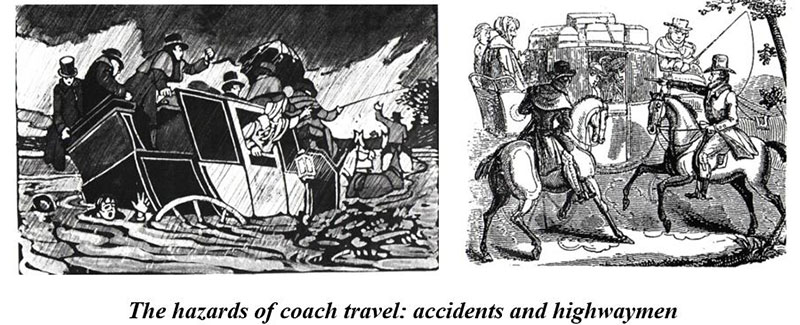
JUDGE & JURY
Joseph Ridgway, revered as the ‘Founding Father’ of modern day Horwich, was one of the most powerful and important Trustees amongst the list of Commissioners of the 1829 Bolton-Horwich Turnpike Road. He was also a Magistrate and the following summons illustrates the power that an autocratic magistrate could wield at that time.
Andrew Rutter, carter of Halliwell, was summoned to appear before Her Majesty’s Justices of the Peace on 6th November 1837 ‘to show just cause (if he can) why a Warrant of Distress shall not be issued against his goods and property in the sum of 20 shillings for...on the 30th day of October being then and there the driver of a certain cart did not keep his said cart on the left or nearside of the road and also did then and there by negligence and misbehaviour prevent, hinder and interrupt the free passage of a certain gig belonging to me, the said Joseph Ridgway, on a certain Turnpike Road leading from Bolton in the Moors to Nightingales in the Township of Heath Charnock contrary to the statute. Given under my hand and seal 20th October 1837.
FUN & FROLICS AT THE CLOSURE OF HORWICH BAR
Extract from Bolton Chronicle 3rd November 1877:
‘The demise of so ancient an institution was anything but an occasion for mourning...about 30 local dignitaries sat down to an excellent supper at the Crown Inn. Songs, toasts and sentiments enlivened the evening before the party adjourned to the Toll House where a large crowd had assembled. There followed the burning of torches which the Bolton Journal likened to something from ‘the foot of Pendle Hill amidst the revelry of riches and flying broomsticks rather that the foot of the peaceful Pike’. At a little before midnight the last conveyance to go through the Toll was a ‘Jerusalem Pony’ (donkey) belonging to John Dickinson, complete with bells and passengers in rural costume. This event was celebrated with a rendition of ‘Auld Lang Syne’ accompanied by local innkeeper, John Calderbank, on the violin.
DISPOSAL OF ASSETS/FINALE
With the dramatic expansion of the railway system, the turnpikes quickly lost trade and in 1876 a termination of all turpikes was agreed and their assets sold off. On 22nd October 1877, the Horwich toll houses, gates and weighing machines were auctioned off. Andrew Peak bought both the old and new tollhouse at the Crown for £30 & £11 respectively but was outbid by John Calderbank for the machine house, cottage & weighbridge which went for £85. The gates & posts went to a local farmer for £2. Fall Birch Toll House was sold to Thomas Curwin for £30 with the gates from this bar being used for many years at the entrance to Lostock Hall Farm at the bottom of Ox Hey Lane (see photo). The iron post from the Fall Birch toll (dated 1829) is now on display in the Horwich Heritage Centre.
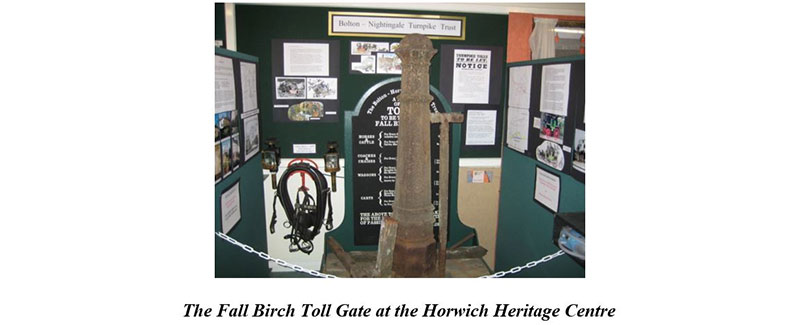
FINALE
Almost overnight, the age of the stage coach with all its drama, glamour and romance passed into history. The sight of a ‘four in hand’ controlled deftly by a weather – beaten coachman became an increasingly rare sight on the roads of Britain. The Royal Mail no longer came thundering by, post horns blaring and the old posting inns had to cut down drastically on the number of horses, stables, stable boys, grooms and ostlers. Something magical went out of our way of life in 1877!
THE LIFE OF JACK FAIRCLOUGH
From ‘Links In A Chain’, The Mayors of Bolton
John (Jack) Fairclough led a fascinating life and was both a politician and business man in post-WWII Horwich, making an important contribution to its development.
Jack was born at 133 Chorley New Road in 1899 and was educated at Rivington & Blackrod Grammar School. He joined the Merchant Navy as an apprentice with Manchester Liners in 1916, at a salary of £2.10s per year. He regarded himself as ‘lucky’ to have survived two ships that were torpedoed and ‘extremely lucky’ to survive a devastating explosion in Halifax harbour, Canada, on 6th December 1917 when 2000 people were killed and 9000 more injured as the result of a collision involving a munitions ship carrying benzene and TNT. The tidal wave that followed stranded hundreds of ships and smaller craft on the beaches. Jack also found himself in Archangel, Russia in 1917 when the Revolution began.
On returning home in 1919, he couldn’t find work so he borrowed £100 to buy a model T Ford one ton truck with an interchangeable body and set up in business for himself. During the week he hauled coal from Stott’s Pit, Westhoughton, for bagging and delivery around Horwich and at weekends the same truck became a ‘charabanc’, running trips to the seaside, football matches etc. He pioneered pensioners’ coach tours to most seaside resorts which also entailed the booking of hotels for the season, all of which he vetted. His brother, Jim, joined him in 1921 and by 1924 they had bought a second coach and erected the first petrol pump outside Bolton next to the Beehive pub. By the time the Second World War broke out they owned four coaches which were then used for ‘Government service’. Fairclough Brothers sold their Coal Haulage business in 1946 and bought the Beehive Garage. The coach business continuing to expand, acquiring new coaches every few years, until it too was sold in February 1966.
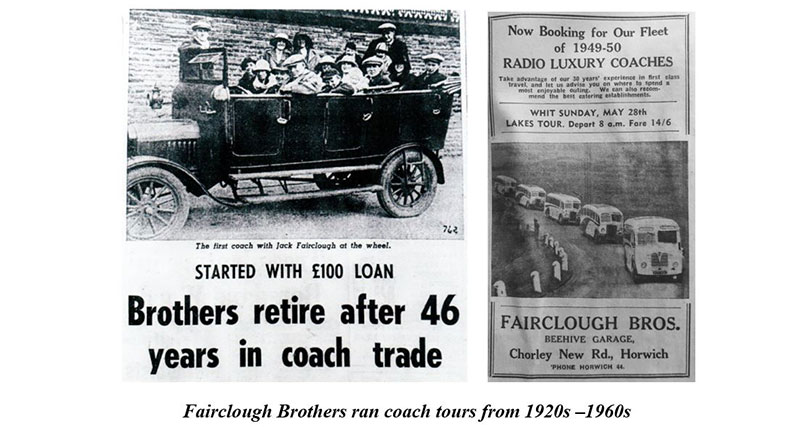
Whilst still running his coach business, Jack started to take an interest in local politics and became the elected representative (Conservative) for Horwich South Ward from 1950-59. He became Chairman of the Housing, Town Planning and Estates Committee and was Chairman of Horwich Urban District Council 1955-56.It was whilst Chairman of the UDC that he inaugurated the first Horwich Civic Ball which was held at the Mechanics Institute on Chorley New Road on 25th January 1956.
His service to the community extended beyond Horwich Council and he served on the Divisional Education Executive, was a Governor of Rivington and Blackrod Grammar School and was a Governor and Vice Chairman of Horwich College of Further Education. As part of his community service, Jack enjoyed being a member of Rotary, joining the Horwich club in 1952. He was a Past President and acted as Conference Secretary for many years. He took a great interest in the welfare of senior citizens and regularly drove the ‘Meals on Wheels’ van which was provided by Rotary.
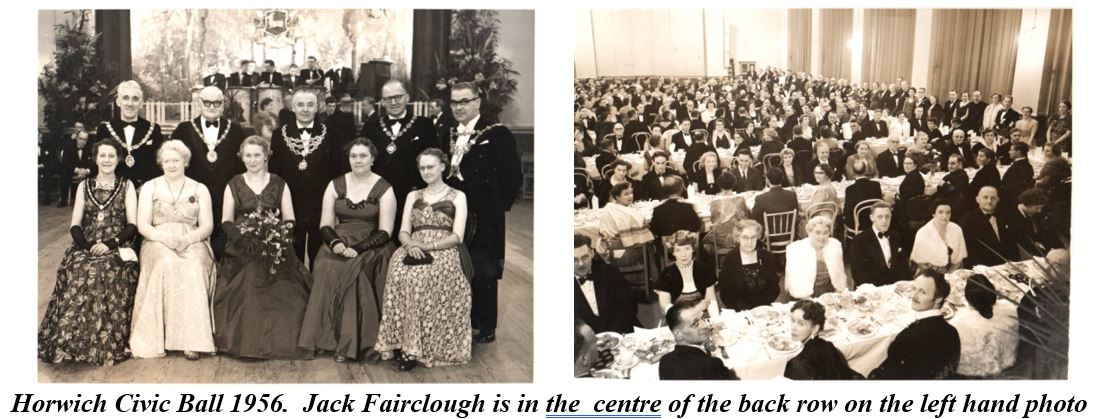
Having started life as a ‘top sider’ (the top side of Horwich), Jack returned to the ‘top side’ on his retirement. His garden was 575 feet above sea level and took up most of his leisure time, rearing his own plants and growing potatoes and tomatoes as a side- line. He also enjoyed walking, foreign travel and photography. He died in Southport in 1979 having served the local community with distinction for over 50 years, a contribution which deserves to be recognised by the generations that have followed on.
120 YEARS OF LEVER PARK By Stuart Whittle
In August, Horwich Heritage opened its latest exhibition celebrating 120 YEARS OF LEVER PARK, the wonderful local recreational area that has been enjoyed by millions of visitors since it opened in 1904.Most people in the Borough of Bolton will be aware of Lord Leverhulme, the local man who made his fortune from selling soap but who never lost his love for his home town and did more than anyone to help to improve the living conditions of its citizens. During his lifetime he paid for the building of Blackburn Road Congregational Church (known locally as the ‘Iron Church’) and the restoration of Samuel Crompton’s birthplace, Hall i’the Wood, his bequest paid for the establishment of Bolton School and he donated the land for the creation of Leverhulme Park and Lever Park. In fact, he would have done even more for the town if the then Borough Council had let him go ahead with his ambitious plans for the redevelopment of Bolton Town Centre.
His plans for Lever Park came about after he had acquired the Manor of Rivington from the Crompton family for £60,000 in 1900. The Rivington Hall Estate extended to over 2,100 acres and included the manorial seat of Rivington Hall, a number of farmsteads, 2 Anglo-Saxon barns and Rivington Pike with its famous watchtower. Having agreed that the Cromptons could continue to live at the Hall, William Lever (as he then was) turned his attention to building a residence for himself high on the western slopes of the moorland just below the Pike (it is reputed that this was his favourite picnic spot which he visited with his wife-to-be during their courtship days). The story of his first bungalow, how it was burnt down by suffragette, Edith Rigby, and how he then built an even better one with exotic gardens is a story we have covered before, so for now we are now going to concentrate on his plans for Lever Park.
Having acquired the Rivington Hall Estate, William Lever offered some 400 acres to Bolton Corporation for use as a municipal park in 1901 however, before this could happen, Liverpool Corporation set about trying to compulsorily acquire the Estate in order to protect the ‘watershed’ of their Rivington Reservoirs. Years of litigation followed, but eventually compensation for the compulsory purchase was agreed at twice the price Lever had paid for the Estate and he was granted the right to lay out Lever Park at his own expense “for the use and enjoyment of the inhabitants of the County Borough of Bolton and generally of the public forever”.
Work began on Lever Park in 1902 with the object of making it as “free, as accessible and attractive as possible”. Access was provided by the creation a series of tree-lined avenues which focussed on the Hall and a replica of the ruins of Liverpool Castle (which was located on the eastern shore of Lower Rivington Reservoir). Shelter for the anticipated thousands of visitors was provided by the use of 2 large Saxon tithe barns: Rivington Hall Barn and Great House Barn, which were sensitively converted into refreshment rooms. When the Crompton family left after the death of John Crompton, the Hall was converted into a Picture Gallery and Art Museum open to the public free of charge. With these facilities in place, the Park was officially opened in 1904 and Lord Leverhulme continued to develop his ideas for the Park until his death in 1925. The main work, however, had been completed by 1911 at which time the workforce and villagers celebrated with a luncheon and dance at Rivington Hall Barn whilst the main guests celebrated in Rivington Hall. Incidentally, Liverpool Corporation officials were consulted at every stage of the Park’s development and raised no objections.
Probably the most audacious idea for the Park was to create on ‘open air zoo’. This was the first time this had been attempted in this country and long pre-dated any of the subsequent zoos of this kind at Whipsnade, Longleate or Knowsley Safari Park. Lord Leverhulme brought in what were for the time exotic animals like zebras, zebu, wallabies, llamas, deer, emus and even lion clubs! Most were allowed to roam free or were kept in large enclosures. One can only wonder at the excitement this must have caused for the visitors who wouldn’t have seen anything like it in their relatively sheltered lives. Sadly, the zoo had to close in 1925 when Lord Leverhulme died and the animals took some catching as this newspaper report of the time indicates:
 At the entrance to Lever Park stand 2 granite pillars erected in 1934 by the 2nd Viscount Leverhulme in memory of his father who gave the park to the people of Bolton and the surrounding district. The pillars inscriptions are:
(Left Hand Pillar) LEVER PARK, THE GIFT OF WILLIAM HESKETH LEVER - 1ST VISCOUNT LEVERHULME – BORN AT 6 WOOD STREET, BOLTON SEPTEMBER 19TH 1851. DIED AT HAMPSTEAD, LONDON MAY 7TH 1925 – FOR THE BENEFIT OF THE CITIZENS OF HIS NATIVE TOWN AND NEIGHBOURHOOD. BY ACT OF PARLIAMENT IN 1902 THE OWNERSHIP AND CARE OF THE PARK WERE VESTED IN THE CORPORATION OF THE CITY OF LIVERPOOL.
(Right Hand Pillar) LEVER PARK – THESE PYLONS WERE ERECTED BY WILLIAM HULME, 2ND VISCOUNT LEVERHULME, TO COMMEMORATE THE GIFT OF LEVER PARK BY HIS FATHER 1934.
During WWII, Lever Park became a ‘no go’ area being under military occupation for the purposes of Home Guard and troop training with the 2 barns being used for the storage of ammunition and equipment. If you know where to look, there is still evidence of that occupation. The Park was opened up for public use again shortly after the war with the Salmon family taking over the running of the catering at the Upper and Lower Barns which they still do today. At the present time, United Utilities are the owners of Lever Park and are responsible for its upkeep but, most importantly, the general public are still able to enjoy its delights free of charge just as Lord Leverhulme intended all those years ago.FOOTBALL IN HORWICH By Stuart Whittle
During the 19th century, Horwich was a village of a few thousand inhabitants mostly clustered around the Ridgway’s Wallsuches Bleachworks (just off Chorley Old Road). As in most towns and villages at the time, people had been kicking makeshift balls (pig’s bladders etc) around in a fairly haphazard fashion until ‘football’ started to get organised resulting in the formation of the Football League in 1888 – which contained a strong contingent of northern teams including Bolton Wanderers, Blackburn Rovers, Burnley and Preston North End. This coincided with the arrival of the Lancashire & Yorkshire Railway Works in Horwich and a population explosion from 3000 to 12,000 in just 10 years. With a workforce approaching 5000, the Works was quick to form a team and, in 1896, Horwich RMI arrived, named after the Railway Mechanics Institute where apprentice training and a whole range of social activities took place. Not surprisingly, they became known as the ‘Railwaymen’ and they played on a ground provided by the L&YR called Grundy Hill. In the early part of the 20th century, the team gradually worked its way up the local leagues to become a force to be reckoned with in the Lancashire Combination, winning the Cup in 1927-28.
Even in a relatively small town, football wasn’t just confined to the RMI. The ‘new town’ of Horwich saw the rapid construction of houses, churches, schools, shops, pubs and clubs, offices and the emergence of a whole range of other industries like textiles, mining, paper, leather, brick making and sanitary ware. Out of the Churches came the Sunday School Leagues and out of the pubs, clubs and industries came a whole range of teams keen to play in other Saturday and Sunday Leagues. Thanks to the Horwich & Westhoughton Journals of the time, we have a good idea of how extensive these leagues were, and a small number continue to this day.
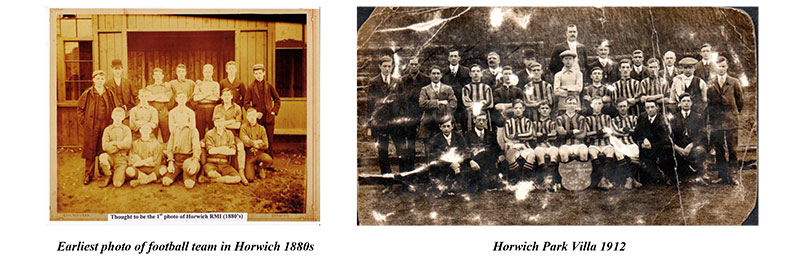

 In recent years, a new amateur team, called Horwich RMI has been formed and is doing well in the Lancashire Amateur League. Other grassroots teams are also flourishing, not least St Mary’s, Old Rivingtonians and ASC Masters and the game now caters for all sexes, ethnicities and abilities.
Despite being a small town, Horwich has had a number of football heroes including Les Hamer who refereed at the highest level (including the League Cup Final in 1968) during the 1960s. In 1948-50, Johnny Walton played for England as an Amateur International while Gordon Astall (who died in 2020 at the age of 93) was a winger who played professional football for Plymouth Argyle, Birmingham City and Torquay United and won 2 England caps in 1956. Frank Wignall played for Horwich RMI in 1957-58 before achieving fame as a goal-scoring centre forward with Everton, Notts Forest, Wolves and Derby County between 1958-71. He was capped by England twice in 1964 scoring 2 goals.

Former Bolton Wanderers, Manchester City, Derby and England centre forward Francis Lee CBE had a glittering football career between 1959-76, winning League Championship, FA Cup and European Cup Winners Cup medals, 27 England caps and scoring 238 goals (‘Franny’ died in 2023 age 79). That career started with him playing for Horwich Technical College before joining the Wanderers at the age of 15. One of Horwich’s favourite sons is Paul Mariner, who sadly died in 2021 age 68. Paul grew up in Autumn Street, Horwich and attended Horwich County Secondary School. He signed for Chorley in 1971 and quickly progressed up the Leagues playing for Plymouth Argyle, Ipswich Town, Arsenal and Portsmouth. He played 35 times for England, scoring 13 goals out of a career total of 188. In 1983, local boy, Tony Caldwell achieved a remarkable record when he scored 5 goals on his debut for Bolton Wanderers (having signed from Horwich RMI). In the whole 147 history of Bolton Wanderers, no one has ever scored more than 5 goals in a match, let alone on their debut – what an achievement! And no doubt there will be more local heroes in the years to come.....
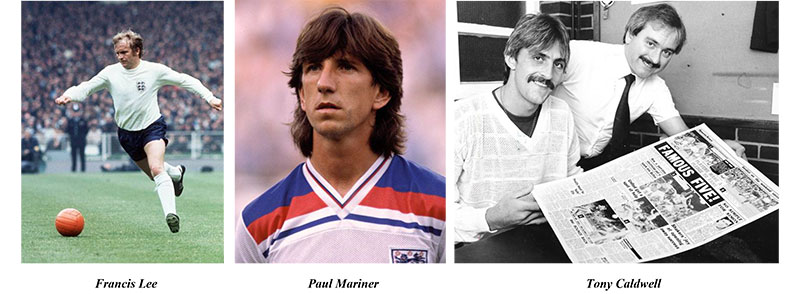
LOWER BRAZLEY HALL by Derek Cartwright
Over the years, hundreds of families have lived in the area which makes up the Lower Brazley Housing Estate in the east of Horwich, comprising Beech, Ainsworth and Brazley Avenues. However, few people these days know the history of that part of our town, how these tree-lined avenues were named and what happened to the people who called the area their home in the 19th century.
In the late C19th and early C20th, many wealthy families built their homes in the up-and-coming Heaton area of Bolton stretching along Chorley New Road from Bolton towards Horwich. Some of these mansions remain together with ornate gate posts and walls as reminders of what was once there. Two brothers who were prominent in the cotton industry settled not in Heaton but in Rivington and Horwich. They were Walton and (Colonel) Charles Frederick Ainsworth and the mills of C&W Ainsworth occupied land on Weston Street, Great Lever and produced fine muslins. The brothers came from a strong cotton manufacturing and bleaching background, being related to the rich and powerful Ainsworth family of Halliwell and eventually Smithills Hall. Walton Ainsworth, the older of the two, moved into a property in Rivington bought in the 1850s by their father, Joseph Ainsworth. The property on Rivington Lane, once named ‘Smith House’, was renamed by the Ainsworths as ‘Beech House’ due to the excellent specimens of beech trees in the vicinity. Walton and his family took a keen interest in the Rivington Parish Church, becoming significant benefactors of the church for the remainder of their lives. The younger brother, Charles Frederick Ainsworth, helped to form the Lancashire Artillery Volunteers (today’s Territorial Army) which had its base in Nelson Street, Great Lever, where the barracks and descendant regiment still exist. His involvement in the Volunteers allowed him to progress to Colonel, a position which gave him much pride.

Business was booming, and in the 1860s Charles Frederick bought land in the east of Horwich which included a farm called Brazley Brow (or Higher Makinson’s). He constructed a house (hall) of mansion proportions in a prominent south-facing position a little lower down than the farm which become known as Lower Brazley Hall. Throughout the time of their residence Higher Makinson’s was known as Higher Brazley Farm. Charles and his wife, Catherine, had 3 sons before arriving in Horwich but once in the town their family increased with the birth of 6 daughters, all born at Lower Brazley Hall and christened at Holy Trinity Church. The Hall had 3 storeys and was surrounded by a perimeter wall, immaculate gardens, substantial main gates and had an imposing carriage drive leading up to house. A monkey puzzle tree guarded the main doors and inside the typical Victorian mansion were pitch-pine walls covered in water colours (pained by Charles himself). The 10-bedroomed hall had servant quarters as well as stables, green houses and cottages for the groundsman and coachman. A thatched summer house overlooked the lawns which were marked out for tennis and croquet. In later years, young ladies from the area were invited round for summer garden parties by the Ainsworth’s daughters.
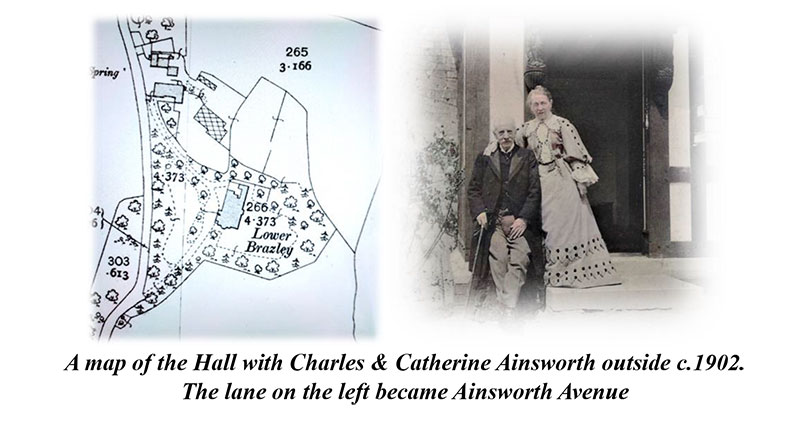
In the 1880s Horwich Works arrived and Charles and Catherine took a great interest in the rapidly-expanding town. Charles became involved in the Local Heath Board (the forerunner of Horwich Urban District Council) and, as a strong ‘conservative’, became the first president of the newly built Horwich Conservative Club in 1887. Charles also became Chair of the Horwich School Board and it was under his leadership that the Chorley New Road ‘Board’ School was built and opened in 1896/97.
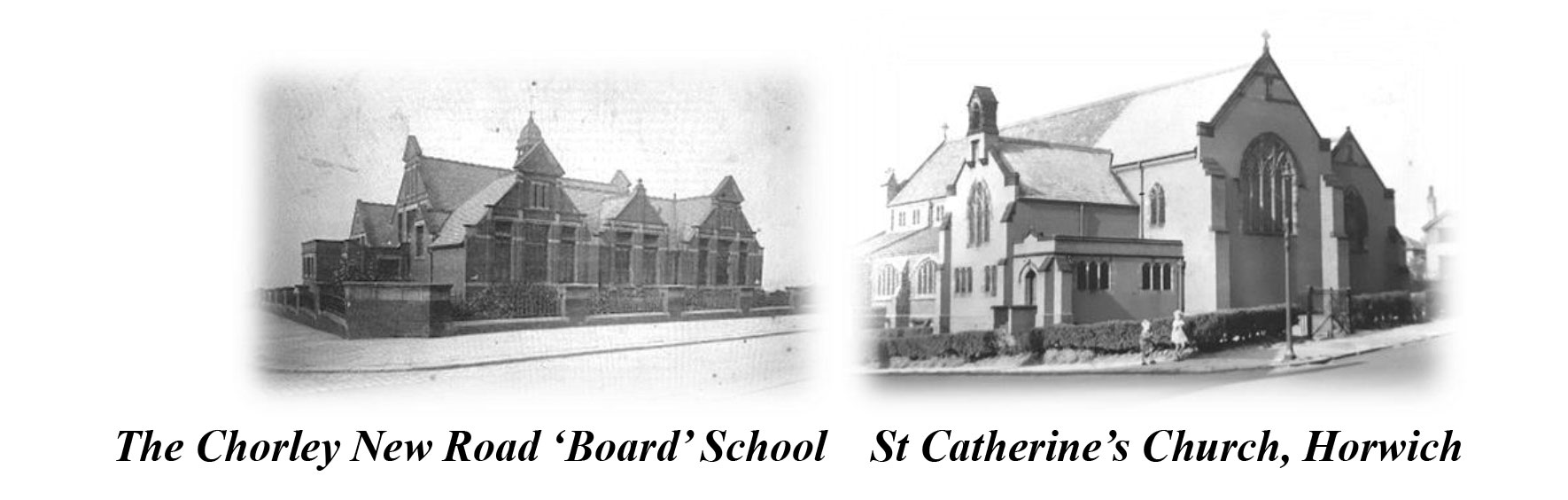
Church and school capacity was a major problem in a rapidly-developing Horwich which saw its population expand four-fold in a decade following the arrival of the Loco Works. To help with this, Charles and Catherine promoted the development of addition places of worship. The first was St Catherine’s, which initially held services in a hay loft of Winter Hey Lane before moving to an empty bakery in Beatrice Street. Charles spearheaded the fund-raising for a more permanent solution and, by 1897, St Catherine’s C. of E. School, was established in Richmond Street. Within a few short years, the church was built as we see it today. The Ainsworth family and many older Horwich residents believe the School and Church were named after Catherine Ainsworth. Land was also donated off Chorley New Road by the family for the building of St Elizabeth’s Church and Church records show regular donations by the Ainsworths to St Elizabeth’s for the rest of their time in Horwich.
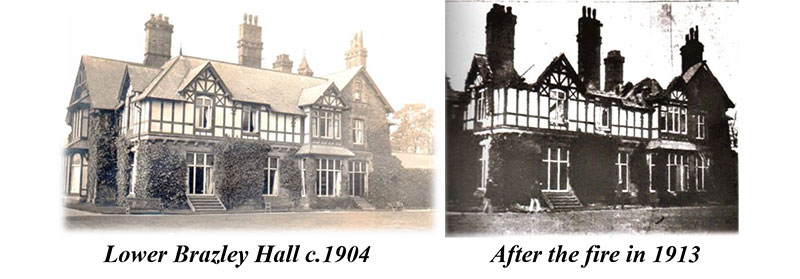
Charles died suddenly in 1904. He had a full military funeral with his coffin draped in the union flag and carried on a gun carriage pulled by 6 black horses with head plumes. Like his mother, father and brother, Walton, Charles was buried in Rivington Parish Church Cemetery. The funeral procession was arguably the largest ever seen in Horwich. Sadly, the Hall was destroyed by fire in 1913 and later demolished. The oldest son of Charles and Catherine was also named Charles and he married Mabel Clare Haslam. She came from another wealthy cotton family and lived at Ravens Wood Hall in Heaton (later to become Haslam’s Maternity Home). Charles and Mabel’s daughter, born a few months after the Lower Brazley Hall fire, was named Kate Brazley Ainsworth in memory of the Horwich famly home.
Catherine passed away in 1917 and, following this, the family moved away from Horwich and Rivington. The son of Walton Ainsworth became a local councillor and was for a time the Chairman of Horwich Urban District Council. It was also at this time that the Lower Brazley land was sold to the Council and, with a grant received from the Government, that the Lower Brazley Housing Estate was built, primarily to provide ‘homes fit for heroes’ returning from the First World War. The first families moved into Brazley, Beech and Ainsworth Avenues during 1920. The tradition of naming new born babies after Brazley didn’t stop with the Ainsworths. The first baby born on the Brazley estate in 1921 was named George Brazley Dickinson. George’s family still live in Horwich.
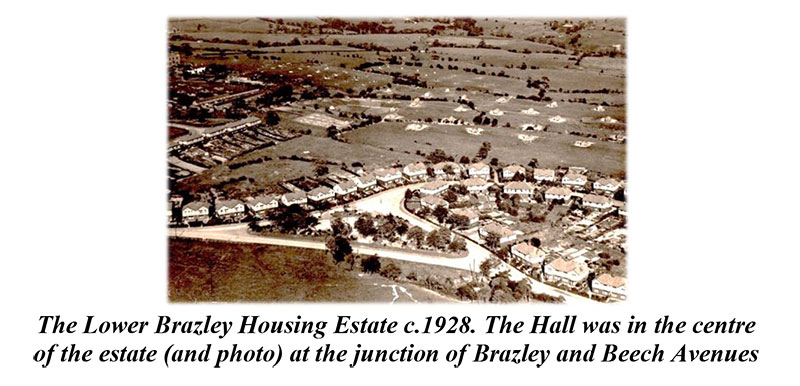
The Ainsworths certainly left their mark on Horwich and Rivington and, as we have seen, we have good reason to be grateful for their benevolence. As well as the Churches, School and Street names, part of the perimeter wall and one main gate post still stand on Ainsworth and Beech Avenues and remains of Beech House are visible off Rivington Lane. Ceramics presented by the Ainsworth can be seen in St Catherine’s Church together with the initials of Charles Frederick Ainsworth on some of the church furniture. At Rivington, the Bell Tower of the Church was renovated by the Ainsworths, land was given to the church for expansion and leaded windows commemorate Edmond Ainsworth, their son who lost his battle with typhoid in 1901.

As an amusing footnote, Tom Dufty, great grandson of Charles and son of Kate Brazley Ainsworth, recalls that his Mum having lived in Surrey since the age of 8, had developed a southern accent with the exception of one word which gave away her Lancastrian origins. The vehicle coming down the road was always a ‘lurry’ and never a ‘lorry’….well done Kate Brazley Ainsworth!
The full story can be read in the book Lower Brazley Hall - The Family, The Hall, The Legacy available at the Horwich Heritage Centre with all receipts going to support the Society.
THE 'CRICKET IN HORWICH' EXHIBITION by David Kaye
Being fiercely proud of my roots (first manifest at 4, Stanley Grove, nigh on eight decades ago) and having had a lifelong addiction (although no counselling ever contemplated!) to our national summer sport, when the words ‘Horwich’ and ‘Cricket’ are juxtaposed it truly touches the soul. Thus it was that, when our chairman asked if I would help in staging an exhibition entitled “Cricket in Horwich”, the frisson felt was quite visceral. “Just up your street”, I told myself, and although realising it would involve a great deal of time and effort, I felt I had at least a head start with my own archive and collection of memorabilia, augmented by a myriad relevant memories.
But after initially feeling delighted, I quickly felt daunted (if not haunted!) by recurring thoughts of the “Football in Horwich” exhibition which had been staged at HH twelve months earlier. I had paid several visits to take in the vast amount of information on display, and along with innumerable other visitors, was most impressed by the scope and professionalism of the project. The gnawing question arose: “Could we go any way to matching it?” Well, I decided this was a ‘once-in-a-lifetime’ chance to profile a story that had meant so much to me since my earliest days, so I just had to give it my best bash. Others will have to be the ultimate arbiters of whether our portrayal of our summer sport hereabouts can ‘live in the same league’ as its winter predecessor, although I confess I found the many favourable comments in the Visitors’ Book at the Heritage Centre most heart-warming, especially so when complemented by those received verbally and via e-mail and social media.

Thus it was that “Cricket in Horwich” was staged from Saturday, 1st October 2022 to Wednesday 25th January 2023, and whilst it is difficult to ascertain accurate numbers of attendees (as, despite the exhortations, not everyone signs the book), it was most encouraging to learn that, in addition to the many local cricket aficionados, people from as far afield as Cheshire, Derbyshire, Yorkshire, London and Northern Ireland were sufficiently interested to come and see what the exhibition had to offer.
For many, of course, the exhibition title conjures up images of a sun-drenched (well, occasionally!) Recreation Ground, which, with its truly magnificent backdrop of the West Pennine Moors and our beloved Rivington Pike, has been (as the Horwich Town Council-sponsored plaque installed on the pavilion in February 2022 tells us) ‘The Home of Cricket in Horwich since 1892’.
Whilst inevitably the story of Horwich RMI C.C. (and its pre-cursors, Horwich C.C. and Horwich L. & Y. C.C.) featured very prominently in the displays, we were keen to ensure the exhibition was as eclectic as possible, with considerable prominence also being given to the histories of the Horwich Sunday School Cricket Association/ Horwich Churches & Welfare Association, which provided cricketing opportunities for untold numbers of locals for approaching a century, and of our other local ‘premier’ club, Lostock C.C., membership of which has meant so much to me for the last 60 years.
There were two fundamental elements to the exhibition, firstly the multiplicity of wall-mounted displays, comprising a combination of photographs/illustrations and text (haven’t counted, but certainly extending to many thousands of words!), beneath which were table-top displays of a wide variety of memorabilia, including cricket clothing, equipment, caps, ties, trophies, scorebooks, handbooks, and a diversity of publications about cricket in these parts. (Renewed thanks to all those kind ‘loaners and donors’ of the many items which greatly enhanced our show). Limitations of space preclude us from embarking upon detailed descriptions, but the following list of ‘bullet points’ summarises the main aspects of the game locally which we graphically profiled:
- Cricket’s Roots
- Cricket arrives in Horwich (1840s)
- A Local Cricket Timeline
- The Story of Horwich RMI CC (& precursors Horwich CC/Horwich L&Y CC)
- The Story of Lostock CC
- The Stories of our Local Leagues (Horwich SSCA/CWCA/BDCA/BCL
- Club Professionals & Club Honours (RMI and Lostock)
- Schools’ and Youth Cricket
- Cricket Grounds in Horwich & Rivington (Map)
- Women’s Cricket
- Pub Cricket/Corporate Cricket/Charity Cricket
- Cricket Cartoons
- Cricketing Footballers
- Floodlit Cricket
- Cricket & Christianity
- Local Cricket Literature & Publications
- In Memoria (Remembering leading local cricket personalities)
- First Class Horwichers
Of the many artefacts and items of memorabilia on display, there was much interest in The Cross Cup (Lancashire’s oldest cricket trophy), the plethora of Bolton Association and Bolton League annual handbooks, scorebooks from seasons long past, and such ‘specials’ as a pair of autographed batting gloves which once belonged to the recently-deposed Prime Minister of Pakistan, Imran Khan!... But the overwhelming and still-intriguing conundrum is: ‘How on earth did HH persuade the MCC to agree to a long-term loan of arguably the world’s most iconic sporting artefact – the 1882 Ashes Urn, displayed ’neath its protective glass dome?’ (Someone in these parts must certainly have some ‘clout’ in high places!!)
We must also mention a couple of ‘posers’ which we interspersed amongst the table-top items, and you are welcome to use ’em in your next Friday night pub quiz, should you wish:
Firstly: Featured was a pair of badly-battered wicket-keeping gauntlets, which we said had: “..been on the receiving end of 90 mph thunderbolts from the likes of Devon Malcolm and Michael Holding”… But to whom did they belong?
Secondly: On display was a bat (and the gloves which gripped its handle) which had been used in a famous Cup Final at Lord’s, which featured – for the only time in history thus far – two Old Rivingtonians on opposing sides. Who were they?
Bolton has long been recognised, both nationally and internationally, as one of the world’s top cricketing ‘hotspots’, and we can be very proud of the fact that the game in Horwich and district has contributed very significantly to that enviable reputation.
In “Cotton Town Cricket” (the story of the Bolton & District Cricket Association, published in 1988 to mark the centenary of Lancashire’s oldest cricket league – and arguably the world’s oldest!), authored by my good friend Roy Cavanagh MBE, we emphasised that the Bolton cricket scene was ‘unique’ in a number of ways (claims not made lightly), and if these assertions were made from a somewhat prejudiced perspective, in the meantime they have been roundly endorsed by less-biased commentators.
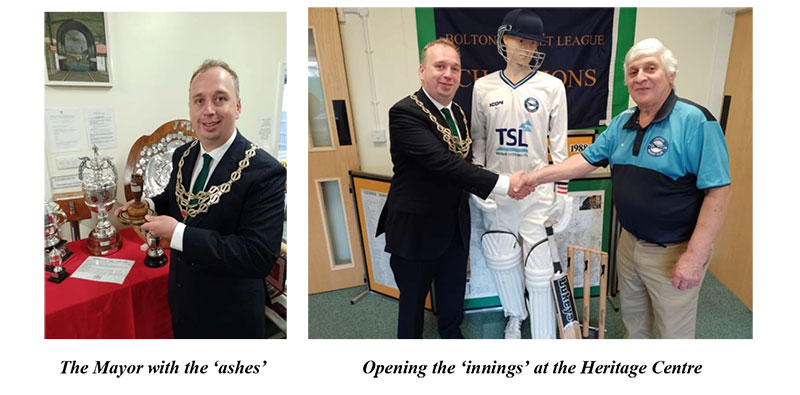
In 2021, Geoff Ogden, a scion of Lancashire cricket, published ‘Born in Bolton’ a book profiling no less than 38 first-class cricketers born within the Bolton Borough boundary, 13 of whom were destined to play test cricket – 12 for England, and 1 for South Africa. Of the 38, we can proudly claim that 5 were Horwich born! Ogden’s book resulted from good-natured banter with the author of a 2015 book, entitled ‘Inside the Boundary’, the publicity for which made the not-so-covert suggestion that Reading could well lay claim to the title of England’s pre-eminent cricketing town. But Bolton’s ‘score’ of 38/13 compared with Reading’s tally of 26/6.....’Nuff said?
Bringing this particular narrative bang up-to-date, we feel it’s no exaggeration to conclude that the extensive publicity relating to “Cricket in Horwich” led (admittedly in slightly convoluted fashion) to BOLTON featuring as the second ‘destination’ (after BIRMINGHAM) in a new series in the renowned journal, Wisden Cricket Monthly. Simply entitled “Hotbeds”, which put “the club game’s most fertile regions” in the spotlight, the profiles are penned by Scott Oliver, a renowned cricket author and freelance journalist, but it is somewhat gratifying that a not-insignificant segment of Bolton’s story which featured in the March 2023 issue of WCM was based on information ‘from a Horwich horse’s mouth’.....
Before ‘pulling up the stumps’, as end of play for the day approaches, harking back to the tributes coming our way during the exhibition, I hope I may be forgiven for concluding by quoting my personal favourite:
“I visited this excellent cricket exhibition at Horwich Heritage this afternoon, and great credit to you for assembling this wonderful display of historical artefacts and information for the benefit of the people of Horwich and beyond… the likes of which we may never see again”.......That’ll do me!
HH and I are also most grateful to moviemaker Ted Wisedale for kindly compiling 20 minutes of video footage, introducing the exhibition and featuring some of its highlights. This provides us with the ideal permanent record of the project, and the footage can still be viewed on YouTube or at the Heritage Centre. Thank you, Ted!
RMI HARRIERS - 100 YEARS by David Barnes
This year Horwich RMI Harriers celebrate their centenary and those celebrations started with the opening of an exhibition at the Horwich Heritage Centre on Saturday 17th February. The exhibition will run until 16th May and we would like to encourage anyone with an interest in Horwich’s great sporting tradition to come along.
Horwich has been an important place for sport for well over a century, stretching back to the opening of the Loco Works in 1885 and before that, and it will continue to be a great place for athletics in the coming years thanks to Horwich Harriers. Horwich RMI Harriers has been a key sporting club in the town for 100 years and is proud to celebrate its centenary this year. The current Harriers stand on the shoulders of ‘giants’ who have sustained and represented the club through lean times and successful ones and the exhibition at Horwich Heritage will go some way to honouring that history with a vision for the future. This has all been achieved by the enthusiasm of members, the support of key partners such as Horwich Town Council, Bolton Council, Bolton Arena, Horwich Rotary, Walsh Sports and many more. It is increasingly recognised what sport and athletics can do for prosperity and wellbeing and the Harriers are one of the largest voluntary providers of children’s activities in Horwich as well as offering senior membership for all ages.
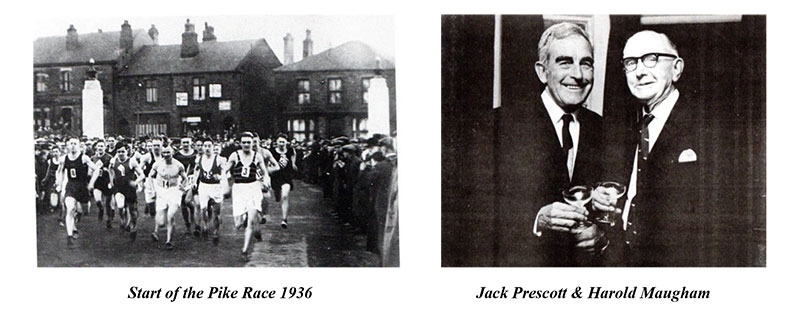
The club's foundation in 1924 was in a period of economic hardship and we’re grateful to that group of employees at Horwich Locomotive Works who set it up. Athletics and sports clubs tend to rely on the efforts of a small core of people, and for the Harriers one man who epitomises this is Jack Prescott. Jack joined the club in September 1924 and at this point he was the club’s leading athlete. When he stopped racing, Jack became club secretary, a role he held for 33 years and his willingness to encourage youngsters to run for the club helped so many Harriers. Even in the club’s darkest days at the end of the 1960s , Jack never wavered despite club turnouts being down to single figures. He kept the club alive along with Cyril Hodgson, Norman Troup and so many more. Jack was still active and involved well into his 80’s and respected by everybody who came under his guidance.

The late 1970s and 1980s saw a resurgence in interest in the sport generally. For the Harriers, it was focused on fell and cross-country racing as well as the road racing craze that swept the nation at that time, not least in the Bolton area where thousands took part in races including the much-loved Bolton Marathon. During that period, there were many successes for the club both in individual performances and in team events such as the Welsh Castles relays and the Manchester to Blackpool relays organised by Horwich. Then, in the late 1990s, there was a once in a generation opportunity that changed the direction of the club. Bolton Wanderers had moved from Burnden Park to the ‘Reebok’ Stadium alongside the Middlebrook Retail Park and, at the same time, Sport England under Sir Trevor Brooking, was keen to establish another key piece of accessible sports infrastructure with the ‘Arena’ and athletics track. The club, under the leadership of Stewart Westhead, the current president but chairman at the time, had the vision to see what could be a great facility, especially for young athletes.
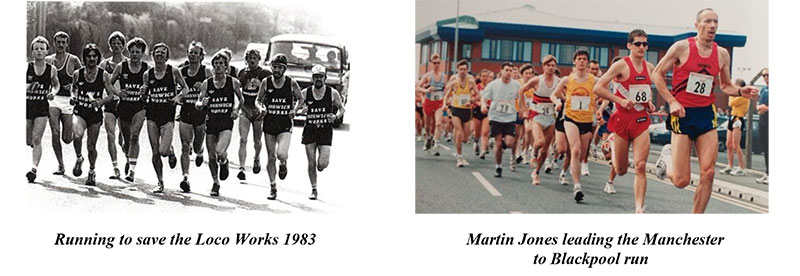
Today we see the fruits of that vision. Although the track is now almost 25 years old and in need of renewal, it has provided the platform for the burgeoning junior section, currently with a membership of 200 and resulted in the opportunities for athletes such as Sophie Walton (who at under-21 has already achieved several top international medals and vests) and Ola Abidogun (world championship medallist and Paralympian). This has been accompanied by a new generation of coaches, such as Trevor Williams coaching the juniors through to elite competition and Tony Hesketh, himself a very good athlete, and still achieving wins in his 70s. Tony started out as a road runner and went on to feature in fell running but again, following in the ‘footsteps’ of Jack Prescott, he has continued, with his wife, Brenda, to nurture junior athletes for participation and competition.
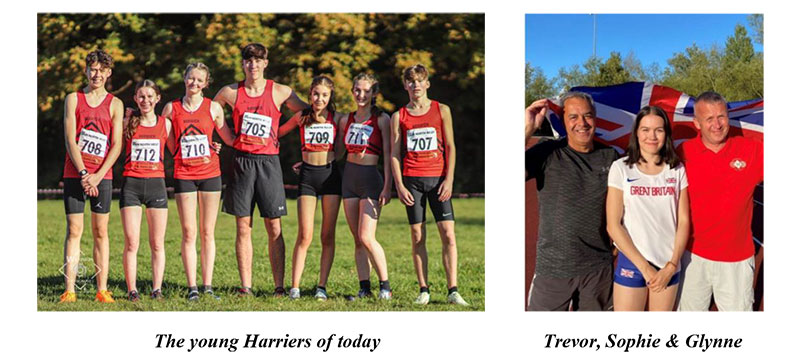
The Harriers have had a distinguished history and are going from ‘strength to strength’ at the present time, but what does the future hold? During the tenure of the current Chairman, Glynne Lever, the club has put in place the building blocks to make sure it moves forward on a solid footing. ‘Covid’ and the associated ‘lockdowns’ proved a challenging time, but Horwich Harriers now has a 10 year plan that aims to ensure that Horwich will continue to have an athletics club to be proud of for many years to come. In 2024, the club is now a quite unusual combination of track and fell specialisms with road, cross-country and field events thrown in. This has produced some excellent results which have continued in recent years with several impressive major competition performances and international vests. All this recognition goes to show what a vital element Horwich Harriers is in promoting the wellbeing and success of a small town on the edge of Greater Manchester and the West Pennines. Long may this continue!
CONFESSIONS OF A GROCER'S DELIVERY BOY By Tony Ratcliffe
My Aunt (nee Connie Rawlinson) and her husband Harry Beresford had a grocer's shop in Bankfield Street, Deane, Bolton. The shop was opposite the Saviour's Church in Deane, a large church now demolished. In the late 1940's to early 60's, cars were not as numerous as today and consequently many local shops organised trips for their customers to the Blackpool Lights or a Manchester Pantomime. My Aunt and Uncle did this as well. I also remember when I was about 7/8 years old my Mother had been ill and was sent to a convalescent home in Skegness, so I stayed at my Aunt's shop in Deane for a couple of weeks until she came home. I always enjoyed travel and I had to catch the 39 bus to Howell Croft South Bus Station,(where the Octagon Car Park now stands) and then walk across to Moor Lane Bus Station to catch the 122, 126, or 130 to the Old Boy's School in Horwich (now home to Horwich Toddlers Group). The bread delivered to the shop was Mellings, Lonsdale and Warburtons - only Warburtons is still active today and in a much larger way. I can also recall deliveries from wholesale grocers such as E H Steele of Deane and W H S Taylors of Bolton with branches in Wigan and Fleetwood.
Later, my Aunt and Uncle purchased the grocer's shop at 62 Lee Lane Horwich (formerly Walker's Grocers) opposite Brownlow Road. When Hazel and myself married in 1968 we lived above the shop in Lee Lane. I must say the aromas of the coffee and ham were very tempting when the smells wafted upstairs. As a teenager I began delivering orders on the order bike, a heavy bike with the basket over the front wheel. These bikes were very common for butchers and grocers. I can remember some of the grocer's boys before me. One was Joe Evers who lived in Store Street, just off Brownlow Road, he was from a Dutch family who dug peat on the Moss in common with other Dutch settlers in Horwich. Another grocer's boy was Joe Holdsworth. I seemed to follow Joe around, he was Head Choir Boy at Horwich Parish Church when they had over 12 choir boys. I followed him in that position and later used to see Joe and Les Duckworth at the Horwich Parish Church Youth Club along with Susan and Jim Firth - all now members of Horwich Heritage. I later became a volunteer at Horwich Heritage and found that Joe & Kay Holdsworth and Les Duckworth were already volunteers.
Whilst out delivering orders on the bike I had to ride up the numerous hills in Horwich and Blackrod to Heather Hall (known as Sod Hall),Foxholes, Fleet Street, Bottom o'th Moor, Wallsuches, Brazley Estate and New Chapel Lane, Tanner's Brow in Blackrod and around Rivington. I rode to Regent Road near the Bolton Golf Club and to the larger houses whose favourite deliveries were ground coffee, speciality teas and dried fruit. Every job has its perks though and I used to take our dog, Rex, in the order basket for a ride on Wednesday half day closing. He enjoyed it with his ears flapping in the breeze and I had his lead on just in case he was tempted to jump out, but he never did.
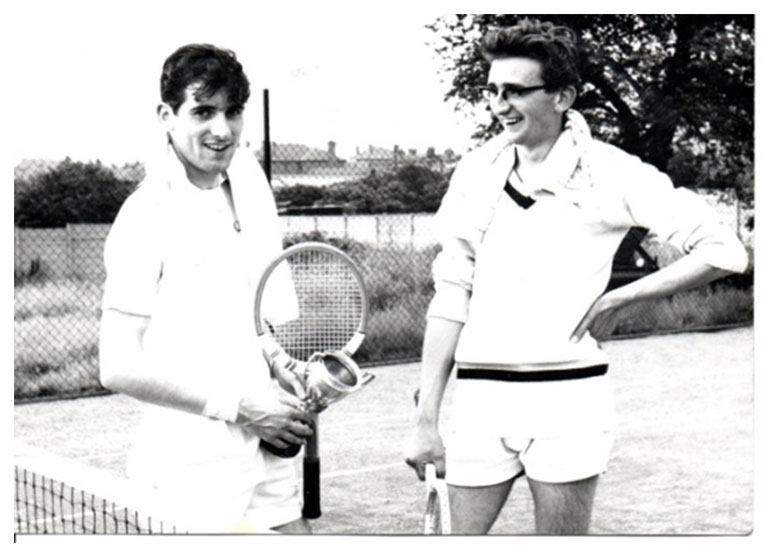
Tennis 'stars' - Tony & John Tench
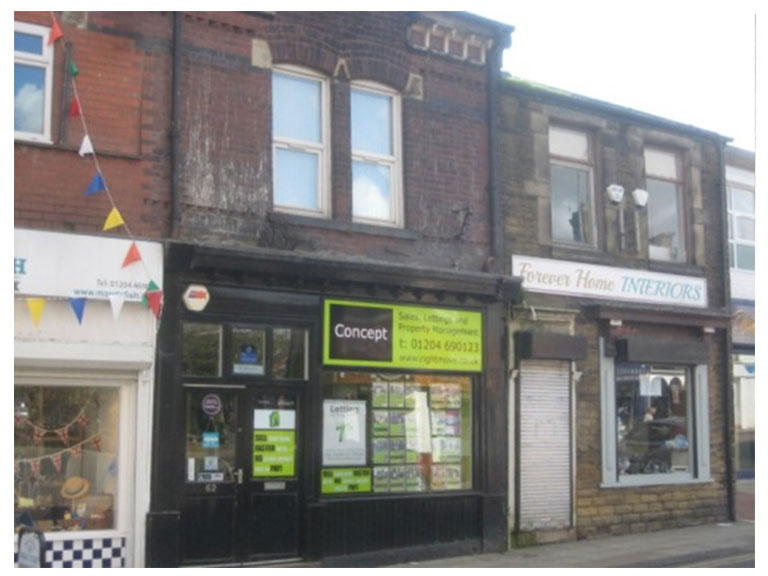
62 Lee Lane today
On reflection, I believe the heavy bike was good for my tennis in later years particularly in the hot weather. I played almost every day and it was good stamina building for long matches. Later on, the shop had an A35 van so order boys were not needed. On some Sunday afternoons I had to help dress the shop window and once a year help with the annual stock taking which was done after the Saturday close of business and which I found very boring. Earlier occupants of the flat were David and Margaret Ruaux, Margaret was Susan Firth's sister. Later occupants were John and Christine Tench. I played tennis for many years at Horwich RMI Tennis Club with John. He always played in a red pullover and I thought he was stitched into it. Kath Grundy also played tennis at Horwich along with Margaret Pyatt. I played regular tennis until arthritis set in and enjoyed it immensely. I remember representing the Bank in tournaments and being chosen to play for the Bolton & District League against other Leagues. I was once asked to represent the Bank in Monaco but refused as I would have been away too long. Horwich Tennis Club worked their way up the Leagues and won the Cecil Cup & 1st Division title. Kath Grundy, John Tench and myself were members of that team. After leaving Horwich Tennis Club in 1980, I played for Chorley Tennis Club in the Bolton Men's League and the Ribble Mixed League. I also played at Horwich in the Lancs. Men's Knock Out (Ranson Trophy).
I also remember the fire at Bullough's TV shop which is now a café at the bottom of Brownlow Road and what was Beresford's grocers shop is now an estate agents. Today things have moved on a lot from when I was a delivery boy, supermarkets now deliver their orders in refrigerated vans - a far cry from a young lad on a bicycle!
SETTING A TREND By Maureen Price
As a new volunteer at Horwich Heritage Centre, I was interested to read David Kaye's article "Lost Businesses of the 'East End' (Part 1)" in the magazine of Autumn 2017, not least because we now share a common interest in supporting the Centre but also because we shared a classroom at Rivington & Blackrod Grammar School from the years 1954 to 1959.
It seems we also shared another 'interest' as my eye was caught by his reminiscences of his time as a paper boy. His recollection that, at that time, delivering newspapers was an 'all-male' domain was correct, at least in Horwich, but not because it was illegal for girls to do the job but more that it was not the 'done thing' at the time. My 'claim to fame' is that, as far as I am aware, I was the first girl to take on a paper round in Horwich. I am looking back to the early 1950s and, as David said, only boys delivered newspapers, one of whom was my brother, who was almost 3 years older than me. We were not given any pocket money at the time, unlike most children of today, and had to earn every penny we had by running errands, jobs round the house, etc. Once he had taken up a paper round, he earned the magnificent sum of 10 shillings a week whereas I was still getting a penny here and a halfpenny there, mostly from running errands for my mother when shopping was still done 'up the Lane' at individual shops.
I think the legal age for teenagers to deliver papers was, as it is now I believe, 13 years of age. I couldn't wait to be in a position to earn such a vast amount of money as 10 shillings a week! I had already approached Cubberley's paper shop on Winter Hey Lane, the nearest newsagents to my home on Chorley New Road, (near what was the tram shed) and was promised a job when I reached 13 years old. True to his word, in 1956, when I was the required legal age, I took up my position of paper girl, the first ever in Horwich, as far as I am aware. It was a shock to my system to be up at 7a.m. in all weathers and down to Cubberley's to pick up a heavy canvas bag filled with morning papers. My round started there, delivering to the side streets off Winter Hey Lane. I remember New Brunswick Street, Canada Street, St John's Street. The houses have long since been demolished and there is now a car park in their place at the back of the TSB bank. I particularly disliked delivering in St John's Street as I had to pass the abattoir at the back of what was Markland's butchers (now The Cow Shed Tea Rooms). The sight of the cows being driven in for slaughter, happily not on a daily basis, always upset me. I can still remember their frantic 'mooing' as if they were aware of their fate.
On then up Longworth Road, Slater Avenue and across Slater's Field. Here I was to encounter another hazard; a gaggle of ferocious geese which took delight in chasing anyone, heads down with menacing 'hissing', that dared to cross their territory. My mother used to give me a bag of bread crusts each morning before I set off to distract them. The bread was thrown in one direction so that I could leg it in the opposite direction to safety. Next down Bridge Street, delivering to the cottages on the right and then down Church Street to deliver in Gorton Fold. On route I often met up with Les Duckworth, (another volunteer at Horwich Heritage), who worked for a different newsagents. We would swop papers, thus shortening each other's rounds!
Back then to return my empty bag to Cubberley's and to return home to get ready, on school days, to set out again to walk, this time with a satchel, to the grammar school. After walking back home from school, it was back to Cubberley's to pick up my evening papers and set off again. On my evening round, I had to wait at Horwich railway station where a train would pull in and a parcel of Lancashire Evening Posts was thrown off. I had to collect these and take them back with me to Cubberleys for sale in the shop. On Saturdays, I had not only morning and evening papers but an extra later delivery of the sporting news; I think it was called The Buff. Both my mother and father watched the Horwich R.M.I. football team at Grundy Hill. I used to go with them and developed an interest in watching football (now at Bolton Wanderers!) so I would read the football reports in the Saturday Buff on my delivery round. Sunday was my day off and another team took over, often lads who only delivered on Sundays as the pay rate was comparatively better. Just before Christmas, we were allowed to deliver little envelopes to all our customers, writing on each one 'A Merry Xmas from your paper boy' (in my case 'girl') in the hope of landing some Christmas tips. I always collected more than the boys for some reason and often was given a box of handkerchiefs or other small gifts. Once a year, all the Horwich newsagents 'clubbed' together to organise a day out on a coach, usually to Blackpool, as a treat for their employees. Their own families also came along but, as you can imagine, the boys outnumbered us girls by a mile, and a good time was had by all (albeit very innocent in those days!)
Articles from Horwich Heritage Magazine Autumn 2017 & Spring 2018
THE BLUNDELL ARMS - MEMORIES & HISTORY By M. Hart
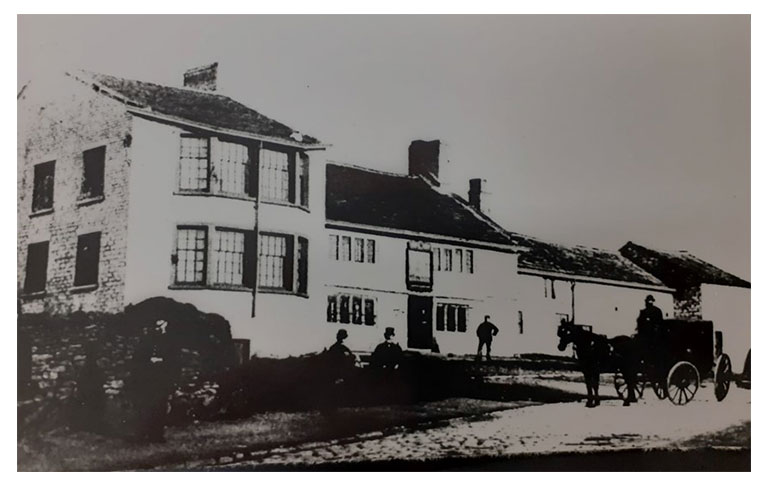
The Blundell Arms c.1900
The Blundell Arms derives its name from the Blundell Family who were substantial landowners in this area until early in the 20th century. It did not always have the same name, and was originally 'The Moorgate Inn', also known as 'The Horwich Moorgate' or just Moorgate', as I first knew it.
The building, however, was not always a pub. In Henry VII's time it was a courthouse, and when became a pub, part of it remained a courthouse. In the original portion built in the late 1400s, the walls are wattle and daub.
The stagecoach used to stop at the Moorgate Inn, en route to Horwich, on the old coach road through Moor Platt, Bottom oth' Moor, Higher Barn and Fleet Street. In 1793, it is recorded that the stagecoach overturned below Horwich Moorgate.
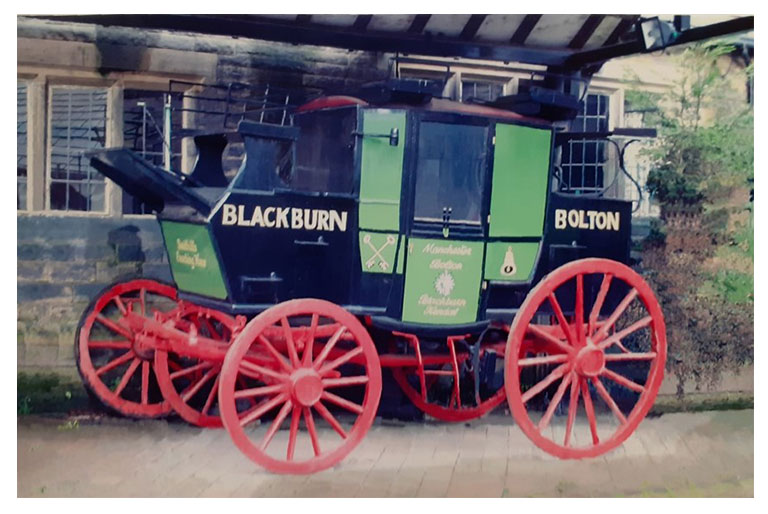
A stage coach used on the old turnpike road
I remember the old-stone built stables which were joined onto the present buildings on the east side. They were demolished after the Second World War.
Long before the porch was built at the front, there were brass rings in the walls each side of the front door for fastening horses in older times. The stone wall has not always been there, and may have been built early in the 20th century, but the old stone flags leading up to the front door may have been part of the original frontage.
In a room at the back, not far from the back door, used to stand the remains of the old courtroom, whilst below in the cellar are the stone slabs of the mortuary. As the Moorgate Inn, its biggest claim to fame was in 1838, when Mathew Lambert was Landlord. The Inquest was held there into the death of George Henderson, a Scotsman, aged 20, native of Annan, Dumfriesshire. A travelling packman for John Jardine of Blackburn, he was barbarously murdered on Horwich Moor at noonday on Friday 9th November 1838. James Whittle, a 22 year old collier, was accused of the wilful murder, but at Lancashire Lent Assizes held at Liverpool Crown Court on 2nd April 1839, Whittle, defended by John Taylor, a young Bolton solicitor, was acquitted.
The field behind the Blundell Arms was, up to 1939, a football field and cricket pitch. They used to leave the wickets up in the field until the next match. A small wooden hut near to the east wall served as a changing room. Leslie Eden was landlord when I was young, and the bowling green (now the car park) was in full use.
Article first published in the Horwich Heritage Magazine, Spring 1999
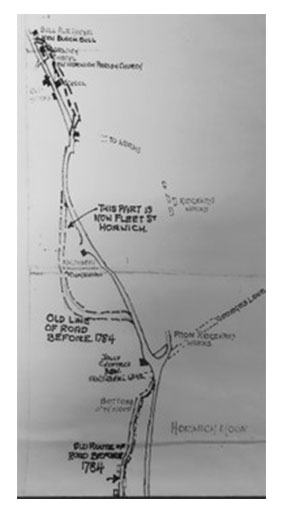
The pre 1784 line of what is now Chorley Old Road. Note the route through "Bottom O'th' Moor, Fleet Street and the rear of the Parish Church. Horwich Heritage
LOCAL HEROES By Stuart Whittle
As part of this year's 'Locomotiv8ors'programme, we came up with a selection of local heroes and asked the children to select their favourite. These are the ones we asked them to choose from because we felt they were all so different, coming from different generations and walks of life. Feel free to choose your favourite or you may feel there are others we should have included - if so please let us know.
The Ridgway Family
If you are talking about 'local heroes', you have to start with the Ridgways because it was they who effectively built the town of Horwich out of nothing. Before Thomas & John Ridgway decided to build their bleachworks at Wallsuches in 1777 (240 years ago), there were only 300 people in the area living in scattered farmsteads. But quite quickly their company started to employ more & more people from the surrounding area and these people needed houses - so they built some (the Club Houses). These families had children and needed a school - so they built one (Horwich Parish 1793) and when that wasn't big enough they built another (1832). In those days all village life centred round the church so they helped to re-build the old one (1842) and village life needed organising - so they did that from the Black Bull (now It Toro). Within 100 years a tiny hamlet had become a thriving village of 3000 and so influential were the Ridgways in making that happen that Joseph Ridgway (the son of Thomas) became known as the 'Father of Present Day Horwich'.
Sir John Aspinall
An even bigger transformation of Horwich than that produced by the Ridgways came with the building of the Lancashire & Yorkshire Railways Locomotive Works in 1886. The massive Works took several years to complete but once up and running it began employing people from across the country. In 10 years the population grew from 3,000 to 12,000 all because of the Works, and the man who masterminded its construction was the Chief Mechanical Engineer, John Aspinall. Not only did he oversee the construction of the Works but he commissioned the building of the Railway Mechanics Institute where all the apprentices were trained and where all the many sports & social clubs had their headquarters. He also oversaw the building of the Recreation Ground & Cricket Ground and helped to organise the building of the workers houses next to the Works. And if that wasn't enough, he designed the first generation of locomotives built at the Works - the first one of which, 1008, (as you know) is preserved at the NRM. John Aspinall went on to greater things after leaving Horwich and became the manager of the whole L&YR Company. He was such an important figure in the development of steam railways & locomotives that he was knighted for his services to Britain's railways in 1917.
Lord Leverhulme
William Hesketh Lever was the son of a grocer from Bolton who founded a world-wide business empire based on the idea of packaging and branding soap. Despite setting up his factory and workers village at Port Sunlight, he never forgot his roots in the Bolton area and gave back so much to the local community. He was a prodigious worker (rising at 5am every morning to have a cold bath!) and in his long and varied career, as well as running his ever-expanding business, he found time to become an MP (he was also in Lloyd George's Government) and the Mayor of Bolton. In the early 1900s, on the Rivington hillside above Horwich, he built his exotic bungalow and gardens and, alongside these, he donated a large area of land for the laying out of Lever Park to be enjoyed for free in perpetuity by all the local residents. In Bolton, he provided the land for Leverhulme Park, restored Samuel Crompton's home at Hall i'th Wood and provided the funding for Bolton School. He was without doubt the greatest benefactor this area has ever seen and today, almost 100 years after his death, hundreds of thousands of visitors enjoy the benefits of his legacy, spending their leisure time in Lever Park or the terraced gardens - which are at last being restored to something of their former glory.
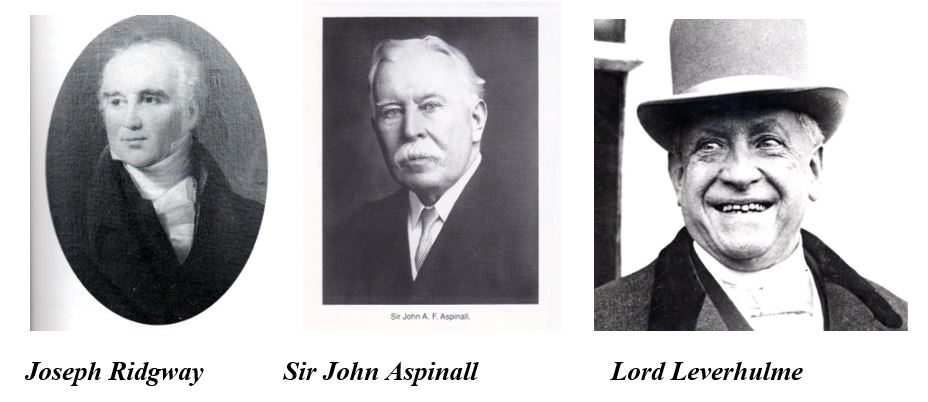
Edith Rigby
Edith Rigby was born in Preston in 1872 and from an early age had strong sympathy for the plight of poor and oppressed people in the town. She championed a number of causes and is best known for her pioneering work for Women's Suffrage. As well as promoting the suffrage cause in her home town, she travelled to London where she was arrested for taking part in suffragette marches and imprisoned on several occasions. Joining in the hunger strikes in prison meant being subject to 'forced feeding' under the notorious 'Cat & Mouse' Act. None of this deterred Edith & her colleagues who began to take increasingly militant action to try to get the Government to change the law and give women the vote. This action included vandalism, defacing public property and arson, and it was Edith Rigby who burned down Lord Lever- hulme's first bungalow at Rivington in 1913 - even though he was a supporter of women's rights! Undeterred, Leverhulme went on to build an even better one. The militant action of the Suffragettes was halted in the national interest at the outbreak of war in 1914 and, thanks to the actions of women like Edith Rigby and the contrib- ution women made to the war effort, women were finally granted a limited right to vote in 1918 (limited to the over 30s) and full voting rights in 1928.
William Parr
Everyone has heard of the Titanic disaster when Britain's biggest & most luxurious liner was struck by an iceberg on it maiden voyage in 1912 and proceeded to sink in the freezing waters of the North Atlantic with the loss of 1500 lives. This was the worst maritime disaster in British naval history at the time. Just recently we discovered that Horwich has its very own connection to the Titanic in the form of a gentleman by the name of William Parr. He grew up in Horwich after his Dad got a job at the newly-opened Loco Works in the 1880s. Like so many boys at the time, William followed his Dad and became an apprentice at the Loco Works. He showed such promise as an Electrical Engineer that he was quickly promoted and became a lecturer at the Mechanics Institute in his early 20s. He was then offered a job at the prestigious Harland & Wolff shipyard in Belfast, Northern Ireland. There he became a member of the elite team who designed the world's great liners and it was his privilege as one of that group to sail on the maiden voyage of any ship that he worked on. Unfortunately, fate was to decree that he was on board the maiden voyage of the Titanic on 15th April 1912 and he and the other members of that elite team all lost their lives. He was just 29 years of age and, to make matters worse, he had recently got married and had a 3 month old child who was left without a father. To commemorate his life Horwich Heritage has recently erected a plaque outside the house where he lived (which is now Poppins Tea Room on Lee Lane opposite the Public Hall) so do look at it when you are next passing.
Tommy Edwards
Tommy Edwards was a soldier in WWI and his life typifies that of so many local men who were called up to fight for (and in many cases die for) their country. Like so many others in the 1880s, his family had moved to Horwich to work at the newly-opened Locomotive Works and by the age of 14 he himself was working there in the boiler shop. At an early age he became interested in the military and joined the local Territorials who were based at the Horwich Barracks (now the Community Centre). However, their regular training routine was interrupted on 4th August 1914 when war was declared and his unit (part of the 1st/4th Loyal North Lancashire Regiment) was despatched to France. Tommy Edwards and his Horwich pals first saw action in June 1915 at the Battle of Festubert - and a bloody affair it was too! Tommy was wounded and many of his colleagues were killed. For his bravery in leading the men when all the officers had been killed he was awarded the Distinguished Conduct Medal (DCM). Sgt. Major Tommy Edwards returned to action and survived the war but only a year later, in 1919, his death was announced in the local newspaper. He was only 36 years of age. His funeral was conducted with full military honours at Horwich Parish Church where he is buried in the graveyard.
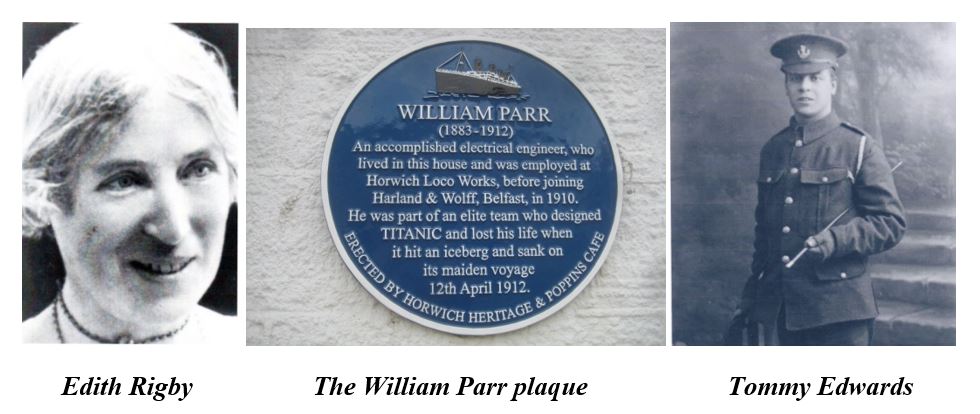
Matron Jubb
Most of the honours in WWI went to the fighting men for their heroics in the trenches, but although women weren't allowed to fight, they played a vital part in the war effort, in particular in the armament factories producing munitions and in nursing the injured both on the front line and back in the many hospitals & convalescent homes in Britain. Over 200 women worked at the Loco Works producing shells for the war effort and at the Cottage Hospital (which was part of the Loco Works) injured soldiers were nursed back to health by Matron Sarah Jubb and her team. For her 'devoted service to injured soldiers' Matron Jubb was awarded the Royal Red Cross, the highest award for nursing. She is reported as having a 'charming and winning disposition' and in addition to her work at the hospital she did a considerable amount of social work in the town. She was also President of the Women's Branch of the British Legion (who to this day look after the welfare of ex-servicemen & women) and retired in 1930 after 35 years service to the community.
Frederick Haughton
As we all know, within 20 years of defeating the Germans in WWI, Britain was at war with Germany again in WWII and another bloody world-wide conflict began costing millions of lives. If you were a young man over the age of 17 you were expected to fight for your country and join either the Army, Navy or Air Force. Here is the story of a remarkable young man from Horwich called, Frederick Haughton. He used to work at the Loco Works but had joined the Navy before the outbreak of war and he soon saw action. In 1941, the war was going badly for Britain as the German battleships and submarines were sinking a record number of our supply ships - threatening to starve the country into submission. It was the job of the battleships of the Royal Navy to stop this threat by attacking the German battleships and the biggest of them all was the Bismarck (of which we have a lovely scale model in the Heritage Centre). Fred Haughton was one of the gun crew on the British battleship, the 'Prince of Wales', which attacked & sank the Bismarck in May 1941. The Prince of Wales was however attacked and sunk by the Japanese Navy later that year and Fred was one of the very few survivors. Despite this, his war was not over yet and he saw action in the D Day landings in France and the protection of the Russian convoys in the North Atlantic. Remarkably, Fred survived all of this and was given the Distinguished Service Medal (DSM) by the King at Buckingham Palace in 1942. He was a very brave man and a true hero.

Ron Sutcliffe
This local hero should be of particular interest to pupils and ex-pupils of Horwich Parish C of E Primary School because he was your Headmaster for 27 years from 1959 - 1986. His name is Ron Sutcliffe. What made Ron special, apart from his teaching abilities, was that he was also a professional cricketer! In those days (and still today) every club in the Bolton Cricket League was allowed to sign one exceptional player. He was their 'professional' and he was paid for his special skills which would help the team to win matches and cups. Ron was a professional in the Bolton League for 13 years, 7 of those for Horwich RMI Cricket Club. During his time at Horwich the team were very successful. They won the League title and the Cup several times and in 1955 did the League & Cup double. Ron was both feared and respected by his opponents and in 1959 won the prize as the League's top professional. When he retired from cricket he became the Head of Horwich Parish C of E Primary School and was a very popular head, particularly when it came to teaching the pupils how to play cricket! Ron also had a strong connection to the Parish Church and became a local preacher after his retirement. What a remarkable dual career he had.
Tony Caldwell
You need to go back a bit to remember when Horwich RMI had a (semi) professional football team that played in the Northern Premier League and Conference and in the FA Cup (remember Blackpool in 1982 or Fulham in 1998?) or to remember their football ground at Grundy Hill (behind the Leisure Centre) where there are now houses. The team's 'hey day' was probably in the 1950s when they won the Lancashire League title and cup and over the years they have had some star players who went on to play for Football League clubs. One of these was Tony Caldwell who in the early 1980s was an electrician playing part time football for Horwich RMI. In 1983 he was spotted by Bolton Wanderers and in his first game for the Wanderers scored 5 goals! In the whole 140 year history of Bolton Wanderers no one has scored more than 5 goals in a match, let alone in their first match - what an achievement!
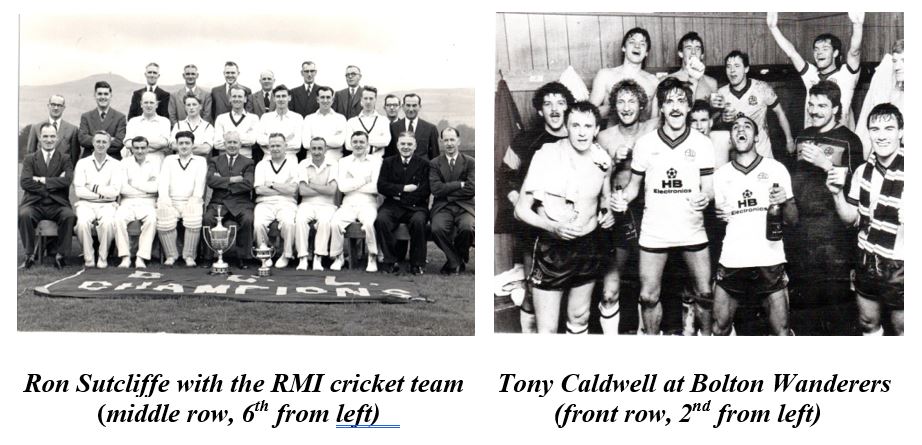
Published in Horwich Heritage Magazine Autumn 2018
SIEGE OF HORWICH (1886)
People today are familiar with the excuse "the building work is held up due to the bad weather and the like", but in 1886 Horwich's new Loco Works was held up for a more colourful reason. Much of the work was being carried out by Irish navvies and there were often lively incidents involving these high-spirited men. Some of themcaused so much troublethat they were sacked, causing further delays through a lack of labour An interesting account was related in the Chronical of the time:"Horwich has for the past few weeks been garrisoned by Police constables. Its streets patrolled by members of the force who walked in couples, and in sight of each other, while a reserve company was held in readiness at the Public Hall. The state of siege was made necessary as a result of the English and Irish navvies employed at the new railway works having got to fighting and in terrible earnest. The ill-feeling has been brewing for some time culminating in a free fight extending over a large area and in which bricks, pokers, and other weapons were freely used. In fact one Irishman was seen galloping round with a scythe, while others were armed with large blocks of wood."
The fight seems to have started at the Craven Heifer Inn when a one-armed Englishman was set upon by the Irish and badly beaten up. A gang of English took revenge with the aid of belts and 40 or 50 men were involved. The reporter takes up the story:
"Subsequently, small fights were common all along Lee Lane and, at about 8pm, a proper set-to took place at the top of Winter Hey Lane. By this time the streets were thronged with people who had come out to see the fun. Bands of navvies paraded up and down Lee Lane and every now and then there was a bit of a flare-up, but it was not until 10.30 pm that there was a real organised fight.
At that time the Irish had concentrated on Summer Street and were yelling at the tops of their voices. The English made a dash at them with belts. The Police were powerless. Bricks were thrown and several windows broken. The Irishman with a scythe was soon put out of action with a well-aimed brick. The conflict raged fiercely, each party having the better of it, until the Police eventually got between the parties and, by a little tact, got the Englishmen to go away"
The fun continued all week, with Blackrod colliers declaring their intention to take part in the battle on the side of the English. Whether that had anything to do with it is not known, but a few days later peace returned to Horwich and some of those who had taken part were sent to jail without the option of a fine.
The Chronical said ill-feeling between the parties was intensified through the Irish working for ½ d per hour less than the English.
Taken from 'The Changing Face of Bolton (Issue 2: Horwich)' by Christine Southern.
First published in the Horwich Heritage Magazine Spring 2002.
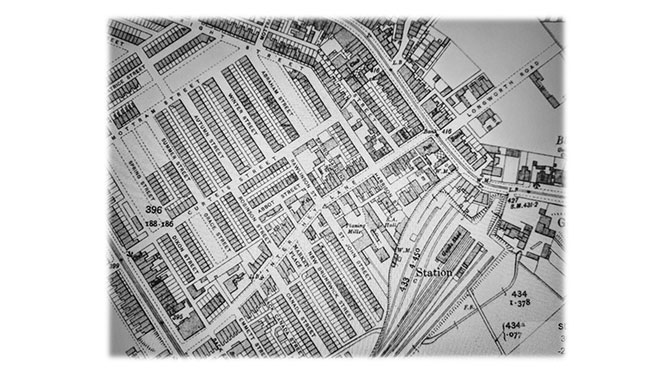
Horwich Town Centre about the time of the Siege
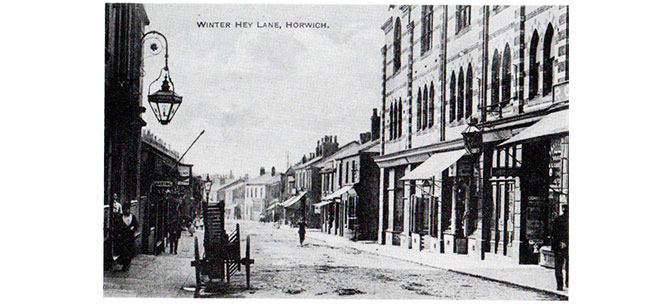
Winter Hey Lane c.1886
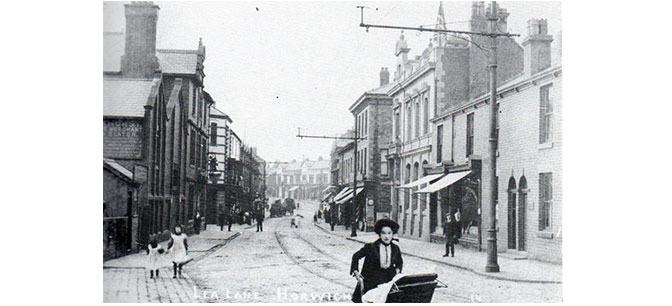
Lee Lane c.1886
BOB'S BROW (PART 3) By Derek Cartwright
In our third instalment looking at 'Bob's Brow', we examine mainly the social activities in which both adults and the young are engaged across all parts of the 36 acres (14.4 hectares) of our town's ever- adaptable and favourite corner. Flanked by Crown Lane, Scholes Bank and Squirrel Lane, we have seen previously that this area has been the location for high living, industry and farming for hundreds of years with cattle grazing and silage production still active into the 1980s and the nearest farm, Anderton Hall Farm, still very much in business in the 21st century. Today the landscape of this much-loved location has become somewhat wild and overgrown as a result of the absence of cattle grazing, which kept the grass short and therefore ideal for a whole range of leisure and play activities. Generations of Horwich children have spent their summer days down Bob's Brow (Bobbs'y), playing in the waterfall, damming the streams, fishing, enjoying rope swings in the trees, playing football, cricket, flying kites, sledging, camping out, having picnics, playing tennis or getting up to no good! Its part of the fabric of the town and colours the memories of so many of us who grew up in Horwich. So let's explore a selection of activities which have taken place in Bob's Brow over the years.
Sports for 'grown ups'
The Race Course: Horwich can boast of having 3 horse racing courses over the last 250 years or so. The first around the Wilderswood area, the second near Bob' Brow with the third and final one being on the land which is now occupied by Green Lane/Fearnhead Avenue and the Lever Park area. The first races held in Bob's Brow took place on August the 19th 1837. The course was situated in extensive fields in the vicinity of the Squirrel Hotel. Walking down Squirrel Lane the large flat fields on the right appear to be the most likely location. Race meetings continued for the next 11 years and a new Crown course for sprint races was introduced for the 1846 meeting, won by Mr Walker's 'The Nobbler'. The final meeting was staged on Friday 29th August 1848. The new Horwich Race Course appears to have taken over from around 1850 with a move from the rear of the Squirrel to the new venue at Green Lane/Fearnhead Avenue and Lever Park. This continued for many years and was still in operation in the early 20th century.
The Anderton Horse Show: The Anderton Horse and Pony shows were held over the Easter weekend for a few years ending in the mid 1970s. The competitions took place in the fields to the right of Squirrel Lane which used to host the race course. At their peak, the Anderton Horse shows were very well attended with all parts of the country represented, everone eager to get involved in the various equestrian events for both adults and children.
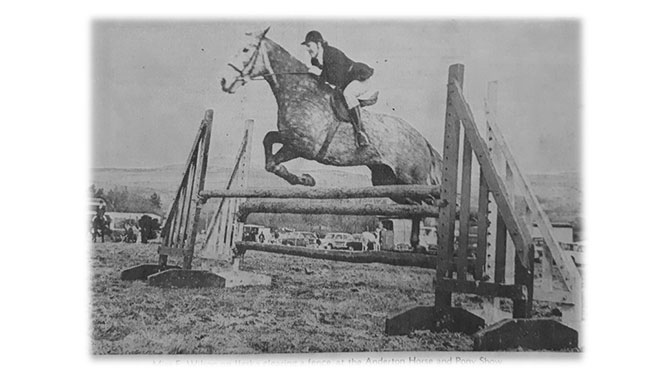
The Anderton Horse and Pony Show near Bob's Brow 1970
Sports of all types
'Tottering Temple' and other establishments in the area were involved in the pre-chemical bleaching industry. This type of bleaching required large flat pieces of land or 'crofts' to be available to peg out the material using 'tenterhooks' to be bleached by sunlight. It is these flat fields which have, during the 20th century, become very popular and well used for all types of sporting activities. During the 1930s, tennis courts including a pavilion, existed just inside the Anderton boundary (see map below). Talking to older residents, it is likely that this facility didn't last much longer than the 1920s. However, remains of the red court shale were still evident in the early 1970s and the flat court area can be clearly seen today.

The tennis courts can be seen slightly right of centre on this 1937 map
Formal football games and cricket matches with marked out pitches and permanent goal posts have featured as part of the story of Bob's Brow since the 1960s. Many more informal games will have taken place before and after that time. During the 1960s/70s and 80s, 4 full size football pitches, a fenced off cricket pitch plus a basic changing room occupied the largest of the flat fields immediately adjacent to Scholes Bank. Local schools utilised the pitches during the week and at the weekend many a Sunday League pub, club or works team also battled it out down there. Overtime, the pitches became used more by Junior Football Clubs with Horwich St Mary's being a prime example.
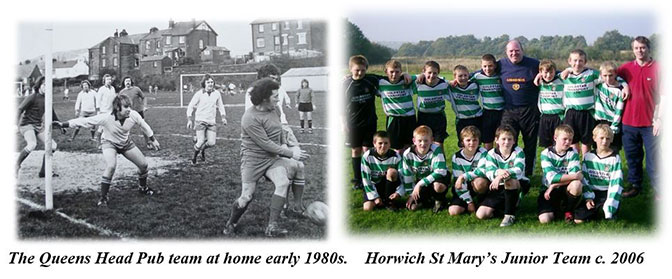
With marked out tracks, local schools held their annual sports days and other events on the same well-utilised fields.
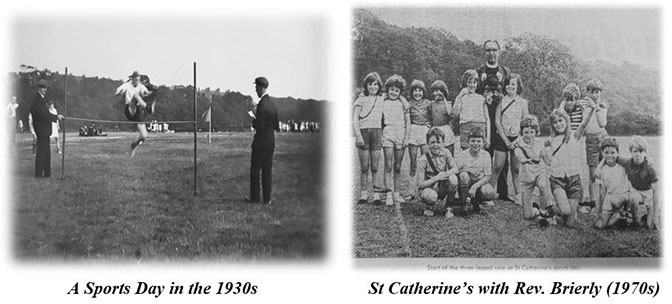
Children at Play
The varied landscape of short steep hills, tree covered plantations, farms, lodges, waterfalls and streams has made for a perfect area for children of all ages to partake in many and varied activities or simply just to play.
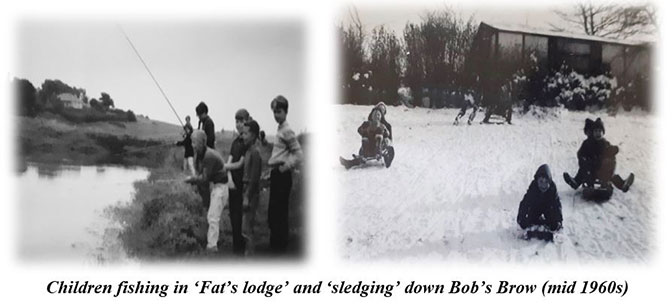
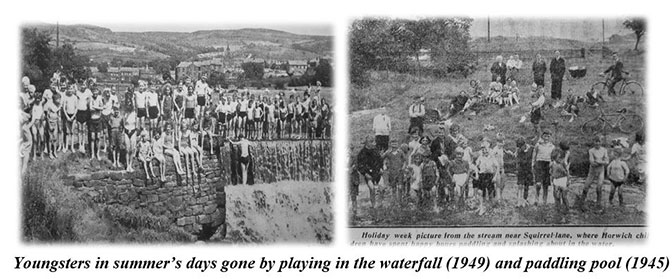
Epilogue
Few pieces of land in or around Horwich could claim a history and heritage as rich as Bob's Brow. These 36 acres of land, bounded on one side by a road said to stretch back to Roman times (Squirrel Lane) and covering the three local townships of Horwich, Rivington and Anderton, have seen the birth and decline of a medieval hall and its dynasty, a 17th century (possibly older) water mill, an ancient bridge, re-aligned rivers, 2 farms (one that once had a water wheel), bleaching grounds, fisheries, a horse racing course and a horse show ground. Its sports fields, once bleaching crofts, have hosted football, cricket and sports of all types and still do. And, woven through all that, thousands of local children have for decades spent countless hours and days of adventure playing down there in all weathers and in all seasons - long may it continue.
Oh, and then there are the aqueducts..! But that's another story!
The Fun Continues
Into the 21st Century the story of our favourite 36 acres and the enjoyment they bring continues...
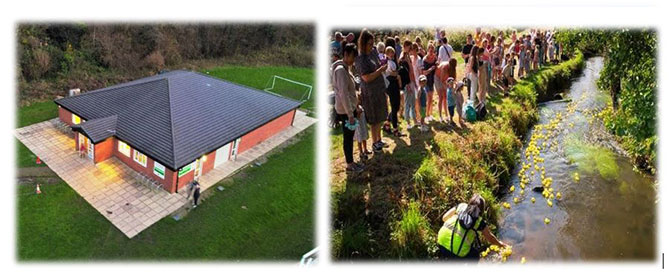
The new Horwich St Mary's Junior Football Club club house which along with the much improved playing fields heralds a new era for sport in Bob's Brow. Each summer we see the 'World Famous' Bob's Brew charity Duck Race seen in the river upstream and feeding the much loved Waterfall (below)
References: Racecourses Here Today and Gone Tomorrow (Volume 1) John Slusar, 2016.
Map produced with kind permission of the National Library of Scotland.
Thanks to St Mary's Junior Football Club and Ivan & Christine Snape.
All other images by the author or Horwich Heritage.
BOB'S BROW (PART 2) By Derek Cartwright
Introduction: We continue the exploration of this fascinating piece of land in Horwich which is flanked by Crown Lane, Scholes Banks and Squirrel Lane. In this instalment we look at the long gone manor house and more about the associated mill, other mills and the bridge. We then take a brief look at the local farms and the Anderton Fisheries.
Anderton Old Hall: We start with the Anderton Manor and although not in Horwich the presence of this manorial home in the Bob's Brew area has had a lasting impact on the layout of this popular and familiar landscape. Many will be aware of Anderton Hall, sometimes referred to as "Stoners," built in circa 1870 which stood majestically on the banks of the Lower Rivington Reservoir until its demolition in the 1930's. This hall was built possibly from compensation monies to replace Lady Hall the ruins of which sit at the bottom of the Lower Rivington reservoir roughly opposite where the Leverhulme built Liverpool Castle now stands. This Anderton Hall is not to be confused with Anderton Old Hall the history of which is uncovered below.
A substantial history can be told about the Anderton dynasty but here's just a small piece about this titled family for context and at a turbulent and relevant time during which the family resided at Anderton Old Hall. The Anderton manor itself can be traced back to 1281, as well as the village and lands of Anderton the manor also included part of Rivington and remained with the Andertons for many centuries. Anderton Old Hall is mentioned as being the property of Peter (I) the son of Oliver Anderton who died in 1559, the hall having various buildings, lands, a bridge and a watermill. William (I) Anderton (son of Peter) was convicted as a recusant (refusing to turn his back on the Pope) and as such suffered the sequestration of two-thirds of his estates in 1593. William (I) died in 1634 leaving the manor of Anderton, the Hall, watermill etc to his brother Peter (II), then seventy years of age. On the death of Peter (II) his son William (II) had the estates confiscated again and sold by Parliament in 1652 due to the families support for the Royalists in the English civil wars (1642-1651). In the same year William made a settlement of the manor to Francis Anderton of Lostock, and four years later Francis purchased the estate which must have been from the government. From this time the manor descended in the same way as Lostock; from Anderton to Blundell and to the Stoner families.
Anderton Old Hall was the manor house and said to be the from the 14th century. The Hall stood on the Anderton side of the River Douglas, in the fields between the river and Anderton Hall Farm. It is unclear when the hall was left and demolished but it is not shown on the Yates Map of 1786 so the Hall must have gone by that time. Generations of locals will have looked across that field, steeped in history to the farm, when with children or as children themselves, playing in the bend or paddling pool in the stream on hot summer days. All that remains of the hall is the uneven field surface with the outline of the foundations becoming a little more visible on frosty mornings.
As we have seen the Anderton Old Hall, the farm, a bridge and a Mill (plus accompanying waterfall or weir) can be traced back well into the middle ages, making the remaining fixtures including the waterfall and bridge being amongst the oldest structures in the wider Horwich area. Jack Rawlinson (1968) suggests the waterfall/weir as we see it today and relating to Anderton Mill is possibly dated from the time of the restoration of the monarchy in 1660 and was said to be originally a corn mill. The mill was not shown on the Horwich Platt map of 1620 on which the River Douglas forms the western boundary which suggests the river was diverted for the mill after 1620. Rawlinson provides a strong argument regarding the age of the mill/waterfall as the land was probably sold back to, and developed by the Andertons wider family by the restored monarchy who might have looked more favourably on the royalist loyal Andertons.

The site of the Anderton Old Hall in the Bob's Brew area can be seen as a dotted square, centre left in the section of the 1850 map, OS grid: SD 62920 11620. The River Douglas can be seen running top to bottom in the centre with the waterfall/weir and long gone mill top centre.
Anderton Bridge
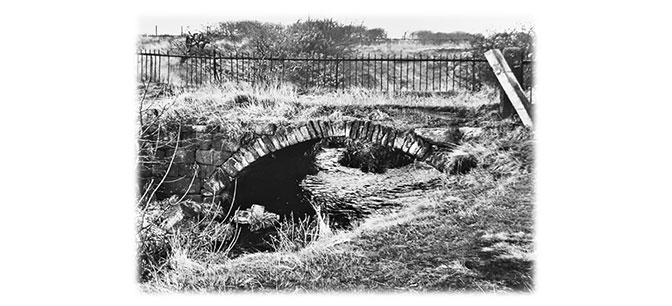
The Anderton 'Mill' Bridge 1960's (John Smith)
As we have seen previously the rivers Douglas and Middlebrook were diverted to supply water to power the watermill (post 1620). The bridging of the diverted River Douglas at this point will have been in existence from possibly around 1660 or before. The bridge allowing a route to be taken from Anderton Hall eastwards towards the other branch of the Anderton family with its seat, Lostock Hall at Ox Hey Lane, Lostock (John Smith). The Anderton Bridge as we see it today is of considerable age but the actual building date at this point is unknown, a working assumption of the 17th century is probably acceptable.
Anderton Hall Farm A listed building which once formed part of the estate of the Andertons. The farm included a mill operation with the waterwheel still being in existence well into the 1970's. The mill-race and lodge supplying water for the wheel can be seen on the 1850 map above top left. The mill was most likely used for milling corn.
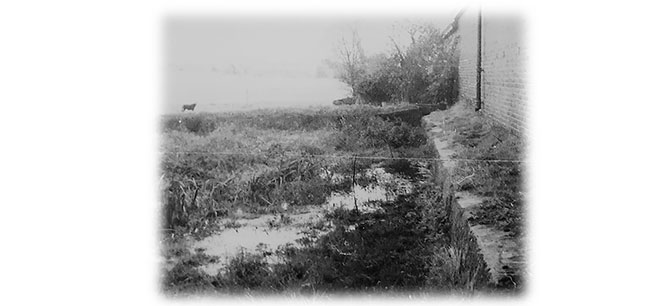
The lodge providing water for the Anderton Hall Farm water mill which still can be seen today (John Smith)

The Anderton Hall Farm waterwheel in 1970s (John Smith)
The Dickenson and Pendlebury families farmed from the Hall Farm which passed from private hands to the Co-op in the early 20th Century. Being sold on again during 1949. The Farm was known locally as Ashworths for many years after the Co-op sale. Today the farm is still in operation with the buildings although expanded and re-built are positioned on the site of the original Anderton Hall Farm.
Ploughing on Anderton Hall Farm when owned by the Co-op at the outbreak of WWII as part of the "grow more food" campaign.

The Co-op farm equipment being sold off 1949 with Anderton Hall farm in the background.
The Anderton Hall Fisheries After leaving school, Harry Chorlton of Bolton set up a small fish hatchery, as a hobby in the basement of his father's house in Derby Street. His small business flourished with Harry being able to breed and supply around 1000 trout annually to fishing associations etc to help stock their waters around the North of England. He was anxious to develop the business on more ambitious lines. The opportunity arose when Harry gained employment at Horwich Loco works as a telephone linesman. By 1904 he had established a sizable fisheries operation in the grounds of, and close to Anderton Hall Farm. Here he breed fish and sold young trout in bulk to re-stock rivers and lakes from the midlands northwards, Harry built up a fine reputation. Fishermen were also allowed to fish directly in the fisheries paying 1s. 6d. per pound of fish caught. Harry told a story of four Stockport men that did so well fishing in his fisheries that they had to wheel their catch away to Horwich Railway Station in a wheelbarrow, from where they took a train to Manchester to sell their catch, making a handsome profit.
Unfortunately Harry had to give up his profitable hobby on the Anderton Hall site in around 1910. This was because of pollutants in the river supplying the fisheries (River Douglas) which killed his entire stock of 83,000 trout in just three days. With the help of his two sons however Harry continued to supply fish, this time it was by netting rivers and lakes and transferring the fish to low stock waterways.

Mr Harry Chorlton who lived in Heavily Grove Horwich, working in the Anderton Fisheries which he established circa 1900
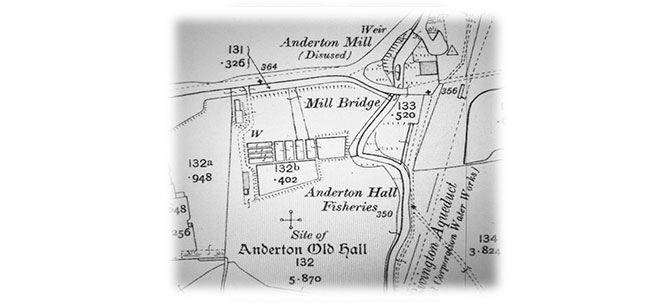
Site of the Anderton Fisheries 1909, established by Harry Chorlton circa 1900. The River Douglas is seen with its bend running top to bottom right of centre
The 'bend' (paddling pool) in the river Douglas during 2021, looking broadly westwards across to the Anderton Hall Farm. The field seen is where the Anderton Fisheries once stood. To the left is the site of the Anderton Old Hall. The raised portion of land to the right against the red brick of the farm building is the farms waterwheel lodge
Monks Farm Monks, probably beef farm was likely to have been part of the Anderton Manor. The name "Monks" appeared in the Anderton family though marriage so could have been related to the farm. The building stood to the west of the original course of the Middlebrook prior to the rivers were diverted. It is possible therefore that this farm also had a simply mill function powered by water from the now defunct Middlebrook.
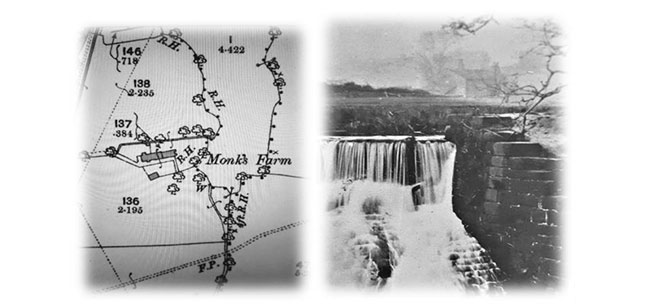 The farm is seen centrally on the 1892 map. Although seen on the 1850 map, Monks farm was not visible on the Yates map of 1786. The farm having gone by 1909. Monks Farm can be seen top right on the right hand photograph with the famous waterfall in the foreground. A lodge in the Bob's Brew area is known locally as "Fats" lodge, it is said that a man called Fats worked at Monks Farm and gave the name to the lodge.
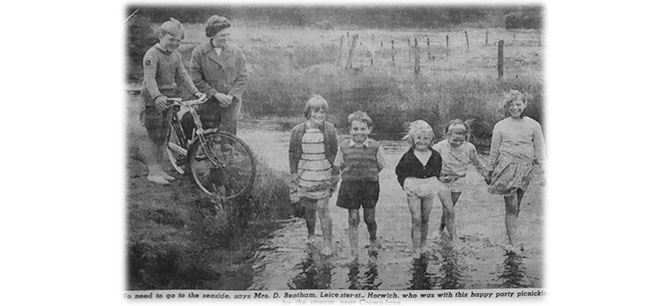
Children playing in the 'bend' (paddling [pool) in the River Douglas 1960s - happy days!The fields steeped in history are over to the right
Helped by the work of: Thomas Hampson (1887), Jack Rawlinson, D. A. Owen. Thanks also to Ivan & Christine Snape. Maps: Yates Map 1786, OS 6 inch:1 mile 1850 and 25 inch:1 Mile 1892 &1909 (with kind permission of the National Museum of Scotland).
ANDREW PEAK (1810 - 1889) LOCAL INDUSTRIALIST & BENEFACTOR
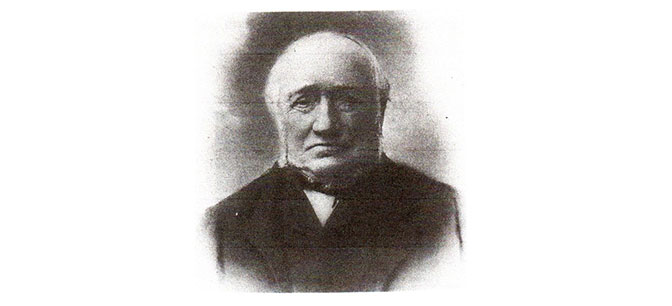
The story of the rise to prominence of Andrew Peak of Horwich is typical of the many remarkable accounts of men of humble origins using their skill and ingenuity to prosper in the Victorian Age; a period which saw the rapid transformation of Britain into an industrialised nation. It also, not untypically, reveals a person of strong religious conviction with a desire to improve the lives of ordinary people.
Andrew Peak grew up in the 'Club Houses' on Church Street, started work at an early age and like the majority of local people at that time worked at Wallsuches Bleachworks. However, by 1846 he was married and had a grocery and drapers shop at 37 Church Street. He continued to prosper acquiring property and building his own terraced houses to let on Lee Lane.
Obviously a man with an eye for business and very much aware of the growth prospects of the then village of Horwich, Andrew Peak took the opportunity to buy Fairclough's Brickworks at Wilderswood shortly after it had been damaged in the major flood of 1850. By 1871 he was listed as being a Colliery Proprietor & Brickmaker employing 58 men and 15 boys and 10 years later he had built more property on Lee Lane, opened another brickworks on Chorley New Road and employed a total of 95 men and 26 boys ( in a village with a total population of c. 3000).
Not content with providing employment for a large part of the village's workforce, Andrew Peak expressed his social concern for Horwich by being a major benefactor of Lee Chapel (later Lee lane Congregational Church): providing money for a Manse, donating a clock, choir gallery and pulpit furniture, by being a Member of the Local Board & Liberal Reform Club, by donating a Public Lamp & Fountain near the Crown Hotel and by leaving considerable sums of money to local churches & charities.
His obituary in the Bolton Chronicle (Dec. 31st 1889) paid tribute to a successful, generous, self-made man who had given much to the community of Horwich. At his funeral Rev. Houlgate praised him as "one of the time-honoured school of old Horwichers" who had been pre-eminent in its recent development, concluding that "Whoever should be privileged to write the history of Horwich for the past 50 years would do him an injustice if he did he not give him a prominent place in the social life of the old-time village."
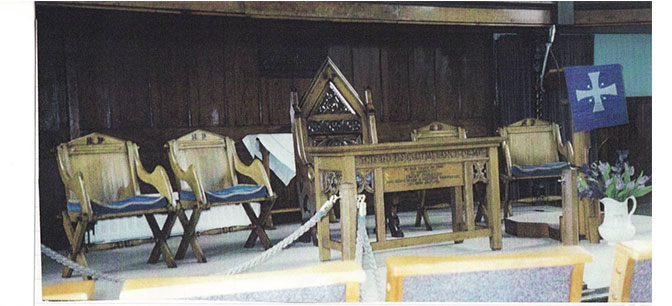
ANDREW PEAK'S CHAIRS c 1875
Andrew Peak presented these five chairs to Lee Lane Congregational Church. The large chair bears the initials of Andrew's wife, Sarah, and the four smaller chairs bear his initials. The chairs were used during Holy Communion Services. The Minister sat in the larger chair, with two church Deacons sitting on either side of him .I don't know just when the chairs were presented to the church, but the present building was erected in 1856, the first Lee Chapel having been built in 1778.There were many well attended churches and chapels in Horwich in the 1800s because more people went to worship regularly. The church was the centre of peoples' social lives - many churches had football and cricket teams, and even in 1956, the then Minister, Rev. Robert Parker wrote, "On Monday and Friday evenings there are Whist Drives, where there are mainly members of the public who are Whist 'fans', and who do a weekly 'tour' of the different churches' whist drives. Tuesdays and Thursdays a Badminton Club meets - on Tuesday for practice and Thursday for serious play in league matches against other teams. A girls' gymnastic class meets on Wednesday evenings, and a boys' club on Tuesdays. Occasionally dances are arranged for Saturday evenings." Nowadays, people find their entertainment elsewhere.
I do not know much about other Christian denominations, but Congregationalism is a Christian movement that rejects the hierarchy of the Anglican and Catholic churches, allowing each church to be independent and to elect its own minister. It began in England in the 16th century, but persecution drove many followers to Holland and America.
The four smaller chairs are made of oak, and the larger one is a Victorian copy of the chair used by an Archbishop when he went round the country visiting the churches. That chair is a medieval copy of a campaign chair used by the Romans. There were many copies made of the chair during the Victorian era.
Andrew Peak, the donor, was born on 17 December 1810, and baptised on 19 December at New Chapel Independent, Horwich - now New Chapel United Reformed Church. The Bolton Chronicle of December 21st 1889 stated, "DEATH OF MR ANDREW PEAK - We have to record this week the death of an old and respected townsman, Mr. Andrew Peak of Gorton House, Horwich. Deceased was in his 80th year, and had been in failing health for a number of years, being attended by Dr. Emmett. He expired on Wednesday morning. He had carried on the manufacture of fire bricks and tuyeres at Wilderswood and Chorley New Road for a long number of years, but had recently taken no active part in the business. In his younger days he was employed at the Wallsuches Works and became manager in the fluers and sutchers department. Leaving there he commenced as a grocer and general dealer in a shop opposite the Church, and did business travelling with goods in the country. He next commenced in the business of brick and tuyere making, and was very successful. He was a shrewd business man, and very far seeing, making several good speculations and never allowed an opportunity to pass by where he thought he could make money. He was a Congregationalist and attended the New Chapel in the Fields, but later Lee Congregational Church. He was a Liberal in politics, and the vice-president of the Liberal Club, the flag having been hoisted to half mast since his death. He was a Local Board member for many years, and gave to his native town the public lamp and fountain near the Crown Hotel. He was a warm supporter of the Congregational religion, and gave the clock to Lee Chapel in 1870. Deceased was the son of William Peak, also a native of Horwich. He leaves a widow but no children. Deceased was one of the largest property owners in the town".
When Lee Lane church closed in 2005, I asked that the chairs be brought to Horwich Heritage, rather than being destroyed. Cynthia Pearcy
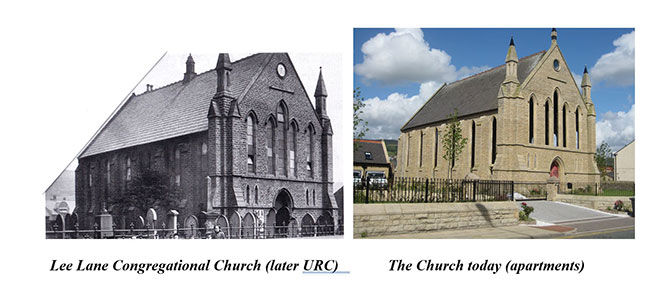
RAILWAY FAMILIES OF HORWICH by Horwich & Westhoughton Journal
We are all familiar with the story of how Horwich was transformed by the building of the L&YR Locomotive Works during the 1880s & 90s and how thousands of people came from all over the country to work there, causing the population to quadruple from 3000 to 12,000 in just 10 years. But have we ever paused to think of the contribution these incoming families made to the development of the Horwich we know today? Told 60 years after the Loco Works had opened, here are 3 stories to remind us how much Horwich owes to its founding 'railway families'.
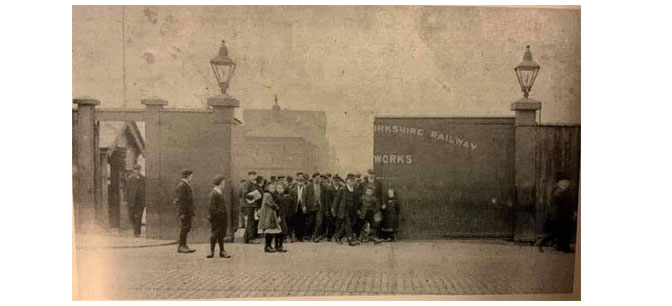
Workers leaving through the Loco Works gates at the end of a shift c.1900
In 1945, Mr & Mrs Joseph Gibbons, aged 70 and 72 of Canada Street celebrated their golden wedding. They were married in 1895 at the Parish Church and had a family of 5 children, 24 grandchildren and 4 great grandchildren. Joseph came to Horwich age 12 from Hindley in 1887 and at 14 started work as an apprentice at the Loco Works. He retired in his mid 60s after 49 years service. However, during WWII he came out of retirement to train employees in munitions work and assist in the metallurgy department at the De Havilland aircraft factory. Away from work, Mr & Mrs Gibbons were life-long members of Lee Lane Congregational Church with Joseph serving as a church deacon and church secretary. He also held the offices of vice-chairman, trustee and concert secretary of Horwich Labour Club. His wife, Edith Gibbons (nee Jolly), was born in Horwich and started work as a part-timer in Southworth's Lee Weaving Mill at the age of 11. She worked there until it closed down.
In 1945, Mr & Mrs Thomas Roberts, age 79 and 80 of Leicester Avenue celebrated their diamond wedding anniversary. They were married in Hulme, Manchester in 1885 and had a family of 9 children, 16 grandchildren and 11 great grandchildren. The couple moved to Horwich in 1892 and Thomas worked at the Loco Works for 42 years before his retirement (he originally started work at the age of 10). His wife, Sarah (nee Foulds) also started work as a part-timer in a textile mill at the age of 10. Both had been tireless workers for St. Catherine's Church and remember the time before the church was built when services were held in premises on the corner of Chorley New Road and Mason Street (eventually occupied by W R Pickups).
Thomas had also been an active member of the RMI Photographic Society and served for 7 years in the Manchester Volunteers before joining the Loyal North Lancs Regiment in Horwich under Colonel Widdows. He served there for a further 10 years, remembering when they used to drill in the old flour mill opposite the Bridge Hotel (Purl Brook Mill) which at the time (1945) was occupied by Livesey's stables. Mr & Mrs Roberts recalled that when they arrived in the 1890s, Horwich was 'but a village - but a rapidly growing one'. The housing situation was critical and the only way to get one 'was to wait at the back door with your furniture whilst the previous tenants were moving out at the front.' From the old village days, Thomas and Sarah remembered Pimbley's Farm which stood on the site of the Post Office, Joe Petty's Farm on the site of Markland's Butchers, the toll bar near the Crown Hotel and the Black Dog Hotel when it was just a small whitewashed house.
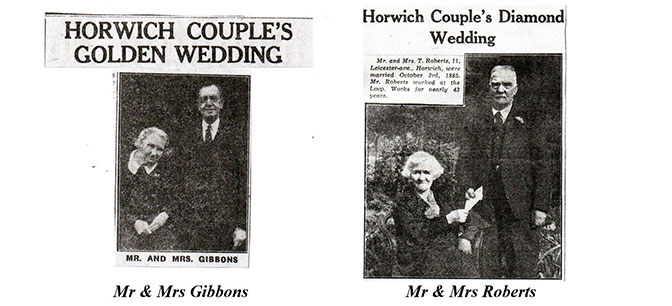
In 1945, Mr & Mrs David Overton, both age 72, of Brownlow Road celebrated their golden wedding. Mr Overton moved to Horwich in 1888 to begin work as an apprentice at the new L&YR Railway Works and stayed there until his retirement 45 years later. During that time he worked his way up becoming a charge-hand, then inspector, then assistant foreman in the erecting shop and became active as a shop steward in the Amalgamated Society of Engineers. He was also a member of the RMI Engineering & Scientific Club. His wife, Mary (nee Jolly) belonged to a well-known local family which had its home in Lee Lane At the age of 10 she began work at Greenhalgh's Wilderswood Mill, where she remained until she got married. Throughout their married life, Mr & Mrs Overton had taken a keen interest in church life, having been associated with St Catherine's almost since it was started as a mission. They had seen the church progress from a corn loft over a bakehouse in Beatrice Street to a magnificent new building and had been in the midst of this work. David had been a sidesman, foundation manager of the day school, member of the Parochial Church Council, member of the Finance Committee and representative at the Diocesan Conference and they were both still active in church affairs.
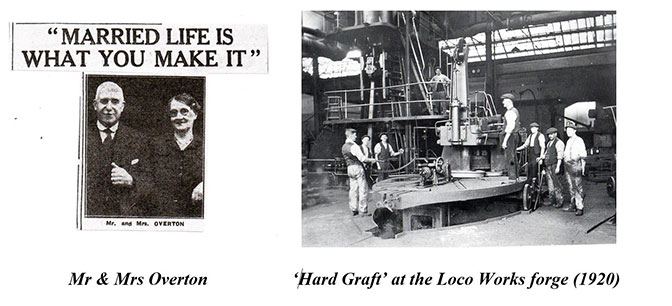
As we can see, these 3 families, as well as putting in a lifetime of work at Horwich Loco Works, made significant contributions to the social and religious life of the town. They were typical of a generation who were determined to build a new community which subsequent generations have greatly benefited from, and today's Horwichers should be grateful to these Loco Works 'oncomers' for laying the foundations of their town.
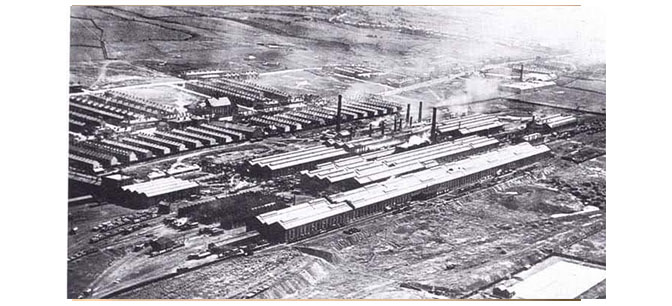
An aerial view of the Loco Works in the 1930s
UNSUNG HEROES OF THE COTTON & BLEACHING INDUSTRY IN HORWICH By Pauline Lord
While researching for our recent exhibition about 'Lost Businesses in Horwich', I came across quite a few interesting people who hitherto haven't received much of a mention in the industrial history of Horwich. Amongst them are Henry Stones and the Longworths.
Handloom weaving and bleaching were the main activities in the area in the C18th. Although cotton had been imported into England from C16th, it was mixed with either linen or worsted yarn, but during the C18th, thanks to the development of techniques and machinery to spin a finer thread, the cotton industry began to boom. From 1776 -1779 Samuel Crompton of Hall i'th Wood was working on his invention which became the 'Spinning Mule'. On 20th November 1780, a meeting at which the Mule was demonstrated took place when 54 tradesmen/mill owners from Manchester, Bolton etc subscribed 1 guinea and 28 individuals paid half a guinea. John Kennedy was a personal friend of Crompton's and in his 'Brief Memoir of Samuel Crompton', read at the Manchester Philosophical Society in 1830, he states that a man from Horwich was probably one of the first to construct Crompton's machine:
"I shall narrate the circumstances, partly from Mr Crompton's verbal communication and partly from those of others on whose testimony I could rely, including the period from 1779 to 1786/7. Although a few, a very few machines were made as described in the account of Crompton's Spinning Machine, the first deviation according to Crompton's own statement, was by an ingenious mechanic, Henry Stones of Horwich, a few miles from Bolton, which might be considered the seat of the manufactories of the finer fabric of cotton cloth in Lancashire at this time. The improvement of Stones was the introduction of metal rollers (he having probably become acquainted with Arkwright's method of rollers for spinning) and clockwork to his rollers, with a chain conveying motion to the rollers from the wheel, with some contrivance, self-acting, to stop the rollers when it was required."
The introduction of metal rollers soon enabled the machine to be extended to a consid -erable length, increasing the number of spindles to 100/130 from the original 20/30. Henry Stones, a carpenter/mechanic of Horwich, was baptised in August 1747 at Deane, the son of James Stones. He married Sarah Schofield 23rd Feb. 1773 but she died 27th May 1793 soon after the birth of their son Henry. He later married Rebecca Simm on 30th October 1808 at Deane. He is buried at Horwich Parish Church on 14th February 1811. In his will he leaves everything to Rebecca, which doesn't amount to very much. Trying to find sources about Henry, I found him mentioned in Richard Pilkington's Diary. His early Diary runs from 1784 - 97. Richard Pilkington is part of the local family who later became the famous glassmakers of St Helens. He is a carpenter, amongst his many other occupations and a pillar of the community in Horwich. He is always busy and is involved in developing a Carding Mill and later a Bleaching Croft. These are the Diary entries which mention Henry Stones:
4th Feb 1785 Henry Stones repairing the engine at Carding Works, Old Low 2nd Oct 1791 With Henry Stones working on smoothing frame, sent rollers to Stones 13th July 1796 In Wilderswood to see Henry Stones.
How Henry Stones became acquainted with Samuel Crompton is not documented but it is possible that Richard Pilkington is the key. There is an entry in his diary:
14th April 1787 A meeting at Richard Mason's. Dick at Hall i'th Wood
Hall i'th Wood was the home of Samuel Crompton. Richard Mason is the owner of a 'Factory', probably a Carding Factory, mentioned in the Horwich Rate Books in 1801.
In looking at the history of the bleaching industry, we find John Hopwood starting at 'Mill Hole' and slowly expanded his business which involved carding as well as bleaching. He then built what became known as Horwich Bleachworks on Bridge Street. John died in 1836 and Richard France & William Pass took over the Bleachworks. On the death of Richard France, William Longworth of Heaton took over the business and other parts of the estate at Hopwood Hill and went on to become a central figure in Horwich in both the church and the town. From this time the Bleachworks is known locally as the Longworth Croft and on 28th May 1838 the Bolton Newspaper states that "On Monday last Mr W Longworth, of The Land, Heaton, held his annual rent day when upwards of 70 tenants sat down". William Longworth was not only a bleacher and landed gentleman, but also a coal proprietor.
William Longworth of Heaton was born 16th August 1795, son of John and Betty Longworth and baptised at Horwich Chapel. He marries Jane France, daughter of Richard France, the previous Bleachworks owner, at Deane in 1832. He has two sons John and Nathaniel and by 1854 he is employing 42 men, 20 Women and 10 boys at the works. He dies at 'the Knowles' in 1861 and by this time he also owns coal pits at Doffcocker and Westhoughton (Brinsop Hall). His sons John and Nathaniel take over until 1876 after which John Longworth runs the Bleachworks on his own and Nathaniel takes over the running of the remaining colliery at Brinsop Hall. Unfortunately, Nathaniel dies suddenly in June 1877 at only 40 years of age and the Colliery is sold. John married Catherine Lewtas in Liverpool in 1867 and had seven children. In 1891 John Longworth was residing at Ridgmont House, the former home of the Ridgway Family, and it is here he dies on 1st October 1896 aged 62 years. He is buried in the family vault at the Parish Church.
At his death an 'admirer' gave this account of his life: "John Longworth was appointed a churchwarden in 1874, a position he retained to his death; for only on Sunday week, then appearing hale and strong, he collected the offertories at the harvest festival. In 1872 Horwich adopted the Local Board of Health Act, and by arrangement of the statutory public meeting appointed 12 members. Amongst those elected was Nathaniel Longworth, brother of John Longworth. In 1873 John took the place of his brother, and in 1882 was elected chairman, a position he held till the re-baptism of the board, when again he was honoured with public confidence, and on the night preceeding his death had been at the Public Hall attending his public duties. He was, as churchwarden, one of the first to have to deal with the distribution of the Ridgway Charity and, though clearly defined as being expressly for those attending the Parish Church, this portion of the will has always been a 'dead letter'. In December 1873, he and the late William Greenhalgh were appointed governors of Rivington Grammar School. In 1877 he presided at a meeting of those interested in the Lee Mill ground rent. The land comprises some 1,472 sq. yards which is virtually town land and, as a sum had accumulated, the meeting was called to determine its disposal."
"A Public Hall and Library was decided upon with Peter Martin of Rivington building the Hall, and the splendid selection of books at the Public Hall have been acquired without costing the ratepayers one penny. It is scarcely necessary to refer to the comparatively recent formation of the School Board, on the occasion of which Mr Longworth, under great pressure and from a sense of duty and devotion to principle, consented to be nominated, though he declined to enter the arena of wordy combat which prevailed at this period. And in the fair and unfettered expression of opinion in his favour, he received the unbought tribute to his merit of being elected by 1,394 votes. He was Chairman of Horwich U.D.C 1894-96."
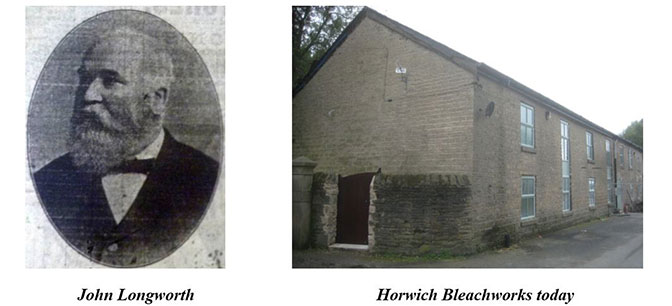
His son, William Lewtas Longworth, born 1868, took over the Bleachworks living at 'The Knowles'. He married Edith Skinner from Leicestershire in 1897 in London. He was appointed a Lieut. in 1st Volunteer Battalion, Loyal North Lancs. Regiment and joined the Army in 1914, becoming a Captain. He had previously been Chairman of Horwich U.D.C in 1905-6 and died at Allendale in 1939. Horwich Bleachworks was taken over in 1914 by the Bleachers Association who acquired all the remaining bleachworks in Horwich, including Wallsuches. The bleaching story in Horwich finally ended when first Horwich Bleachworks closed in 1928 and then Walluches in 1933. However, the contribution of the Longworth family to the industrial, social and spiritual development of Horwich was a significant one and deserves to be recognised.
THE LOST INDUSTRIES OF RED MOSS By Andrew Waldron
The earliest settlers in or around Horwich, and indeed on the Moss itself, go back to the Neolithic period, then came the Bronze Age, followed by the Medieval period and it this latter period where the story of the lost industries of the Moss starts. Several small farms were to be found around the Moss as early as the first century AD. An early quern stone was found on the Moss by Dutch peat cutters c.1880, indicating that corn grown on the Moss was being ground to produce flour over 1000 years ago. In 1943 a Dutch peat cutter, Egbert Krikken, discovered the skull of a woman dating from around 1000 years BC and antler picks from a red deer have also been found dating from the Mesolithic period. These items are clear evidence that the Moss was being used by early settlers
The present Moss is far smaller than it originally was. The former Loco Works site and part of the Middlebrook Retail Park were once a part of Red Moss and, before the M61 was built, the Moss extended almost to the A6 trunk road. It also once bordered the eastern side of Crown Lane and Vale Avenue. Land reclamation, farming and road building have gradually decreased its size so that it is about a third smaller that it was around the year 1870. Over the centuries, Red Moss has been used for a variety of uses, some of which have helped to support the industrial growth of Horwich.
Farming - the earliest farms on a significant scale date back to the 14th and 15th centuries and peat was probably cut on the Moss as early as the 16th century for use as fuel. Early records show Park Hall Farm, Moss House Farm, New Close Farm, Sefton Fold Farm (which was a medieval moated farm), Lower House Farm, Old Hart's Farm and Sharrock's Farm on or around the Moss. The date stone from Sefton Fold Farm (1611) is to be found in the foyer at the Heritage Centre.
Two early roads or tracks are known to have crossed the Moss, one having been used as a 'pannier route' by pack mules. The 1840 map shows Barker's Farm which grew flax for use in linen production (as this is a plant which thrives in soft peat deposits). A trackway (Moss Lane) connected the farm to Blackrod and is still there today. By 1907 the farm was known as Gibb Farm.
Coal Mining - no fewer than six collieries once operated on Red Moss, all of which used vertical shafts to access the coal seams beneath. These pits were all on land that had since the 1750s been reclaimed from the Moss. The Main Coal Mines were:
Victoria Main Colliery was on the western edge of the Moss. It was first operated by Thomas Ridgway in the early 1800s then by the Wigan Coal & Iron Co. and was finally exhausted by 1900. Park Hall Colliery was located close to what is now Station Road, Blackrod and later became Blackrod Cottage Hospital. This mine was also taken over by the Wigan Coal & Iron Co. in the late 180s and closed in 1900. Hilton House & Red Moss Colliery was just off the present A6 and had its own coal yard and goods facilities with sidings connected to the Hilton House branch line. The Company also had a fleet of coal wagons and its good quality hearth coal was distributed over a wide area to the iron & steel trades. Park Hall Mine was located near Park Hall Farm and was the largest colliery in the Horwich area. The originals shaft was sunk c.1790 and the mine closed in 1886. A quantity of coal from this pit was used by Thomas Ridgway at his Wallsuches Bleach- works. Sefton Fold Mine was a small scale mine on the Sefton Fold Estate supplying local needs.
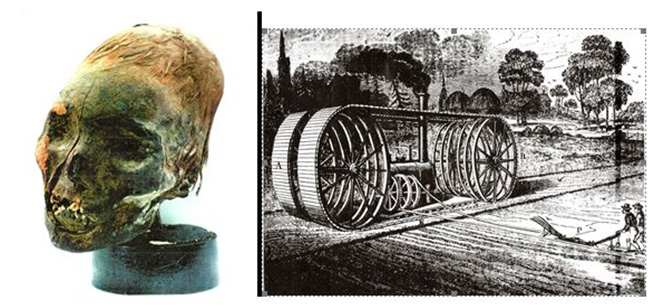
3000 year old skull found on the Moss John Heathcote's steam plough on Red Moss 1832
Iron Works - few people know that Red Moss once had an iron foundry. Horwich never really had a sizeable iron trade, apart from the railway-related activities at the Loco Works. There were three smithies at one time, but the only real iron works, was established on Red Moss, in 1861 by John Crowley & Co., Iron Founders. This firm made use of the native peat bog as a source of fuel, turning the sods of peat into briquets and by 1875 was trading as the Red Moss Iron Co., located near Blackrod, producing various castings and carrying out boiler repairs. They also made agricultural machinery & implements in association with a local blacksmith, James Fairclough,
Peat Charcoal Factories - The 1870/71 Directories mention a firm called Danchell N F Hann & Co., Peat Charcoal & Peat Works Contractors, Red Moss Works. In May 1873, the same firm, under the title of the Red Moss Peat Works Co. Ltd., were looking to sell 200 tons of peat charcoal, suitable for all horticultural purposes or sanitary use. By 1874 the firm had changed its name again to the Peat Engineering and Sewage Filtration Co Ltd., Red Moss Works but it appears to have closed. However, a new firm, the Red Moss Works Co. Ltd., was formed in 1887 taking over the assets of the Red Moss Peat Works Co Ltd and the Red Moss Iron Co, including their premises on Station Road, Blackrod. In the same year, the company acquired a patent to produce peat fuel and peat products including peat charcoal gas. Unfortunately this did not last long either, being liquidated in 1891.
Victorian Rubbish Tip - As early as the 1880s, a part of Red Moss became a rubbish tip and a much larger tip was formed with the arrival of the Locomotive Works in 1885. The L&YR laid a main line siding onto the northern end of the Moss and used it to tip all manner of unwanted material collected from stations all over the system. Before a properly-built sewerage and sanitation system was introduced, Horwich UDC used the Moss both as a rubbish tip and for depositing 'night soil'. The tip access from an early date was via Iron Street and what is now Aspinall Way with the 'night soil' being deposited over a wide area using a tramway system. Other activities on the Moss include trials of the earliest steam plough ever built (by John Heathcote 1832) and extensive trials of military equipment & vehicles (including field guns and tanks) in both World Wars.
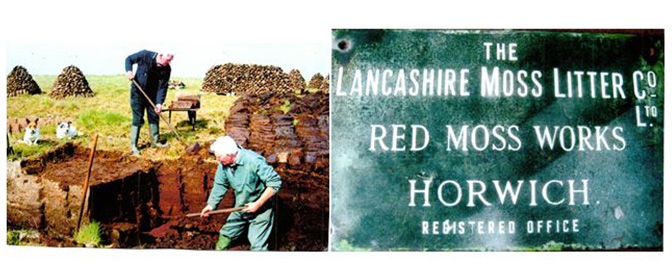
Traditional peat cutting methods on the Moss The Lancashire Moss Litter Co. ran from 1935-77
Peat Production - Peat as a domestic fuel has been cut on the Moss since ancient times but since 1810 various firms have used the Moss to good effect as a commercial gathering ground for the rich moss peat. It has been dug and baked to produce charcoal (see above) but the rarer (surface) sphagnum moss has also proved highly effective in the production of animal bedding litter and various firms and individuals have used it to good advantage supplying a range of businesses from race horse owners and poultry farmers to banana packers and strawberry & mushroom growers. Sphagnum moss has also been used for its medical properties. During WWI its top layer was extensively used as bandages since it contains natural iodine. Peat cutting is a labour- intensive process that has changed little over the years. Ditches have to be dug to drain off the water before the cutters can get to work cutting the sods and stacking them on the banks to dry out. They are then 'clamped' into small stacks ready to be loaded onto wagons. When peat cutting was at its peak, there was a network of miniature railway lines criss-crossing the Moss, first using horse-drawn wagons and then small locomotives to take the peat back to the milling plant at the factory and then on to the main line for distribution.
The first large scale commercial firm on the Moss was Richardson's Moss Litter Co Ltd, who had come down from Scotland in 1904. The Company used the Red Moss peat for animal bedding, for growing fragile crops and in the banana trade and their activity on the Moss was extensive. They laid out 6 miles of track to the cutting areas and built a mill and packing plant but eventually moved to Rainford near St. Helens in 1925 where the where the moss was better drained and more suited to production. The second and larger of the two commercial companies to work the Moss was the Lancashire Moss Litter Co. Ltd. The company went on to work other moss bogs in the locality at Astley, Irlam and the vast Chat Moss as well as around the Solway Firth in Scotland. On Red Moss the main headquarters was at Gibb Farm, which later doubled as a machinery depot, where all the firm's modern peat plant came for servicing or repairs. The Lancashire Moss Litter Co. first commenced work on the Moss in 1935. Initially they used Dutch and Irish labour to cut the peat by hand. but at the end of World War II mechanised machinery (electrically powered) was introduced using crawler tracks which removed the need for rails. In order to cut the peat in this way, the Moss was arranged in a grid pattern with one machine working north - south and the other east - west. By June 1966 the Lancashire Moss Litter Co. had ceased to cut and draw peat from the Moss. The main works stayed open to service machinery still in use at Irlam and Astley but by 1970 even this had come to an end. Most of the rail lines on the Moss and all of the machinery had been removed by 1975, the firm going into voluntary liquidation in 1977.
Most people in Horwich associate peat cutting on the Moss with Dutch families. Egbert and his son Hilbert Krikken are known to have cut peat on the Moss from the 1920s up until the 1960s and in 1945, a Dutchman named Beuken started a company called Beuken Brothers Ltd (which later changed its name to the Red Moss Peat Cutting Co.). He offered work primarily to other Dutch families like the Krikkens, Boonstras, Van Limbeeks and Schonewellers and also to Irish families, notably the Wallaces & Robinsons. Unfortunately the firm's activities on the Moss ceased in 1963 and, whilst others have operated intermittently (usually one-man bands) up until quite recently, all commercial activity had ceased by 2014.
Red Moss today - After an attempt by the Greater Manchester Waste Authority to extend refuse tipping on the Moss was rejected in the 1980s, the remaining area was then declared an SSSI and all peat cutting is now prohibited. However there is still plenty of evidence of the Moss's 'industrial' past if you know where to look.
SEFTON FOLD & ITS FAMILY CONNECTIONS By Stuart Whittle
Many of us were saddened by the demolition of Sefton Fold Farm in late 1992/early 1993 to make way for the Middlebrook development. Being some distance from the heart of the Horwich, not everyone was aware of its historical and architectural significance, but fortunately for us and posterity, the Greater Manchester Archeological Unit undertook a comprehensive survey in September/October 1992 and have left us a valuable and revealing record. This combined with some fascinating family history makes for an intriguing story.
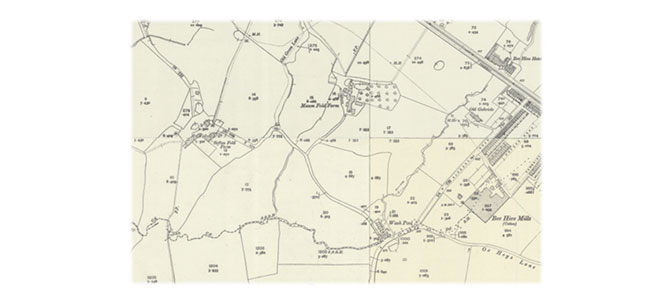
General location of Sefton Fold Farm (centre left), the Beehive Pub is top right (1892)
There were 3 buildings on the site at the time of the survey: the 2 storey stone farmhouse (which had been re-built in 1811 - see datestone now at Horwich Heritage Centre), an older 2 storey, 3- bay, timber-framed, house built of sandstone/gritstone dating from the mid C16th and a late C18th threshing barn constructed of sandstone with a timber framed and flagstone roof. The most interesting of these structures was the central, 2 storey, timber-framed house (see plan). Analysis of the timber-framed components indicated a construction date somewhere between 1550 -1600. A closer examination of the structure suggested that it might have been part of another building, perhaps a medieval hall. The inventories of 1669 and 1675, produced upon the deaths of Thomas and William Anderton, indicate a much larger structure was in evidence at the time with the 3 bay structure surveyed by GMAU being a wing of this building. There was little indication from the remaining structure of the position of a hall but the wider site survey conducted in 1992 (including trial trenches) revealed that the house had been situated on a moated platform, which would confirm a date from medieval times. Historical records show that from at least the early C15th, the site lay within the Horwich tenement of the Greenhalgh family, who were granted this tenancy in 1425 by the Lord of Manchester. If they were indeed resident in the area in this period, then this is a further reason for considering Sefton Fold to have been the site of a medieval hall as their social and economic status would have required something more substantial than the 3- bay, timber-framed house which remained in the C16th/C17th.
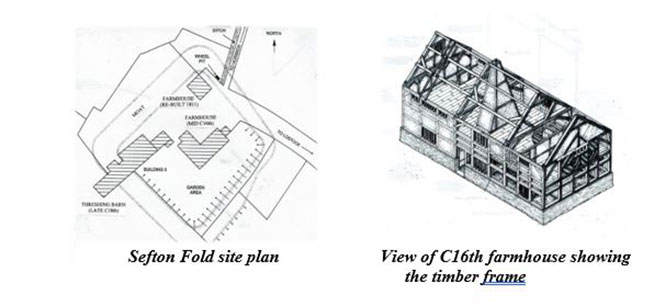
This property underwent considerable alteration in the first half of the C17th, during the occupation of the Andertons, principally to install fireplaces and chimneys. A south wing was then added in the mid/late C18th, probably by Henry Pilkington who was given the property by his father-in-law, John Sefton. It was the same Henry Pilkington who re-built the other farm house in 1811 (originally built by Thomas Anderton in 1666) as his family's requirements expanded, but it also appears that other modifications & improvements from the 1830s onwards were to accommodate several tenant households. A remarkable feature that survived until demolition was the waterwheel pit and 'butter churn'mechanism which served the 1811 farmhouse. Although the original waterwheel had long since disappeared, it was possible to salvage the mechanism, which has been preserved. This arrangement of utilising water power to drive butter churns was apparently quite common on upland farms in the C19th. Unfortunately none seem to have survived intact in the Bolton area, making the Sefton Fold example unique. The position of the wheel pit and headrace channel are significant in that the wheel pit was probably constructed within the earlier moat channel and the head race was the original water supply to the moat.
To look back into the family origins of Sefton Fold is to look back at the very origins of Horwich itself. Horwich was one of 20 townships in the NW corner of the Salford Hundred which were held by the medieval Lords of Manchester dating from the time of the acquisition of the Manor of Manchester by the Grelley family in the late C11th/early C12th. Whilst the Grelleys granted tenancies to other townships, they retained direct control over Horwich as a hunting forest and as an economic resource. In 1282 there were 3 foresters in charge of the area, once located at Oaken Lee, just to the west of Sefton Fold. By the early C15th tenancies were being granted in Horwich and the first unequivocal evidence occurs in 1425 when James Greenhalgh acquires a messuage and adjoining lands at Lee Wood, one of several vaccaries (lands used for cattle rearing) listed in the area. Over the centuries the various land holdings consolidated by acquisition or marriage. In 1572, the Heaton's lands in Horwich passed to Christopher Anderton whose son, James, bought the Manor of Horwich in 1599.
From this date onwards until 1760, the Manor of Horwich descended through the Anderton family of Lostock, after which it passed to the Blundells and, after Henry's death in 1810, to the Stoners. It is during the C17th that the earliest individuals can be identified as living at Sefton Fold. Thomas Anderton, father of Christopher, is thought to have lived there in the late C16th followed by a succession sons before the last recorded family member, Dr William, who unfortunately died as a result of a fall into a fire whilst drunk in 1675. It is unclear when Sefton Fold passed from the Andertons to its subsequent tenants but it remained known as 'Dr Anderton's' for the next 100 years. The next known occupant is John Sefton in the mid C18th and it is his name that stayed with the property until its demolition. He appears to have come into possession of the house through his marriage to Ann Marsh in 1738, the daughter of James Marsh of Horwich, a man of some social standing in the area. 30 years later, whilst still living there, he transfers the property to his daughter Ellen and Henry Pilkington on the occasion of their marriage in 1768. John died in 1784 and Henry Pilkington in 1812 being succeeded by his son John. Unfortunately, ownership of the property becomes unclear after 1830 with a number of tenant farmers appearing on the later census records. The Barlow, Fletcher and Owen of families are listed as living there in 1841 with the Barlows still there in 1871 farming 40 acres.
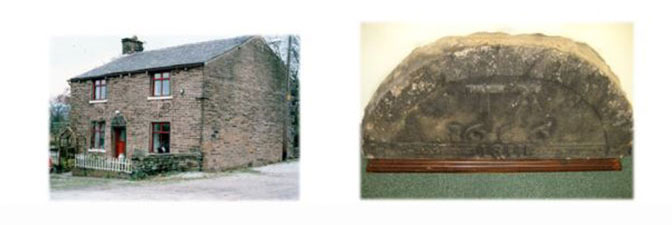
1811 farmhouse rebuilt by Henry Pilkington. The datestone is now at the Heritage Centre.
As far as our research is concerned, the Pilkington family connection with Sefton Fold looks to have ended with the death of John Pilkington. However, a recent request for information on the Pikingtons and Sefton Fold sent to Horwich Heritage from Ross McCowan in Hamilton, New Zealand, has opened up a whole new chapter. It appears that Ross's great, great grandparents, Edward (one of John's sons) & Margaret Pilkington and their 6 children emigrated to New Zealand in 1858. They bought a farm on the slopes of Mt. Wellington and then further land on the outskirts of Auckland. The family farmed there until the 1950s when the land was taken for government housing. Ross's great grandfather, Edward, and great uncle, Henry, fought in the Maori wars and his grandparents were married on the family farmstead. In return for this very useful family information, I offered to look up the extensive Pilkington family tree records which we hold and was delighted to be able to tell Ross that I had been able to trace his family line right back to Leonard, Lord Pilkington of Manchester, who fought at the Battle of Hastings in 1066 - you can imagine his reaction to that!!! So if you needed further proof of Horwich's world-wide family connections this has to be it!
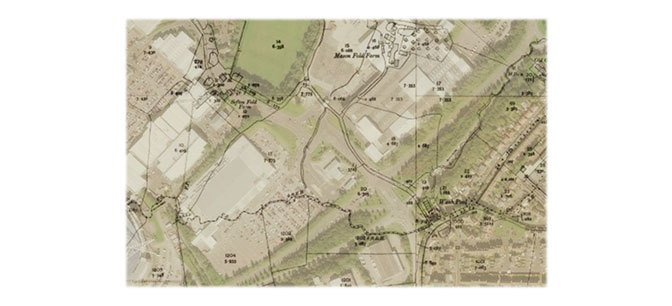
The site of Sefton Fold Farm (1892) overlaid on today's features in the area. The Tesco roundabout (with its Loco monument) is centre left of the image with the football stadium seen bottom left hand corner.
THE PATH & PAVED CAUSEWAY OF SPITLER'S EDGE By Derek Cartwright
A popular route for the walker is that from Hordern Stoops situated part way along the Rivington to Belmont Road (and accessed from a small car park) across the moor and Spitler's Edge in a westerly direction to Great Hill on Anglezarke Moor, or the other way around. Great Hill is accessed from other paths the most common being the route from White Coppice. Walkers often refer to the stroll across this sometimes bleak and eerie moorland as a "walk over Spitler's Edge". This is an interesting piece of moorland, the wall running along most of the paths length has a significance in history and the now paved causeway has its own story to tell.
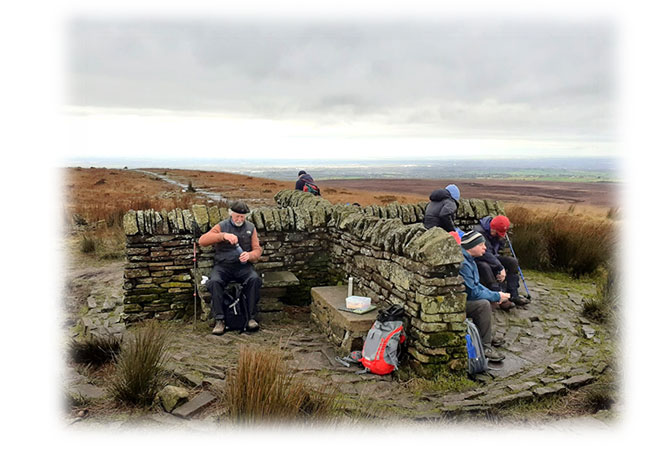
The Summit of Great Hill (381 meters) with Preston and the Fylde Coast in the distance, February 2022
Spitler's Edge is a ridge running along the eastern edge of Anglezarke Moor, from Standing Stones Hill to Hordern Stoops. The ridge, complete with a cairn (see below) peaks at 392 m, the high point of Anglezarke moor. Redmonds Edge links Spitler's Edge to Great Hill.
Along the length of the Spitler's Edge is a stone wall of some historical importance, this wall was built in 1841 as a relief measure to provide respite from the "Hungry Forties". This period in the 1840s was one of trade depression and repeated failed harvests resulting in the poor suffering terribly. Work was created for the unemployed, this wall being one of the schemes. The wall is the parliamentary division boundary between Chorley and Blackburn and continues across the Rivington/Belmont Road towards Winter Hill.
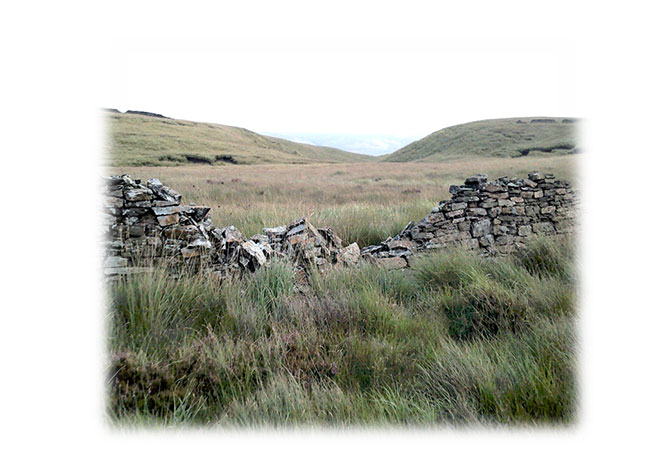
A section of the 1840s wall on Spitler's Edge forming the parliamentary boundary between Chorley and Blackburn/Darwin. Darwen Moor is seen in the distance.
The name "Spitler's" is derived from the fact that in medieval times, the Knights Hospitallers of St John of Jerusalem used this route when travelling to their holdings in the area. The ridge provides the peaks that supply the source water to the Yarrow River and Limestone Brook, both of which feed the Rivington Reservoir system and beyond.
The Cairn just off Spitler's Edge SD 64839 18545, 361 meters above sea.
The Modern Path and Paved Causeway
A significant portion of the path from Great Hill to Hordern Stoops is paved. Other sections are of hard core construction and at least one stretch of the path runs on the base of the 1840's wall. The stone paved causeway, a little over 3 Km running from Will Nar to Great Hill was constructed in stages commencing in the mid 1990's.
The causeway looking east from the summit of Great Hill towards with Winter Hill in the distance.
The first section (1995/96) was a 2 km stretch spanning from Higher Anshaw along Spitler's Edge and Redmans to the boundary wall and fence which contains a style at the south east side of Great Hill. Conservation volunteers had positioned some of the large stones that cross the small streams and gulley's along the path in preparation for the major work to commence.
A section of the paved causeway with a bridge crossing a gully.
The flag stones came from various demolished mills from around the East Lancashire and possibly the West Yorkshire areas, many show signs of the fixtures and fitting positions from when they were on the floor of the mills. One wonders how many pairs of clogged feet have crossed these very flag stones while they were part of the Lancashire king cotton empires of days gone by.

One of the flagstones on Spitler's Edge with the tell tale mill fixtures and fitting marks.
The Flags were held in a reclamation yard in the Bacup area prior to being weighed and moved in batches ready for the transportation up onto the hills. The batches of flags could weigh no more than 900 Kg as they were to be lifted onto the moor via helicopter, e.g. two large stones and a small one would easily make up the 900 Kg maximum payload with some stones being more than 100 mm thick. Once dropped onto the moor the positioning didn't necessarily match the requirement on any particular stretch to be paved so the flags often needed to be moved again along Spitler's Edge via a dumper truck, not an easy task.
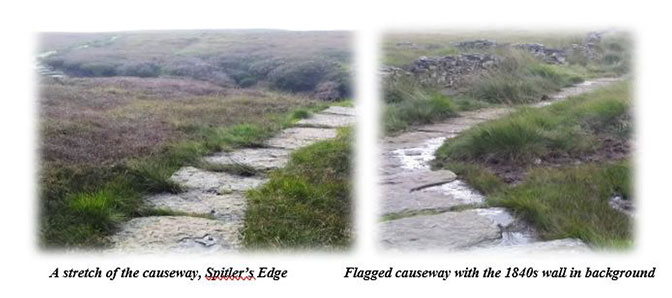 The next section to be paved was from the crest of Great Hill to the boundary wall and fence mentioned above, this stretch was completed in around 2002, with the last stretch from Higher Anshaws to the top of Will Nar completed as late as 2014. Will Narr is linked to the Hordern Stoops car park via a path of mixed hard core, stone paving slabs and the remains of a dry stone wall. As well as the mills fixture markings the flagstones across the full present length have another interesting feature and worthy of study by the walker. Many show the fossilised ripples of the seashore of which they were once part all be it 300 million years ago.
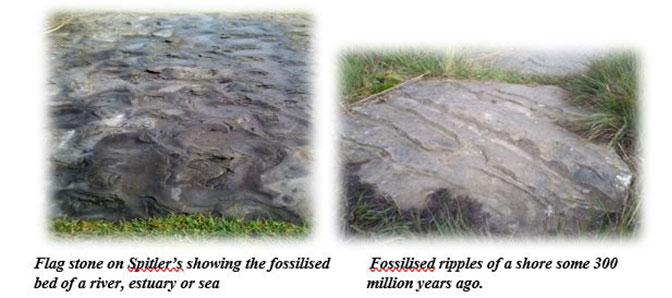
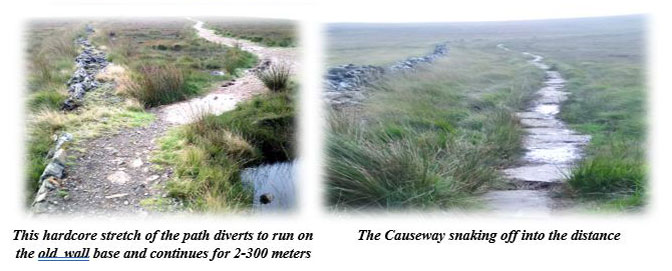
Walkers beware very marshy pools at least waist deep are dotted along the length of the pathway, best to stay on the paving.
Thanks to Andy Ryding for the history of the paved causeway . Andy with colleagues constructed the middle 2 kilometre section in 1995/96 taking a little over two weeks.EDWARD HART - STONEMASON TO LORD LEVERHULME By Ann Massey
Following the recent request from the Rivington Gardens Trust for information about people who might be connected to the gardens, here is my family tale which I hope is of interest. My Great Grandfather,Edward Hart, was born on 9th January 1866 in Ashton near Wigan, the son of Methusalah Hart. Methusalah Hart was a stonemason and possibly worked for Robinsons Monumental Masons in Southport. It is likely that Edward followed his father into the same kind of work as the census records show. Edward married Sarah Ratcliffe on 22nd April 1889 at St. Pauls Church Southport and by the 1901 census had 3 children, Sarah, Emma and Charles. Charles was my grandfather and was born 1895.
By the 1911 census, Edward and his family were living on Deane Road, Bolton where they also had a fish and chip shop which was probably run by Sarah, his wife. They now had 4 children. Edward is now a stonemason and we assume was working for Lord Leverhulme. We are not sure when the family moved to live at Rivington Hall Cottage, behind the top barn but they were certainly there in August 1920 when Charles, his son, married Mary Elizabeth Jones -my grandmother. The marriage was in Liverpool where my grandmother was living and working having moved from Bleanau Ffestiniog to find work. We have one or two photos of Sarah and other family members standing outside Rivington Hall Cottage where there is a fence of sloping pieces of wood. According to my father, Edward made the fence from picking up odd bits of fallen trees on the estate. The estate was my Father's and his cousins' playground. He also said that Lord Leverhulme hosted parties at the bungalow for his estate workers and he remembers his grandmother, Sarah, saying she danced with Lord Leverhulme at one such event.
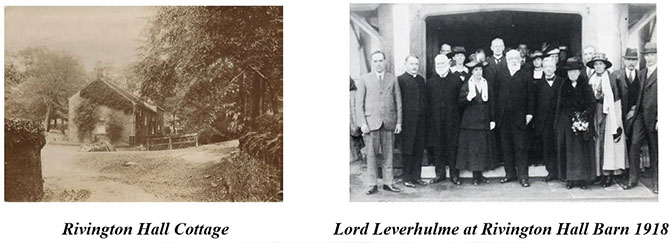
We know that my father, Rowland Hart, was born at Rivington Hall Cottage in February 1925 and the family lived there until my father was 8 or 9 years old.
Various members of the family have lived in Rivington Hall Cottage, South Lodge and Manor House but exact dates are unknown. We have a leaflet, widely available to visitors to Rivington, that mentions Edward's name and says that South Lodge was occupied by Edward between 1914 and 1926. The 2 girls in the picture below, Edith and Evelyn, were my father's cousins, their grandfather being Edward. They lived at Manor House until they moved to Ormskirk where my second cousin, Susan, still lives. Susan is the daughter of Evelyn.
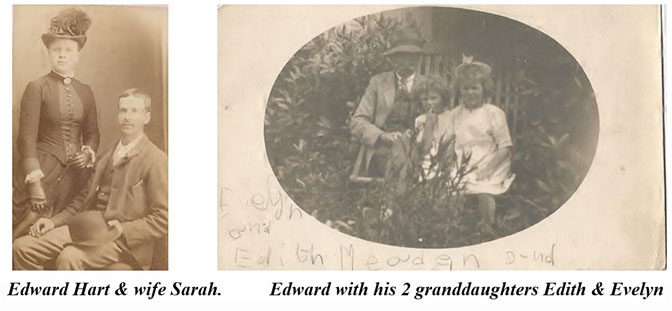
We know that Edward was sent to Nigeria to have a look at a bridge that Lord Leverhulme had seen and wished to replicate on his estate at Rivington. This must have been an adventure for an ordinary workman in those days. The result of this was the 'Seven Arch Bridge'. Edward also had a hand in building the replica of Liverpool Castle and was probably instrumental in much of the stonework within the bungalow gardens.
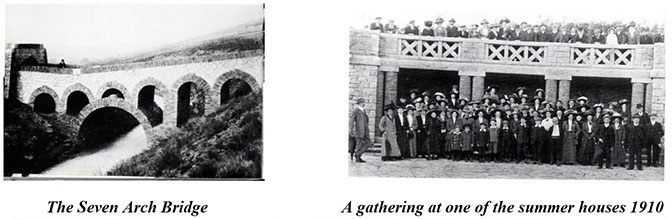
We don't know how he came to Lord Leverhulme's notice but have pieced together the information that the architect Thomas Mawson must have known about Edward's work. We have also found out that Thomas Mawson had a connection with the Victorian landscape garden company, James Pulham & Son, who were well known at the beginning of the 20th century for designing rock gardens, follies and grottoes using their own artifical stone known as 'Pulhamite'. They were commissioned to do work at Rivington using this material.
According to his death certificate, Edward Hart died in 1938 in Rivington Hall Cottage but is buried in Southport.
RECOLLECTIONS OF COOKE & NUTTALL'S By Michael Hough
I am the son of Norman Hough the last General Manager of the mill from 1962 until its closure in December 1980 and, as a student, I worked in most of the departments in my school and university holidays, starting in 1966. As I am now retired, I thought it was time to write down the history of the mill and my own memories as fewer and fewer people in Horwich will now remember it and its important contribution to the community over 120 years. These are now contained in a booklet which I have donated to the Heritage Centre and here is a brief summary.
According to Hampson's 'History of Rivington', the building of the Rivington reservoirs and the poor quality and quantity of the compensation water released had a disastrous impact on the Horwich Vale Print Works which relied on plentiful, clean water for the bleaching, dyeing and printing of cotton materials and, despite legal action, the Works closed in 1860 and hundreds were thrown out of work. The large collection of buildings lay idle until Mr Leonard Cooke began the business of paper manufacture in 1862. After his death the business continued under his son Horace. In 1898 Mr T Y Nuttall joined the firm and undertook an extensive rebuilding and equipping programme. Horace Cooke died in 1917 and T Y Nuttall in 1920, after which time the business was run by his son, Capt. W E Nuttall MBE who had joined in 1902. He was active in the affairs of the paper industry, both technical and commercial. The mill always claimed to be the first manufacturer of Kraft (from the old German to literally mean strength) paper in Great Britain from 1862.
In about 1938/39, soon after Dad started at C&N as an office junior, C&N was sold and eventually amalgamated with other manufacturers to form Associated Paper Mills Ltd. There was also a separate sales company with regional offices in London, Birmingham, Manchester and Glasgow. Head office was originally in Plough Fetter Lane, just off Fleet Street in London, where the senior directors were based. The Group's Technical Director, Dr Harrison, was based at the Central Labs in Horwich and well-respected Group Managing Director, J K Horsburgh, was based at Otley.
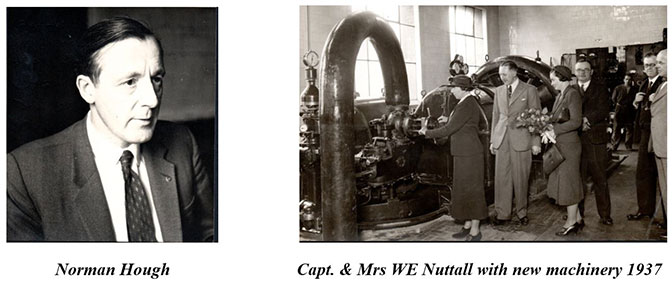
Another significant event at Horwich was the fire of 1963 which started at the rear of the Fourdrinier paper machine and quickly spread up into the roof, which was completely destroyed. I'm not sure how long operations were affected but there was full coverage of the fire and damage in the Bolton Evening News. It should be remembered that the buildings at the bottom of Star Lane also contained the business premises of 3 other companies - Star Bleaching and Jolly & Jackson which had amalgamated as part of the Bleachers Association and, perhaps less well-known Nathaniel Lloyd & Co, who started out as tinplate printers in London but later went on to produce the 'tear tapes' used to open plastic packaging and the cellophane wrapping around cigarette packets. They also produced the silver security thread which was incorporated into bank notes.
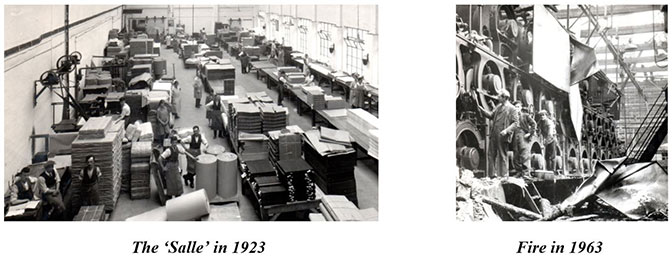
Around that time (1960), my family had moved into West View Villa, a mill property nearby, having moved from a smaller one across Farmer Pendlebury's fields at the bottom of Crown Lane (No.26). Mr Charlie Whalley (a retired employee of Jolly & Jackson) and his wife lived at Vale Cottage at the end of Star Lane. My mother's family left Yorkshire in 1926, on the first day of spring, when she was only 6 weeks old to come and work in the Horwich paper mill. There was my grandfather Horner Coulson and eventually 5 sons and one daughter who all worked for some or all their lives at C&N: George - day foreman, Robert (Bob) who had moved to a mill in Somerset, Jack - tractor driver, fitter's mate and general strong man, Harry - moved to the Loco works, Frank - also moved to the Loco works (machine shop) and Mary - Salle 'sticker'girl. Grandfather's brother Bill stayed behind in Rawcliffe but his other brother, Fred, and his son, Fred (night foreman) came to Horwich as did other families; the Lees (Harold & Ambrose) and Walkers (Fred, was brother-in-law to the Lees). I'm not sure why my family and the others moved to Horwich but it was the year of the General Strike and mother recalls Fred Walker making a comment about "not wanting to be involved with that kind of trouble again". Other family names with a long association with C&N include: Foy, Greenhalgh, Boardman, Mather, Sumner, Winnard, Gregory and Kirkham plus others I'm sure.
When I started at the mill at 15 it had been considerably extended from my grandfather's time there - the second M G machine having been installed in the mid 1950s, largely I was told on the basis of an unwritten agreement with one important customer in Manchester to buy a lot of the extra production. I believe this was the Blackwell family who ran a company by the name of Packaging Products, one of whose main lines was a waterproof wrapping paper known as 'Kraft Union' or tar paper. In the early 1960s this machine was refitted with a large M G Cylinder manufactured by Walmsley's on Crompton Way, Bolton - one of the largest yet made at 6 metres diameter and about 3.30 metres wide. It weighed about 100 tonnes with all the supporting framework and drying hood and required the foundations to be strengthened by injecting concrete underneath to stop them sinking! Another extension to the buildings involved reducing the size of the mill lodge and moving the road to create space for a new 'calender house' for a Hunt & Moscrop supercalender - used to give a smooth, rolled and highly -glazed finish. You had to watch out for your fingers when feeding the paper tail through the machine and the static electricity which sometimes built up in the reel could give you quite a belt!
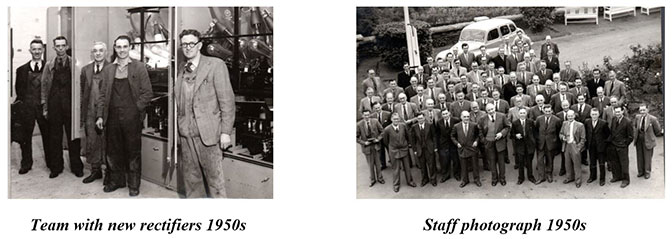
After 5 or 6 spells of working in the mill I decided I was interested in papermaking as a career and wanted to leave school after A Levels but I was advised that I should continue my education and then consider joining the industry. Which is what I did - coming full circle by eventually arriving in Otley where I was latterly production manager before starting my own business, buying and selling paper and board. When I arrived in Otley to work at the Wharfeside Mill of P Garnett & Son in 1984, I came across several C&N men who had previously transferred to Yorkshire: Bill Moss (mill chemist), Ronnie Taylor (chief engineer), Alan Beveridge production manager (1 of the men in white coats from Central Labs), Michael O'Neil (technical - who I had spent 2 weeks with during the annual shutdown at Horwich), Tej Singh (general manager of Purification Products - a spin off from the R&D work done in Central Labs) and Mike Johnson who had spent some time at Horwich before moving back to Otley. My first boss here was a very experienced Scottish papermaker by the name of Peter Urquhart who had moved from Watsons at Blairgowrie but who had spent 6 weeks in Horwich to learn about MG papermaking. He remembered staying at the Ridgway Arms and meeting 'uncle' George Coulson and Eric and Hilda Yoxall (who introduced him to Lancashire hotpot) as well as my father and mother. He also took in a match at Burnden Park: Wanderers v Newcastle Utd and he still has the programme!
Now that the C&N mill site has been redeveloped for housing and only Star Lane is recognisable, I should like to record the names of 3 young men from C&N who gave their lives in WWII: Richard (Dick) Cecil Butterworth of 244 Crown Lane, Horwich who worked in the general office with my father, was killed in action in 1944, age 24, whilst serving with the 1st Battalion, The Loyal Regiment (North Lancs), in Italy. Eric Farrimond of 96 Chorley Road, Blackrod, who worked on the paper cutter, KIA also in 1944, age 19, whilst serving with the 5th Battalion, East Lancashire Regiment in Northern France. Sampson (Sam) Everin, Lance Sergeant and winner of the Military Medal. KIA, age 35, whilst serving with the 2nd Battalion, Grenadier Guards in Holland. Remembered also are Tommy Turtington who unfortunately took his own life as a consequence of the terrible treatment he received as a Japanese POW and electrician, Jack Hilton, who died in an accident at the Mill.
Writing down all my recollections of Cooke & Nuttall and the people I met working there has brought home just how important this relatively small mill was in training and developing the skills and experience that allowed some of the workforce to move on to more senior roles in what was then a countrywide industry. The mill and its management, commercial and technical, also played their part in the regional and national affairs of the British papermaking industry throughout its long history in Horwich. If you include the times I assisted Dad in serving the work's Christmas dinner to the night shift, then I think it fair to say I received a good all round introduction to papermaking which certainly prepared me for a rewarding career. If you want to know more about the technicalities of paper making at C&N or read about the many people I came across working there, please look out my booklet at the Heritage Centre.
I would love to make contact with the person who donated the wonderful photographs to the Horwich Heritage archives or with anyone else who worked at C&N. My number is 07774181822 and e-mail: epspaperltd@yahoo.co.uk
SPEAKERS & EVENTS
All Talks Take Place At Horwich Community Centre
Tuesday 7.30pm
14th July
M. Watson / S. Westhead - Our Legendary Local Running Clubs
11th August
Frank Pleszak - Manchester Aviation Heritage
8th September
Diane Duffy - Elizabeth Gaskell & Manchester Poor
13th October
Steve Drinkwater - The Western Front Way Challenge
10th November
Norman Nuttall - Bolton Cinemas & Music Halls
8th December
Christmas Event - Horwich Community Choir
EXHIBITIONS
June – Aug 2026
Rivington Pike
Sept – Nov 2026
20 Years of Horwich Heritage Centre
Nov 2026 - Feb 2027
The Mechanics Institute
All Open Days Are
ADMISSION FREE
MEMBERSHIPS
Membership: £15 per annum
Non-Members/Visitors: £2 per meeting
CONTACTS
General Enquiries: 01204 847797
Membership: 07789 367677
Family History: 07784 737660
